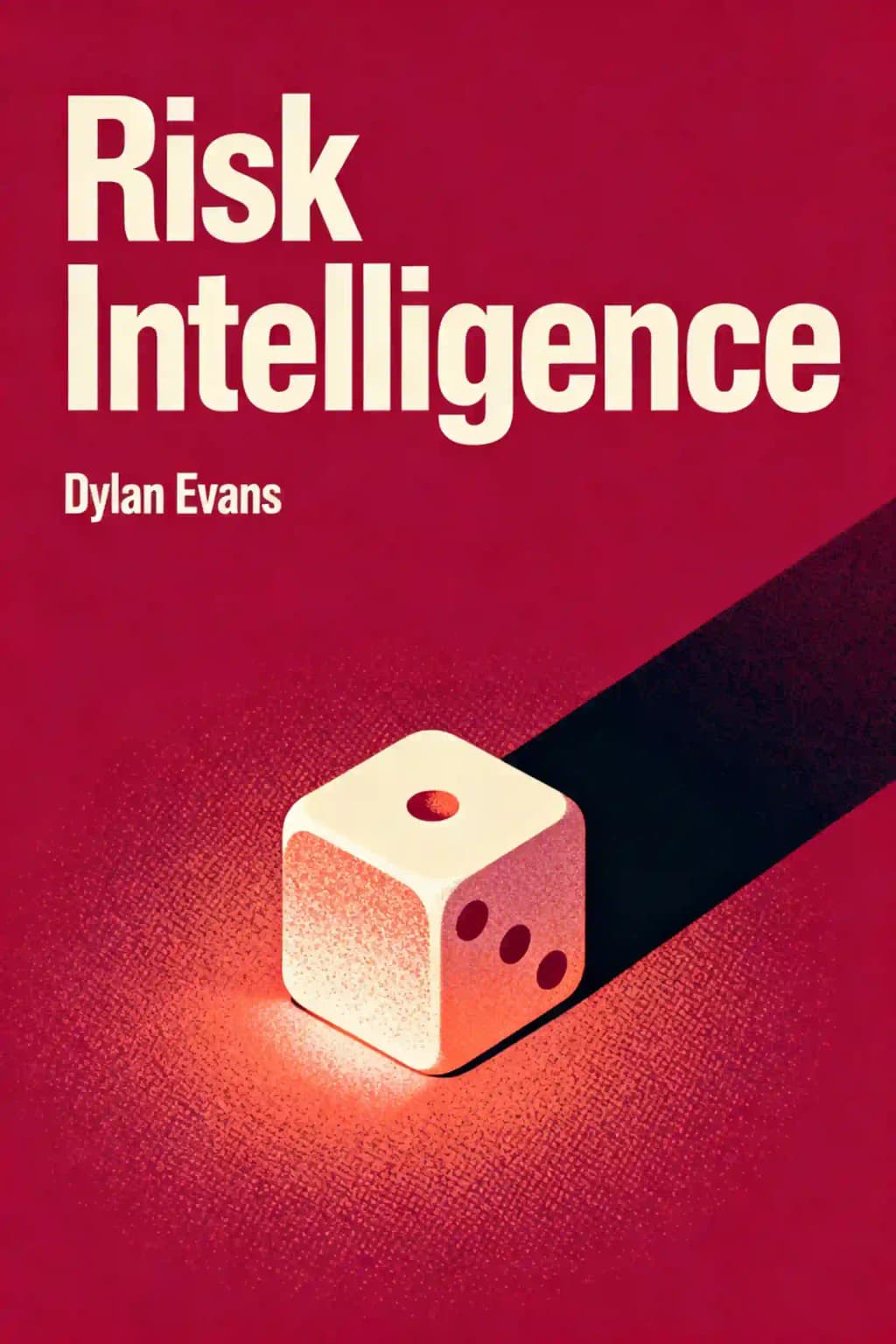
Dylan Evans' "Risk Intelligence" reveals how to master uncertainty in an increasingly complex world. Endorsed by World Economic Forum's Klaus Schwab, it exposes why horse race handicappers make better forecasters than financial experts. Could your ability to calibrate confidence determine your success?
Dylan Evans is the author of Risk Intelligence: How to Live with Uncertainty and a behavioral science expert renowned for his interdisciplinary approach to decision-making under ambiguity. A philosopher and academic with a PhD from the London School of Economics, Evans combines rigorous research with real-world insights, drawing on roles as CEO of Projection Point—a global risk intelligence consultancy—and his tenure at Mindlab International.
His work bridges psychology, probability theory, and practical strategy, themes central to Risk Intelligence, which dissects cognitive biases and offers frameworks for navigating uncertainty in fields from finance to counterterrorism.
Evans’s acclaimed bibliography includes Emotion: The Science of Sentiment and Placebo: The Belief Effect, establishing him as a thought leader in human behavior. Recognized by the Independent on Sunday as one of Britain’s top young writers, his ideas have been endorsed by figures like World Economic Forum founder Klaus Schwab and applied by Fortune 500 firms. Risk Intelligence distills decades of research into actionable strategies, cementing Evans’s reputation as a pioneering voice in modern risk management.
Risk Intelligence explores how to make better decisions in uncertain situations by accurately estimating probabilities. Dylan Evans introduces "risk intelligence" as the ability to gauge the limits of one’s knowledge, balancing confidence and caution. The book uses real-world examples, from financial crises to airport security, to show how probabilistic thinking improves outcomes in business, healthcare, and daily life.
Professionals in finance, healthcare, and leadership roles will benefit from its insights on decision-making under uncertainty. It’s also valuable for psychology enthusiasts and anyone interested in avoiding cognitive biases. Evans’ blend of behavioral science and practical frameworks makes it accessible for both experts and general readers.
Yes. Publishers Weekly praises it as a “valuable manual,” blending psychology, mathematics, and real-world case studies. Evans’ expertise in behavioral science and his engaging writing style make complex concepts like probabilistic reasoning actionable. The book’s lessons on avoiding overconfidence and worst-case thinking remain highly relevant.
Risk intelligence is the ability to estimate probabilities accurately while recognizing the limits of one’s knowledge. Evans emphasizes that it involves knowing when to act confidently (with sufficient data) and when to seek more information. This skill helps navigate uncertainty in fields like finance, medicine, and crisis management.
Evans argues that businesses often fail by ignoring probability-based strategies. For example, he critiques excessive focus on worst-case scenarios (e.g., costly security theater) and advocates for data-driven risk assessments. The book also highlights how overconfident executives contributed to the 2008 financial crisis.
Some readers find early chapters overly academic, though Evans balances theory with relatable examples like gambling strategies and forensic science. Critics note the “Risk Intelligence Test” focuses more on tolerance for ambiguity than actionable skills, but overall, the book is praised for its practicality.
Unlike Daniel Kahneman’s Thinking, Fast and Slow, which focuses on cognitive biases, Evans prioritizes calibrating confidence through probabilistic thinking. It complements works like Philip Tetlock’s Superforecasting by emphasizing self-awareness in uncertainty.
With a PhD in philosophy and experience in behavioral science, Evans founded Projection Point, a risk consultancy advising hedge funds and private equity firms. His interdisciplinary approach—mixing psychology, economics, and real-world case studies—lends credibility to the book’s frameworks.
In an era of AI, global crises, and rapid technological change, Evans’ emphasis on probabilistic thinking helps individuals and organizations avoid binary decisions. The book’s lessons on managing uncertainty apply to contemporary challenges like algorithmic bias and pandemic response planning.
Evans compares risk-intelligent thinking to navigating a “darkened room”—acting decisively despite incomplete information. He also critiques the “CSI Effect,” where people demand unrealistic certainty, akin to expecting forensic TV-show conclusiveness in real-life scenarios.
저자의 목소리로 책을 느껴보세요
지식을 흥미롭고 예시가 풍부한 인사이트로 전환
핵심 아이디어를 빠르게 캡처하여 신속하게 학습
재미있고 매력적인 방식으로 책을 즐기세요
Risk intelligence isn't about knowing more facts; it's about knowing the limits of your knowledge.
Learning to feel comfortable with uncertainty is crucial for risk intelligence.
Risk Intelligence의 핵심 아이디어를 이해하기 쉬운 포인트로 분해하여 혁신적인 팀이 어떻게 창조하고, 협력하고, 성장하는지 이해합니다.
Risk Intelligence을 빠른 기억 단서로 압축하여 솔직함, 팀워크, 창의적 회복력의 핵심 원칙을 강조합니다.

생생한 스토리텔링을 통해 Risk Intelligence을 경험하고, 혁신 교훈을 기억에 남고 적용할 수 있는 순간으로 바꿉니다.
무엇이든 물어보고, 목소리를 선택하고, 진정으로 공감되는 인사이트를 함께 만들어보세요.

샌프란시스코에서 컬럼비아 대학교 동문들이 만들었습니다
"Instead of endless scrolling, I just hit play on BeFreed. It saves me so much time."
"I never knew where to start with nonfiction—BeFreed’s book lists turned into podcasts gave me a clear path."
"Perfect balance between learning and entertainment. Finished ‘Thinking, Fast and Slow’ on my commute this week."
"Crazy how much I learned while walking the dog. BeFreed = small habits → big gains."
"Reading used to feel like a chore. Now it’s just part of my lifestyle."
"Feels effortless compared to reading. I’ve finished 6 books this month already."
"BeFreed turned my guilty doomscrolling into something that feels productive and inspiring."
"BeFreed turned my commute into learning time. 20-min podcasts are perfect for finishing books I never had time for."
"BeFreed replaced my podcast queue. Imagine Spotify for books — that’s it. 🙌"
"It is great for me to learn something from the book without reading it."
"The themed book list podcasts help me connect ideas across authors—like a guided audio journey."
"Makes me feel smarter every time before going to work"
샌프란시스코에서 컬럼비아 대학교 동문들이 만들었습니다

Risk Intelligence 요약을 무료 PDF 또는 EPUB으로 받으세요. 인쇄하거나 오프라인에서 언제든 읽을 수 있습니다.
Imagine you're absolutely certain your favorite team will win tonight's game. You'd bet your house on it. Now imagine waking up tomorrow homeless. This scenario plays out daily - not just in sports betting, but in business decisions, relationship choices, and career moves. What separates successful decision-makers from the rest isn't necessarily what they know, but how accurately they assess what they don't know. This is risk intelligence: the ability to estimate probabilities in an uncertain world. Unlike IQ, which measures raw cognitive horsepower, risk intelligence measures how well you gauge the limits of your knowledge. It's about knowing exactly how much you don't know - and it might be the most important skill you never learned.