Axworthy's definitive history unveils Iran's revolutionary transformation from monarchy to Islamic republic. Praised for its balanced approach, this nuanced exploration dispels Western misconceptions while examining the revolution's global impact. What hidden complexities of Iranian politics might change your understanding of Middle Eastern dynamics forever?
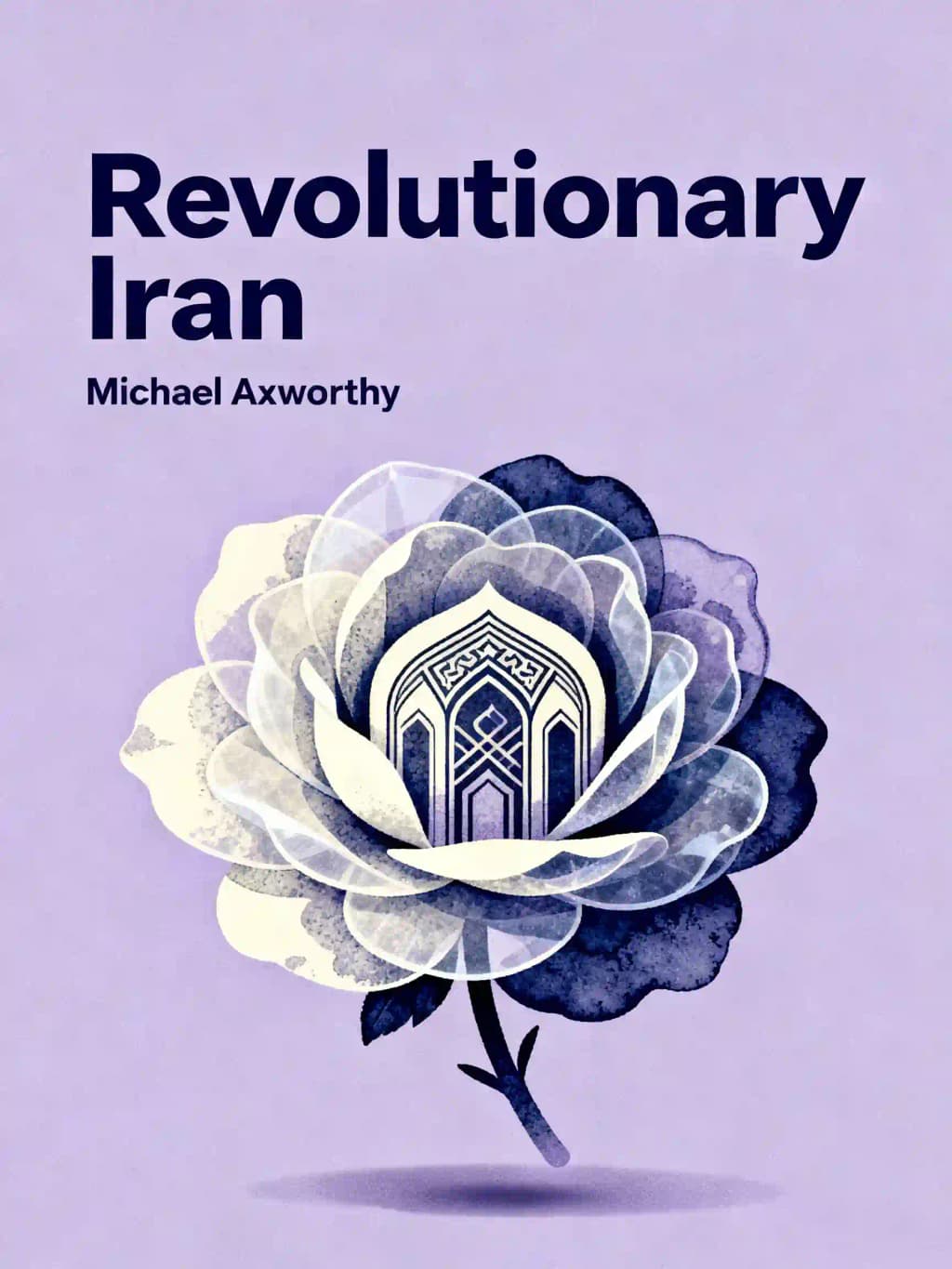
Michael George Andrew Axworthy (1962–2019) was a British academic, historian, and leading authority on Iranian history, best known for his critically acclaimed work Revolutionary Iran.
As Director of the Centre for Persian and Iranian Studies at the University of Exeter and former head of the Iran section at the British Foreign & Commonwealth Office, Axworthy brought unparalleled expertise to his analysis of Iran’s political and cultural evolution. His seminal book A History of Iran: Empire of the Mind – praised by the Financial Times as “a beautifully distilled retelling of Iranian history” – cemented his reputation for blending scholarly rigor with accessible storytelling.
Axworthy’s works explore themes of geopolitical identity, religious complexity, and Iran’s enduring influence across centuries, informed by his diplomatic experience and frequent media commentary for outlets like The Daily Telegraph. His nuanced perspectives challenged Western stereotypes of Iran while critically examining its authoritarian tendencies. Revolutionary Iran has become essential reading for understanding modern Middle Eastern politics, with translations reaching global audiences and acclaim from publications like The Observer and New Statesman.
Revolutionary Iran examines the 1979 Islamic Revolution, Ayatollah Khomeini’s rise, and the establishment of Iran’s Islamic Republic. Michael Axworthy analyzes Iran’s political evolution, its resistance to Western influence, and internal struggles, offering a comprehensive look at the revolution’s global impact and legacy. The book blends historical context with firsthand accounts to explain Iran’s complex modern identity.
This book is ideal for historians, political analysts, and readers interested in Middle Eastern geopolitics. Policymakers and students of Islamic studies will gain insights into Iran’s ideological clashes, while general audiences seeking to understand Iran’s defiance of Western norms will find it accessible. Axworthy’s nuanced perspective bridges academic rigor and narrative readability.
Yes. Axworthy’s balanced analysis challenges stereotypes, detailing Iran’s post-revolutionary resilience without excusing its autocratic regime. The book is praised for integrating soldier testimonies, memoirs, and political critique, making it a definitive resource on Iran’s modern history. Its exploration of ideological tensions and human rights issues remains widely cited.
The revolution stemmed from widespread discontent with the Shah’s authoritarian rule, U.S. interference, economic inequality, and Khomeini’s mobilization of religious nationalism. Axworthy highlights how these factors coalesced into a grassroots movement that overthrew the monarchy, replacing it with a theocratic state.
Axworthy uses soldier interviews and memoirs to illustrate the war’s devastation and Iran’s ideological fervor. He emphasizes the Basij volunteers’ sacrifices and the conflict’s role in consolidating the Islamic Republic’s identity while straining its economy. The war is framed as a catalyst for Iran’s isolationist policies.
Khomeini is central as the revolution’s architect and the Islamic Republic’s ideological figurehead. Axworthy critiques his authoritarian measures, including mass executions and suppression of dissent, while acknowledging his enduring influence on Iran’s anti-Western stance.
Some scholars argue Axworthy understates the 1988 mass executions (estimating 4,000–5,000 deaths vs. opposition claims of 30,000) and downplays systemic repression. Others note his focus on political history over social dynamics. Despite this, the book is lauded for its balanced approach.
Axworthy portrays Iran as a “defensive” power historically victimized by foreign interventions, yet defiant in asserting Islamic sovereignty. He discusses its nuclear ambitions and support for proxy groups as strategies to counter Western dominance.
The book draws on memoirs, revolutionary slogans, novels, and interviews with veterans and politicians. This diversity enriches its narrative, offering perspectives from both regime supporters and dissidents.
Themes include ideological resilience, the clash between democracy and theocracy, and Iran’s struggle for autonomy. Axworthy also explores generational shifts, women’s roles, and the tension between religious authority and secular nationalism.
A pivotal Khomeini decree states: “The decisiveness of Islam before the enemies of God is among the unquestionable tenets of the Islamic regime.” Another highlights Iran’s historical self-view: “Misunderstood and exploited by external enemies”.
Axworthy contrasts the Shah’s regime, where torture sought information, with the Islamic Republic’s use of torture for forced confessions. He details post-revolution executions, censorship, and the Green Movement’s suppression.
Unlike oversimplified narratives, Axworthy’s work contextualizes Iran’s actions within its historical grievances. It is frequently compared to Ervand Abrahamian’s A History of Modern Iran for its focus on ideological evolution.
저자의 목소리로 책을 느껴보세요
지식을 흥미롭고 예시가 풍부한 인사이트로 전환
핵심 아이디어를 빠르게 캡처하여 신속하게 학습
재미있고 매력적인 방식으로 책을 즐기세요
History pivoted the moment Khomeini's feet touched Iranian soil.
Iran defies simple categorization.
Each funeral became a political demonstration.
Khomeini wasn't a medieval throwback but a sophisticated religious innovator.
We seem to be moving from one dictatorship to another.
Revolutionary Iran의 핵심 아이디어를 이해하기 쉬운 포인트로 분해하여 혁신적인 팀이 어떻게 창조하고, 협력하고, 성장하는지 이해합니다.
Revolutionary Iran을 빠른 기억 단서로 압축하여 솔직함, 팀워크, 창의적 회복력의 핵심 원칙을 강조합니다.

생생한 스토리텔링을 통해 Revolutionary Iran을 경험하고, 혁신 교훈을 기억에 남고 적용할 수 있는 순간으로 바꿉니다.
무엇이든 물어보고, 목소리를 선택하고, 진정으로 공감되는 인사이트를 함께 만들어보세요.

샌프란시스코에서 컬럼비아 대학교 동문들이 만들었습니다
"Instead of endless scrolling, I just hit play on BeFreed. It saves me so much time."
"I never knew where to start with nonfiction—BeFreed’s book lists turned into podcasts gave me a clear path."
"Perfect balance between learning and entertainment. Finished ‘Thinking, Fast and Slow’ on my commute this week."
"Crazy how much I learned while walking the dog. BeFreed = small habits → big gains."
"Reading used to feel like a chore. Now it’s just part of my lifestyle."
"Feels effortless compared to reading. I’ve finished 6 books this month already."
"BeFreed turned my guilty doomscrolling into something that feels productive and inspiring."
"BeFreed turned my commute into learning time. 20-min podcasts are perfect for finishing books I never had time for."
"BeFreed replaced my podcast queue. Imagine Spotify for books — that’s it. 🙌"
"It is great for me to learn something from the book without reading it."
"The themed book list podcasts help me connect ideas across authors—like a guided audio journey."
"Makes me feel smarter every time before going to work"
샌프란시스코에서 컬럼비아 대학교 동문들이 만들었습니다

Revolutionary Iran 요약을 무료 PDF 또는 EPUB으로 받으세요. 인쇄하거나 오프라인에서 언제든 읽을 수 있습니다.
February 1979: as millions lined Tehran's streets, a bearded cleric in his seventies descended from an Air France jet after fifteen years in exile. When Ayatollah Khomeini's feet touched Iranian soil, history pivoted. Within days, 2,500 years of monarchy collapsed, replaced by the world's first modern theocracy. This wasn't just another regime change-it represented a profound rejection of Western political models that had dominated global discourse for centuries. Revolutionary Iran defies simple categorization. Neither fully democratic nor completely totalitarian, it blends revolutionary fervor with ancient traditions in a sophisticated civilization with continental diversity. The revolution stands alongside the French and Russian as one of history's three great modern revolutions, yet uniquely placed religion at its center when most intellectuals assumed faith was retreating from public life. The revolution's spark came amid economic uncertainty when the Shah's government relaxed some repressive measures in 1977. A government attack on exiled Khomeini triggered demonstrations where religious students were killed by police. This created forty-day mourning cycles that fueled further protests-each funeral becoming a political demonstration, each demonstration creating new martyrs in a self-perpetuating cycle the regime couldn't break. What made this revolution distinctive was its fusion of traditional Shi'a religious narratives with modern revolutionary politics. When protesters faced the Shah's troops, they weren't just opposing a dictator; they were reenacting the sacred drama of Imam Husayn's martyrdom at Karbala-a story central to Shi'a identity where the Prophet's grandson was killed by a corrupt ruler.