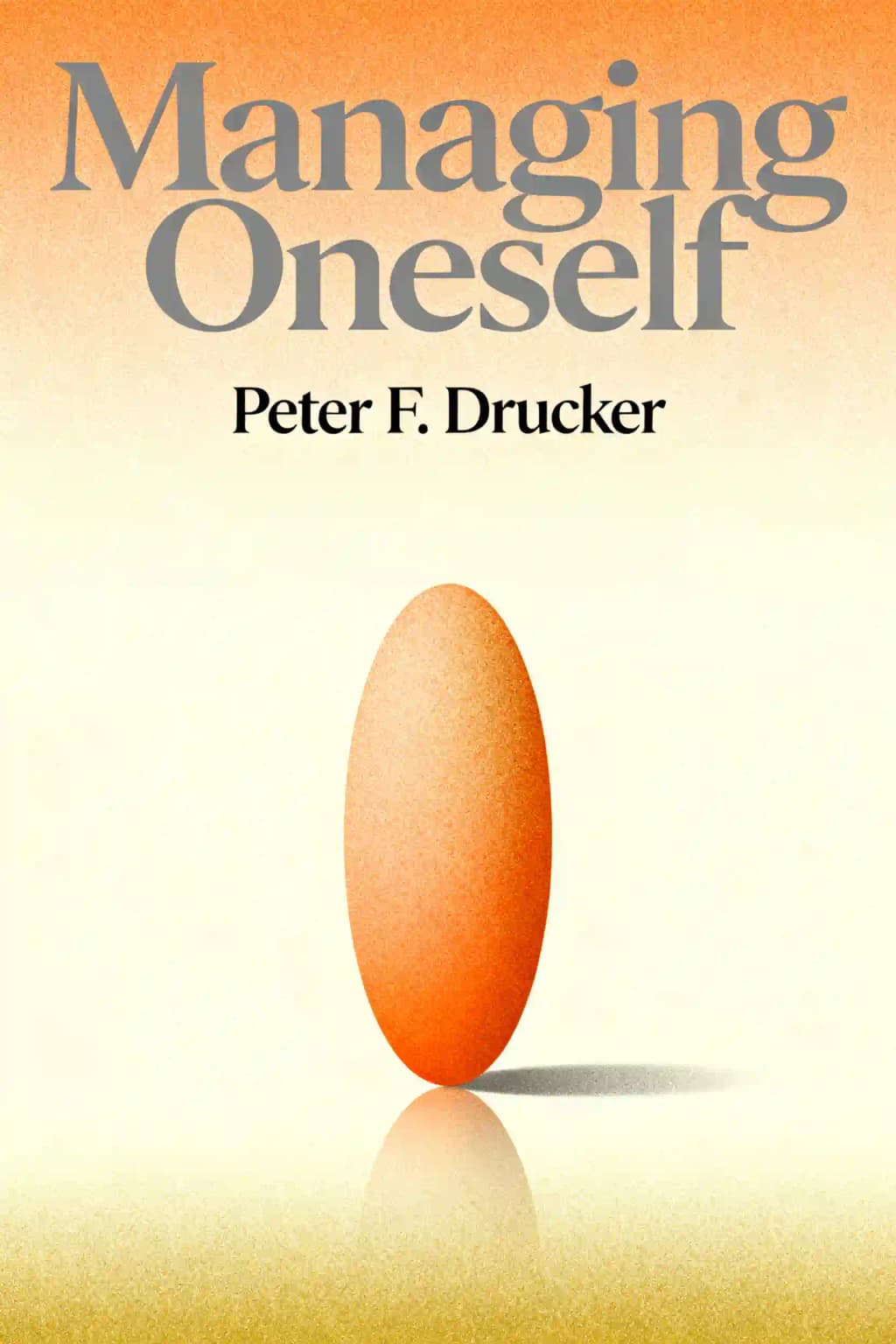
In "Managing Oneself," management legend Peter Drucker reveals how understanding your strengths, learning style, and values creates extraordinary careers. The 72-page classic that shaped modern self-development asks one powerful question: Do you truly know how you work best?
Peter F. Drucker, the visionary management philosopher and author of Managing Oneself, revolutionized modern business theory with his human-centered approach to organizational and personal effectiveness.
A Vienna-born thought leader with a PhD from the University of Frankfurt, Drucker shaped management as an academic discipline through foundational works like The Effective Executive, Innovation and Entrepreneurship, and The Practice of Management. His career spanned decades as a professor at Claremont Graduate University’s Drucker School of Management (named in his honor) and a strategic advisor to Fortune 500 companies like General Motors and General Electric.
Drucker’s insights on self-management, productivity, and career alignment in Managing Oneself stem from his pioneering concepts of decentralization, knowledge workers, and ethical leadership. A prolific columnist for the Wall Street Journal and Harvard Business Review, his 39 books have been translated into 37 languages, establishing him as one of the most influential business thinkers of the 20th century. Over 30 million copies of his works circulate globally, with principles adopted by corporations, nonprofits, and MBA programs worldwide.
Managing Oneself is a foundational guide to personal and professional development, emphasizing self-awareness as the key to productivity. Drucker outlines five critical questions to answer: identifying strengths via feedback analysis, understanding learning styles, aligning values, finding the right work environment, and defining meaningful contributions. The book empowers readers to take charge of their careers by leveraging self-knowledge.
This book is essential for professionals, knowledge workers, and anyone seeking career growth. It’s particularly valuable for mid-career individuals navigating transitions, entrepreneurs building teams, or leaders aiming to maximize their impact. Drucker’s insights also benefit students preparing to enter dynamic, self-driven work environments.
Feedback analysis is Drucker’s method for identifying strengths: record expectations for decisions, then review outcomes 9–12 months later. This reveals patterns in strengths and weaknesses. For example, predicting a project’s timeline and comparing it to actual results highlights planning accuracy. Consistent use helps focus on areas where excellence is achievable.
Drucker advises concentrating efforts on strengths rather than weaknesses. Key strategies include:
Critics argue the book oversimplifies career navigation by underemphasizing systemic barriers like workplace bias. Others note its focus on individual responsibility may overlook collaborative dynamics. However, its timeless principles on self-awareness remain widely praised.
Drucker’s emphasis on self-directed productivity aligns with remote work trends. The book’s frameworks help remote workers structure tasks based on strengths, communicate effectively (tailoring to others’ learning styles), and maintain accountability through feedback analysis—a boon for hybrid teams.
Drucker coined “knowledge worker” to describe professionals who use expertise over manual labor. The book argues these workers must self-manage to thrive, as their value lies in innovation and problem-solving. This foreshadowed today’s gig economy and freelance trends.
While both focus on personal effectiveness, Managing Oneself is more tactical, with specific tools like feedback analysis. 7 Habits emphasizes broader principles like “Begin with the End in Mind.” Drucker’s work is ideal for career strategy; Covey’s for holistic life balance.
Notable quotes include:
Drucker advises assessing strengths, values, and preferred work modes before pivoting. For example, a marketer transitioning to leadership might use feedback analysis to identify managerial aptitudes. The book also stresses choosing organizations whose values align with yours.
In an era of AI and rapid skill obsolescence, Drucker’s focus on adaptability and lifelong learning remains critical. The rise of freelance and project-based work makes his self-management frameworks indispensable for sustaining relevance.
For complementary reads, consider:
저자의 목소리로 책을 느껴보세요
지식을 흥미롭고 예시가 풍부한 인사이트로 전환
핵심 아이디어를 빠르게 캡처하여 신속하게 학습
재미있고 매력적인 방식으로 책을 즐기세요
You can only build exceptional performance on strengths, not weaknesses.
These knowledge gaps aren't just professional blind spots; they're career killers.
The goal isn't personality transformation but performance optimization.
Your values should ultimately determine where you work.
Managing Oneself (Harvard Business Review Classics) (Harvard Business Review Classics)의 핵심 아이디어를 이해하기 쉬운 포인트로 분해하여 혁신적인 팀이 어떻게 창조하고, 협력하고, 성장하는지 이해합니다.
Managing Oneself (Harvard Business Review Classics) (Harvard Business Review Classics)을 빠른 기억 단서로 압축하여 솔직함, 팀워크, 창의적 회복력의 핵심 원칙을 강조합니다.

생생한 스토리텔링을 통해 Managing Oneself (Harvard Business Review Classics) (Harvard Business Review Classics)을 경험하고, 혁신 교훈을 기억에 남고 적용할 수 있는 순간으로 바꿉니다.
무엇이든 물어보고, 목소리를 선택하고, 진정으로 공감되는 인사이트를 함께 만들어보세요.

샌프란시스코에서 컬럼비아 대학교 동문들이 만들었습니다
"Instead of endless scrolling, I just hit play on BeFreed. It saves me so much time."
"I never knew where to start with nonfiction—BeFreed’s book lists turned into podcasts gave me a clear path."
"Perfect balance between learning and entertainment. Finished ‘Thinking, Fast and Slow’ on my commute this week."
"Crazy how much I learned while walking the dog. BeFreed = small habits → big gains."
"Reading used to feel like a chore. Now it’s just part of my lifestyle."
"Feels effortless compared to reading. I’ve finished 6 books this month already."
"BeFreed turned my guilty doomscrolling into something that feels productive and inspiring."
"BeFreed turned my commute into learning time. 20-min podcasts are perfect for finishing books I never had time for."
"BeFreed replaced my podcast queue. Imagine Spotify for books — that’s it. 🙌"
"It is great for me to learn something from the book without reading it."
"The themed book list podcasts help me connect ideas across authors—like a guided audio journey."
"Makes me feel smarter every time before going to work"
샌프란시스코에서 컬럼비아 대학교 동문들이 만들었습니다

Managing Oneself (Harvard Business Review Classics) (Harvard Business Review Classics) 요약을 무료 PDF 또는 EPUB으로 받으세요. 인쇄하거나 오프라인에서 언제든 읽을 수 있습니다.
In today's knowledge economy, your greatest competitive advantage isn't technical expertise - it's your ability to manage yourself effectively. Unlike previous generations who worked in predictable environments for decades, modern professionals navigate a complex landscape where self-management isn't just helpful - it's essential. This revolutionary approach to career development has transformed how successful people navigate their professional journeys. Warren Buffett keeps a copy on his nightstand, while tech giants like Google and Apple make it required reading. Why? Because understanding yourself - your strengths, work style, values, and potential contributions - creates the foundation not just for career success, but for a fulfilling life.