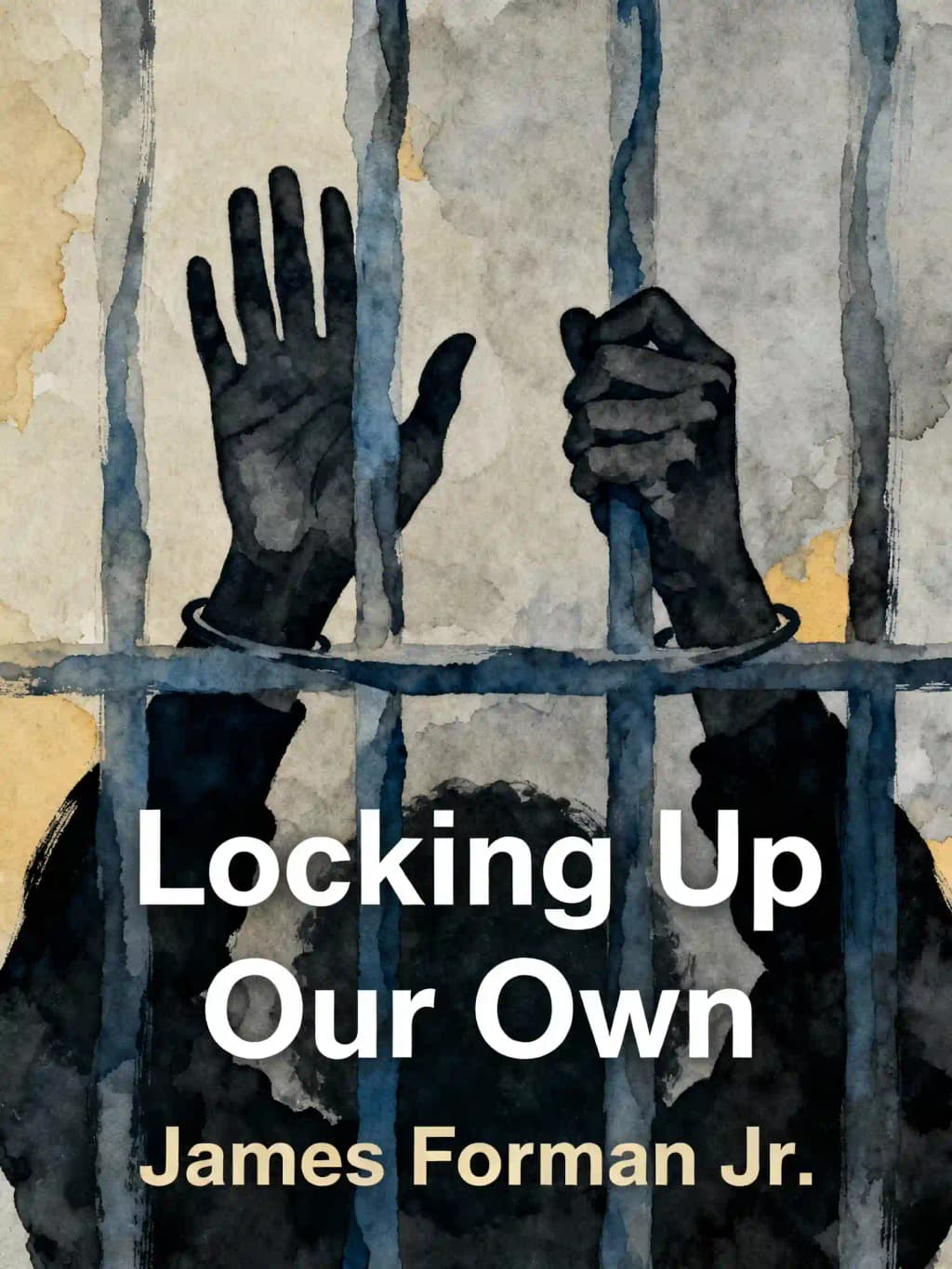
Pulitzer Prize-winning "Locking Up Our Own" explores how Black leaders inadvertently fueled mass incarceration through tough-on-crime policies. Cited in Supreme Court cases and praised by Dr. Ibram X. Kendi, this timely work asks: How did well-intentioned justice become systemic injustice?
James Forman Jr., author of the Pulitzer Prize-winning Locking Up Our Own: Crime and Punishment in Black America, is a leading legal scholar and criminal justice reform advocate. A Yale Law School professor and former Washington, D.C. public defender, Forman combines academic rigor with firsthand experience representing marginalized communities.
His groundbreaking work explores mass incarceration’s complex roots, particularly how Black leaders in the 1970s-90s contributed to punitive policies aimed at protecting vulnerable neighborhoods—a paradox he analyzes through historical documents and courtroom narratives.
Forman’s expertise stems from his roles as a Supreme Court clerk for Justice Sandra Day O’Connor and co-founder of Washington’s Maya Angelou School for incarcerated youth. His writing has appeared in The New York Times, The Atlantic, and Washington Post, establishing him as a vital voice on race, law, and inequality.
Locking Up Our Own — a New York Times Top 10 Book of 2017 and National Book Award finalist — has become essential reading in law schools and policy circles, translated into six languages. The Washington Post bestseller continues to shape national debates about policing and prison reform.
Locking Up Our Own examines how Black policymakers and community leaders in 1970s-1990s America supported harsh criminal justice policies that unintentionally fueled mass incarceration. Pulitzer Prize-winning author James Forman Jr. analyzes debates over drug laws, gun control, and policing, revealing how systemic racism and crisis-driven decision-making led to devastating consequences for Black communities.
This book is essential for criminal justice reformers, historians, and policymakers seeking to understand systemic racism’s role in mass incarceration. It also resonates with educators, social workers, and readers interested in African American history, offering critical insights into race, class, and the unintended consequences of well-intentioned reforms.
Yes—it won the 2018 Pulitzer Prize for its groundbreaking analysis of racial inequities in the legal system. Forman combines legal expertise, historical research, and firsthand experience as a public defender to challenge conventional narratives about crime and punishment in Black America.
Forman argues Black leaders initially backed drug criminalization to protect communities from addiction and violence. However, aggressive policing and mandatory minimums—coupled with racial profiling—expanded incarceration rates while failing to address root causes like poverty and underfunded schools.
The book describes how some Black churches endorsed punitive measures, viewing strict laws as moral solutions to crime. This alliance between religious institutions and lawmakers often sidelined restorative justice approaches, exacerbating racial disparities in arrests.
Some scholars argue Forman underemphasizes the federal government’s role in mass incarceration. Others praise the book for humanizing Black policymakers while urging readers to confront systemic failures beyond individual choices.
While Michelle Alexander’s The New Jim Crow focuses on structural racism in the legal system, Forman’s work highlights Black leaders’ complex agency in shaping punitive policies. Both books are critical for understanding intersectional approaches to criminal justice reform.
These lines underscore the book’s exploration of policy trade-offs and institutional limitations.
As a DC public defender and co-founder of the Maya Angelou School for at-risk youth, Forman witnessed how education gaps and poverty funneled clients into the legal system—a perspective that grounds the book’s critique of carceral solutions.
The book provides historical context for modern movements like defunding police and ending cash bail. Its analysis of unintended policy consequences remains critical amid ongoing discussions about prison abolition and restorative justice.
Forman advocates for reinvesting in schools, mental health services, and economic opportunities instead of incarceration. He emphasizes community-led reforms and policies that address systemic inequities rather than punitive measures.
저자의 목소리로 책을 느껴보세요
지식을 흥미롭고 예시가 풍부한 인사이트로 전환
핵심 아이디어를 빠르게 캡처하여 신속하게 학습
재미있고 매력적인 방식으로 책을 즐기세요
Mass incarceration is, at bottom, a story about choices—choices made by people in positions of power.
The drug war was not simply imposed on black communities; it was in part a response to demands from them.
Black people are not merely victims of the drug war; they are also its agents.
We must acknowledge that the tough-on-crime movement was a multiracial phenomenon.
We must be willing to see black people as actors, as people with agency, as people who make choices.
Locking up Our Own의 핵심 아이디어를 이해하기 쉬운 포인트로 분해하여 혁신적인 팀이 어떻게 창조하고, 협력하고, 성장하는지 이해합니다.
Locking up Our Own을 빠른 기억 단서로 압축하여 솔직함, 팀워크, 창의적 회복력의 핵심 원칙을 강조합니다.

생생한 스토리텔링을 통해 Locking up Our Own을 경험하고, 혁신 교훈을 기억에 남고 적용할 수 있는 순간으로 바꿉니다.
무엇이든 물어보고, 목소리를 선택하고, 진정으로 공감되는 인사이트를 함께 만들어보세요.

샌프란시스코에서 컬럼비아 대학교 동문들이 만들었습니다
"Instead of endless scrolling, I just hit play on BeFreed. It saves me so much time."
"I never knew where to start with nonfiction—BeFreed’s book lists turned into podcasts gave me a clear path."
"Perfect balance between learning and entertainment. Finished ‘Thinking, Fast and Slow’ on my commute this week."
"Crazy how much I learned while walking the dog. BeFreed = small habits → big gains."
"Reading used to feel like a chore. Now it’s just part of my lifestyle."
"Feels effortless compared to reading. I’ve finished 6 books this month already."
"BeFreed turned my guilty doomscrolling into something that feels productive and inspiring."
"BeFreed turned my commute into learning time. 20-min podcasts are perfect for finishing books I never had time for."
"BeFreed replaced my podcast queue. Imagine Spotify for books — that’s it. 🙌"
"It is great for me to learn something from the book without reading it."
"The themed book list podcasts help me connect ideas across authors—like a guided audio journey."
"Makes me feel smarter every time before going to work"
샌프란시스코에서 컬럼비아 대학교 동문들이 만들었습니다

Locking up Our Own 요약을 무료 PDF 또는 EPUB으로 받으세요. 인쇄하거나 오프라인에서 언제든 읽을 수 있습니다.
A Black teenager stands before a Black judge in a Washington D.C. courtroom. The lecture is familiar-wasting opportunities that civil rights heroes died for. Six months in detention for gun and marijuana possession. The judge, prosecutor, bailiff, even the court reporter-all Black. The police chief, the mayor-Black too. How did a majority-Black city end up locking away so many of its own children? This question drives one of the most unsettling revelations in recent American history. After the 1965 Voting Rights Act, African Americans finally gained real political power in cities like D.C. Yet the policies they helped shape-born from genuine concern, limited options, and unforeseeable consequences-would contribute to creating the world's largest prison system. This isn't a simple story of oppression from above. It's far more complicated, and far more human.