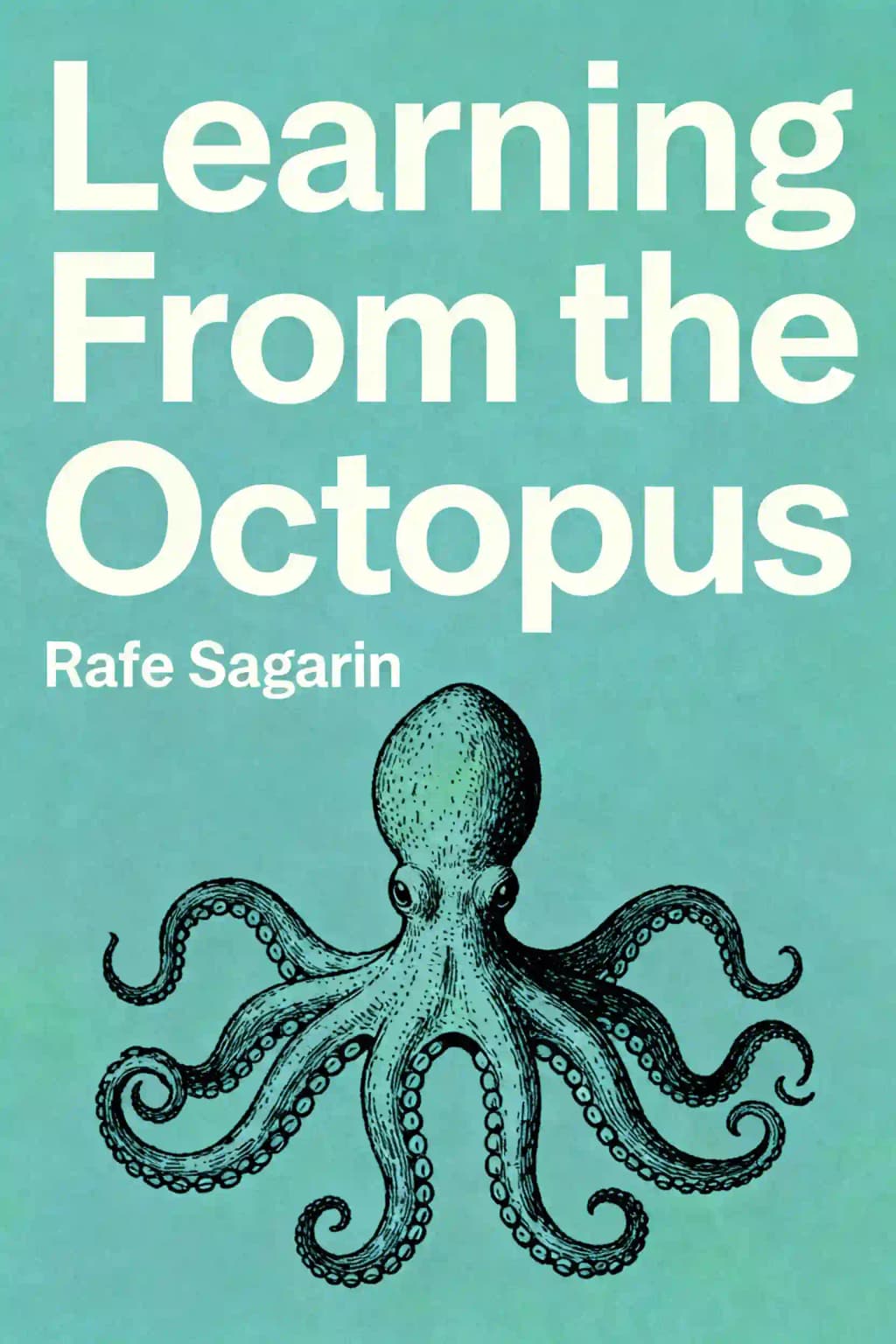
Nature's ultimate security system isn't military might, but adaptation. "Learning from the Octopus" reveals how biological resilience can revolutionize our approach to terrorism, disasters, and disease. Princeton's Simon Levin calls it "brilliant" - what if our greatest defense strategies come from the ocean's most intelligent invertebrate?
Rafe Sagarin, a Guggenheim Fellow and marine ecologist at the University of Arizona, is the author of Learning from the Octopus: How Secrets from Nature Can Help Us Fight Terrorist Attacks, Natural Disasters, and Disease. This groundbreaking work in science and security strategy blends ecological insights with practical solutions for human challenges, reflecting Sagarin’s interdisciplinary approach as a researcher and policy analyst.
His expertise stems from roles as a program manager for ocean conservation initiatives and a consultant for military, government, and business organizations seeking nature-inspired adaptability frameworks.
Sagarin co-authored Observation and Ecology: Broadening the Scope of Science to Understand a Complex World, which expands on his methods for integrating unconventional data into scientific research, exemplified by his climate change study using Alaska’s 84-year Nenana Ice Classic betting records. A frequent contributor to outlets like Business Insider, he championed bridging science and real-world problem-solving through art, policy advocacy, and cross-disciplinary collaboration.
His work remains influential in ecological research and organizational risk management, with principles applied by security experts and environmental policymakers.
Learning from the Octopus explores how biological adaptability in nature—like the octopus’s survival strategies—can inform human approaches to security, disaster response, and disease management. Marine ecologist Rafe Sagarin argues that natural systems thrive through decentralized decision-making, diversity, and redundancy, offering lessons for combating terrorism, climate crises, and pandemics. The book blends ecology, security studies, and real-world case studies to redefine resilience.
This book suits security professionals, disaster planners, business leaders, and environmentally conscious readers. It appeals to those seeking unconventional strategies for managing uncertainty, from military tacticians to sustainability advocates. Sagarin’s interdisciplinary approach also engages nature enthusiasts interested in biomimicry and science-driven problem-solving.
Yes—the book offers fresh perspectives on adaptability by bridging ecology and human challenges. While some critics note repetitive sections, its actionable insights on decentralized systems and real-world examples (e.g., immune responses, IED detection) make it valuable for rethinking risk management. Reviewers praise its accessibility despite complex themes.
Key concepts include:
The book argues that ecosystems’ adaptability—like shifting species distributions amid climate change—can model disaster response. It critiques rigid, top-down planning, advocating instead for flexible, locally informed strategies. Case studies include post-9/11 security reforms and hurricane recovery systems.
While praised for creativity, some note repetitive passages and occasional oversimplification of complex systems. Critics suggest the biological analogies, though insightful, may not fully translate to human institutions. However, most agree its core message—embracing uncertainty through adaptability—remains compelling.
The octopus symbolizes decentralized intelligence and rapid adaptation. Sagarin highlights its ability to reassign tasks post-injury, camouflage dynamically, and use distributed neurons for problem-solving. These traits mirror effective human systems, like immune responses or agile corporate teams.
Notable lines include:
Unlike Biomimicry (Benyus) or The Nature of Design (Orr), Sagarin focuses specifically on security and uncertainty. It stands out for blending military/policy case studies with ecology, offering a roadmap for real-world crisis management rather than general sustainability principles.
Rafe Sagarin (1971–2015) was a marine ecologist, Guggenheim Fellow, and Biosphere 2 researcher. He advised Congress on environmental policy, studied coastal ecosystems from Mexico to Alaska, and authored award-winning books bridging science and society. His fieldwork on climate-driven species migration informed his views on adaptability.
Sagarin ties ecosystem shifts—like species migrating due to warming oceans—to human climate strategies. He advocates for decentralized, iterative approaches (e.g., community-led resilience projects) over static infrastructure, mirroring how nature evolves without centralized control.
Key takeaways include:
저자의 목소리로 책을 느껴보세요
지식을 흥미롭고 예시가 풍부한 인사이트로 전환
핵심 아이디어를 빠르게 캡처하여 신속하게 학습
재미있고 매력적인 방식으로 책을 즐기세요
Security isn't about developing perfect answers to specific problems.
You go to war with the Army you have.
Adaptable enemies can always learn to overcome it.
Nearly every security problem stems from past failure to learn.
Centrally controlled organizations rarely thrive.
Learning from the octopus의 핵심 아이디어를 이해하기 쉬운 포인트로 분해하여 혁신적인 팀이 어떻게 창조하고, 협력하고, 성장하는지 이해합니다.
Learning from the octopus을 빠른 기억 단서로 압축하여 솔직함, 팀워크, 창의적 회복력의 핵심 원칙을 강조합니다.

생생한 스토리텔링을 통해 Learning from the octopus을 경험하고, 혁신 교훈을 기억에 남고 적용할 수 있는 순간으로 바꿉니다.
무엇이든 물어보고, 목소리를 선택하고, 진정으로 공감되는 인사이트를 함께 만들어보세요.

샌프란시스코에서 컬럼비아 대학교 동문들이 만들었습니다
"Instead of endless scrolling, I just hit play on BeFreed. It saves me so much time."
"I never knew where to start with nonfiction—BeFreed’s book lists turned into podcasts gave me a clear path."
"Perfect balance between learning and entertainment. Finished ‘Thinking, Fast and Slow’ on my commute this week."
"Crazy how much I learned while walking the dog. BeFreed = small habits → big gains."
"Reading used to feel like a chore. Now it’s just part of my lifestyle."
"Feels effortless compared to reading. I’ve finished 6 books this month already."
"BeFreed turned my guilty doomscrolling into something that feels productive and inspiring."
"BeFreed turned my commute into learning time. 20-min podcasts are perfect for finishing books I never had time for."
"BeFreed replaced my podcast queue. Imagine Spotify for books — that’s it. 🙌"
"It is great for me to learn something from the book without reading it."
"The themed book list podcasts help me connect ideas across authors—like a guided audio journey."
"Makes me feel smarter every time before going to work"
샌프란시스코에서 컬럼비아 대학교 동문들이 만들었습니다

Learning from the octopus 요약을 무료 PDF 또는 EPUB으로 받으세요. 인쇄하거나 오프라인에서 언제든 읽을 수 있습니다.
Imagine a world where the most sophisticated security systems have been perfected not by human engineers but by creatures without brains as we understand them. The humble octopus, with its distributed neural network and remarkable adaptability, has been outperforming our best security designs for millions of years. This revelation forms the foundation of Rafe Sagarin's revolutionary perspective on security-one that has captured attention from military strategists to Silicon Valley innovators. When the 2004 Indian Ocean tsunami struck, animals across three continents sensed the danger and fled to higher ground, while 225,000 humans perished despite our technological advantages. This stark contrast illustrates the fundamental difference between natural and human security approaches. While animals rely on adaptable responses refined over evolutionary time, humans often depend on rigid technological solutions that fail catastrophically when circumstances change. The contrast couldn't be clearer: natural systems don't plan, predict, or seek perfection. Instead, they adapt continuously through variation, selection, and replication. This adaptability allows organisms to respond effectively to unpredictable threats without central control or perfect information. Meanwhile, our institutions remain trapped in rigid planning cycles that fail to address emerging challenges-despite humans possessing the cognitive tools to learn from experience and implement creative solutions.