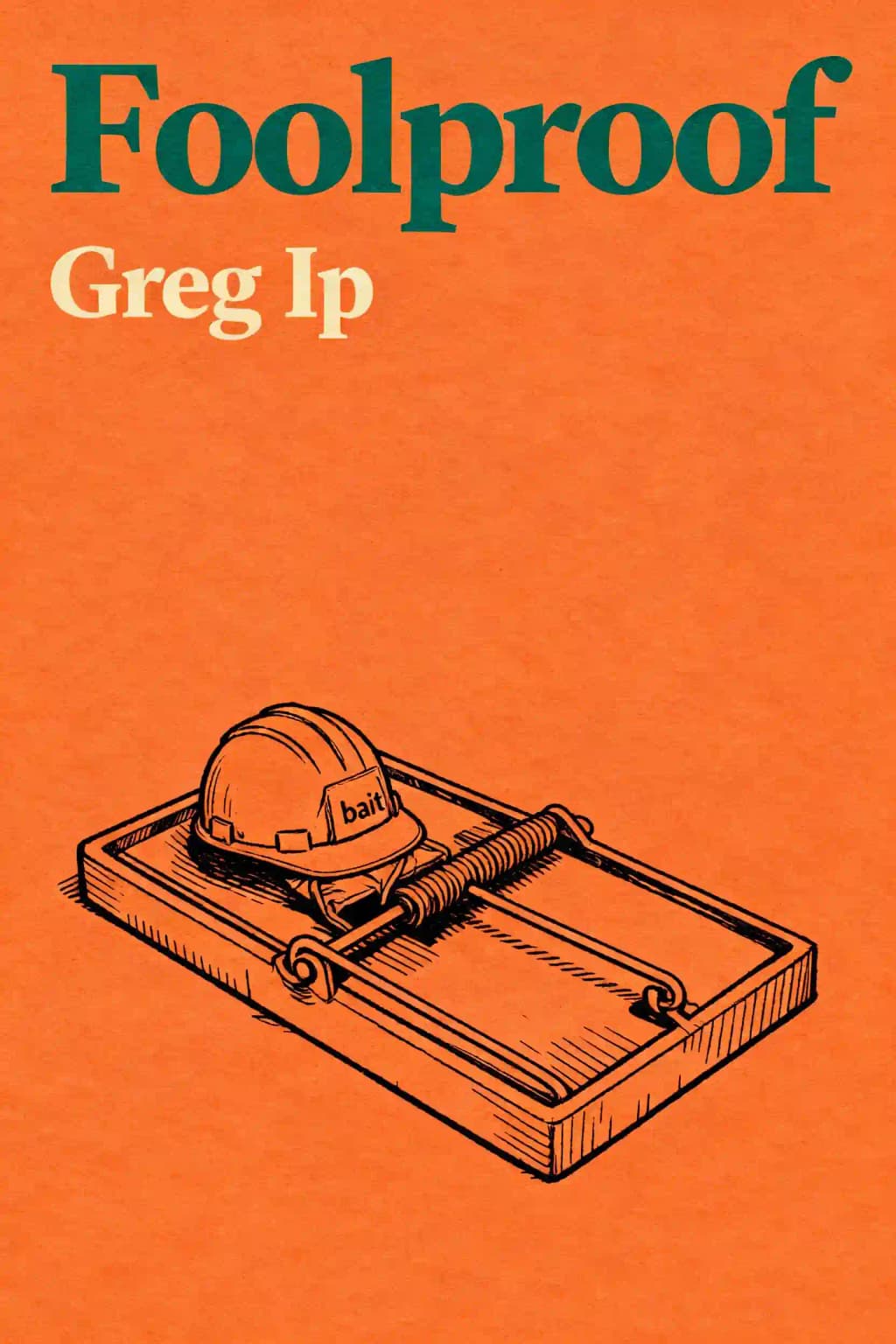
In "Foolproof," Greg Ip reveals the paradoxical truth: safety measures often create new dangers. Endorsed by Pulitzer Prize-winner Liaquat Ahamed as "illuminating," this Financial Times best book of 2015 challenges everything you thought about risk. Why did football helmets actually increase injuries?
Greg Ip is the bestselling author of Foolproof: Why Safety Can Be Dangerous and How Danger Makes Us Safe and a renowned economist and chief economics commentator for The Wall Street Journal. Specializing in global economic policy and crisis analysis, Ip leverages his decades of experience covering financial markets and policymaking to explore how societies balance risk and resilience.
Born in Canada and educated in economics and journalism at Carleton University, he previously served as U.S. economics editor for The Economist and won a Pulitzer Prize for his reporting on the 2001 economic fallout. His earlier work, The Little Book of Economics, distills complex economic concepts into accessible insights for general audiences.
A regular commentator on CNBC, BBC, and PBS, Ip’s analysis bridges academic rigor and real-world relevance. Foolproof was named one of the Financial Times’ best books of 2015, praised for its timely examination of how safety measures can inadvertently breed systemic vulnerability.
Foolproof examines how safety measures often create unintended risks, arguing that systemic complexity and human behavior amplify vulnerabilities. Greg Ip uses financial crises, sports safety, and environmental disasters to show how overreliance on safeguards can breed complacency and new dangers, urging a balance between security and adaptability.
Policymakers, economists, and risk management professionals will gain critical insights, as will general readers interested in systemic risks. The book appeals to those exploring how safety protocols in finance, technology, and infrastructure can inadvertently backfire.
Yes—it offers a fresh perspective on risk by linking diverse examples like forest fires and bank runs. Ip’s analysis of how stability breeds instability is particularly relevant for understanding modern economic and environmental challenges.
The paradox arises when safety successes (e.g., financial regulations or helmets) encourage riskier behavior, increasing vulnerability. Ip explains how stability in systems like banking or ecosystems can mask accumulating risks, leading to larger crises.
Ip notes that helmets reduced skull fractures but incentivized more aggressive play, increasing concussions. This illustrates how partial solutions shift—rather than eliminate—risk, emphasizing the need for adaptive safety strategies.
Post-2008 reforms like stricter banking rules created an illusion of safety, encouraging risk-taking in shadow banking. Ip argues that central banks’ crisis prevention efforts can distort markets, making collapses harder to predict.
Flood barriers and fire suppression are shown to worsen long-term risks by encouraging development in hazard-prone areas. Ip advocates for controlled small-scale disasters (e.g., prescribed burns) to prevent catastrophic events.
Some argue Ip underestimates regulatory benefits or oversimplifies behavioral responses. Critics note his focus on systemic risks may downplay individual accountability in crises.
Both explore unpredictability, but Ip emphasizes systemic interdependencies, while Taleb focuses on outlier events. Foolproof offers more pragmatic solutions for balancing safety and risk in complex systems.
“The safer you are, the more you are at risk; crises are born of success as much as failure.” This encapsulates Ip’s thesis that stability often sows seeds of future instability.
Ip’s framework suggests overengineering fail-safes in AI or cybersecurity may stifle innovation or create blind spots. Embracing iterative testing and “controlled failures” could build more resilient systems.
Global supply chains, climate policies, and AI governance face Ip’s paradox: solutions like carbon offsets or algorithm regulation may hide escalating risks. The book’s lessons on adaptive resilience remain critical.
저자의 목소리로 책을 느껴보세요
지식을 흥미롭고 예시가 풍부한 인사이트로 전환
핵심 아이디어를 빠르게 캡처하여 신속하게 학습
재미있고 매력적인 방식으로 책을 즐기세요
Each successful crisis intervention only compounds risk-taking behavior.
Safety measures make people feel secure, which changes behavior.
Successfully preventing one type of risk often funnels it elsewhere.
Forest fires are wholly within the control of men.
Complex systems inevitably produce unintended consequences.
Foolproof의 핵심 아이디어를 이해하기 쉬운 포인트로 분해하여 혁신적인 팀이 어떻게 창조하고, 협력하고, 성장하는지 이해합니다.
Foolproof을 빠른 기억 단서로 압축하여 솔직함, 팀워크, 창의적 회복력의 핵심 원칙을 강조합니다.

생생한 스토리텔링을 통해 Foolproof을 경험하고, 혁신 교훈을 기억에 남고 적용할 수 있는 순간으로 바꿉니다.
무엇이든 물어보고, 목소리를 선택하고, 진정으로 공감되는 인사이트를 함께 만들어보세요.

샌프란시스코에서 컬럼비아 대학교 동문들이 만들었습니다
"Instead of endless scrolling, I just hit play on BeFreed. It saves me so much time."
"I never knew where to start with nonfiction—BeFreed’s book lists turned into podcasts gave me a clear path."
"Perfect balance between learning and entertainment. Finished ‘Thinking, Fast and Slow’ on my commute this week."
"Crazy how much I learned while walking the dog. BeFreed = small habits → big gains."
"Reading used to feel like a chore. Now it’s just part of my lifestyle."
"Feels effortless compared to reading. I’ve finished 6 books this month already."
"BeFreed turned my guilty doomscrolling into something that feels productive and inspiring."
"BeFreed turned my commute into learning time. 20-min podcasts are perfect for finishing books I never had time for."
"BeFreed replaced my podcast queue. Imagine Spotify for books — that’s it. 🙌"
"It is great for me to learn something from the book without reading it."
"The themed book list podcasts help me connect ideas across authors—like a guided audio journey."
"Makes me feel smarter every time before going to work"
샌프란시스코에서 컬럼비아 대학교 동문들이 만들었습니다

Foolproof 요약을 무료 PDF 또는 EPUB으로 받으세요. 인쇄하거나 오프라인에서 언제든 읽을 수 있습니다.
October 13, 1989: Wall Street plunges 7% in a single hour, sending tremors through trading floors still haunted by Black Monday's ghost. At a Cambridge conference days later, Larry Summers radiates confidence-government safeguards have created impenetrable firewalls between finance and the real economy. Across the room, economist Hyman Minsky offers a darker prophecy: every successful rescue operation only emboldens greater risk-taking. Two decades later, the 2008 financial meltdown would vindicate Minsky's warning in spectacular fashion. What if our most sophisticated safety measures don't protect us-but instead create the conditions for catastrophe? This counterintuitive insight lies at the heart of a phenomenon that explains everything from forest fires to financial crashes: the more secure we feel, the more danger we court.
