1장
When Uncertainty Becomes Our Greatest Certainty
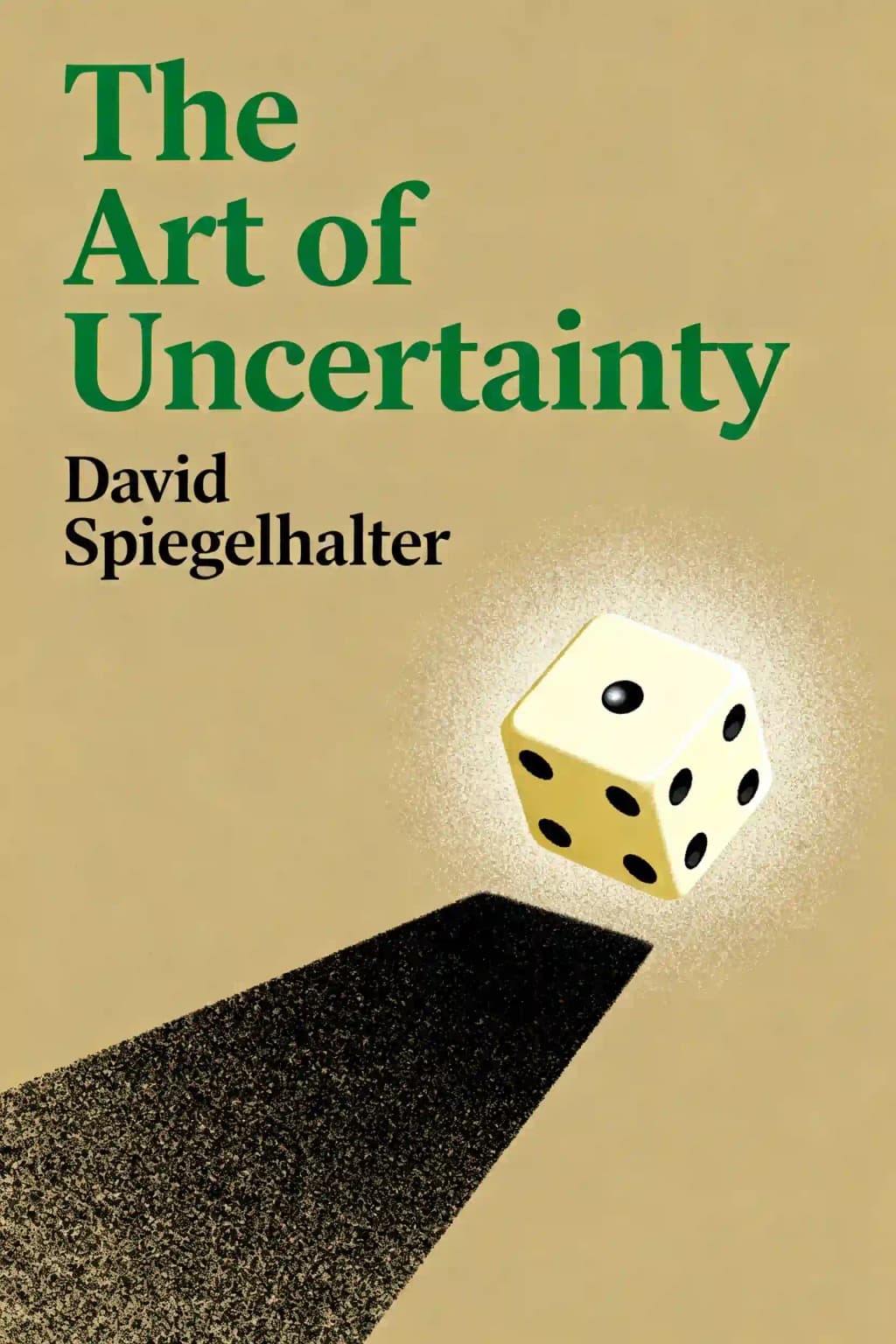
Have you ever found yourself in a situation where the odds seemed impossibly stacked against you? David Spiegelhalter, a renowned statistician and risk communication expert, opens his book with a profound realization: his very existence stems from an improbable series of chance events. His mother narrowly escaped pirates, his parents met during wartime, and his father survived both a plane crash and tuberculosis. The Art of Uncertainty isn't just another academic treatise-it's a deeply personal exploration of how randomness shapes our lives.
Since its publication, the book has become a favorite among tech entrepreneurs like Bill Gates and Elon Musk, who cite its frameworks for decision-making under uncertainty. Its cultural impact extends beyond business circles, influencing everything from public health communication during the COVID-19 pandemic to how meteorologists present weather forecasts. In a world increasingly obsessed with certainty and prediction, Spiegelhalter offers something counterintuitive yet liberating: embracing uncertainty as fundamental to human existence.
2장
Uncertainty is Personal, Not Universal
Uncertainty isn't some abstract property of the world but rather a relationship between an observer and what they're observing. This becomes clear through a simple coin flip experiment. If I flip a coin, catch it, and peek at it while keeping it hidden from you, our relationship with that coin differs dramatically. For me, there's no uncertainty-I know with certainty whether it's heads or tails. For you, there's complete uncertainty-you'd reluctantly say there's a 50% chance of heads.
This example illustrates several important principles. First, uncertainty belongs to the observer-it's "your probability" rather than "the probability." Second, uncertainty can concern both future events we cannot yet know (aleatoric uncertainty) and current states we don't know but could (epistemic uncertainty). The ancient Greeks consulted oracles not just about unknown futures but also about unknown presents and pasts-like who stole silver or committed murder.
Our responses to uncertainty vary widely across cognitive, emotional, and behavioral dimensions. Some people deny uncertainty while others accept it; some respond with fear while others show courage; some avoid uncertain situations while others approach them. These responses typically vary by context-the same person might take enormous physical risks while being financially cautious.
The professional poker player Phil Ivey demonstrated uncertainty's personal nature when he won 7.7 million at London's Crockfords casino using "edge-sorting." By noticing and exploiting manufacturing imperfections on playing card backs, he reduced his personal uncertainty about upcoming cards without changing their objective randomness. The casino still faced the same uncertainty, creating an asymmetry that Ivey leveraged for profit. The UK Supreme Court ultimately ruled against him, determining that his actions constituted cheating despite his claims of legitimate "advantage play."
Uncertainty tolerance varies dramatically between individuals. Those scoring high on uncertainty intolerance scales face increased risk of clinical anxiety and depression. Statements like "Unforeseen events upset me greatly" or "When it's time to act, uncertainty paralyzes me" help identify this trait. Yet interestingly, people sometimes prefer uncertainty-when 1,000 German adults were asked if they wanted to know when they would die, 88% said "no." For Christmas gifts, 60% preferred not knowing what they'd receive.
3장
The Language and Mathematics of Uncertainty
Words like "common," "rare," "probable," and "possible" create dangerous ambiguity in decision-making contexts. This imprecision can lead to catastrophic misunderstandings, as demonstrated by the Bay of Pigs disaster. When the Joint Chiefs assessed a 30% chance of success, Brigadier General Gray translated this to "fair chance" for President Kennedy, who interpreted it as reasonable odds and approved the invasion. The result was a complete fiasco that damaged U.S. credibility and strengthened Castro's position in Cuba - all because of misaligned probability interpretations.
Research shows remarkably vast interpretation differences for probability terms across cultures and contexts. When 5,000 people from 25 countries were asked what "probable" meant as a percentage, the median answer was 60%, but responses ranged from 25% to 90%. Even within professional fields, interpretations vary significantly. Medical professionals, for instance, showed wide disagreement when asked to quantify terms like "likely side effect" or "rare complication" - differences that could significantly impact patient care decisions.
This vagueness has led organizations to standardize definitions in specific contexts. The Intergovernmental Panel on Climate Change defines "likely" as 66-100%, while intelligence agencies have developed their own calibrated probability scales. US intelligence agencies consider "likely" to mean 55-80%, NATO uses different standards, and financial institutions often employ their own frameworks. These varying standards can create confusion in cross-organizational collaboration, particularly in crisis situations requiring rapid decision-making.
The 2011 raid that killed Osama bin Laden provides a compelling case study in probability assessment's real-world impact. Intelligence officers' probability estimates that bin Laden was in the compound ranged widely from 30-40% to 80-90%. Different analysts interpreted the same satellite imagery, human intelligence, and surveillance data yet arrived at vastly different conclusions. Obama ultimately summarized it as "50-50" before approving the raid - not necessarily a precise probability estimate but possibly an acknowledgment of deep uncertainty in a high-stakes decision.
The best forecasters consistently demonstrate three key characteristics that help them navigate uncertainty more effectively. First is aggregation - they actively seek multiple information sources, work well in teams, and combine various perspectives to form more accurate assessments. Second is metacognition - they regularly examine their own thinking processes, acknowledge their biases, and actively work to counteract them. Third is intellectual humility - they readily acknowledge uncertainty and willingly update their beliefs when new evidence emerges.
Philip Tetlock's groundbreaking research on expert prediction revealed that "foxes" who draw from multiple sources significantly outperform "hedgehogs" with one big theory. This difference becomes even more pronounced when predicting outcomes in areas where hedgehogs considered themselves experts. Foxes maintain their accuracy by remaining flexible, incorporating new information, and avoiding overconfidence - essential traits for navigating uncertainty in complex systems.
4장
The Surprising History of Probability
Despite millennia of gambling with dice and knucklebones, the formal concept of probability emerged surprisingly late in human history. Symmetrical dice have existed for at least 3,000 years, with examples found in Egyptian tombs, ancient Greek settlements, and Roman ruins. Yet no one applied analytical approaches to chance until the 1500s. Various explanations exist for this historical quirk: classical civilizations valued logical proof over experimentation; early gambling devices lacked perfect symmetry, often made from animal bones and shells; gambling was considered divinely controlled, with outcomes attributed to gods rather than mathematical principles; and Western numerical systems remained inadequate until around 1200 CE, when Arabic numerals finally replaced cumbersome Roman numerals.
Gerolamo Cardano (c.1500-1571), an Italian Renaissance physician and prolific gambler, made the breakthrough observation that symmetrical dice should have equal probabilities for each number: "I can as easily throw one, three, five, as two, four, six." Through careful observation and mathematical reasoning, he enumerated all possible outcomes when throwing two dice (36 possible combinations), calculating the probability of specific totals. His work "Liber de Ludo Aleae" (Book on Games of Chance) represented the first systematic treatment of probability - though it wasn't published until 90 years after his death, likely due to gambling's questionable reputation in society.
The "problem of points" - how to fairly divide stakes when a game is interrupted - occupied mathematicians for centuries. Consider two players betting equal amounts on who will first win three games: what happens if they must stop when one player leads 2-1? Pierre de Fermat and Blaise Pascal corresponded extensively on this problem in the 1650s, developing what's now considered the foundation of probability theory. Their solution revealed fundamental probability rules that still guide analysis today: probabilities range from 0 to 1; the probability an event won't occur equals 1 minus the probability it will; add probabilities of mutually exclusive events; multiply probabilities of independent sequential events.
Giacomo Casanova, known primarily as a lover and adventurer, was also a formidable mathematician who established a national lottery in Paris in 1757. He carefully calculated the odds using combination formulas, ensuring long-term profit - for three-number tickets, only 44% of money wagered would be returned as prizes. The lottery's mathematical structure proved ingenious: players could choose various bet types with different odds, creating an illusion of control while maintaining house advantage. The system was enormously successful, at one point providing 4% of national income and continuing through the French Revolution. Casanova's lottery design influenced gambling systems throughout Europe and demonstrated how probability theory could be applied to generate reliable revenue streams.
This historical progression shows how probability theory evolved from informal gambling observations to a rigorous mathematical discipline, ultimately transforming our understanding of risk, chance, and decision-making across multiple fields - from insurance and finance to scientific research and modern statistics.
5장
The Mathematics of Coincidence
Coincidences are the "plus side" of uncertainty-unexpected connections that make us smile rather than cause harm. The Cambridge Collection of Coincidences gathered about 5,000 such stories, including Ron Biederman's trousers: A backpacker called Doug had his clothes stolen in Miami, and someone named Ron Biederman gave him a striped shirt. Years later in a London hostel, Doug chatted with a girl who also knew Ron Biederman. The first coincidence was their mutual acquaintance; the second was that Doug was wearing Ron's shirt. Then the girl stood up to reveal she was wearing matching trousers, also given to her by Ron at a kibbutz.
What are the odds of such coincidences? While most resist formal analysis, some can be evaluated numerically. The probability of two people sharing a specific birthday (like January 27) is approximately 1/133,000-quite remarkable when it happens spontaneously. The same calculation applies to frequently reported stories of families with three different-aged children sharing the same birthday.
The Law of Truly Large Numbers explains why coincidences happen: given enough opportunities, even very rare events will eventually occur. A classic example shows that in a group of just 23 random people, there's at least a 50% chance two will share a birthday. This means in more than half of football matches, two people on the field will have a common birthday.
People have poor intuition about how randomness behaves. We see patterns everywhere-faces in toast, "due" lottery numbers, hidden messages in Bible letters. Our fundamental problem is failing to understand that random doesn't mean uniform. If rice grains are randomly scattered on a map, they naturally form clusters. Whether cancer cases or accidents, randomness often produces uneven distributions-events frequently happen in groups purely by chance.
In classroom demonstrations, students can quickly learn to distinguish fake coin flip sequences from real ones, as real random sequences typically contain longer runs of heads or tails than people imagine. A random sequence of twenty coin flips has a 78% probability of containing at least four consecutive heads or tails-something people rarely include in their fabricated sequences.
6장
The Role of Luck in Our Lives
Luck occurs when events outside our control-often perceived as improbable random occurrences-help or harm us. David Flusfeder calls it "the action of chance taken personally." The crucial element is lack of control, though when examining "lucky" outcomes, we often discover people had more control than initially apparent. For instance, a "lucky" business breakthrough might reveal careful preparation meeting unexpected opportunity.
Philosophers since Aristotle have wrestled with the concept of "moral luck"-whether to praise or blame people for events beyond their control. This philosophical debate has profound implications for how we judge success, failure, and responsibility in both personal and professional contexts. Through centuries of discussion, scholars have developed a useful classification system for different types of luck:
Resultant luck: When people in identical situations experience different outcomes due to factors beyond their control. Classic examples include winning a lottery where all tickets had equal probability, surviving a WWI infantry attack when comrades didn't, or two equally careful drivers having different outcomes when a child runs into the street. These cases highlight how similar actions can lead to vastly different results through no fault of the individuals involved.
Circumstantial luck: Being in the right or wrong place at the right or wrong time. This encompasses situations like missing a flight that later crashes, being born during an economic boom versus depression, or happening to meet a future spouse at a random event. Silicon Valley success stories often involve circumstantial luck-being in the right place during the tech boom with the right skills and connections.
Constitutive luck: The fortune of who you were born as-your parents, background, genes, and character traits. This fundamental type of luck shapes everything from educational opportunities to health outcomes. For example, being born with a high IQ, into a wealthy family, or with natural athletic ability represents constitutive luck that significantly influences life outcomes.
Luck's significance often becomes apparent only in retrospect. The author's grandfather Cecil Spiegelhalter might not have felt lucky when a German shell exploded near him in January 1918, but this "bad luck" kept him from being sent to one of WWI's most dangerous locations. Similar historical examples abound, like people who missed the Titanic due to seemingly unfortunate delays.
We can quantify luck's role in certain domains through statistical analysis. In professional sports, particularly football leagues where teams play each other twice, approximately 42% of the point spread in the 2022-23 English Premier League can be attributed to random chance rather than skill differences. The German Bundesliga shows even more influence of luck, with 58% of its point spread attributable to randomness, indicating relatively equal team quality. This higher percentage suggests that when teams are more evenly matched, luck plays a larger role in outcomes.
Statistical analysis reveals substantial uncertainty in team quality estimates. When plotting each team's average points with 95% probability intervals, significant overlap appears between many teams, indicating insufficient matches to confidently determine true team quality. Only five teams can be confidently placed above average, and five below. This mathematical approach to measuring luck's influence helps quantify what many intuitively understand-that even in highly competitive environments, random chance plays a significant role in determining outcomes.
7장
Randomness in Science and Life
In 2016, the author was diagnosed with prostate cancer, adding to his family's extensive cancer history that included multiple relatives across generations. Deeply concerned about potentially carrying the BRCA2 gene mutation - which could significantly impact his two daughters' future health - he sought guidance from a genetic counselor. After meticulously entering his family's comprehensive cancer history into a specialized diagnostic program, they calculated a 33% probability he carried the gene. This probability was over 100 times the background rate in the general population and sufficiently high to justify genetic testing.
This 33% probability exemplifies epistemic uncertainty - like a hidden coin that has already been flipped, the reality exists but remains unknown until revealed. The mechanics of genetic inheritance further illustrate probability in biology: during reproduction, offspring receive one chromosome from each parent's pair, resulting in a 50:50 chance of inheriting either allele. This raises a fundamental question about the nature of probability: does this "50% probability" of inheritance represent a truly random mechanism actively deciding which chromosome we inherit, or is it merely the result of an extraordinarily complex but ultimately mechanical process whose inherent symmetry creates what appears to be 50:50 odds?
Nature abounds with uncertainty - from the chaotic dance of water molecules creating massive ocean currents to the formation of uniquely patterned ice crystals in snowflakes, and the intricate development of specific characteristics in living organisms. Yet the philosophical question persists: is this uncertainty truly random or just extraordinarily complex beyond our current understanding? When Pierre-Simon Laplace contemplated probability in 1814, he proposed a thought experiment involving a hypothetical intellect capable of knowing all forces moving through nature and the precise positions of all objects. Such an entity, he argued, could predict everything with perfect accuracy, viewing past and future with equal clarity. This concept, now known as "Laplace's demon," represents the ultimate expression of determinism, suggesting that probability merely serves as a crutch for our incomplete understanding of the universe's vast mechanical complexity.
The emergence of quantum mechanics in the early 20th century appeared to definitively challenge this deterministic worldview. Groundbreaking work by Niels Bohr, Werner Heisenberg, and their contemporaries revealed that the subatomic world operates on fundamentally stochastic principles - particles exist in probability distributions of positions and velocities until observed, rather than maintaining definite states. This fundamental uncertainty manifests most clearly in phenomena like radioactive decay, where unstable atomic nuclei spontaneously decompose without any apparent triggering cause or predictable timing.
Yet arguments against inherent randomness persist in scientific discourse. Einstein famously objected, declaring "I am convinced He does not play dice," reflecting his deep-seated belief in deterministic causality. "Hidden variables" theories continue to emerge despite Nobel Prize-winning experimental work claiming to disprove them. The increasingly popular "many-worlds interpretation" offers another perspective, suggesting that all possible outcomes actually occur across multiple branching realities, with our consciousness simply experiencing one particular path through this infinite possibility space.
8장
The Bayesian Approach to Uncertainty
Reverend Thomas Bayes, born around 1700, defined probability as the ratio of what you expect to win in a bet to what you would receive if you win-defining probability in terms of subjective belief rather than symmetry or long-term frequency. Ironically for a Presbyterian minister, his most fundamental definition was framed in terms of gambling.
Bayes' paper contains a fundamental idea beneath its confusing language: initial beliefs about some unknown quantity are revised after observing data, and these new beliefs subsequently serve as the basis for estimates and predictions. Consider two identical opaque bags, each containing three balls. Bag 1 has 1 dotted and 2 striped balls, while Bag 2 has 2 dotted and 1 striped ball. If I randomly choose a bag, draw a dotted ball, replace it, and draw again from the same bag, what are the reasonable probabilities for which bag I chose?
Using expected frequency trees, we can determine that after drawing one dotted ball, the probability of having chosen Bag 1 is 1/3 and Bag 2 is 2/3. If we then draw a second dotted ball, our probability of having chosen Bag 2 increases to 4/5 = 80%. We've quickly revised our beliefs, going from 1/2 (50%) to 2/3 (67%) to 4/5 (80%) after seeing two dotted balls.
This process of revising probabilities in light of experience is a subtle idea. Bayes' theorem provides a formal procedure for updating our beliefs with the basic form: Pr(A|B) = [Pr(B|A) x Pr(A)] / Pr(B). We start with a prior probability Pr(A), and after observing evidence B, it's revised to a posterior probability Pr(A|B).
Alan Turing, who led the team at Bletchley Park that broke the Enigma codes during World War II, relied on Bayesian reasoning. In 1941, Turing beautifully defined probability as "the fraction of cases in which an event may happen, given the evidence." To make Bayesian calculations feasible, Turing took logarithms of likelihood ratios so multiplication became addition, and multiplied these by 10 or 20 and rounded to whole numbers. This reduced the process to simple addition and subtraction with pencil and paper.
A fundamentally important principle called "Cromwell's rule," popularized by Bayesian statistician Dennis Lindley, states: never assign probability 1 to any event unless it's logically true (like 2+2=4), and never assign probability 0 unless it's logically false. This principle encourages intellectual humility-keeping our minds open to unexpected events and being prepared for surprises. The rule comes from Oliver Cromwell's 1650 letter: "I beseech you, in the bowels of Christ, think it possible you may be mistaken."
9장
Communicating Uncertainty Effectively
Uncertainty communication happens in various situations-from routine economic data publication to emotionally charged medical diagnoses to active crises like pandemics. During crises, effective communicators should follow John Krebs' five-step strategy: acknowledge what we know, admit what we don't know, explain what we're doing to find out, offer practical advice for the interim, and acknowledge that guidance may change.
Politicians often struggle with admitting uncertainty or the provisional nature of advice, fearing accusations of "U-turns" if policies change. They also typically resist acknowledging the need for research or experiments, as demonstrated during COVID-19 when many school infection control policies were implemented with minimal supporting evidence.
The first rule of communication is to listen. Understanding your audience-their culture, needs, knowledge, emotions, anxieties, misconceptions and goals-is essential whether communicating with colleagues, the public, or policymakers. Language and imagery must be appropriate, like the Bank of England's fan charts that make information accessible.
When communicating numbers summarizing uncertainty and risk, framing matters-"98% survival" sounds better than "2% mortality," so it's best to provide percentages or frequencies for both positive and negative outcomes. Uncertainty about quantities can be expressed as full probability distributions, estimates with 95% intervals, rounded numbers, or ranges.
For trustworthy communication, five key principles where uncertainty plays a crucial role include: 1) Inform rather than persuade-enable audience decisions aligned with their values rather than manipulating them; 2) Be balanced-present both pros and cons, benefits and harms, winners and losers; 3) Be upfront about uncertainty using verbal, numerical, or graphical methods; 4) Acknowledge limitations in evidence by clearly defining its quality and strength; 5) Try to pre-empt misunderstandings by knowing your audience and highlighting what conclusions can and cannot be drawn from data.
Research shows that for skeptical audiences, "balanced" messages are rated significantly more trustworthy than "persuasive" formats-an important finding suggesting that standard governmental attempts to convince actually reduce trust in the very groups they most want to reach.