1장
The Art of Being Present: Improvisation's Transformative Power
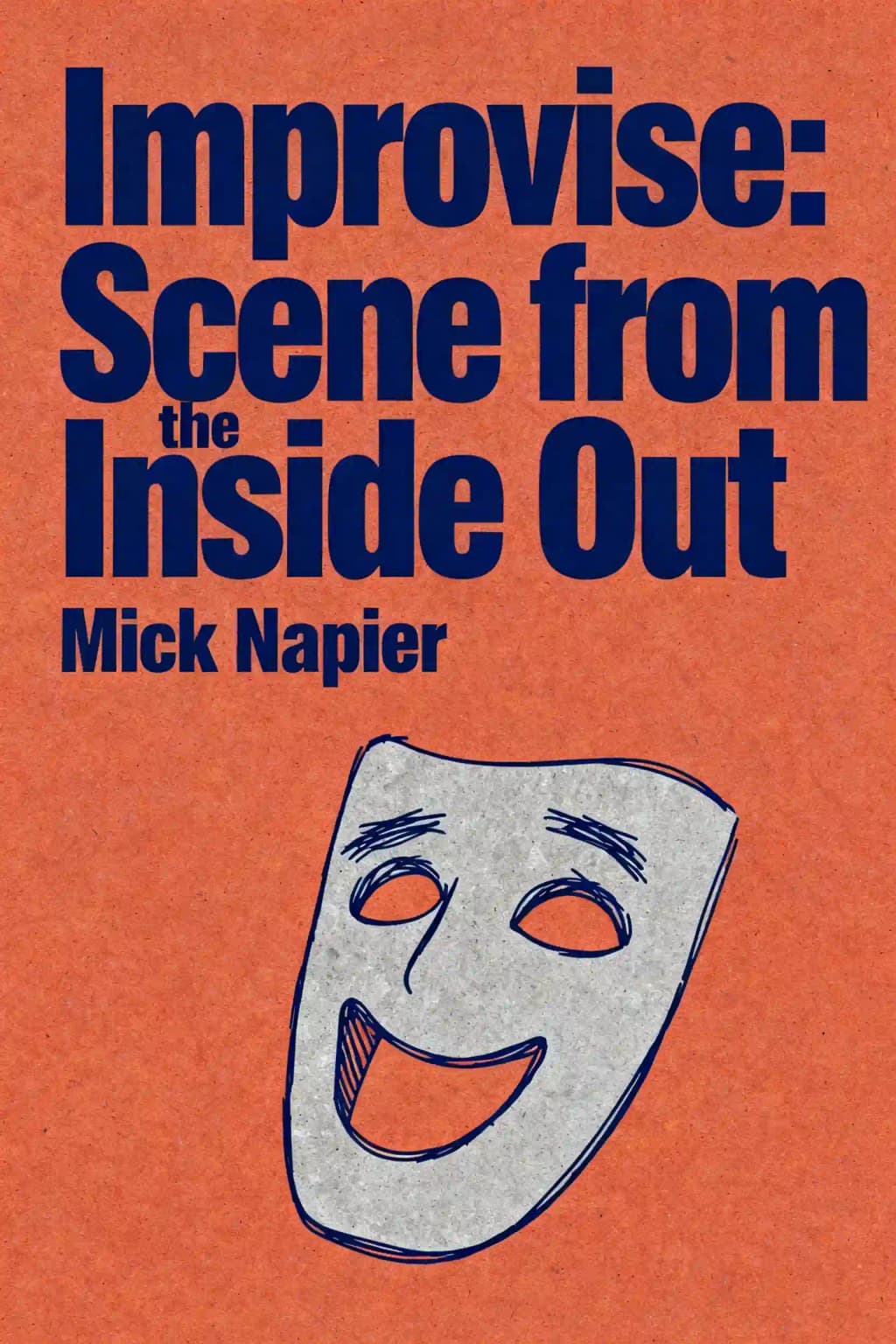
Ever wonder why some people can instantly create compelling characters, stories, and laughter from thin air while others freeze in terror? In Mick Napier's "Improvise: Scene from the Inside Out," we discover it's not about following rules-it's about transcending them. As a former veterinary aspirant turned improv revolutionary, Napier challenges conventional wisdom with a refreshingly counterintuitive approach. His methodology has influenced countless performers, including Tina Fey and Stephen Colbert, who credit his techniques for their spontaneous brilliance on screen. This book has become required reading at major comedy institutions like Second City, UCB, and The Groundlings, transforming how improvisation is taught worldwide. Rather than memorizing do's and don'ts, Napier reveals how true improvisation emerges when we silence our inner critic and simply act. It's a philosophy that extends beyond performance into everyday life-teaching us how to be genuinely present in an increasingly scripted world.
2장
Improvisation Demystified: The Simple Yet Challenging Art
Improvisation is getting on stage and making stuff up as you go along. That's it.
This deceptively simple definition belies the profound challenge it presents, particularly for adults who've spent decades learning to think before they act. We find ourselves moving about and talking without any real knowledge of what we're going to do next. What's astonishing is how something so conceptually simple can be so extraordinarily difficult to execute well.
Improvisation appears in various forms worldwide-as a writing tool, an actor training method, and as a performance art in itself. It manifests as games, scenes, long-form structures, monologues, songs, and countless other formats. It can be intentionally funny or intentionally serious. Unfortunately, it's often unintentionally unfunny.
The beauty and challenge of improvisation is that it can't be mastered through reading alone. You must do it. Repeatedly. Relentlessly. The physical and mental act of improvising creates neural pathways that books and theory cannot. Each time you step on stage without a script, you're rewiring your brain to function differently-to bypass the critical, analytical mind and access a more spontaneous, intuitive intelligence.
This explains why many brilliant people struggle with improvisation while those with less intellectual firepower sometimes excel. Traditional intelligence relies on careful analysis and consideration, while improvisation demands immediate action without the safety net of preparation. It's not about being clever enough to think of the perfect response; it's about being present enough to discover what's already there.
3장
The Rules Trap: Why Conventional Improv Wisdom Falls Short
If you've spent even a moment in an improv class, you've encountered The Rules: don't deny, don't ask questions, don't dictate action, don't talk about past or future events, establish who/what/where immediately. These commandments seem logical and helpful-until they paralyze you on stage.
The problem isn't that these guidelines are inherently wrong; it's that they address symptoms rather than causes. They're like telling someone with a fever to stop being hot rather than treating the underlying infection. The behaviors these rules aim to prevent-denial, pointless questioning, dictating action-aren't the cause of bad scenes; they're the consequence of scenes that were already failing.
Consider how The Rules came to be. In the beginning, there was a miraculous improv scene-playful, vibrant, engaging. Those watching were amazed; those performing felt possessed by something beyond themselves. As others tried to replicate this magic and failed, observers began noticing patterns in the bad scenes: performers denying each other's reality, asking fruitless questions, dictating action rather than doing it.
A false hypothesis emerged: if we eliminate these behaviors, good scenes will naturally follow. But correlation isn't causation. These "bad moves" appear nearly as often in wonderful scenes but go unnoticed because everyone's too busy enjoying themselves. Even worse, focusing on The Rules often creates the very problems they aim to prevent, as performers become preoccupied with not breaking them rather than being present in the moment.
What's really happening in those bad scenes? Fear. Confusion. More fear. Thinking. More fear.
As adults, we've been conditioned to protect ourselves through conscious thought. We remember dangers and make choices based on past experiences-an evolutionary advantage that kept our ancestors alive but kills spontaneity on stage. When improvisers bring this self-protective consciousness into performance, they carefully consider all possibilities before acting, creating what improvisers call being "in your head." But audiences don't pay to watch adults thinking; they come to see people playing.
4장
The Three-Step Path to Authentic Improvisation
If The Rules don't work, what does? The path to good improvisation is surprisingly straightforward, though not always easy to follow. It consists of three simple steps that bypass fear and connect you directly to your creative impulses.
First: Do something. Anything. Something.
When I say do anything at the top of a scene, I mean literally anything-a quiet "Hmmm," a subtle observation, a single word, or just a shift in body weight. The specific choice matters far less than the act of choosing itself. You'll know when you've made a move that feels right; you might still be scared, but you won't care in a wonderful way.
Physical choices can be particularly powerful starting points. Grabbing an imaginary object, for instance, can either launch you into a character or become a stalling tactic, depending on your commitment. Compare an improviser who grabs a pointer, aims at an invisible blackboard with a sneer, and says in a British accent, "Interesting lotion," versus one who tentatively reaches for a cup, stares at it, looks at their partner, and after an excruciating silence says, "So, how's it going?"
What about planning ideas before a scene begins? While technically "cheating," improvisers do it anyway. Preconceiving an entire scene rarely works-too much left-brain baggage. Forcing a "funny" line usually falls flat. Using a favorite character works temporarily until the well runs dry. Choosing an emotional state beforehand can be harmless if not done out of fear. Thinking of a first line is something every improviser has done-but the simpler the line, the better. "So, you're here" leaves more room for discovery than an elaborate setup about robots from Andromeda.
Second: Check out what you did.
After making your initial choice, take half a second to notice what you've created. If you yawned and said "Ah, Saturdays," don't spiral into questions like "Why did I say that?" or "What's my partner doing?" or "What am I going to say next?" Simply observe what you literally just did.
An improviser will often say something at the top of a scene that gets a laugh, then follow with a disconnected second line that falls flat because they didn't understand what made the first line work. They literally do not know what they are doing.
Create boldly in the first moment, then check out what's up-not with worry about what happens next, but with simple awareness of what you just established. Good improvisers do this automatically through intuitive self-appraisal.
Third: Hold on to what you did.
Once you've acknowledged what you've created and how you did it, hold onto it fiercely. Be possessed by what you created. Don't let go.
In The Wizard of Oz, Dorothy must passionately hold on to her innocent desire to return to Kansas. The Tin Man must always want a heart, the Lion courage, and the Scarecrow a brain. They never waver from these core desires, or the movie falls apart. In improvisation, you're creating your entire character instantaneously, but the principle remains the same.
Many improvisers struggle with this step for several reasons: they're too nice and fear being seen as selfish; they reach their fear threshold and abandon their choice when it feels risky; they think they've run out of things to do with their character; or they mistakenly believe that different equals funny, switching up characters or denying reality when consistency would serve them better.
The magic of improvisation happens when you're totally out of your head, hitting every line and action from within a consistent point of view. Everything coming out of your mouth lands because it's filtered through that character or disposition. It feels like magic, but it's really your choice at work-something you created, recognized, and played to its fullest potential.
5장
Supporting Through Strength: The Partner Dynamic
At this point, you might wonder: isn't improvisation supposed to be about supporting your partner? Where does the partner fit when you're focused on your own initiation?
The most supportive thing you can do is get over your fear and make a strong choice in the scene. Support your partner with your power, not your timidity. Give them the gift of your commitment. I only feel supported by partners who make a move, who do something. If they just stand there thinking about supporting me, I am absolutely unsupported.
"Support your partner" is a well-intentioned phrase that often makes improvisers weak. It creates a fantasy land where people constantly defer their power and never make decisive moves. You want to support your partner? Do something now. They'll feel supported, believe me. Two people making strong choices is nothing but supportive.
Another way to support your partner is to maintain your own choice once you've made it. By sticking to your powerful choice, you give your partner something concrete to play against. This creates the foundation for what improvisers call "the game of the scene"-the relationship dynamic that emerges when two strong points of view interact.
For example, if your partner's character becomes angry at your laughing character, you support their point of view by making them angrier-adding fuel to their fire while simultaneously heightening your own point of view (laughing more at everything they do). The more you laugh, the angrier they become. That's the relationship, that's what the scene is about, that's the game. This support arrives through individual choices recognized in self and partner, and heightened because both parties are aware of what each created.
What about listening? Merely listening has little value-you have to know how to listen. I listen so I can respond to operative information my partners supply and filter it through my own character. Listening gives me ammunition to pour into what I've created. I don't just politely absorb information; I listen for opportunities to say or do something relevant through my character's voice when I respond.
When you're not the first to speak in a scene, snap into a character or point of view or at least an emotional disposition at the very top. Then you have your armor for the scene, even if your partner literally initiates the content with words. When you respond, you already have something to respond through (not respond to, but respond through). You've taken care of yourself first, regardless of whether you were the first to speak.
6장
The Power of Context: Creating a World That Works
Once you've created a strong space for yourself and your partner has done the same, you have the makings of a good scene. Now what? Hold on to whatever you've created and play it for all it's worth. Playing means making more of what you've already created, realizing the context that has been established, playing within that context, and making surprising choices. Context is everything-not just in improvisation, but in life itself.
Context is the frame for all great works and the unspoken credo of everyday living. Human beings cannot function, observe, or enjoy anything without context. All of life has many contexts, and all good improvisation has context-an agreed-upon road map for living.
Context allows people to know what to expect. In life, surprises within a context become theatrical; in improvisation, surprises within a context usually result in laughter.
People assess contexts all day without thinking about it and act accordingly. Even people themselves have contexts-"He's a whiner" or "She's always got something nice to say." If someone acts outside their usual context, we say "He's not himself today."
In entertainment, context is equally crucial. In The Wizard of Oz, Kansas is black and white while Oz is color-a context declaration that's never violated. The yellow brick road provides a literal contextual road map. Character desires form another context: Dorothy wants to go home, Scarecrow wants a brain, Tin Man wants a heart, and Lion wants courage.
In improv scenes, context is everything-not just what people are talking about but how they're saying it. The context becomes the road map for the scene that both performers and audience understand. For example, two people discussing a birthday party sarcastically while performing surgery creates a context of "being snitty and gossipy is more important than high-stakes operation." Once the context is established, performers must not just maintain it but surprise from within it, like The Wizard of Oz adding flying monkeys and talking trees.
Effective improvisers don't just repeat the same beats but bring new elements to the established context, building from one emotional state to another (like sarcastic to condescending to hateful) while maintaining their core point of view. These surprises within the established framework typically generate audience laughter and delight.
7장
Breaking Through Common Improv Pitfalls
Even with a solid understanding of the do-something approach, improvisers often develop behavioral patterns that can hinder their performance. These aren't rules but common problems worth addressing:
Too Much Exposition: Some improvisers dump excessive information at the beginning of scenes: "I'm glad you, my brother, are here because we must wash the car before mother and father arrive at the apartment here noon to discuss my getting fired from my factory job." This stems from being taught to establish who, what, and where immediately, but it feels unnatural. If exposition is necessary, dole it out gracefully throughout the scene rather than frontloading it.
Talking Too Much: This manifests as continuously talking until finding something that works. Improvisers with this habit often use "I mean" as a verbal crutch. The solution is simple: practice saying one short sentence at a time and then shutting up. Put a period after your sentences and wait for your partner's response.
Justifying: Justifying happens when improvisers explain why they said or did something instead of just letting it be. It typically occurs after the second or third exchange when someone becomes uncomfortable with the scene's mystery. This fear-based habit dilutes the power by explaining the play rather than allowing it to unfold naturally-like Abbott and Costello explaining "Who's on First" instead of performing it.
Pausing: Improvisers who haven't established a strong character at the scene's beginning often fall into measured pausing before each line. These painful silences happen because they're thinking too hard about what to say next. The solution? Make a game of responding immediately after your partner's line. Remember that magical scenes typically have a rapid-fire quality, even in slow scenes.
Bailing on a Point of View: Ninety-nine percent of the time, shifting your point of view pulls the rug out from under a scene. When tempted to bail, restate your position and heighten it instead. For example, when "I don't feel well" isn't working, don't give in with an "Okay" that signals surrender. Instead, double down with "I think I'm dying. Yes, I'm definitely going to die."
8장
Mastering Multi-Person Scenes: The Art of Ensemble
Managing scenes with more than two performers requires special finesse and timing. The biggest challenge comes from improvisers thinking "different" when they should think "same."
Three-person scenes often fail when the third person tries to be different rather than supporting what's already established. When two improvisers establish a direction and the third stands silently trying to figure out what to do, they frequently blurt out something contrary to gain power. Instead, go with the flow. Join an existing point of view rather than creating a tangential one.
The audience is trying to understand what the scene is about, and they appreciate clarity. This shared perspective doesn't require identical dialogue-it could manifest through matching character traits, emotions, or states of mind (like three angry people saying different things, but all being angry).
Before entering an established scene, consider why you're doing it. For scene-ending entrances, do the opposite of maintaining continuity-enter with a different point of view to create closure. If the scene needs resolution, resolve it. If characters are waiting for someone, enter as that person.
A less disruptive entrance is the "walk-through" or "pop in"-briefly appearing to add energy without changing the scene's focus. For example, in a scene about a missing monkey, you could pop in as the monkey without the characters seeing you, adding humor while preserving the scene's premise.
Group scenes with four or more people are notoriously difficult. The key is identifying the dominant energy-what's most important in the scene right now-and aligning with it. Contrary to appearances, the most physically active person isn't necessarily creating the dominant energy; often it's the people the audience naturally focuses on for context.
When someone speaks first, their words become the dominant energy, and everyone should align with that premise. Unfortunately, group scenes typically fail because improvisers get stuck in their heads, pursue disparate ideas, or wait too long to speak.
9장
Advanced Techniques: Breaking Patterns for Richer Scenes
Despite improvisation's spontaneous nature, certain patterns emerge repeatedly. Given the suggestion "cave," most improvisers create scenes about escaping. Submarine scenes inevitably feature periscopes. Hot air balloon scenes focus on landing. This phenomenon reflects how people share common associations with locations and situations. Breaking these patterns creates richer, funnier, more substantive scenes.
Make Opposite Choices: Go contrary to what seems obvious. Given a used car lot suggestion, most improvisers immediately try selling a car. Instead, imagine two coworkers at a used car lot complaining about their girlfriends. This unexpected choice creates something more exciting and theatrical, putting you in a wonderful world of discovery rather than playing out the familiar negotiation scene.
Embrace Specificity: Specificity is one of the most effective tools in improvisation. When we're in a state of self-judgment, we tend to be vague, using phrases like "put that over there" or "they will be there soon." Instead, weave specifics into scenes: "Put that red vase next to the porcupine statue" or "The legislators will be at Sonny's Deli soon." Specifics color the scene, provide valuable information to your partner, expedite the scene so you don't fish for substance, and garner quicker audience reactions.
Pull Out/Pull Back In: Once you understand what your scene is about, temporarily go opposite your established point of view, then restore your original view in the next beat or line. For example, if your character fears being an outcast at a party, you might reluctantly agree to go (pulling out), then immediately revert to your fear (pulling back in). This gives your initial declaration more power after restoration and provides the audience with a sense that the scene pushes and pulls against itself.
Throw Curve Balls: Once your scene is established, introduce something seemingly unrelated and catch up to it later. In a scene about a boy dreading his parents' wrath over a car scratch, he might suddenly ask "Do you like butterflies?" This seemingly random question later connects when we learn he used to chase butterflies before the scratch-an activity he'll now be denied. For this to work, you must establish your point of view clearly first, and your partner must trust the disparate element will weave into the scene.
Create Personal Objects and Mannerisms: Superior improvisers add personal objects or mannerisms to their characters, adding substance and believability. An executive flicking a yo-yo during a serious conversation transforms from archetypal to multidimensional. These personal touches provide insight into character personality and generate more laughs. Even simple choices like an executive obsessively stroking his ear or a southern belle doing a little wave after everything she says make characters more individual and interesting.
Vary Your Energy: Many improvisers repeat patterns of energy, emotion, and staging throughout a show. Make variety a conscious choice, especially in long-form improvisation. If you've done two angry, shouting scenes center stage, try a quiet vulnerable scene downstage right on one knee. Track your patterns and deliberately break them. Focus on variety of emotion, volume, staging (both horizontal position and vertical height), numbers of people in scenes, and rhythm.
10장
The Science of Scene Energy: Thermodynamics of Improvisation
Improvisers often talk about "energy" in scenes, but is this just a metaphor or something more tangible? If we consider an improv scene as a closed system and the energy as real, it should adhere to the laws of thermodynamics.
The First Law of Thermodynamics states that energy can never be created or destroyed, only transformed. The universe contains a fixed amount of energy that can change form but never increases or decreases. "You can't win" with energy-you'll never come out ahead because no new energy is ever created.
The Second Law of Thermodynamics is even more relevant to improvisation: in a closed system, entropy (disorder) will always increase over time. Entropy isn't chaos itself but waste heat-energy that escapes into the universe, never to be recaptured by its original system. Things naturally tend toward cooling and disorder. A hot Irish coffee cools on its own as heat disperses. A glass breaks and can't spontaneously reassemble because the energy binding it together has dispersed.
An improv theater becomes a closed system with internal energy inputs: lights, audience reactions, air conditioning, improvisers, sound, movement, and potential energy. All these energies drive what the scene is about. Like pistons in an engine, improvisers must fire their energy efficiently to move the scene forward.
Our greatest challenge is reducing entropy-minimizing wasted energy. When an improviser abandons a point of view, hesitates in fear, or repeats the same territory, you're witnessing waste energy dispersal. The second law doesn't care-it will take energy from your scene whenever possible. Everything created in improv must be fueled with energy NOW to prevent disorder. Whatever the scene is about, once you lose its energy, "it ain't ever coming back."
This scientific perspective helps explain why maintaining and heightening your choices is so crucial-you're fighting against the natural tendency toward disorder. Each moment you spend in your head or hesitating allows energy to dissipate. Each strong choice you make injects new energy into the system, temporarily pushing back against entropy's inevitable march.
11장
Practical Growth: From Theory to Performance
Improvisation is ultimately a performing art, not just a theoretical one. Beyond understanding principles, improvisers need practical tools for growth and success in the field.
Talent matters, but it's not everything. Be brutally honest with yourself about what you want from improvisation. Declare what you honestly want and live that vision fearlessly. If you pursue improvisation professionally, understand it takes years to develop the necessary skills. Even natural talent needs technical skill to avoid common pitfalls.
Balance training with performance. There's such a thing as too much training. If you're entering your second year of classes with limited performance experience, consider taking time off to assess your progress. This break helps you absorb what you've learned and develop a more objective perspective on the various contradictory approaches to improvisation.
In audition situations, remember this crucial truth: auditors desperately want you to do well. Don't acquiesce to the tense energy in the room; snap into play despite the atmosphere. Make strong choices when told to "go." State your name simply without trying to be funny. Dress nicely-no gimmicky outfits. Show variety in your characters and energy. Take acting classes to gain an edge. Prepare by auditioning regularly-those who've reached the point of not placing excessive importance on the outcome often perform best because they're free to play without burden.
The journey of improvisation is ultimately about freedom-freedom from self-judgment, freedom from rules, freedom from the paralysis of thinking. It's about reclaiming the spontaneous joy of play that most of us left behind in childhood. By making strong choices, acknowledging what we've created, and holding onto our point of view, we can access a state of flow that feels magical but is actually the result of being fully present in the moment.
Whether you're performing on stage or navigating everyday life, the principles of good improvisation remain the same: do something, check out what you did, and hold onto what you created. In this simple three-step process lies the path to authentic self-expression and genuine connection with others-the true art of being present.