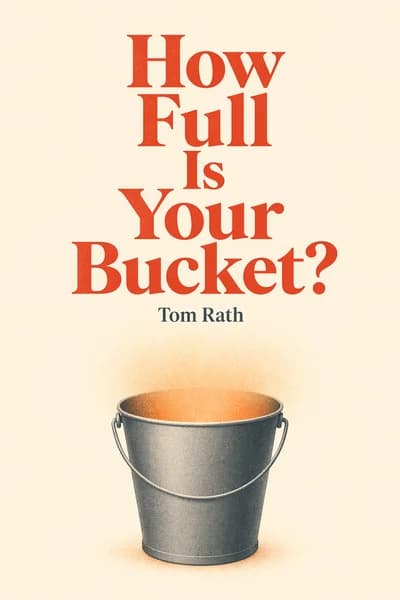
Discover why "How Full Is Your Bucket?" became a #1 NYT bestseller, transforming workplace dynamics with its simple yet profound question: are you filling or emptying others' emotional buckets? Universities nationwide use this 10-million-copy phenomenon to revolutionize human interactions.
Tom Rath, bestselling author of How Full Is Your Bucket?, is a leading expert in positive psychology and employee engagement.
Drawing from his tenure as a senior scientist at Gallup, where he pioneered research on strengths and well-being, Rath’s work bridges human behavior with practical strategies for personal and professional fulfillment. His influential titles, including the global bestseller StrengthsFinder 2.0 and Eat Move Sleep: How Small Choices Lead to Big Changes, have sold millions worldwide, with translations in over 16 languages.
Rath’s contributions extend to platforms like Contribify, aiding readers in optimizing their daily habits and team dynamics. A University of Pennsylvania guest lecturer, his actionable insights are applied in corporate and academic settings globally.
How Full Is Your Bucket? alone has surpassed 1 million copies sold, cementing Rath’s legacy as a transformative voice in self-development literature.
How Full Is Your Bucket? explores the impact of positivity and negativity through the metaphor of an invisible "bucket" and "dipper." Positive interactions fill buckets, boosting well-being and productivity, while negativity drains them. The book combines 50 years of research with actionable strategies to cultivate positivity in work, relationships, and daily life, emphasizing how small gestures create lasting change.
This book is ideal for leaders, managers, and individuals seeking to improve workplace morale, personal relationships, or emotional resilience. It’s particularly valuable for those navigating team dynamics, parenting challenges, or self-improvement goals, offering tools to foster gratitude and reduce negativity.
Key concepts include:
The book advocates for recognition, gratitude, and constructive feedback to boost employee engagement. For example, Gallup studies show teams with regular praise see 20–50% productivity increases. Managers are urged to replace criticism with strengths-based coaching to reduce turnover and improve morale.
The "dipper" represents actions that add to or drain others’ emotional buckets. Criticizing or ignoring someone dips from their bucket, while encouragement fills it. This theory underscores reciprocity: filling others’ buckets also enriches your own.
Some argue the metaphor oversimplifies complex emotions, potentially dismissing valid negative experiences. Others note the focus on individual actions may overlook systemic workplace issues. However, its practicality and research-backed strategies remain widely praised.
Unlike Atomic Habits (focusing on routines) or The Power of Now (mindfulness), this book emphasizes interpersonal dynamics. Its actionable framework—like the five strategies—differentiates it from abstract self-help guides. Fans of The 5 Love Languages may appreciate its focus on personalized positivity.
Parents can model gratitude, praise effort over outcomes, and teach children to recognize "bucket-filling" actions. For example, using a physical bucket prop helps kids visualize how kindness impacts others. The book’s kid-friendly version reinforces these lessons through stories.
The authors cite Gallup studies spanning 40+ years, including 4 million workplace interviews. Findings link positivity to higher productivity, better health, and longevity. For instance, teams with frequent praise report 30% fewer errors and 37% lower absenteeism.
The 2023 edition updates research and adds a 23-page workbook for team-building exercises, self-assessment tools, and actionable worksheets. It strengthens the link between bucket-filling and modern challenges like remote work and mental health.
Rath’s resilience through health struggles (vision loss, cancer) illustrates bucket-filling in adversity. His grandfather, coauthor Donald Clifton, pioneered strengths psychology, grounding the book in family legacy and empirical research. Their collaboration blends storytelling with data-driven insights.
저자의 목소리로 책을 느껴보세요
핵심 아이디어를 빠르게 캡처하여 신속하게 학습
When it's full, you feel great. When it's empty, you feel awful.
The number one reason people leave their jobs is that they don't feel appreciated.
The choice is yours.
Positivity transforms your world, one interaction at a time.
How Full Is Your Bucket?의 핵심 아이디어를 이해하기 쉬운 포인트로 분해하여 혁신적인 팀이 어떻게 창조하고, 협력하고, 성장하는지 이해합니다.
How Full Is Your Bucket?을 빠른 기억 단서로 압축하여 솔직함, 팀워크, 창의적 회복력의 핵심 원칙을 강조합니다.

무엇이든 물어보고, 목소리를 선택하고, 진정으로 공감되는 인사이트를 함께 만들어보세요.

샌프란시스코에서 컬럼비아 대학교 동문들이 만들었습니다
"Instead of endless scrolling, I just hit play on BeFreed. It saves me so much time."
"I never knew where to start with nonfiction—BeFreed’s book lists turned into podcasts gave me a clear path."
"Perfect balance between learning and entertainment. Finished ‘Thinking, Fast and Slow’ on my commute this week."
"Crazy how much I learned while walking the dog. BeFreed = small habits → big gains."
"Reading used to feel like a chore. Now it’s just part of my lifestyle."
"Feels effortless compared to reading. I’ve finished 6 books this month already."
"BeFreed turned my guilty doomscrolling into something that feels productive and inspiring."
"BeFreed turned my commute into learning time. 20-min podcasts are perfect for finishing books I never had time for."
"BeFreed replaced my podcast queue. Imagine Spotify for books — that’s it. 🙌"
"It is great for me to learn something from the book without reading it."
"The themed book list podcasts help me connect ideas across authors—like a guided audio journey."
"Makes me feel smarter every time before going to work"
샌프란시스코에서 컬럼비아 대학교 동문들이 만들었습니다

How Full Is Your Bucket? 요약을 무료 PDF 또는 EPUB으로 받으세요. 인쇄하거나 오프라인에서 언제든 읽을 수 있습니다.
Imagine you're carrying an invisible bucket with you everywhere you go. This bucket represents your emotional state. When it's full, you feel great. When it's empty, you feel awful. Every interaction you have with others either fills your bucket or empties it. But here's the interesting part - you also carry an invisible dipper. With this dipper, you can fill other people's buckets by saying or doing things that increase their positive emotions. And when you do this, you're not just filling their bucket - you're filling your own too. On the flip side, when you use your dipper to take from someone else's bucket - by saying or doing things that decrease their positive emotions - you're not just emptying their bucket. You're emptying your own as well. This simple metaphor is at the heart of our book, "How Full Is Your Bucket?" It's a powerful way to understand the impact of our daily interactions and the profound influence they have on our relationships, productivity, health, and overall happiness.