1장
The Power of Perspective: Breaking Free from Self-Limitation
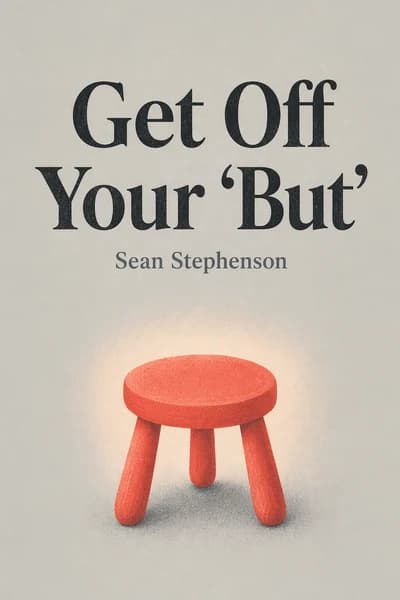
Sean Stephenson wasn't supposed to survive. Born with Osteogenesis Imperfecta-brittle bones disease-doctors told his parents he might die within 24 hours. If he lived, they warned, even a sneeze could shatter his fragile ribs. Yet against all odds, this three-foot-tall man with over 200 lifetime bone fractures became a renowned psychotherapist, motivational speaker, and confidant to presidents.
"Get Off Your BUT" has become a cultural phenomenon, endorsed by celebrities like Tony Robbins and featured on major networks including CNN, NBC, and The Discovery Channel. The book's transformative approach has resonated with millions seeking to overcome their own limitations. What makes this work so powerful is Stephenson's radical premise: our greatest limitations aren't physical but mental-the excuses, insecurities, and fears (our "BUTS") that prevent us from living extraordinary lives.
Through his journey from constant fractures and pain to becoming a therapist, speaker, and White House intern, Stephenson discovered universal principles about human potential that apply to everyone, regardless of their circumstances. His message is clear and revolutionary: no matter what challenges you face, you can create a life more fulfilling than you ever imagined possible.
2장
Born to Overcome: A Life Beyond Limitations
Sean Stephenson entered the world with almost every bone in his tiny body broken from the trauma of delivery. Doctors encased him in a cast, propping him on a pillow with limbs sticking straight out like "King Tut on his throne." The prognosis was grim: if he survived at all, his bones would remain as fragile as glass throughout his life.
When a nurse tried to give his mother an injection to dry up her breast milk, suggesting "why would you want to nurse a baby like that?", his parents began their pattern of refusal-refusing to lose faith in their son's potential. They never thought "We would be happy about our son...BUT he'll never be normal." Instead, they remained solidly committed to seeing him not just survive but succeed.
While other babies progressed from crawling to walking, Sean developed "scootching"-an army-crawl-like movement on his back. Eventually, he learned to log-roll around the house for greater speed. His muscles weren't developed enough to sit up independently, and standing was impossible-his muscles, stronger than his brittle bones, permanently twisted his legs into positions that made walking impossible.
His parents transformed his wheelchairs into creative floats for Halloween, Fourth of July parades, and their hometown Pet Parade. They built everything from train engines and race cars to pirate ships and mummy coffins. Sean spent three-quarters of each day in his wheelchair at school and friends' houses, with the remaining quarter lying on the floor resting his exhausted back muscles.
Extreme back pain dominated his life until he turned eighteen. Confined indoors by pain, he naturally discovered meditation, visualization, and mind-body healing techniques out of necessity. No one taught him the technical terms for displacing pain from his conscious mind or self-hypnosis-he developed these skills through self-discovery. Pain became his teacher, and he became its dedicated student.
While most toddlers learn causality through dropping toys or touching hot stoves, Sean's equation was different: if he lifted something heavy, his arm would snap. His brain became wired for constant vigilance, scanning for dangers other children never considered. Despite this caution, he was still a child who sometimes forgot to think-like one particular Halloween morning in fourth grade that changed everything.
3장
Finding Purpose Through Pain
After breaking his femur on Halloween morning-his favorite day when he could finally "disappear" among costumed peers-Sean lay in agony on the living room floor. As his mother tried to distract him from the pain, she asked a life-changing question: "Sean, is this going to be a gift or a burden?"
In that moment, something magical happened. A warm wind of wisdom seemed to surround him, and he had a clear revelation: he had always loved his life despite the pain, and he was meant to teach others how to do the same. His mother then shared another profound thought: "Pain is inevitable. Eventually, it touches us all. Suffering, however, is optional."
Over the years, Sean accumulated bone fractures like other boys collected merit badges. These breaks disrupted countless events from vacations to school days. When people asked if he ever got used to the pain, his answer remained: "No, at best, I understand how to control it." Yet surprisingly, the physical pain wasn't as torturous as the emotional pain of isolation-watching friends play games he couldn't join, often praying for rain so recess would be held indoors where he could participate.
As he entered junior high, new yearnings emerged-particularly for girls. He always had girlfriends until "the note" in seventh grade. A beautiful eighth-grade girl he was dating left a message: "We have to break up. My girlfriends said I shouldn't be dating a guy like you." Through his cousin, he learned the devastating truth-her friends mocked her for dating "a little guy in a wheelchair." This rejection formed a limiting belief that haunted him for twelve years: "You are flawed. You're a nice guy, BUT that will never be enough for girls to love and want you."
High school brought positive developments. His parents wisely advised: "Sean, there are many things you won't be able to do because of your physical condition, so get busy finding the things you can do." As puberty arrived, his bone fractures diminished, allowing him to miss fewer school days and participate in extracurricular activities. He gravitated toward television production and student government, producing talk shows, dating shows, and even a seven-episode sitcom series that won a Silver prize at Columbia College's Video Festival.
4장
Connections That Transform Lives
When Sean was ten, his family met "Boston Bill," a sad-looking bus driver who drove them to their hotel after a canceled flight. Despite being exhausted and uncomfortable in a child's car seat, Sean engaged with Bill, asking questions and joking around. Later at dinner, Bill approached them in tears, revealing he'd been contemplating suicide that night. Despite therapy and counseling, nothing had helped until meeting Sean-seeing his happiness despite his challenges gave Bill hope.
This puzzled Sean for years until, in his twenties, he watched a brilliant speaker fail to engage his audience. That's when he realized: communication is merely exchanging information, but connection is exchanging our humanity. With Bill, he'd established a deep connection that changed his life.
Connection happens when one person feels another genuinely cares about them. Once this caring energy is mutually experienced, the connection is reciprocated, and both parties instantly recognize it. With true connection, deep communication becomes possible. Without it, even the best advice falls flat. We're biologically hardwired to recognize who truly cares about us-it's an evolutionary survival mechanism.
While we teach communication in our educational system, we neglect teaching connection. Despite having instant messaging, texting, emails, and cell phones, we often feel lonelier than our ancestors did, lacking the deeper purpose that motivates meaningful exchange. Authentic human connection is powered by emotion. Every neurologically typical person experiences emotions-happiness, sadness, loneliness, excitement, confusion, fear. Without emotion, life would be merely mechanical movements.
During his White House internship, Sean observed President Bill Clinton's masterful connection techniques: telling emotionally evocative stories rather than making direct points; making physical contact; remembering names despite meeting countless people; using your name multiple times in conversation; maintaining unwavering eye contact; expressing genuine emotions through facial expressions; calibrating his vocal tone based on rapport level; asking for opinions, making others feel important; choosing words carefully; and praising people publicly.
When clients tell Sean they're too shy to connect, he understands the spectrum from introversion to extroversion. "Shy" behavior exists primarily because we think it protects us from getting hurt-what he calls the "turtle complex." By hiding in our shells, we avoid failure, ridicule, and disappointment, but we also miss life's greatest juice: connection! Shyness activates when we focus on ourselves and dissipates when we think selflessly about helping others.
5장
The Language We Live In: Transforming Self-Talk
Words aren't just letters strung together-they're packages of emotions that can heal or harm us. Despite the childhood saying about sticks and stones, words absolutely can hurt us. Our language directly correlates with how we feel: positive people use uplifting words, negative people choose cynical language, victims speak in terms of victimhood, and grateful people express gratitude.
After helping a third-grade girl with webbed hands reframe her self-perception from "weird" to "memorable," Sean received a call from her mother weeks later. The girl had completely transformed, confidently telling classmates, "I'm not weird... I'm mem-or-able... and you're going to remember me for the rest of your life!" This dramatic change from just replacing one word demonstrated the incredible transformative power of language in shaping our identity and confidence.
Words do more than define our experiences-they often create them. While we're taught "if you can't say something nice, don't say anything at all" regarding others, we rarely apply this wisdom to our self-talk. That constant inner voice chattering in the background affects our emotions and behaviors profoundly. When ignored, this voice can become increasingly disruptive, leading people to seek escape through destructive behaviors.
Like good parents of demanding two-year-olds, we need to take control and start parenting our inner voice. We must intervene when we catch ourselves saying cruel things internally, apologizing to ourselves-a foreign concept but necessary practice. We should speak to ourselves with the same respect and kindness we'd offer a best friend or mentor. Life presents enough challenges without becoming our own obstacle through harmful self-talk.
Our self-talk is a dialogue we rarely listen to consciously, yet it's often brutally critical. If we talked to our friends the way we talk to ourselves, we'd have no friends left. We're typically harder on ourselves than on anyone else. Instead of worrying about what others think about you-which is more about them than you-focus on treating yourself with respect.
Most negative self-talk centers around three specific language patterns: BUT fears, BUT excuses, and BUT insecurities. Fear-based self-talk typically starts with "BUT what if..." phrases that imagine worst-case scenarios. Remember FEAR is False Experiences Appearing Real. Most feared outcomes never materialize. BUT excuses are based on imaginary resource shortages that prevent action: "BUT I don't have the time/money/energy!" BUT insecurities attack our self-esteem with thoughts like "BUT I'm not attractive enough" or "BUT I'm not smart enough."
6장
Embodying Confidence: The Physical Path to Power
Physical confidence is the external expression of our internal confidence state-how confidence looks and sounds. We can identify confident people instantly because confidence manifests physically. The mind and body operate as a single unit-psychological changes trigger physiological reactions and vice versa. Our entire body functions as a thinking and feeling machine, with even microscopic parts communicating constantly.
The nervous and digestive systems are so interconnected that researchers refer to them as the "brain-gut axis." The gut contains as many neurons as the spinal cord, with the central nervous system releasing chemicals that regulate stomach function. In return, the digestive system sends electrical messages to the brain creating sensations like hunger or pain. According to Dr. Emeran Mayer, the vagus nerve runs between brain and gut with 95% of fibers going from gut to brain-potentially influencing our moods and emotions.
Our emotional states correspond directly to physical positions-anger manifests in clenched fists and tight lips, while happiness shows in open hands and upward-curved mouth. By consciously shifting our physiology, we can change our emotional state. Though this won't solve underlying problems, it can decrease emotional intensity and create space for clearer thinking.
To increase physical confidence, Sean recommends several practices: relax your entire body and release tension; breathe deeply and completely; slow down your blinking rate; keep your head up and shoulders back to maintain optimism; adopt relaxed, slightly asymmetric posture rather than rigid symmetry; use a strong, controlled voice tone; smile gently and authentically; and cultivate stillness and calm. These adjustments help you feel more comfortable with yourself while making others feel at ease around you.
People often misunderstand sexual attraction, focusing solely on physical attributes like height, weight, and facial features. However, physical confidence plays a far more significant role in attraction than appearance alone. Sean illustrates this with contrasting examples: a conventionally handsome man who projects insecurity through poor body language will repel potential partners, while someone with average looks but authentic, playful confidence will attract interest. Similarly, women who project physical insecurity often attract manipulative, emotionally unstable men, while those radiating genuine confidence draw higher-caliber partners.
Physical confidence is a decisive factor in performance across all competitive arenas. Sean has observed this pattern repeatedly while working with athletes at every level-from high school to Olympic competitors-as well as with Fortune 500 executives. Those who project confidence through their posture and movements consistently outperform their peers.
7장
Directing Your Focus: The Flashlight of Consciousness
During what began as a routine wheelchair roll through the park, Sean experienced a profound lesson about focus. Passing a beautiful new house filled with a happy family, he fell into envy and discontent, thinking "I'll be happy when I get to live in a house that large." Shortly after, seeing a Porsche drive by triggered temporary elation followed by more dissatisfaction with his "boring" car and house. Then, encountering a beautiful jogger, he thought "I'll be so happy when I'm dating a girl like that," which spiraled into self-defeating questions about why he lacked these things.
As darkness fell, Sean realized he had completely missed the point of his park outing. He'd been so focused on what he lacked that he'd overlooked everything he had, including the perfect weather and beautiful flowers all around him. With a shift in perspective, he remembered the fleeting nature of life and reconnected with the present moment, appreciating the gift of time itself.
Our conscious mind can only process about seven chunks of data per second before losing focus. Think of your focus like a flashlight beam in a dark room-you can only see what the light shines on. As Sean's mentor Zan Perrion taught him, "Whatever you focus on, your life will head in that direction." The happiest people focus on life's great things, while the most miserable concentrate solely on what's wrong. The foolproof recipe for misery is simple: focus exclusively on what you don't like and don't have, ignoring everything else.
Sean's parents devised an ingenious solution for managing his self-pity without denying his feelings. When they caught him feeling sorry for himself, they'd bring an egg timer and say, "Sean, if you want to feel sorry for yourself, that's totally okay. However, today you only get fifteen minutes." This technique taught Sean to focus intensely on his feelings for a prescribed period rather than dragging them out indefinitely. The time constraint trained his brain to see prolonged self-pity as useless and ineffective.
Comparing ourselves to others is a losing game regardless of how we play it. If we see ourselves as worse off, we feel inferior; if we act superior, we become arrogant and push people away. Sean's simple mantra-"Compare leads to despair"-helps him quickly shift focus from what he lacks to what he has whenever he catches himself making these destructive comparisons.
One of Sean's toughest challenges as a therapist is helping people with "BUT it's not fair" disease-complainers whose grievances range from trivial to truly tragic. The cure, though uncomfortable, is simple: fairness is an illusion that never existed and never will. No one gets less or more than others-just different experiences. What appears to be taken away is always replaced with other opportunities and gifts if you look for them.
8장
Your Pit Crew: The Company You Keep
Many adults believe they're immune to peer pressure, but Sean's research revealed a shocking truth: we inevitably become exactly like those we spend the most time with. Like a goldfish in contaminated water, humans in toxic peer groups eventually become toxic themselves. The right companions can be your greatest asset for success and wellbeing, while the wrong group can destroy everything you've achieved.
While watching a muted TV program about high-performance auto racing in his hotel room, Sean had an epiphany about friendship. He observed pit crews servicing race cars and realized this was the perfect metaphor for how the people around us determine our success in life. What if these pit crews didn't have the cars' best interests in mind? Sean imagined three destructive pit crew types: takers who steal resources, drainers who leak your energy, and destroyers who actively damage your potential.
We maintain relationships with toxic people for many reasons: pity, obligation, thinking we can change them, fear of leaving, addiction to drama, having someone to mock, shared history, wanting something from them, or feeling better about our lives by comparison. Most commonly, we simply haven't acknowledged the extent of damage they've caused. While these people aren't necessarily evil, they need help-but trying to save them often means getting dragged down with them.
Sean divides his friendships into three categories based not on affection but on how much time he can safely spend with each person: A Friends (Always want to be around) who genuinely support your dreams and make healthy choices; C Friends (See ya later!) who are extreme takers, drainers and destroyers to avoid completely; and B Friends, the majority who sometimes act positively and other times negatively. B Friends eventually either evolve into A Friends or reveal themselves as C Friends.
Having A Friends isn't just nice-it's essential for navigating life's challenges. When Sean experienced an emotional crisis after an intense psychology training, his A Friends John and Jeremy immediately recognized his distress at a party and took him back to the car without complaint, despite the long drive and attractive social scene. They sat with him through fifteen minutes of uncontrollable sobbing, never judging or teasing him about this vulnerable moment. When he finally calmed down, they simply asked if he felt better and if they could help.
The best way to attract A Friends is to be one yourself. Sean promises his A Friends a hunger for knowledge, willingness to run in the rain, commitment to making the world better, trust in intuition, pure honesty, fierce loyalty, charming enthusiasm, resilience in adversity, tolerance for different lifestyles, and wisdom to know when to praise, critique, console, or surrender.
9장
Taking Responsibility: The Ultimate Freedom
When Sean was asked to perform his best friend John's wedding ceremony in San Francisco, he was honored. But the night before the wedding, he experienced excruciating abdominal pain that sent him to the emergency room at 2:30 AM. As the pain intensified beyond anything he'd experienced before, he cataloged every sensory detail-the smell of hand sanitizer, colorful scrubs, the hum of air filtration. When the nurse asked if he wanted a priest, reality shifted. He realized this might be serious enough to warrant last rites.
As the pain overwhelmed him, Sean mentally left his body and found himself in a movie theater-his lifelong sanctuary. On the screen flashed a slideshow of everyone he'd ever loved: from the nurses who called him "King Tut" at birth, to his family, childhood friends, teachers, girlfriends, mentors, and even audiences he'd spoken to. The images accelerated until the screen wrapped around him in a 360-degree memory cyclone. Then came the horror film-visions of everything he wanted to do but never had. He screamed for another chance, promising to take responsibility for his life.
After thirty-six hours of excruciating pain, the kidney stone passed. Sean felt an Ebenezer Scrooge-like elation-he was alive! He still had time! Whether his near-death movie experience was divine intervention or morphine-induced hallucination didn't matter. It was his wake-up call. He immediately scribbled his neglected goals on a napkin he's kept to this day.
Ownership is one of Sean's favorite words. Until you own something-whether it's an addiction, fear, excuse, or thought-it owns you. The weakest people own nothing meaningful: not where they are in life, their physical health, the pain they've caused others, or their life's direction. Until you own your life-both good and bad-you're like a beached fish, moving but going nowhere.
Sean's mentor Dr. Matthew James taught him a simple yet powerful formula that transformed his life: C > E-Cause is greater than Effect. When you live at Cause, you take full responsibility for everything in your life. When you live at Effect, you blame others and make excuses. Living at Cause means you're the conscious mover of your life; living at Effect means things just "happen" to you. Taking responsibility doesn't mean feeling guilty for past events, but owning how you respond to them now.
You'll never live at Cause until you stop blaming others for what's wrong in your life. Pity is a drug-your first hit feels good, but it's temporary and leaves you craving more. Setting down your "pity pipe" isn't comfortable, but it's the only way to truly own your life. Forgiveness is key to your living salvation. You don't have to condone others' actions to let them out of your head, but you must absolve them of responsibility for your life.
When Sean stopped talking about action and started taking action, everything turned around-not overnight, but gradually. He calls this the "wheel-catching moment." Just as a car's wheels take time to respond when you turn the steering wheel, your life follows the same principle. You can't lose fifty pounds overnight or fix a failing relationship in a day. It takes patience and faith. Living at Cause immunizes you from the "BUT it's not fair" disease, allowing you to see everything as either a reward or a learning experience.
As Sean's mentor Eben Pagan once asked him when a person learns something. Sean thought it was when they retain information, but Eben corrected him: "Learning doesn't occur until a behavior has changed. As long as you know something intellectually but haven't put it into practice, you haven't learned it at all." Common sense isn't common sense until it becomes common practice. Put the knowledge from this book into action. Show the world you're doing the bravest, smartest thing possible-getting off your BUT and taking a stand for your life!