1장
Time's Finite Dance: Embracing Life's Brief Gift
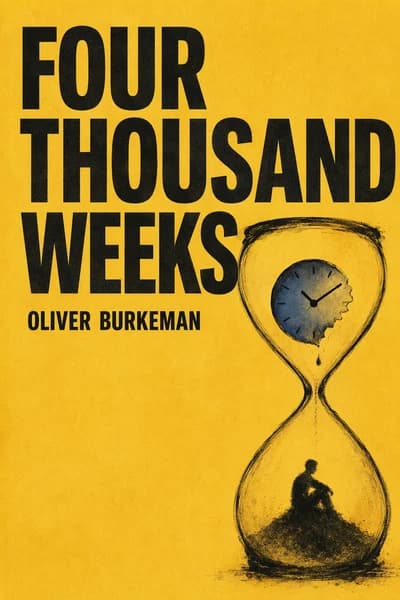
Four thousand weeks. That's all we get if we're lucky enough to live to 80. Oliver Burkeman's revolutionary book has become a quiet phenomenon, spreading through word-of-mouth recommendations from Silicon Valley executives to mindfulness practitioners. Even celebrities like Emma Watson and Brene Brown have praised its perspective-shifting insights. What makes this book so special? It's not just another productivity manual-it's an anti-productivity manifesto that has resonated deeply in our burnout culture. In a world obsessed with time management and efficiency, Burkeman offers a radical alternative: what if the solution isn't to squeeze more into our limited time, but to finally confront the uncomfortable truth of our finitude? This book invites us to stop running from our mortality and instead use it as the very foundation for a more meaningful existence. The question isn't how to get everything done-it's how to accept we never will.
2장
The Conveyor Belt of Modern Life
We live on a kind of conveyor belt, constantly trying to stay ahead of an endless stream of tasks and obligations. The modern world has transformed us into productivity machines, yet we feel more time-poor than ever. Consider this startling reality: despite all our time-saving technologies, surveys consistently show that people feel more rushed today than in decades past. The wealthier and more privileged we become, the more acute our time poverty feels.
Why does this happen? Because when we save time in one area, we don't actually save it at all-we fill it with more demands. Email makes communication instantaneous, but now we're expected to respond immediately. Washing machines freed us from manual laundry, but now we wash clothes far more frequently than our grandparents ever did. Each efficiency improvement doesn't liberate time-it accelerates the pace of life.
This creates what I call the efficiency trap: the more efficiently you work, the more work materializes to fill your newly available time. It's like trying to empty the ocean with a bucket-the water never stops coming. Productivity systems and time management techniques might temporarily relieve the pressure, but they ultimately reinforce the delusion that with just the right approach, you could finally get on top of everything.
Remember Sisyphus from Greek mythology? Condemned to roll a boulder up a hill, only to watch it roll back down, repeating for eternity. Our inboxes, to-do lists, and social media feeds function the same way-they're designed to be infinite. The moment you clear your email, more arrives. The moment you check off tasks, more get added. The conveyor belt never stops; it only accelerates.
This creates a painful paradox: we frantically try to get things done to feel at peace, but the very franticness prevents the peace we seek. We're caught in what philosopher Martin Heidegger called the "constant not-yet"-always looking forward to some future moment when everything will finally be under control, a moment that never arrives.
3장
The Invention of Time Pressure
Time wasn't always experienced this way. For most of human history, people lived according to what sociologists call "task orientation"-you did what needed doing when it needed doing. You harvested when crops were ready, not when the calendar said so. You slept when tired, ate when hungry. The concept of being "on time" or "running late" simply didn't exist.
Everything changed with the industrial revolution and the invention of mechanical clocks. Suddenly, time became something external to human experience-objective, measurable, and most importantly, something that could be commodified. Factory owners needed workers to arrive at specific times, regardless of whether they felt ready to work. Time became money, and wasting time became a moral failing.
This shift fundamentally altered our relationship with time. We started seeing time as a resource to be used rather than life to be lived. The clock transformed time from something we inhabit into something we feel we should control. We began to believe that with proper management, we could master time itself.
The digital age has only intensified this pressure. Our devices constantly remind us of time's passage. Notifications interrupt our focus, emails demand immediate responses, and social media feeds never end. We're perpetually connected to work, erasing boundaries between professional and personal time. The result is a chronic sense of time anxiety-the nagging feeling that you're never doing enough with your limited hours, that life is slipping through your fingers.
This anxiety isn't just psychological-it manifests physically. Studies show that perceived time pressure correlates with elevated stress hormones, increased blood pressure, and compromised immune function. The constant rush literally makes us sick. Yet we've normalized this state, even glorified it. Being "crazy busy" has become a status symbol, a way of signaling importance in a culture that equates busyness with worth.
4장
The Impossible Project of Total Control
At the heart of our time struggles lies what philosophers call the "paradox of limitation"-the fact that any choice to do something is simultaneously a choice not to do countless other things. We hate this truth. We want to be unlimited, to experience everything, to keep all possibilities open. But time forces us to choose, to close doors, to accept that we cannot do it all.
This creates an uncomfortable tension. We try to escape the anxiety of limitation through various strategies-multitasking, speed-reading, efficiency hacks-but these only reinforce the underlying problem: our refusal to accept finitude. We believe that with just the right system or enough determination, we could somehow transcend human limitations. But this is an impossible project.
Consider how we approach our to-do lists and goals. We create bucket lists with hundreds of destinations, career ambitions spanning multiple industries, and reading lists that would take several lifetimes to complete. We treat these as projects to be "finished," not understanding that they're actually infinite. For every book you read, ten more get published that you "should" read. For every skill you master, dozens more become relevant.
The productivity industry exploits this anxiety, promising that with just the right morning routine or note-taking system, you'll finally conquer the chaos. But these approaches miss the fundamental truth: the problem isn't that you're doing productivity wrong. The problem is that productivity is impossible as an all-encompassing life goal.
What makes this especially painful is that we're surrounded by messages suggesting unlimited possibility. "You can be anything you want!" "Don't settle!" "Follow all your dreams!" These seemingly inspirational messages actually create profound distress by denying the basic reality of human limitation. They set us up for inevitable disappointment when we discover we can't, in fact, do everything.
5장
Embracing Your Finitude
What's the alternative to this exhausting pursuit of total control? It begins with a radical acceptance of finitude-the recognition that your time is limited and that this limitation isn't something to overcome but the very condition that makes your choices meaningful.
When you truly internalize that you have just four thousand weeks (if you're lucky), something shifts. The question changes from "How can I get everything done?" to "What's actually worth doing with my limited time?" This isn't depressing-it's liberating. It gives you permission to stop trying to do everything and instead focus on what matters most.
This acceptance leads to what I call "strategic underachievement"-deliberately failing at less important tasks to succeed at the truly important ones. It means accepting that your email inbox will never be empty, your house never perfectly clean, your knowledge never complete. These aren't failures; they're the necessary consequences of choosing to focus your finite time on what truly matters.
Consider Warren Buffett's famous advice to his pilot. When asked about career success, Buffett instructed him to list his top 25 goals, then circle the five most important. The pilot assumed he should focus on the top five while working on the others when he had time. "No," Buffett corrected him. "Everything you didn't circle just became your avoid-at-all-costs list." This is strategic underachievement in action-recognizing that saying yes to your most important priorities requires saying no to many good but less important options.
Embracing finitude also means accepting that you'll never "catch up" with all your obligations and interests. There will always be unread books, unwatched films, unvisited places. Rather than seeing this as a source of anxiety, you can view it as a testament to the world's wonderful abundance. The goal isn't to experience everything-an impossible task-but to be fully present for the experiences you do choose.
6장
The Art of Better Procrastination
We typically think of procrastination as a problem to overcome. But what if it's actually an inevitable consequence of having finite time? Since you can't do everything, you're always procrastinating on something. The question isn't whether you'll procrastinate, but what you'll procrastinate on.
Most of us procrastinate badly-we delay important but challenging work in favor of easy, urgent tasks. We clean our desks instead of writing that difficult email. We check social media instead of starting that important project. We respond to minor emails while neglecting deep relationships. This is procrastination at its worst.
Better procrastination means deliberately deciding what to neglect. It means accepting that your inbox might overflow because you're focusing on deep work. It means letting the laundry pile up because you're spending quality time with your children. It means postponing certain goals indefinitely because they don't align with your deepest values.
This approach requires courage. It's easier to pretend you'll eventually get to everything than to make the hard choices about what deserves your limited attention. But these choices are happening whether you acknowledge them or not. Better to make them consciously than to let them happen by default.
Better procrastination also means abandoning the fantasy of the perfect moment. Many of us delay important projects until conditions seem ideal-when we have more time, more knowledge, more confidence. But this perfect moment rarely arrives. The most meaningful work often happens in imperfect circumstances, in the messy middle of life. As the writer Annie Dillard puts it: "How we spend our days is, of course, how we spend our lives."
7장
The Watermelon Problem: Distraction as Existential Avoidance
Why do we find it so hard to focus on what truly matters? It's not just about willpower or digital distraction. There's something deeper at work-what I call the "Watermelon Problem," named after an old joke about a man who goes to the doctor complaining that it hurts when he presses his arm. The doctor's diagnosis: "Your arm is fine. Your finger is broken."
Similarly, we think our problem is distraction, but the real issue lies in what we're trying to avoid. Distraction isn't just an annoyance; it's a strategy for avoiding the discomfort of confronting what matters most. The most important things in life-creative work, intimate relationships, personal growth-inevitably involve difficulty, uncertainty, and the possibility of failure. Checking email or scrolling social media provides immediate relief from these uncomfortable feelings.
Consider the writer who constantly checks Twitter instead of facing the blank page. The problem isn't Twitter; it's the anxiety of creative work. Or the parent who stays late at the office rather than facing the messy, demanding reality of family dinner. The problem isn't overwork; it's the challenge of intimate relationships.
Our devices make this avoidance easier than ever. They offer an infinite supply of mild but immediate rewards-likes, updates, messages-that help us avoid the discomfort of focusing on what matters most. They're not just distracting; they're specifically designed to exploit our vulnerability to distraction.
This understanding changes how we approach distraction. Rather than simply trying to resist it through willpower or productivity techniques, we need to develop a higher tolerance for the discomfort that comes with doing important things. We need to recognize that feeling anxious or uncertain when facing meaningful work isn't a sign something's wrong-it's a sign you're in territory that matters.
The solution isn't to eliminate all distraction (an impossible goal) but to build a healthier relationship with difficulty. This means learning to stay with uncomfortable feelings rather than immediately seeking relief. It means recognizing that meaningful accomplishment requires passing through periods of uncertainty and struggle. And it means understanding that distraction will always be tempting precisely because important work is hard.
8장
We Never Really Have Time
One of our most persistent illusions is that we "have" time-that time is a resource we possess and control. But this framing fundamentally misunderstands the nature of time and our relationship to it. We never "have" time; we are in time. Time isn't something external to our existence that we can manipulate; it's the medium of our existence itself.
This distinction matters because it changes how we approach our lives. When we think we "have" time, we treat it as a commodity to be optimized and controlled. We try to "make time" for important things, as if time were clay we could mold to our purposes. But time moves at its own pace, regardless of our preferences. The sun rises and sets, children grow up, bodies age-all according to rhythms we didn't create and can't control.
Ancient cultures understood this better than we do. The Greeks had two words for time: chronos (clock time, which passes regardless of what happens within it) and kairos (the opportune moment, when conditions are right for a particular action). Modern life fixates on chronos while neglecting kairos-we obsess over measuring time while missing the moments that matter.
This perspective shift-from having time to being in time-leads to a different approach to life. Instead of trying to control time, we can learn to work with it. Instead of fighting against limitations, we can use them as creative constraints. Instead of trying to "find time" for what matters, we can recognize that the present moment is all we ever have, and choose to fill it with what's most important.
This doesn't mean abandoning all planning or surrendering to pure spontaneity. It means planning with a humble awareness of your lack of control. Make schedules, set goals, create routines-but hold them lightly, knowing that life will inevitably disrupt them in ways you can't foresee. The point isn't to eliminate structure but to create structures that acknowledge reality rather than denying it.
9장
The Cosmic Insignificance Therapy
One of the most liberating perspectives on time comes from what I call "Cosmic Insignificance Therapy"-the recognition that in the grand scheme of the universe, nothing you do matters very much at all. The earth is a tiny speck in an incomprehensibly vast cosmos. Human civilization is a brief flash in the long history of this planet. And your individual life is an even smaller moment within that flash.
This might sound depressing, but it's actually profoundly freeing. When you realize that the universe is indifferent to your achievements and failures, you're released from the crushing pressure to make your life "count" on some cosmic scale. You don't need to justify your existence through extraordinary accomplishments. You don't need to leave a lasting legacy. You're free to live your life for its own sake, not as a means to some greater end.
This perspective doesn't diminish the importance of your choices-it actually enhances it. If the meaning of your life isn't dictated by some external cosmic purpose, then you get to create meaning through how you choose to spend your limited time. Your choices matter enormously to you and to those around you, even if they don't matter to the universe as a whole.
Cosmic Insignificance Therapy helps resolve the paradox at the heart of our relationship with time: we feel simultaneously that life is too short and that it's intolerably long. When we're caught up in anxious productivity, racing to accomplish everything, life seems impossibly brief. But when we're bored or suffering, minutes can stretch into what feels like eternity. Both perspectives miss something essential-that life is neither short nor long but limited. And limitations aren't flaws to be overcome but the boundaries that give shape and meaning to existence.
10장
Rediscovering Rest and Presence
In our hyperactive culture, genuine rest has become almost impossible. We've forgotten how to simply be without doing, producing, or consuming. Even our leisure activities have become goal-oriented-we exercise to burn calories, read to improve ourselves, travel to collect experiences. We've lost the capacity for what philosopher Josef Pieper called "leisure"-not mere relaxation but a receptive, contemplative attitude toward the world.
True leisure isn't about escaping work but about engaging with reality in a different way. It's about being fully present rather than constantly striving toward future goals. It's about appreciating things for their own sake, not for what they help you achieve. This kind of presence has become increasingly rare in a world designed to capture and monetize our attention.
Consider how we experience nature. Many of us rush through hikes, checking landmarks off a list rather than truly experiencing the landscape. We take photos to document the experience rather than fully inhabiting it. We might climb a mountain not for the climb itself but to say we've done it. This instrumental approach drains experiences of their inherent value, turning them into mere means to other ends.
The alternative is what Zen practitioners call "beginner's mind"-approaching experiences with curiosity and attention rather than habitual judgment. It's about noticing the texture of everyday moments: the sensation of water on your skin in the shower, the complex flavors in a simple meal, the feeling of connection in a conversation with a friend. These aren't distractions from your "real life"; they are your real life.
This kind of presence isn't about adding another task to your to-do list ("practice mindfulness for 10 minutes daily"). It's about a fundamental shift in how you relate to time-from seeing it as something to use efficiently to seeing it as something to experience fully. It's about recognizing that your life consists only of moments, and that how you attend to those moments is how you attend to your life.
11장
The Patience Revolution
In a world of instant gratification, patience has become a radical act. We've lost the capacity to wait-for responses to messages, for websites to load, for skills to develop, for relationships to deepen. Studies show that people abandon websites that take more than a few seconds to load. We expect immediate results from exercise programs and immediate responses to texts. This impatience doesn't just make us frustrated; it fundamentally limits what we can experience and achieve.
The most valuable things in life require patience. Creative breakthroughs come after periods of apparent stagnation. Deep relationships develop through years of commitment. Mastery in any field requires thousands of hours of practice. By constantly seeking immediate rewards, we cut ourselves off from these deeper satisfactions.
The Finnish bus station theory, developed by photographer Arno Rafael Minkkinen, beautifully illustrates this principle. If you're at Helsinki's central bus station, you'll find several platforms with buses going in the same direction for the first few miles. If you get impatient and keep switching buses, trying to find a faster route, you'll never get far from the station. But if you stay on one bus, eventually it will take you to unique territory.
The same applies to creative work, relationships, and personal growth. The initial stages often feel unoriginal or unrewarding. It's only by persisting through this phase-by "staying on the bus"-that you reach territory that's uniquely yours. But this requires tolerating the discomfort of not seeing immediate results, of wondering whether you're on the right path at all.
Patience isn't passive waiting; it's active engagement with the reality of time. It's about aligning your expectations with how things actually unfold rather than demanding that the world conform to your preferred timeline. It's recognizing that some processes simply can't be rushed-seeds grow at their own pace, wounds heal according to their own schedule, and understanding deepens through its own natural rhythm.
12장
Community and Synchronicity
We've been exploring how time shapes individual experience, but time also fundamentally structures our relationships with others. Modern life has given us unprecedented freedom to organize our time as we choose, but this freedom comes at a cost-the loss of what sociologists call "social synchronization," the shared rhythms that once bound communities together.
In earlier times, communities operated according to common schedules dictated by natural cycles, religious observances, and practical necessities. Everyone harvested at the same time, observed the same holidays, gathered at the same markets. These shared temporal structures created natural opportunities for connection and belonging.
Today, we pride ourselves on personalized schedules optimized for individual productivity. We work, eat, sleep, and socialize according to personal preference rather than communal rhythm. This temporal flexibility seems liberating, but it often leaves us isolated, coordinating brief meetings with friends weeks in advance rather than naturally flowing through life together.
The digital nomad lifestyle represents this individualistic approach to time at its extreme. Location-independent workers can live anywhere, set their own hours, and avoid commitments that might limit their freedom. Yet studies consistently show that this radical autonomy often leads to loneliness and disconnection. Without the friction of shared schedules and geographic limitations, relationships become optional rather than inevitable parts of daily life.
The alternative isn't returning to rigid traditional structures but finding ways to create meaningful synchronicity in modern life. This might mean establishing regular rituals with friends or family-weekly dinners, monthly gatherings, annual traditions. It might mean participating in community events that bring people together in shared experience. It might even mean embracing certain constraints on your freedom for the sake of deeper connection.
Synchronicity matters because humans are fundamentally social creatures. We find meaning not just in individual achievement but in belonging to something larger than ourselves. The experience of "collective effervescence"-the special energy that emerges when people come together in shared activity-provides a kind of fulfillment that solitary productivity never can.
13장
Living a Life That's Truly Yours
After exploring all these perspectives on time and finitude, we arrive at the most important question: How do you want to spend your four thousand weeks? Not according to productivity gurus, social media influencers, or cultural expectations, but according to what truly matters to you.
This question is deceptively difficult. We're so immersed in messages about what we should want-success, wealth, influence, excitement-that we often lose touch with our authentic desires. We pursue goals that promise happiness without questioning whether they align with our deepest values. We follow paths that impress others without asking if they fulfill us.
Finding your own path requires what philosopher Martin Heidegger called "authenticity"-the courage to live according to your own sense of what matters rather than absorbing your priorities from others. This doesn't mean ignoring social responsibilities or pursuing pure self-interest. It means thoughtfully choosing which obligations to embrace rather than automatically accepting whatever demands society places on you.
Ask yourself: If you knew you had exactly four thousand weeks to live (which you do), what would you do differently? Which relationships would you prioritize? What work would feel worth your limited time? What experiences would you seek out? What would you stop doing altogether?
These questions have no universal answers. What constitutes a well-spent life varies enormously from person to person. The point isn't to find the "right" answers but to ensure that your choices reflect your values rather than unconscious conformity or fear.
This approach to life-accepting finitude, embracing limits, focusing on what truly matters-won't eliminate all struggle or guarantee happiness. You'll still face difficult choices, painful trade-offs, and periods of doubt. But it offers something more valuable than perpetual happiness: a life that feels like your own, spent on what truly matters to you, with a clear-eyed acceptance of its brevity and preciousness.
In the end, a meaningful life isn't about getting everything done or experiencing everything possible. It's about being fully present for the finite number of moments you have, choosing them wisely, and embracing them completely-with all their imperfection, uncertainty, and transience. Because these four thousand weeks aren't just counting down to something else. They are your life itself.