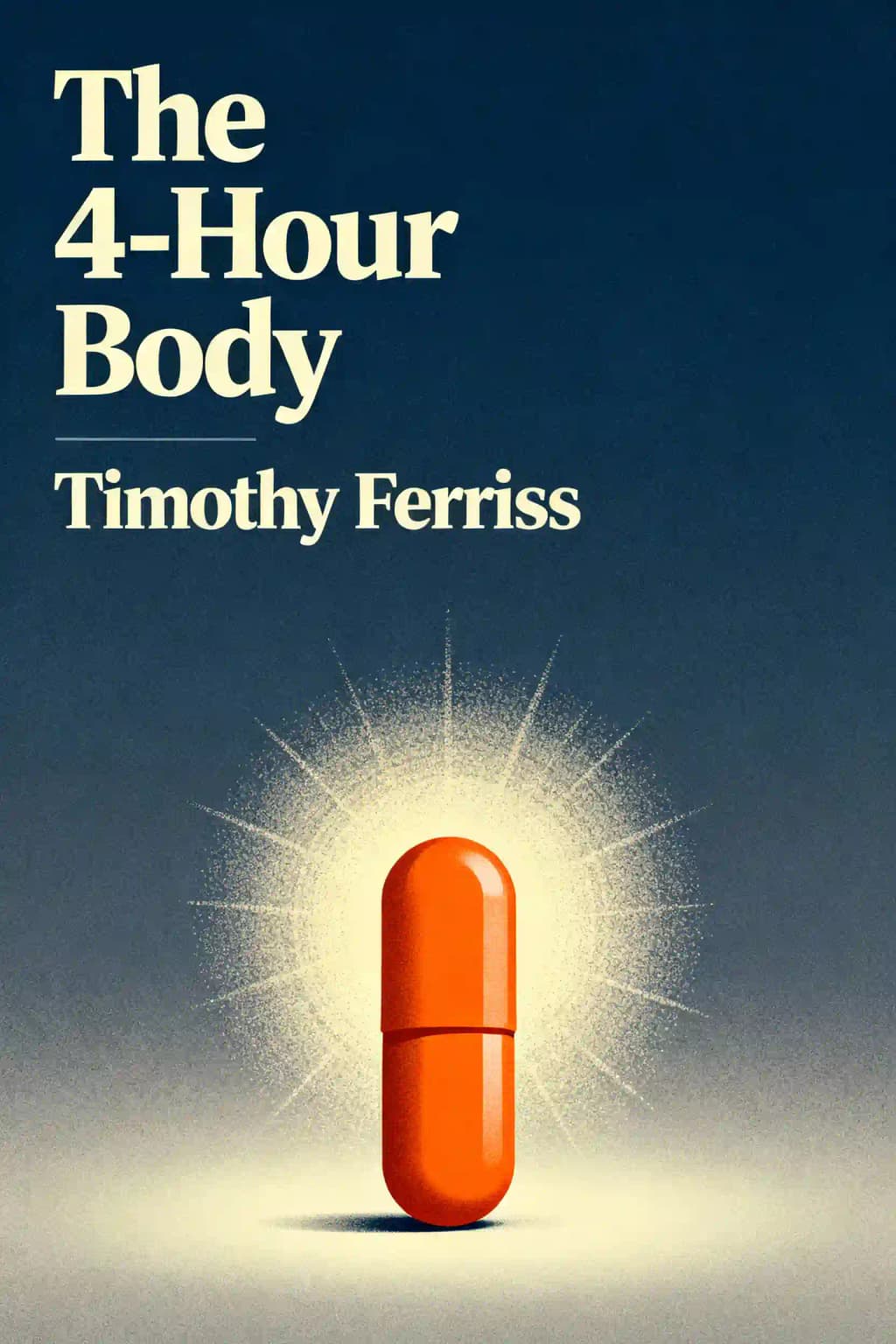
4-Hour Body
An Uncommon Guide to Rapid Fat-Loss, Incredible Sex and Becoming Superhuman
4-Hour Body 개요
Transform your body with Tim Ferriss's revolutionary approach to rapid fat-loss and peak performance. This #1 New York Times bestseller sparked controversy by challenging conventional wisdom - even a 73-year-old lost 25 pounds in six weeks following its unconventional "slow-carb" method.

4-Hour Body의 핵심 주제
- minimum effective dose
- slow-carb diet
- human self-experimentation
- behavioral psychology hacks
- biological data tracking
4-Hour Body의 명언
What we fear doing most is usually what we most need to do.
One can steal ideas, but no one can steal execution or passion.
Everything popular is wrong.
Scientists focus on calories because they're easy to measure, but they're the least important piece of the puzzle.
To say that something has a genetic component does not make it unchangeable.
4-Hour Body의 등장인물
- Timothy FerrissAuthor and self-proclaimed human guinea pig
- Chad FowlerCase study who experienced the Harajuku Moment
- Eric LanderHuman Genome Project expert on genetic potential
- Dr. B.J. FoggStanford researcher on behavioral change
- Michael LevinAuthor used as a case study for small goals
저자 소개
4-Hour Body의 저자 소개
Timothy Ferriss, bestselling author of The 4-Hour Body, is a leading voice in self-optimization and lifestyle design. Known for blending scientific experimentation with unconventional strategies, Ferriss explores rapid fat-loss, muscle gain, and peak performance in this health and fitness manifesto. A Princeton University lecturer and serial entrepreneur, he draws from his background as a guinea-pig experimenter—gaining 34 pounds of muscle in 28 days and testing sleep-hacking techniques—to challenge conventional wellness wisdom.
Ferriss rose to prominence with The 4-Hour Workweek, a global phenomenon translated into 35 languages that redefined productivity culture. His work extends to the The Tim Ferriss Show, one of history’s most-downloaded podcasts, where he deconstructs peak performers’ habits. As an early investor in Uber, Shopify, and Duolingo, Ferriss bridges Silicon Valley innovation with personal transformation frameworks.
The 4-Hour series—including The 4-Hour Chef and Tools of Titans—has collectively sold millions of copies, establishing Ferriss as a pioneer in biohacking and evidence-based life design. The 4-Hour Body remains a cult classic among athletes, CEOs, and anyone seeking to maximize physical potential through minimum effective dose principles.
4-Hour Body 요약 다운로드
4-Hour Body 요약을 무료 PDF 또는 EPUB으로 받으세요. 인쇄하거나 오프라인에서 언제든 읽을 수 있습니다.
이 책에 대한 FAQ
The 4-Hour Body offers unconventional strategies for rapid fat loss, muscle gain, and health optimization using minimal effort. Tim Ferriss combines self-experimentation, athlete insights, and medical research to explore diet hacks, sleep optimization, injury recovery, and sexual health. The book emphasizes "minimum effective dose" principles for fast, measurable results, making it a guide for redefining physical limits.
This book suits biohackers, fitness enthusiasts, and anyone seeking actionable shortcuts to improve body composition or health. It’s ideal for readers open to experimenting with unconventional methods, such as specific food combinations, brief workouts, or sleep adjustments. Ferriss advises treating it as a reference manual rather than a cover-to-cover read.
Yes, for its pragmatic, results-driven approach. While some criticize its reliance on anecdotal evidence, the book provides actionable steps for fat loss, muscle gain, and performance enhancement. Readers praise its focus on measurable outcomes and real-world testing, though individual results may vary.
The MED is the smallest effort needed to trigger a desired outcome, like 15 minutes of sun exposure for vitamin D. Ferriss applies this to fat loss (e.g., specific dietary tweaks) and muscle growth (targeted exercises). Overcomplicating routines undermines progress, so the MED prioritizes efficiency over intensity.
A Harajuku Moment is an emotional catalyst that turns a goal into a non-negotiable priority. It originates from Chad Fowler’s realization while shopping in Tokyo: his weight made clothing irrelevant. Ferriss argues such moments are essential for lasting change, as they replace vague intentions with urgent action.
Ferriss advocates “slow-carb” diets (avoiding white carbs, eating protein-rich meals) and strategic calorie cycling. He also details “cold exposure” and safe supplements to boost metabolism. The focus is on sustainable habits, like weekly cheat days, to prevent burnout while achieving rapid results.
- Kettlebell swings for full-body conditioning in 10 minutes.
- Occam’s Protocol: Low-rep, high-rest weightlifting to maximize muscle growth.
- Myoelectric gadgets to stimulate muscle activity passively.
These methods aim to reduce time investment while increasing efficiency.
Ferriss recommends polyphasic sleep (2-hour core naps + 20-minute breaks) and using ice baths or magnesium supplements to deepen rest. He also advises tracking sleep phases with wearables to optimize recovery without increasing total sleep time.
Critics argue some methods lack peer-reviewed validation or may be unsustainable long-term (e.g., extreme calorie restriction). Others note the book’s fragmented structure. However, supporters highlight its actionable advice and success stories from Ferriss’s 200+ test subjects.
Unlike generic plans, Ferriss focuses on individualized experimentation, rapid results, and quantifying progress. While traditional guides emphasize gradual lifestyle changes, The 4-Hour Body prioritizes “hacks” like targeted supplements, precise meal timing, and data tracking.
Yes. Ferriss details techniques like Active Release Therapy (ART) for tendon issues and eccentric exercises for knee pain. He also explores cryotherapy and collagen supplements to accelerate healing, drawing from athlete protocols and clinical studies.
Self-experimentation is central—Ferriss encourages readers to test methods (e.g., diet tweaks, sleep hacks) and track outcomes via blood tests or body measurements. This “lab rat” approach helps identify personalized solutions rather than relying on one-size-fits-all advice.