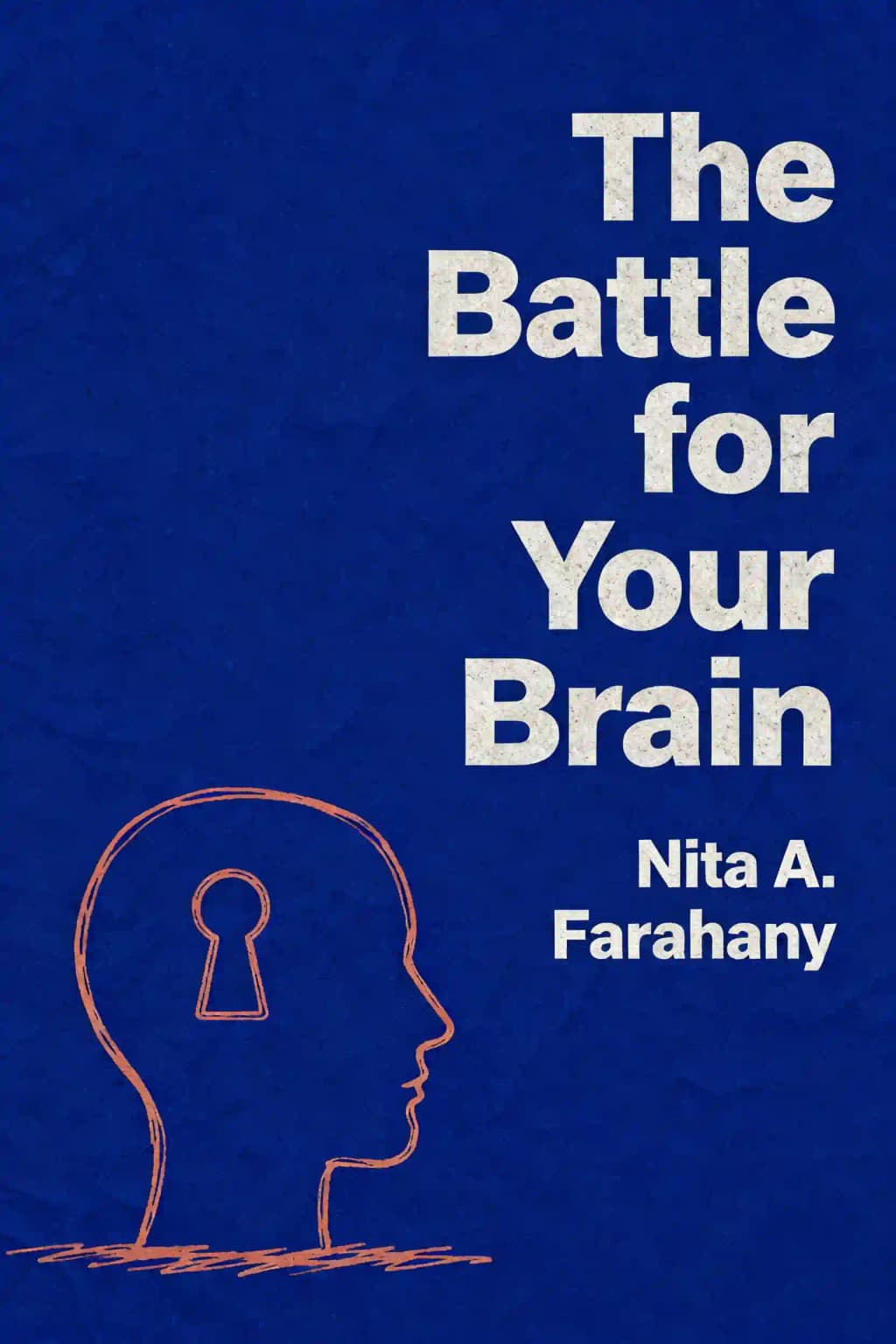
Battle for Your Brain: Defending the Right to Think Freely in the Age of Neurotechnology book cover

Battle for Your Brain

Defending the Right to Think Freely in the Age of Neurotechnology

Nita A. Farahany
3.83 (779 Reviews)

Overview of Battle for Your Brain

In "The Battle for Your Brain," Farahany warns how neurotechnology threatens our cognitive liberty. What happens when employers can monitor your thoughts? This 2023 "superb introduction" to neuroethics explores the urgent fight for your mental privacy in a world of brain-reading tech.

Key Themes in Battle for Your Brain

  • cognitive liberty
  • neurotechnology ethics
  • brain data privacy
  • workplace neural surveillance
  • brain-computer interface regulation

Quotes from Battle for Your Brain

  • Our brains-the last fortress of privacy-are about to be breached.

  • No wearable, no job.

  • Employees fear employer access to their brain data more than any other entity.

  • Employees "don't stand a chance."

  • The dignity of workers and the future of work itself are at risk.

Characters in Battle for Your Brain

  • Nita A. FarahanyAuthor, neuroscientist, and legal scholar
  • Patrick Chung23andMe board member
  • Kerry CuthbertLong-haul trucker and case study in surveillance
  • Stacy MitchellExpert at the Institute for Local Self-Reliance

About the Author

About the Author of Battle for Your Brain

Nita A. Farahany, author of The Battle for Your Brain: Defending Your Right to Think Freely in the Age of Neurotechnology, is a world-renowned neuroethics scholar and the Robinson O. Everett Distinguished Professor of Law & Philosophy at Duke University. As founding director of Duke’s Initiative for Science & Society, her work bridges cutting-edge neuroscience, ethics, and policy. A former presidential bioethics advisor under Barack Obama, Farahany has shaped global standards as U.S. delegate to UNESCO’s Neuroethics Committee and co-chair of the World Economic Forum’s Neurotechnology Council.

Her book—a clarion call for cognitive liberty—draws on decades of research into brain-tracking technologies and their societal risks. Farahany’s insights have reached millions through TED Talks, NPR, The New York Times, and keynotes at Davos and South by Southwest. A Harvard-trained biologist and Duke-educated philosopher-lawyer, she translates complex neurotech debates into urgent policy agendas.

The Battle for Your Brain has sparked international dialogue, informing legislation on mental privacy and establishing Farahany as a defining voice in 21st-century human rights discourse.

Download Summary of Battle for Your Brain

Get the Battle for Your Brain summary as a free PDF or EPUB. Print it or read offline anytime.

FAQs About This Book

The Battle for Your Brain explores the ethical and societal implications of emerging neurotechnologies, examining how brain-tracking tools and cognitive interventions threaten mental privacy, freedom of thought, and self-determination. Nita A. Farahany, a leading expert in law and ethics, argues for establishing legal safeguards like "cognitive liberty" to protect individuals from neural surveillance and manipulation while balancing technological benefits like epilepsy prediction and addiction treatment.

This book is essential for readers interested in neuroscience, digital privacy, or bioethics, including policymakers, tech professionals, and educators. It offers critical insights for anyone concerned about how governments, corporations, or militaries might exploit neurotechnology to monitor or influence thoughts, emotions, and behaviors.

Yes—Farahany combines rigorous research with accessible storytelling to map both the promises (e.g., memory enhancement) and perils (e.g., thoughtcrime prosecutions) of neurotechnology. Its actionable framework for ethical guidelines makes it a vital resource for navigating the coming "neurorevolution".

Cognitive liberty is defined as the right to self-determination over one’s mental experiences. Farahany argues this includes informational self-access (understanding your neural data) and freedom from interference (protection against unauthorized brain monitoring or manipulation). She positions it as a necessary update to human rights in the digital age.

Devices like consumer EEG headsets and workplace neural monitors can extract emotional states, political beliefs, or subconscious biases. Farahany warns that unchecked, these tools might enable employers to screen hires based on brain activity or governments to prosecute "pre-crime" thoughts, eroding free will.

The book advocates four principles for neurotech use:

  • Transparency: Users must know when their brains are being monitored.
  • Symmetry: Individuals retain control to resist neural interventions.
  • Freedom: Opt-out options for neurotech applications.
  • Benevolence: Technologies must avoid intentional harm.

Farahany highlights risks like AI-driven "neuro-cinema" that adapts films to manipulate viewers’ emotions or social media algorithms bypassing conscious decisions. She urges regulations to prevent tech giants from weaponizing neural data for profit or control.

Current applications include:

  • Health: Seizure prediction systems for epilepsy patients.
  • Consumer tech: Emotion-detecting headphones and focus-enhancing wearables.
  • Military: DARPA projects to accelerate soldiers’ cognitive processing.

As a Presidential Bioethics Commission appointee and Duke University law professor, Farahany leverages 15+ years of work on neuro rights. Her interdisciplinary expertise (genetics, philosophy, law) grounds the book’s analysis of technical feasibility and policy gaps.

Some reviewers note the book prioritizes dystopian scenarios over quantifying current risks. Others highlight unresolved tensions, like allowing therapeutic neural enhancements while banning cognitive "doping" in workplaces.

Unlike technical primers (e.g., Neuroethics by Martha Farah), Farahany’s work focuses on actionable policy solutions, making it a natural companion to Yuval Noah Harari’s discussions of data colonialism in 21 Lessons for the 21st Century.

With AI accelerating neurotech adoption in healthcare, education, and surveillance, Farahany’s warnings about cognitive warfare and mental autonomy resonate amid debates about ChatGPT’s neural interfaces and Meta’s brain-compatibility projects.

Explore Your Way of Learning

Battle for Your Brain isn't just a book — it's a masterclass in Science. To help you absorb its lessons in the way that works best for you, we offer five unique learning modes. Whether you're a deep thinker, a fast learner, or a story lover, there's a mode designed to fit your style.

Quick Summary Mode

Read or listen to Battle for Your Brain Summary in 12 Minutes

Break down key ideas from Battle for Your Brain into bite-sized takeaways to understand how innovative teams create, collaborate, and grow.

play
00:00
00:00

Fun Mode

Battle for Your Brain Lessons Told Through 24-Min Stories

Experience Battle for Your Brain through vivid storytelling that turns innovation lessons into moments you'll remember and apply.

play
00:00
00:00

Personalize Mode

Experience Battle for Your Brain in your own learning style

Ask anything, choose your learning style, and co-create insights that truly resonate with you.

Personalize Mode

From Columbia University alumni built in San Francisco

BeFreed Brings Together A Global Community Of 1,000,000 Curious Minds

"Instead of endless scrolling, I just hit play on BeFreed. It saves me so much time."

@Moemenn
platform
star
star
star
star
star

"I never knew where to start with nonfiction—BeFreed’s book lists turned into podcasts gave me a clear path."

@Chloe, Solo founder, LA
platform
comments
12
likes
117

"Perfect balance between learning and entertainment. Finished ‘Thinking, Fast and Slow’ on my commute this week."

@Raaaaaachelw
platform
star
star
star
star
star

"Crazy how much I learned while walking the dog. BeFreed = small habits → big gains."

@Matt, YC alum
platform
comments
12
likes
108

"Reading used to feel like a chore. Now it’s just part of my lifestyle."

@Erin, Investment Banking Associate , NYC
platform
comments
254
likes
17

"Feels effortless compared to reading. I’ve finished 6 books this month already."

@djmikemoore
platform
star
star
star
star
star

"BeFreed turned my guilty doomscrolling into something that feels productive and inspiring."

@Pitiful
platform
comments
96
likes
4.5K

"BeFreed turned my commute into learning time. 20-min podcasts are perfect for finishing books I never had time for."

@SofiaP
platform
star
star
star
star
star

"BeFreed replaced my podcast queue. Imagine Spotify for books — that’s it. 🙌"

@Jaded_Falcon
platform
comments
201
thumbsUp
16

"It is great for me to learn something from the book without reading it."

@OojasSalunke
platform
star
star
star
star
star

"The themed book list podcasts help me connect ideas across authors—like a guided audio journey."

@Leo, Law Student, UPenn
platform
comments
37
likes
483

"Makes me feel smarter every time before going to work"

@Cashflowbubu
platform
star
star
star
star
star

"Instead of endless scrolling, I just hit play on BeFreed. It saves me so much time."

@Moemenn
platform
star
star
star
star
star

"I never knew where to start with nonfiction—BeFreed’s book lists turned into podcasts gave me a clear path."

@Chloe, Solo founder, LA
platform
comments
12
likes
117

"Perfect balance between learning and entertainment. Finished ‘Thinking, Fast and Slow’ on my commute this week."

@Raaaaaachelw
platform
star
star
star
star
star

"Crazy how much I learned while walking the dog. BeFreed = small habits → big gains."

@Matt, YC alum
platform
comments
12
likes
108

"Reading used to feel like a chore. Now it’s just part of my lifestyle."

@Erin, Investment Banking Associate , NYC
platform
comments
254
likes
17

"Feels effortless compared to reading. I’ve finished 6 books this month already."

@djmikemoore
platform
star
star
star
star
star

"BeFreed turned my guilty doomscrolling into something that feels productive and inspiring."

@Pitiful
platform
comments
96
likes
4.5K

"BeFreed turned my commute into learning time. 20-min podcasts are perfect for finishing books I never had time for."

@SofiaP
platform
star
star
star
star
star

"BeFreed replaced my podcast queue. Imagine Spotify for books — that’s it. 🙌"

@Jaded_Falcon
platform
comments
201
thumbsUp
16

"It is great for me to learn something from the book without reading it."

@OojasSalunke
platform
star
star
star
star
star

"The themed book list podcasts help me connect ideas across authors—like a guided audio journey."

@Leo, Law Student, UPenn
platform
comments
37
likes
483

"Makes me feel smarter every time before going to work"

@Cashflowbubu
platform
star
star
star
star
star

"Instead of endless scrolling, I just hit play on BeFreed. It saves me so much time."

@Moemenn
platform
star
star
star
star
star

"I never knew where to start with nonfiction—BeFreed’s book lists turned into podcasts gave me a clear path."

@Chloe, Solo founder, LA
platform
comments
12
likes
117

"Perfect balance between learning and entertainment. Finished ‘Thinking, Fast and Slow’ on my commute this week."

@Raaaaaachelw
platform
star
star
star
star
star

"Crazy how much I learned while walking the dog. BeFreed = small habits → big gains."

@Matt, YC alum
platform
comments
12
likes
108

"Reading used to feel like a chore. Now it’s just part of my lifestyle."

@Erin, Investment Banking Associate , NYC
platform
comments
254
likes
17

"Feels effortless compared to reading. I’ve finished 6 books this month already."

@djmikemoore
platform
star
star
star
star
star

"BeFreed turned my guilty doomscrolling into something that feels productive and inspiring."

@Pitiful
platform
comments
96
likes
4.5K

"BeFreed turned my commute into learning time. 20-min podcasts are perfect for finishing books I never had time for."

@SofiaP
platform
star
star
star
star
star

"BeFreed replaced my podcast queue. Imagine Spotify for books — that’s it. 🙌"

@Jaded_Falcon
platform
comments
201
thumbsUp
16

"It is great for me to learn something from the book without reading it."

@OojasSalunke
platform
star
star
star
star
star

"The themed book list podcasts help me connect ideas across authors—like a guided audio journey."

@Leo, Law Student, UPenn
platform
comments
37
likes
483

"Makes me feel smarter every time before going to work"

@Cashflowbubu
platform
star
star
star
star
star

See More Stories?

How people are talking about BeFreed across the web
1.5K Ratings4.7
Start your learning journey, now