1장
The Paradox of Hope in a World That Seems Broken
When Witold Pilecki voluntarily entered Auschwitz in 1940, he embarked on what might be the most courageous mission in human history. This Polish resistance fighter deliberately got himself arrested by Nazi soldiers to gather intelligence about the death camp from within. Over the next two and a half years, he built an entire resistance network, constructed a radio from spare parts, and became the first person to alert the world about the Holocaust. Despite his desperate pleas, Allied forces dismissed his reports as exaggerations. After a daring escape, Pilecki continued fighting against Soviet occupation until his capture in 1947. Before his execution, he declared: "I have tried to live my life such that in the hour of my death I would feel joy rather than fear."
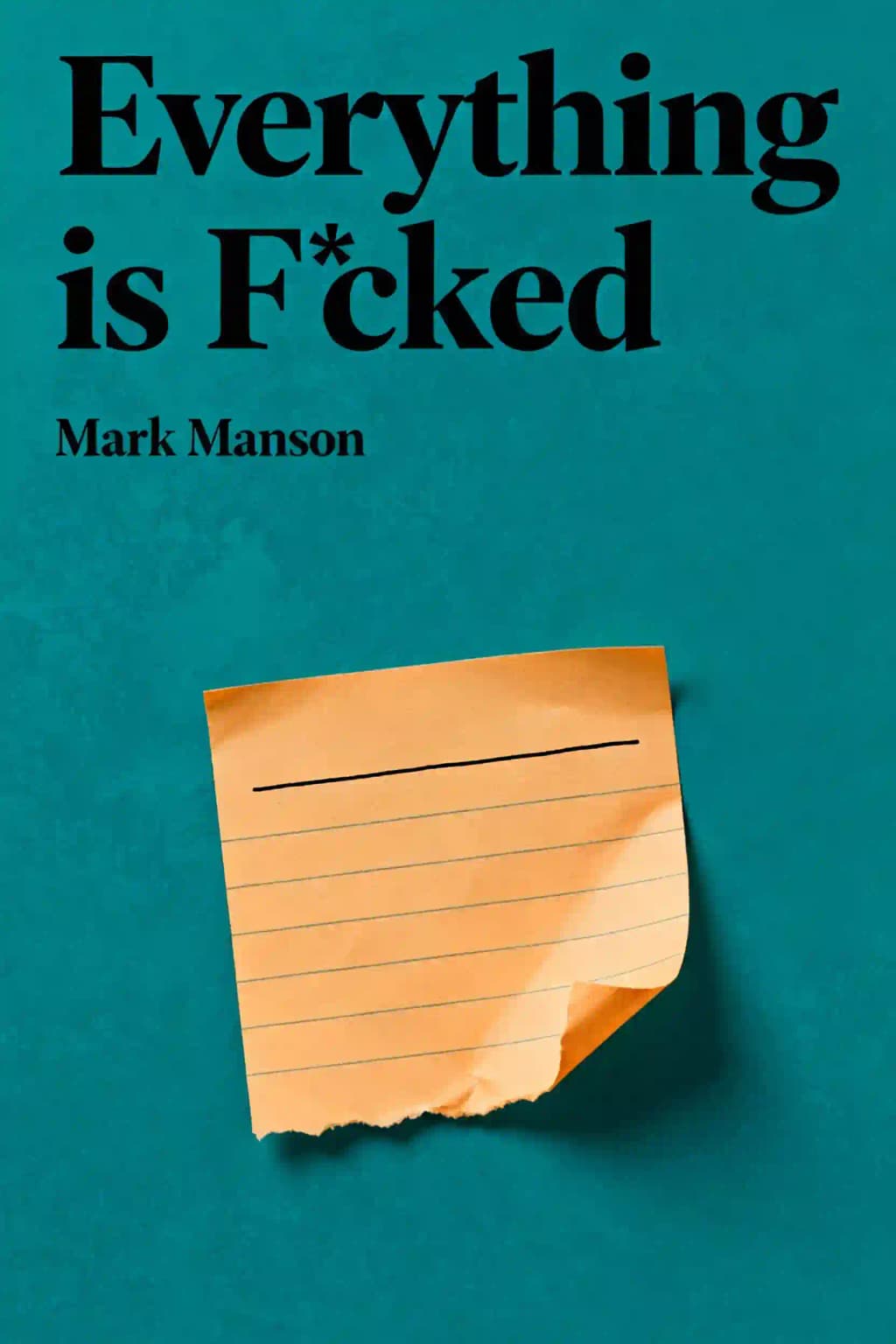
Mark Manson's "Everything is F*cked" has resonated with millions of readers worldwide, including celebrities like Mila Kunis and Ashton Kutcher, who have publicly praised its unflinching examination of hope and meaning. The book builds on the cultural phenomenon of Manson's previous work, "The Subtle Art of Not Giving a F*ck," which sold over five million copies and cemented his position as one of the most influential contemporary philosophers for everyday people. What makes this book particularly relevant today is how it addresses our collective paradox: despite unprecedented prosperity, we're experiencing a crisis of hope.
2장
The Uncomfortable Truth We All Avoid
We exist as nothing more than cosmic dust on a tiny blue speck in an incomprehensibly vast universe. Our lives, our achievements, our entire civilization will eventually disappear without a trace. This is the Uncomfortable Truth we desperately try to avoid confronting-our cosmic insignificance and the inherent meaninglessness of existence. When we truly contemplate our place in the universe - a universe that spans billions of light years, containing billions of galaxies, each with billions of stars - our individual existence seems vanishingly small.
To shield ourselves from this truth, we frantically construct narratives of importance. We create stories about our special place in the universe, our unique purpose, or our lasting legacy. Hope becomes our mind's primary project-the fuel that keeps us going. Without hope that the future will improve, we spiritually die. The opposite of happiness isn't sadness or anger (which mean you still care about something); it's hopelessness-the belief that everything is fucked, so why bother? This hopelessness manifests as the root of anxiety, depression, and addiction, leading many to seek escape through various destructive behaviors.
We create "hope narratives" after tragedies, like when I imagined my deceased grandfather watching over me. These narratives give our lives purpose and meaning, helping us cope with loss and uncertainty. Whether through religion, career goals, family, or personal projects, we all need something to hope for. Some find meaning in raising children, others in creating art, building businesses, or serving their communities. These narratives become our personal mythology, the stories we tell ourselves to make sense of our existence.
And here's the paradox: despite unprecedented material progress and safety, we're experiencing rising depression, anxiety, loneliness and suicide rates. Writers like Steven Pinker and Hans Rosling have documented extraordinary progress-less violence, more education, fewer diseases, less poverty, and longer lives. Global literacy rates have soared, extreme poverty has plummeted, and medical advances have eradicated diseases that once decimated populations. They're right, but these facts don't necessarily make us feel better. In fact, our awareness of how good things are can intensify our fear of losing it all.
The better things get, the more we have to lose-and the more desperately we need hope. Hope doesn't care about problems already solved; it fixates on problems still unsolved. Our ancestors worried about surviving winter; we worry about climate change. They feared local threats; we fear global catastrophes. To build and maintain hope, we need three things: a sense of control over our lives and circumstances, a belief in the value of something greater than ourselves, and a community that shares our values and supports our efforts. Lose any of these elements, and you lose hope entirely. This trinity of control, meaning, and connection forms the foundation of human resilience and psychological well-being.
3장
The Illusion of Self-Control
Consider "Elliot," a successful executive whose life unraveled after brain surgery to remove a tumor. Despite maintaining his intelligence and reasoning abilities, Elliot lost something fundamental: his ability to feel emotion. Without emotional capacity, he became incapable of making even simple decisions, eventually losing his job, family, savings, and dignity.
When neuroscientist Antonio Damasio examined Elliot, he made a revolutionary discovery. While Elliot could pass every cognitive test, he couldn't explain why he made catastrophically poor choices. This challenged centuries of wisdom suggesting that suppressing emotions leads to better decision-making. Instead, without emotions, we lose the ability to make effective decisions and exercise self-control-even when we intellectually understand what we should do.
Western thought has long assumed emotions cause our problems and reason must control them-what we might call the "Classic Assumption." This belief traces back to Socrates, through Descartes, Kant, and Freud, culminating in Moniz's lobotomies that attempted to give reason dominion over emotions.
This assumption permeates modern culture, making us judge people harshly for perceived lack of self-control-whether obesity, addiction, or depression-viewing these as moral failings rather than complex conditions. We simultaneously celebrate ruthless efficiency and emotional suppression in business leaders and athletes.
The truth is we have two distinct mental systems: the Thinking Brain (conscious, rational, methodical but slow and energy-intensive) and the Feeling Brain (quick, intuitive, impulsive but often irrational). Contrary to popular belief, the Feeling Brain-not the Thinking Brain-actually drives our decisions.
The Feeling Brain controls action because emotion is action-it's the biological system that physically moves our bodies. Fear tightens muscles and releases adrenaline; anger pushes us forward; anxiety pulls us back. While the Thinking Brain exists only in our skull, the Feeling Brain represents the wisdom and folly of our entire body.
This explains why we don't do things we know we should: we simply don't feel like it. Problems of self-control, procrastination, and impulsiveness are emotional problems, not informational ones. And since emotional problems can only have emotional solutions, intellectual understanding alone can't change behavior.
4장
The Laws Governing Our Emotional Universe
Imagine if Isaac Newton had turned his analytical mind toward human emotions rather than physics. This "Emo Newton" would have observed that people constantly lie to themselves and others, not out of malice but habit, and that human behavior follows predictable patterns much like physical objects.
Through his observations, this hypothetical Newton might develop three laws of emotion, beginning with the First Law: "For every action, there is an equal and opposite emotional reaction."
When someone causes us pain, a moral gap opens between us that demands equalization. This drive to equalize is emotion itself: sadness is feeling powerless to make up for a loss; anger is the desire to equalize through force; happiness is feeling liberated from pain; and guilt is feeling you deserve pain that never arrived.
This desire for equalization underlies our sense of justice, codified throughout history in principles like "an eye for an eye" and "do unto others as you would have done unto you." In evolutionary biology, it's known as reciprocal altruism, and in game theory as a "tit for tat" strategy.
Newton's Second Law might state: "Our self-worth equals the sum of our emotions over time." When moral gaps persist without the ability to equalize, they normalize and become our default expectation. If someone harms us and we can't retaliate, our Feeling Brain eventually concludes: "I deserve to be hit." This surrender to persisting moral gaps creates shame or low self-worth.
The reverse is also true-receiving unearned rewards leads to falsely believing we're superior, creating deluded high self-worth. Both high and low self-worth are two sides of the same counterfeit coin-both involve seeing oneself as special and separate from the world.
Newton's Third Law would be: "Your identity will stay your identity until a new experience acts against it." Our values aren't just collections of feelings-they're stories we construct to explain our emotional reactions. These narratives become our identity, clinging to us and defining how we see ourselves and others.
Our earliest experiences create our core values, which is why childhood trauma has such lasting effects. These early values become background noise in our minds, seeming natural and inevitable despite being completely made up. The only way to change values is through contradictory experiences, which inevitably causes pain-there is no growth without discomfort, no becoming someone new without grieving who you used to be.
5장
The Religion of Hope
It's 2 a.m. and you're still awake on the couch, staring bleary-eyed at the TV-the perfect moment of apathy when you're most vulnerable to persuasion. I appear on your screen, energetic and somehow comforting, claiming I can solve all your problems and make your dreams come true.
Though skeptical, you listen as I describe feelings of isolation and hopelessness that resonate with you. I speak to universal human suffering in a way that feels personally tailored to your pain. As my infomercial continues, your psychological defenses weaken against your existential need to find meaning. My outlandish claims begin to seem plausible because I've demonstrated understanding of your pain and offered a way out.
This is how religions are born-not just spiritual ones, but ideological and interpersonal ones too. Everyone must have faith in something-without it, there can be no hope. Even non-religious people exercise faith in concepts like money, education, or love having value. Whatever becomes our highest value-our "God Value"-becomes the lens through which we interpret everything else.
Spiritual religions require the most skill to establish but offer the greatest follower loyalty and longevity, as supernatural beliefs can never be disproven. They've historically provided hope in afterlife rewards when earthly conditions were unbearable. Ideological religions (like capitalism, communism, or environmentalism) are moderately difficult to create and face more competition, with most lasting only decades. Interpersonal religions (centered on romantic partners or celebrities) are easiest to form but typically represent immature attachments one must outgrow.
To protect your religion from criticism, create a self-reinforcing us-versus-them dichotomy that automatically transforms critics into enemies. These false dichotomies paint a simple picture: those who "get it" will save the world, while those who don't will destroy it.
Creating fear is essential-followers need to feel they're holy warriors of justice fighting against evil. Conspiracy theories serve this purpose perfectly, transforming ordinary disagreements into existential battles against sinister forces.
6장
When Hope Itself Becomes the Problem
Friedrich Nietzsche famously declared "God is dead!" as a warning to mankind about a dangerous new age. Despite the profound importance of this message, his book sold fewer than forty copies.
Nietzsche observed that human societies naturally develop hierarchies where those with advantages accumulate resources and power, creating a division between "masters" and "slaves." Masters develop a moral code justifying their position through strength and merit ("master morality"), while the disadvantaged develop "slave morality" that values sacrifice, suffering, and equality.
Before science, priests and holy men controlled society as arbiters of hope, telling people what God wanted. The scientific revolution changed everything-microscopes, printing presses, effective medicine-suddenly life visibly improved. People could now see progress within their lifetime rather than waiting for an afterlife. This shift brought concepts of freedom, responsibility, and equality that had never existed before, as people realized they could control their own destiny in this life.
The scientific revolution eroded spiritual religions and made way for ideological religions. But Nietzsche was concerned because unlike supernatural deities that remain impervious to worldly affairs, ideologies are constantly challenged, proven, and disproven, offering little psychological stability. When ideological foundations are shaken, we confront the Uncomfortable Truth about our existence.
Nietzsche's famous "God is dead" wasn't atheistic gloating but a warning-he believed humans weren't psychologically equipped to determine their own cosmic significance. He predicted that ideological religions (democracy, nationalism, communism) would eventually cause unprecedented destruction through conflicts between master and slave moralities-wars not for God but between gods, with those gods being us.
In Greek mythology, Pandora brought a beautiful box to earth that, when opened, released all evils into the world-death, disease, hatred-but at the bottom remained hope. The common interpretation is that hope is the antidote to evil, but what if hope itself is just another form of evil?
Hope inspired both Pilecki's heroics and Hitler's genocides. Like a surgeon's scalpel, hope can both save and take lives. The paradox is that hope requires everything to be fucked-it depends on rejecting what currently is. The sources of hope that give our lives meaning are the same sources of division and hate.
7장
Growing Up in a World That Encourages Childishness
Immanuel Kant believed in clear right and wrong that transcended human emotions, living his principles despite opposition from kings, priests, and academics. He showed us how we progress from childhood to adulthood.
Children operate based on pleasure/pain, while adolescents learn to navigate social rules and make transactional decisions. However, adolescents still fundamentally make choices to maximize pleasure and minimize pain, just with more sophisticated calculations. They see everything as bargains: working for money, calling mom to avoid conflict. This approach ultimately fails because you never stand for anything outside yourself-you're just living according to others' desires.
True adulthood means breaking free from constant bargaining and embracing higher principles. Being an adult isn't just about job interviews, finances, and cleaning up after yourself-these are merely means to ends that prevent you from being a child. True adulthood means recognizing that the most important things can't be gained through bargaining. You can't negotiate for love, respect, or trust-attempting to do so destroys them.
An adult realizes abstract principles are right for their own sake, even when painful. While adolescents value honesty because it produces good results, adults are honest because honesty itself matters more than pleasure or pain. Adult values are unconditional-they're ends in themselves, not means to other ends.
People get stuck in childhood or adolescent value systems through trauma, neglect, or poor parenting. Children need consistent consequences to learn that life extends beyond their impulses. Adult behaviors-like bosses taking responsibility for employees' mistakes or mothers sacrificing for their children-hold the world together.
Kant's "Formula of Humanity" provides a single principle to escape transactional hope: "Act that you use humanity, whether in your own person or in the person of any other, always as an end, never merely as a means." This explains our moral intuitions and virtues without relying on imagined futures. Treating people as means to ends forms the basis of all wrong behavior-whether lying, cheating, or violence.
8장
Pain as the Universal Constant
Researchers conducted experiments where subjects identified blue and purple dots on screens. When blue dots became scarcer, people began misidentifying purple dots as blue. This "Blue Dot Effect" extended to perceiving threats in friendly faces and seeing ethical issues in innocuous proposals when researchers reduced actual threats or problems. This explains why, as society becomes safer, we perceive threats where none exist.
Words like "violence," "trauma," and "genocide" have been redefined to describe increasingly minor discomforts. The better things get, the more we perceive nonexistent threats-the paradox of progress.
Einstein's relativity theory reveals that space and time aren't universal constants but variables to another constant. Similarly, our psychological constants aren't what we think they are. Research shows humans maintain a consistent "seven" on the happiness scale regardless of circumstances. After major positive or negative life events, we briefly spike up or dip down, but inevitably return to our baseline.
This "hedonic treadmill" means we're constantly chasing an imaginary "ten" that remains perpetually out of reach. The pain we experience is actually the universal constant of life, not our perception of it. Our minds simply adjust expectations to maintain a steady level of dissatisfaction, making the pursuit of happiness fundamentally self-defeating.
On June 11, 1963, Thich Quang Duc led a Buddhist procession to a busy Saigon intersection. As monks formed a semi-circle, Quang Duc sat in the lotus position while another monk doused him in gasoline. Without flinching, he struck a match and set himself ablaze. Despite being engulfed in flames, he remained perfectly still, never moving or making a sound-a stunning display of mind over matter that shocked witnesses and journalists alike.
This act of supreme self-control weakened Diem's grip on Vietnam; within months, thousands revolted, military commanders disobeyed orders, and eventually Diem was assassinated. The monk's ability to endure extraordinary pain without flinching demonstrated an almost supernatural mastery of suffering that people found both horrifying and inspiring.
Pain is the currency of our values and the foundation of meaning. Without death creating stakes in life, we would have no way to determine what matters. When we become fragile by avoiding pain, our emotional reactions become disproportionate to events. Conversely, antifragility creates emotional grace and principled values, making it synonymous with growth and maturity.
9장
The Economy of Feelings
Edward Bernays revolutionized marketing in the 1920s by understanding that people make decisions emotionally rather than rationally. When hired by the American Tobacco Company to market cigarettes to women, Bernays staged a publicity stunt during the Easter Sunday Parade where women lit "torches of freedom," connecting smoking with women's liberation. This successful campaign demonstrated the power of appealing to values and identity rather than logic.
The world runs on feelings-people spend money on what makes them feel good, and where money flows, power follows. Money itself functions as a universal mini-religion that equalizes moral gaps between people, originating from kings needing to compensate soldiers.
The Feelings Economy drives technological progress through two value-creation methods: innovations that upgrade pain (like vaccines replacing disease with a needle prick) and diversions that temporarily numb pain (like entertainment or drugs). While diversions aren't inherently problematic, they become dangerous when they dominate our lives, potentially creating addiction cycles where numbing pain only makes it worse, leading to compulsive behavior and downward spirals.
Corporate leaders defend themselves by claiming "We're just giving people what they want!" But what we want is often terrible-our Feeling Brain makes poor choices. Giving people diversions rather than innovations is dangerous: many want awful things, are easily manipulated into wanting things they don't actually need, and become weaker through pain avoidance.
True freedom comes not through unlimited choices but through self-limitation-choosing what you're willing to give up. While fake freedom demands endless variety, real freedom expands through conscious sacrifice. Physical exercise enhances bodily freedom; work ethic creates career opportunities; willingness to engage in conflict frees your social interactions.
The deepest freedoms emerge from long-term commitments-relationships, skills mastered over decades, communities where you've put down roots. Fake freedom produces diminishing returns, requiring ever more energy for the same joy. Real freedom generates increasing returns, needing less energy for the same meaning.
10장
The Final Religion: Artificial Intelligence and Human Obsolescence
In 1997, IBM's Deep Blue supercomputer defeated world chess champion Garry Kasparov. This once-shocking technological milestone now seems quaint and inevitable-of course a computer would beat a human at chess. AI has rapidly evolved from this point, leading us toward a future where artificial intelligence will likely surpass human capabilities in virtually every domain.
I propose viewing the history of the world through a new lens: "survival of the best information processing." Life itself consists of algorithms that self-replicate, with evolution favoring organisms that process information most effectively. The amoeba's membrane sensors, the lizard's camouflage, the whale's songs-all represent information processing advantages.
While humans are physically unexceptional, we became Earth's dominant species through our superior information processing capabilities. Yet our algorithms, which worked well on the savannah, break down in our complex modern world. We create escalating cycles of conflict without permanent satisfaction. Every major problem-nuclear weapons, climate change, genocide-stems from our flawed algorithms. We're simply outdated code, about to be replaced by something exponentially better.
Our human minds remain incredibly flawed despite our accomplishments. Our emotional needs hijack our rational thinking, our perceptual biases curve our information processing inward, and our moral compass gets swung off course by our need to generate hope through conflict. We are fundamentally self-hating and self-destructive, not as a moral judgment but as fact. This internal tension that drove our evolution is about to hand the baton to machines-the next epoch's defining information processors.
In this closing reflection, I dare to hope for a post-hope world-one where people are treated as ends rather than means, where consciousness isn't sacrificed for religious aims, where reason is valued, and where our institutions reflect this maturity. I dare to hope people will integrate their Thinking and Feeling Brains, becoming aware of their desires' pitfalls while embracing growth-inducing discomfort.
I envision AI creating a new virtual religion so enticing we'll stop killing each other, with digital altars we'll worship at not because we're forced to but because we'll want to. Eventually, our consciousnesses may merge with machines, transcending individual hopes as we evolve into something greater beyond human limitations. Perhaps then we'll finally embrace the Uncomfortable Truth: that we invented our own purpose and importance, that we were always nothing. And maybe then, the eternal cycle of hope and destruction will end.