1장
The Eternal Struggle Between Having and Being
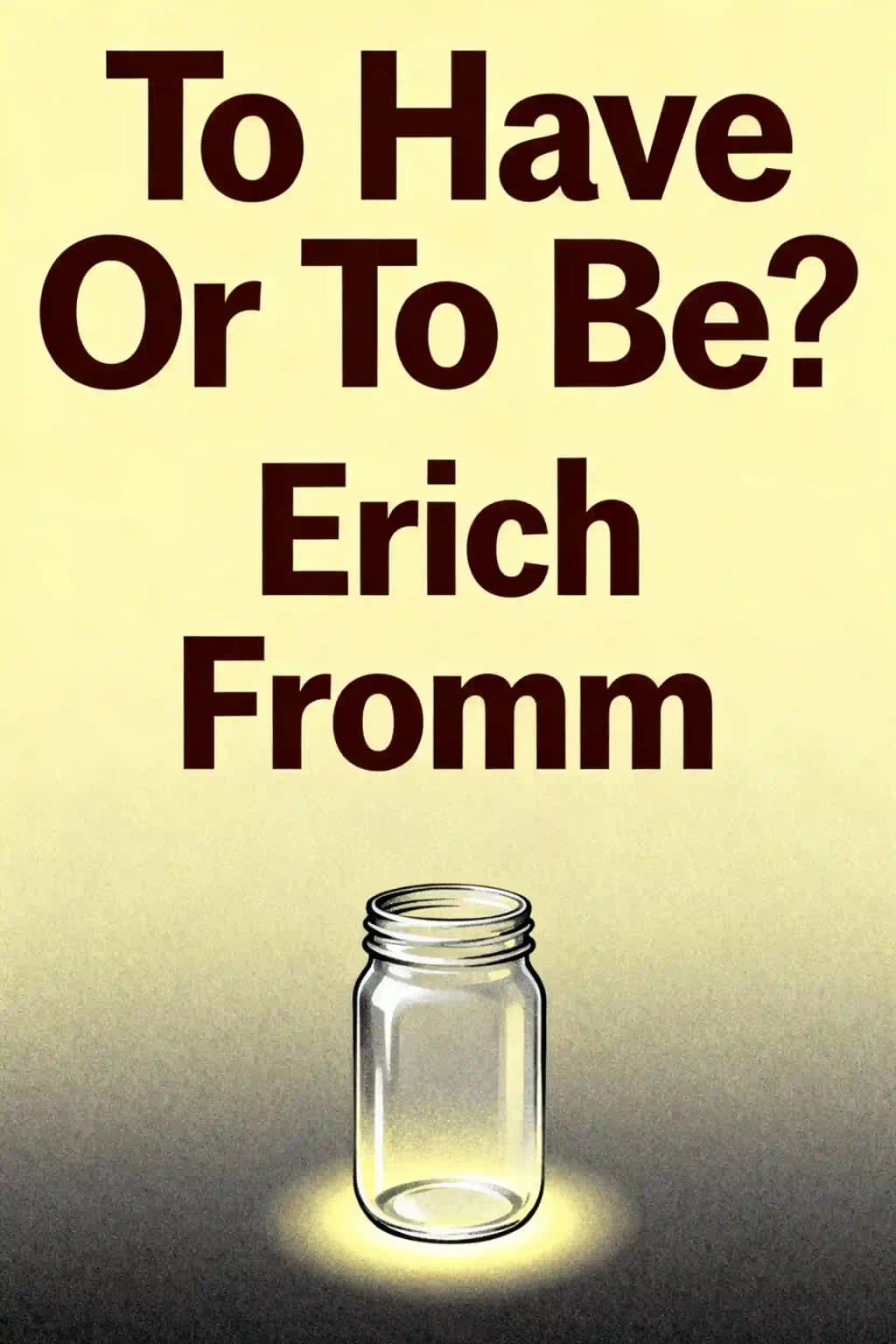
In a world obsessed with accumulation, Erich Fromm's masterpiece stands as a revolutionary counterpoint to our consumer culture. Published in 1976 during escalating Cold War tensions and environmental concerns, "To Have or To Be?" quickly became a cornerstone of humanistic psychology. The book has influenced generations of thinkers, from Bernie Sanders (who frequently cites Fromm's critique of materialism) to Pope Francis, whose encyclical "Laudato Si" echoes Fromm's warnings about consumerism. Despite being written nearly five decades ago, its message resonates even more powerfully today as we face unprecedented ecological threats and spiritual emptiness amid material abundance. As tech billionaire Elon Musk once remarked, "Many people are trying to buy happiness when what they really need is meaning." Fromm's work invites us to consider: are we living to have more, or to be more?
2장
Two Fundamental Modes of Human Existence
At the heart of Fromm's analysis lies a profound distinction between two modes of existence: having and being. The having mode centers on possession, acquisition, and control-defining ourselves by what we own, collect, and accumulate. This encompasses not just material possessions, but also knowledge, relationships, and even memories that we treat as collectibles. The being mode, by contrast, focuses on aliveness, authentic experience, and productive activity-defining ourselves by who we are, how we engage with others, and our moment-to-moment lived experience in relating to the world.
This distinction isn't merely philosophical abstraction but manifests in countless daily situations. We can observe it in everyday language and experience. When someone says "I have a problem," they've transformed their subjective experience (being troubled) into an object possessed, when in reality the problem possesses them. Our language increasingly substitutes nouns for verbs-"having love" instead of "loving," "making a decision" instead of "deciding," "having an impression" instead of "thinking"-reflecting our tendency to transform experiences into possessions. This linguistic shift reveals a deeper transformation in how we relate to our experiences.
Consider how we approach flowers: Do we pluck them to possess their beauty (like Tennyson's poem where he "plucks" a flower "root and all"), or do we appreciate them without needing to own them (like the Japanese poet Basho who simply "looks carefully" at the flower)? The first approach represents the having mode-possession that ultimately kills what it seeks to preserve. The second embodies the being mode-joyously employing one's faculties to connect with the world without domination. Similar patterns emerge in how we approach education (memorizing facts versus engaging with ideas), relationships (controlling versus sharing), and work (accumulating achievements versus finding fulfillment).
This distinction isn't fundamentally East versus West, but between societies centered around persons versus things. Modern consumer culture exemplifies the having mode, while traditional societies often emphasized being. And while both modes exist in everyone, our social character largely determines which predominates. In contemporary consumer society, the having mode has become so dominant that we barely recognize alternatives exist. This manifests in our obsession with ownership, our equation of success with possession, and our tendency to view even intangible aspects of life through the lens of acquisition and control.
The implications extend beyond individual psychology to shape entire social structures. Educational systems focus on having knowledge rather than developing understanding, relationships become transactions of emotional possession rather than mutual growth, and work becomes about accumulating credentials rather than developing genuine competence. Understanding these modes helps us recognize and potentially transform our relationship with ourselves, others, and the world around us.
3장
The Great Promise and Its Failure
The industrial age heralded an unprecedented promise of human advancement, built upon three fundamental pillars: the complete mastery over nature through technology, the creation of unlimited material abundance, and the achievement of happiness for the greatest number of people. This trinity of promises - unlimited production, absolute freedom, and unrestricted happiness - coalesced into a powerful new religion of Progress that energized and motivated generations of people across the globe.
The promise was intoxicating: machines would free humans from drudgery, science would conquer disease and extend life, and technological innovation would create endless prosperity. Cities would become modern utopias, poverty would be eliminated, and everyone would have access to education, healthcare, and opportunities for self-actualization. This vision captured imaginations from factory workers to philosophers.
However, Fromm identifies two fundamentally flawed psychological premises that doomed this grand vision. The first is radical hedonism - the belief that maximum pleasure through satisfying any and all desires leads to genuine happiness. This manifests in modern society through compulsive consumption, entertainment addiction, and the endless pursuit of novel experiences. The second flawed premise is the notion that individual egotism and greed naturally create social harmony - the idea that when everyone pursues their self-interest, society as a whole benefits.
The hedonistic experiment has conclusively failed. Despite unprecedented material comfort - air conditioning, smartphones, endless entertainment options, convenient transportation - modern humans remain profoundly anxious, depressed, and disconnected. Studies show rising rates of mental illness, loneliness, and suicide even as material prosperity increases. The promise of happiness through consumption proved hollow.
Similarly, the premise that individual egoism creates harmony has proven catastrophically wrong. Instead of harmony, unfettered self-interest has produced growing inequality, environmental destruction, and social fragmentation. Corporate profit-seeking has led to worker exploitation, community destruction, and climate change. As long as the dominant ethos remains "more for me," genuine peace and sustainability remain impossible.
Beyond these philosophical failures, we now face hard physical limits to the having orientation. Multiple reports by the Club of Rome and other scientific bodies demonstrate that current patterns of production and consumption are literally destroying the biosphere. Only dramatic changes in economic systems and technologies - combined with fundamental shifts in human values and behavior - can prevent ecological collapse. For the first time in history, human survival depends on a radical transformation of consciousness from having to being.
Yet despite these existential threats, society remains largely passive and paralyzed. Political leaders create illusions of progress through endless conferences and empty promises while avoiding necessary structural changes. The general public stays distracted by consumption and entertainment. Most dangerously, we've accepted the false belief that we have no alternatives to current economic systems, whether corporate capitalism or state socialism. Until our greatest minds shift focus from technical advancement to social reconstruction, we'll lack the imagination and will to create viable alternatives to our current path toward destruction.
4장
The Having Mode: Possession as Identity
The having mode stems from private property's nature-the unlimited right to keep what's acquired, excluding others from its use. In contemporary society, this orientation extends far beyond material possessions to include friends, health, ideas, beliefs, and even one's self-concept. The statement "I have something" implies permanence in both subject and object, yet this permanence is illusory since both will eventually perish.
In the having mode, my identity becomes defined by my possessions: "I am I because I have X." The relationship becomes one of deadness rather than aliveness-the object has me as much as I have it, since my sense of identity depends upon having it. As Marcel observed, "The more the having mode dominates my existence, the less I am."
This possessive orientation manifests in various aspects of daily life. In learning, students in the having mode merely collect and store information, writing down every word to memorize later, without integrating knowledge into their own thought system. In conversation, people defend their opinions as possessions, fearing the impoverishment of changing views. In reading, they consume books to collect information as cultural property rather than engaging in dialogue with the author.
Even our language reinforces the having orientation by creating the illusion that processes are fixed substances. Names suggest people are immortal beings rather than processes. Common nouns like "love" or "hate" obscure that we're dealing with ongoing activities, not fixed entities.
Our biological desire to live despite knowing we'll die drives us to seek immortality through possessions. If my self is constituted by indestructible possessions, I become immortal through them. This explains why death creates such terror in the having mode-it means losing everything that constitutes identity.
5장
The Being Mode: Aliveness and Authenticity
The being mode represents a fundamentally different orientation toward existence that transforms how we experience life and relate to the world around us. While having refers to fixed, describable things that can be counted and measured, being refers to the lived experience that defies simple categorization or quantification. The fundamental characteristic of the being mode is inner activity-the productive use of human powers to express one's faculties, grow, love, and transcend the prison of isolated ego through genuine engagement with life.
In the being mode, security and self-worth emerge from within rather than from external possessions or achievements. When identity is rooted in the conviction that "I am who I am" rather than "what I have," external circumstances and material losses cannot fundamentally threaten one's core sense of self. Unlike material possessions that depreciate or diminish with use, our essential human powers of reason, love, creativity, and wisdom actually expand and deepen through their expression. Each act of genuine understanding or authentic connection strengthens rather than depletes these capacities.
This orientation profoundly transforms everyday experiences and interactions. Students operating in the being mode respond actively and creatively to material, developing novel perspectives and insights rather than merely acquiring and storing information. They engage in genuine dialogue with texts and ideas, allowing themselves to be changed by what they learn. In conversation, those in the being mode respond spontaneously and productively, temporarily forgetting themselves while fully engaging with others. Rather than defending rigid positions or trying to "win" arguments, they remain open to new ideas and allow fresh understanding to emerge through dialogue. Their authentic presence and engagement creates an atmosphere of aliveness that draws others in, transforming mere exchange into genuine dialogue where the joy of shared discovery takes precedence over being right.
The being mode enables a profound form of enjoyment that doesn't depend on possession or control. One can deeply appreciate the majesty of mountains, the transcendence of music, the power of art, or the wonder of children without needing to own or control them. In interpersonal relationships, being-oriented people can truly enjoy others' presence and uniqueness without requiring exclusive possession or demanding that others conform to their expectations. This orientation allows for shared appreciation - multiple people can simultaneously enjoy the same sunset, piece of music, or insight, creating one of humanity's deepest pleasures: the joy of mutual recognition and shared experience.
This mode operates primarily in the present moment-the here and now-rather than being fixated on past achievements or future acquisitions. While the having mode is governed by linear time and focuses on accumulation and planning, the being mode transcends ordinary time through immersion in creative acts, authentic love, spontaneous joy, and moments of insight that happen in what might be called the eternal now. These experiences of full presence and engagement give life its depth and meaning beyond mere accumulation or achievement.
6장
Learning to Be: Examples from Religious Traditions
Religious traditions have long recognized the distinction between having and being, though often using different terminology. The Old Testament's central theme is liberation from possessions and fetters to achieve true being. This journey begins with Abraham leaving his country and clan - sacrificing wealth, status, and security for faith - and continues with Moses leading the Hebrews from Egyptian bondage into the desert-a place of nomadic, non-propertied life. This exodus represents not just physical liberation but spiritual transformation from a life defined by possessions to one defined by covenant and community.
The Sabbath emerges as Judaism's most important concept-not merely a day of rest, but one of complete harmony between humans and nature, where one lives as if having nothing, pursuing only being. On this day, all work and commerce cease, social distinctions dissolve, and people focus on family, community, and spiritual reflection. It anticipates the Messianic Time, when property and money become meaningless, and human relationships are based on authentic connection rather than material exchange.
The New Testament radicalizes this protest against having through numerous parables and teachings. Jesus taught radical renunciation of possessions, blessing the poor and warning against accumulating treasures on earth. His parable of the rich young ruler, who couldn't part with his wealth to follow Jesus, illustrates how attachment to possessions prevents spiritual growth. Early Christianity practiced communal sharing of material goods, as described in Acts, where believers held everything in common and distributed to anyone in need. They established ethical norms rooted in being, sharing and solidarity, creating communities that transcended social and economic barriers.
Master Eckhart, the Dominican theologian and greatest representative of German mysticism, offered profound insights into the nature of being versus having. He defined the truly poor person as "one who wants nothing, knows nothing and has nothing." This doesn't mean asceticism or material deprivation, but rather freedom from craving and attachment. For Eckhart, "wanting nothing" means abandoning greed and desire for control; "knowing nothing" warns against possessing knowledge as intellectual property or status symbol; and "having nothing" means being emptied even of the concept of God - achieving a state of pure receptivity to divine presence.
Eckhart rejects behavioristic views, insisting that what we are matters more than what we do: "People should not consider so much what they are to do as what they are." Our being is the fundamental reality, while deeds separated from our dynamic core lack authenticity and transformative power. Being active, in Eckhart's view, means "to go out of oneself," which he describes as "boiling," "giving birth," something that "flows and flows in itself and beyond itself." This dynamic understanding of being emphasizes creativity, spontaneity, and genuine self-expression rather than mechanical adherence to rules or accumulation of merit.
These religious perspectives collectively suggest that authentic existence requires letting go of the having mode - whether of material possessions, knowledge, or even spiritual achievements - to enter fully into the being mode of life.
7장
The Social Character: How Society Shapes Our Orientation
The character structure of average individuals and the socioeconomic structure of their society exist in a complex, mutually reinforcing relationship. This interweaving creates what Fromm identifies as "social character"-the shared psychological orientation that enables people to function effectively within their particular social system. Society molds people's character structure so they internally desire to perform the roles required of them, while these collective character traits simultaneously work to maintain and strengthen the existing socioeconomic structure.
The relationship operates on multiple levels: through family dynamics, educational institutions, religious teachings, and economic incentives. For example, a society that values punctuality and orderliness will develop child-rearing practices and educational methods that instill these traits, creating individuals who then perpetuate these same values in their professional and personal lives.
Despite the common perception that Western civilization is fundamentally rooted in Christian values and traditions, Fromm presents a compelling argument that our true dominant religion has become what he terms "industrial religion"-a system that reduces human beings to servants of the economic machinery they themselves constructed. This modern faith system centers on three core elements: unquestioning submission to authority, pervasive guilt for any deviation or disobedience, and the erosion of human solidarity through aggressive individualism and self-interest. These manifestations can be observed in phenomena like workplace hierarchy, consumer guilt, and the celebration of competitive individualism.
The historical transformation of social character is particularly evident in the shift from what dominated society from the 16th through 19th centuries-the authoritarian-obsessive-hoarding character-to what Fromm identifies as the "marketing character." This contemporary personality structure is based on experiencing oneself primarily as a commodity with fluctuating exchange value in the social marketplace. Success in this system depends not on fixed qualities but on how effectively people can package and sell themselves, constantly modifying their persona according to shifting market demands. Marketing characters typically lack a stable sense of self or authentic core identity, operating predominantly on a cerebral level while avoiding deeper emotional engagement or genuine self-reflection.
This modern character type corresponds to what Fromm describes as a "cybernetic religion," where humans have achieved godlike technological capabilities while paradoxically experiencing profound personal powerlessness. As social isolation intensifies and various global crises loom, this belief system becomes increasingly malignant. Society unconsciously worships destruction and death-evident in our fascination with apocalyptic scenarios, violent entertainment, and environmental destruction-while maintaining a conscious narrative of progress and optimism about the future. This psychological split between our conscious hopes and unconscious destructive tendencies creates a particularly dangerous form of social character that threatens human survival while denying the very real dangers it creates.
The marketing character manifests in numerous contemporary phenomena: the rise of personal branding, the gig economy's demand for constant adaptation, social media's emphasis on curated self-presentation, and the increasing prevalence of burnout as individuals struggle to maintain their market value in an ever-shifting landscape.
8장
Joy and Pleasure: The Emotional Dimensions of Having and Being
Eckhart taught that aliveness produces joy, which differs crucially from pleasure. Pleasure is the satisfaction of temporary desires without requiring inner growth or transformation. These pleasures manifest in various forms: social status and recognition, material wealth accumulation, superficial relationships, mindless consumption, competitive victories, or artificial states induced by substances. Modern society has become increasingly focused on these fleeting pleasures, creating an endless cycle of seeking more intense experiences to fill an internal void. This pursuit often leads to diminishing returns, requiring ever-stronger stimuli to achieve the same level of satisfaction.
Joy, by contrast, accompanies productive and meaningful activity that emerges from our authentic being. Unlike pleasure's "peak experience" that culminates suddenly and fades quickly, joy manifests as a plateau experience-a steady, sustainable glow that accompanies being fully present in one's life and activities. While pleasure leads to emptiness or sadness after the peak passes because nothing has fundamentally changed within the person, joy creates lasting fulfillment through genuine engagement with life. Religious and philosophical traditions across cultures emphasize joy's centrality to authentic being. Buddhism, while rejecting temporary pleasures as sources of suffering, sees Nirvana as inherently joyful-a state of profound peace and contentment. The Old Testament portrays joy as accompanying being, with the Sabbath designated as joy's sacred day-a time for being rather than doing or having. Christianity's very name-"Glad Tidings"-emphasizes joy as the natural fruit of surrendering the having mode of existence.
The fear of dying reveals itself as fundamentally inseparable from the having mode of existence. When we define ourselves through attachments to possessions, status, or fixed identities, we inevitably fear losing them-and ultimately, losing what we consider our greatest possession: our life itself. This fear manifests in various ways: anxiety about aging, obsession with security, and resistance to change. The real fear isn't of the physical process of dying itself but of losing what we have-our body, ego, possessions, and constructed identity-essentially facing what Fromm calls "the abyss of nonidentity." The path to transcending the fear of death isn't through preparation for dying or philosophical acceptance, but through actively reducing our investment in the having mode and increasing our capacity for being. As Spinoza insightfully observed, the wise person thinks about life, not death, understanding that authentic living naturally dissolves the fear of dying. This transformation requires cultivating presence, engaging in meaningful work, and developing genuine connections rather than accumulating possessions or experiences.
9장
The Path Forward: Creating a New Society
For a fundamental shift from having to being, human character must change under specific conditions: we must recognize our suffering, understand its origins, see a path to overcome it, and follow new norms for living. These four points parallel Buddha's Four Noble Truths and also characterize Marx's approach to social transformation.
The new society must encourage people whose character exhibits qualities like: willingness to give up having to fully be; security based on faith in what one is rather than possessions; finding meaning within oneself; being fully present; joy from sharing not hoarding; love for all life manifestations; reduced greed and illusions; critical thinking with capacity for love; and freedom to be oneself.
Despite seemingly insurmountable obstacles, there remain reasons for hope. Growing recognition that economic survival requires new ethics, human solidarity and cooperation provides one basis for optimism. Increasing dissatisfaction with the consumer system-many feel the emptiness of their isolated lives and meaningless consumption-offers another.
The being orientation remains a strong potential in human nature. Though our society currently encourages having over being, this balance can tip through social change. The marketing character-focused on functioning rather than hoarding-may actually be more amenable to change than previous generations' property-focused mindsets.
Creating a new society requires facing nearly insurmountable difficulties with hardheaded realism. Just as technical challenges once seemed impossible but were overcome through the "new science" of the 17th century, today we need a Humanistic Science of Man as the basis for Social Reconstruction. The human Utopia of a united humankind living in solidarity and peace can be achieved if we devote the same energy and intelligence to it as we have to technical utopias.
Fromm's vision threatens no one's property while improving conditions for all. It appeals across political divides to all who care rather than those who don't care-to all who recognize that our survival depends not on what we have, but on who we become.