1장
The Art of Decision Making: Mastering Your Mental Toolkit
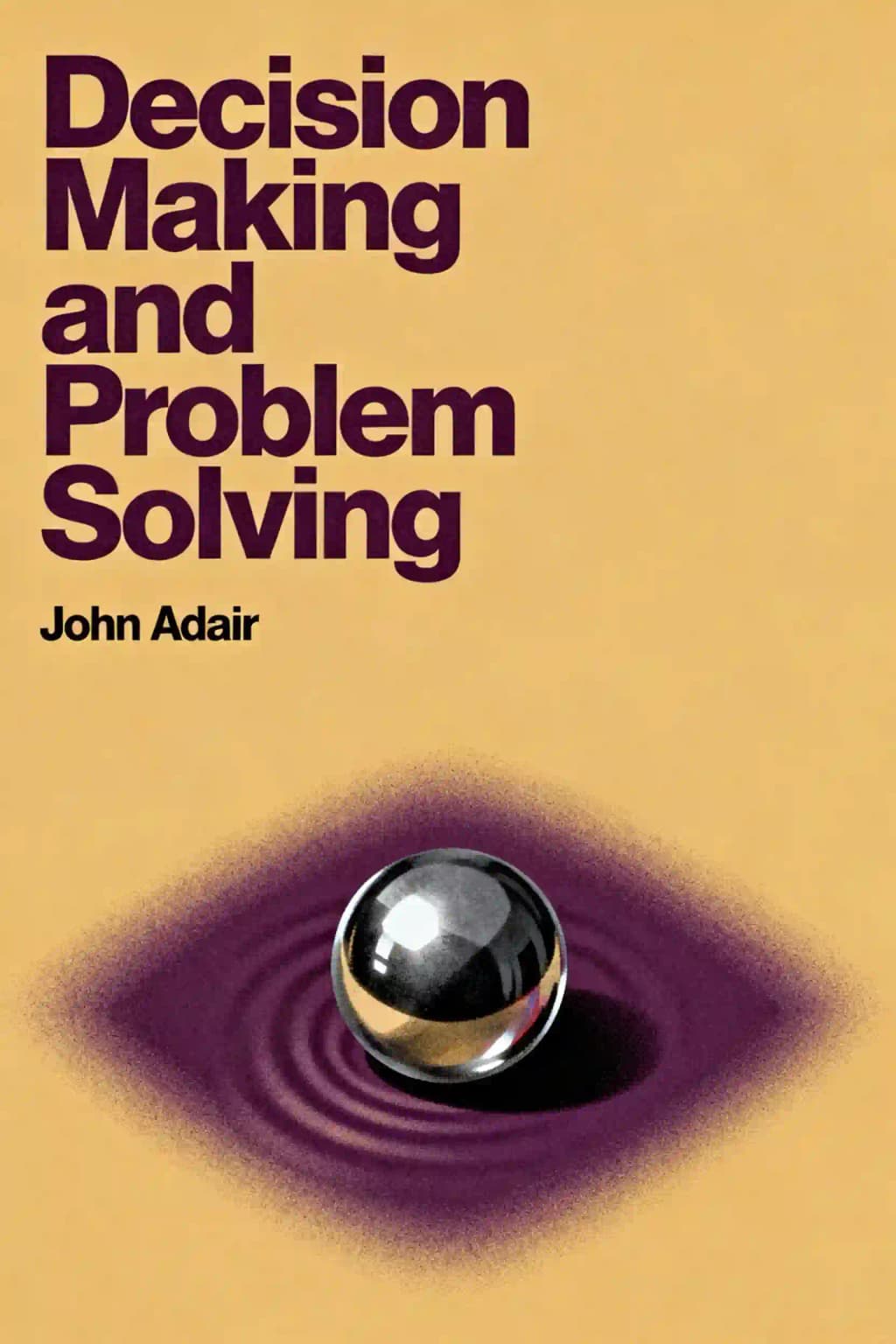
Have you ever wondered why some people seem to make brilliant decisions effortlessly while others struggle with even simple problems? Decision making is perhaps the most crucial skill in both business and life, yet surprisingly few of us are ever taught how to do it effectively. John Adair's masterpiece on decision making and problem solving has become a hidden gem among top executives and military leaders worldwide. Warren Buffett reportedly keeps a copy on his nightstand, while former US President Barack Obama cited it as influential during his time in office. The book's principles have been incorporated into leadership training at companies like Apple, Google, and the Royal Military Academy at Sandhurst. What makes this work so powerful is its rare combination of psychological insight and practical application-transforming the intimidating task of decision making into an art form anyone can master. Let's explore how you can harness the full power of your mind to make better decisions, solve problems creatively, and ultimately transform your life and career.
2장
The Most Complex Machine in the Universe: Your Mind at Work
Behind every decision you make lies the most extraordinary instrument in the known universe-your brain. With approximately 10 billion cells, each connecting to roughly 10,000 neighbors, your brain creates a network of staggering complexity. Yet most of us utilize only about 10% of this remarkable capacity. Why? Because we've never learned how to fully engage our mental machinery.
Your mind operates through three interlocking functions that work together like a symphony: analyzing (breaking things into components), synthesizing (combining elements into new wholes), and valuing (making judgments based on criteria). These functions don't operate in isolation-they dance together in a fluid, dynamic process that shifts moment by moment as you think.
Consider how you might approach buying a new car. You analyze by breaking down your needs (reliability, fuel efficiency, safety features), synthesize by imagining different models meeting those needs, and value by weighing options against your budget and preferences. This process happens so naturally you barely notice it, yet understanding these distinct mental operations can dramatically improve your thinking.
Most fascinating is what Adair calls the "Depth Mind"-the subconscious processing that continues even when you're not actively thinking about a problem. Have you ever struggled with a difficult question, given up, then had the answer suddenly pop into your mind while showering or walking? That's your Depth Mind at work. Scientists, artists, and innovators throughout history have reported similar experiences of insight emerging after periods of incubation.
The implications are profound: effective thinking isn't just about conscious effort but also about creating space for your subconscious to work its magic. This explains why forcing solutions rarely works, while stepping away from problems often leads to breakthroughs. As Einstein noted, "The intellect has little to do on the road to discovery. There comes a leap in consciousness... and the solution comes to you and you don't know how or why."
Mental exercise, like physical exercise, strengthens these capacities over time. Just as muscles atrophy without use, your brain literally shrinks without regular challenges. The good news? Every difficult decision or complex problem you tackle actually builds your mental muscle for future challenges. What seems impossible today becomes manageable tomorrow through this progressive development of your thinking powers.
3장
The Five-Step Path to Superior Decisions
Decision making isn't a mysterious talent bestowed on a lucky few-it's a structured process anyone can master. The classic approach follows five essential steps that form a roadmap for navigating even the most complex choices.
First, define your objective with crystal clarity. This seems obvious, yet it's where many decision processes go awry. Without knowing precisely what you're trying to achieve, you'll wander aimlessly through options. Write down your aim and review it after a short break-you'll be surprised how often this simple act sharpens your focus and reveals unstated assumptions.
Next, collect relevant information-but beware the paralysis of analysis. We live in an age of information overload, where the New York Times contains more data in a single day than the average 17th-century person encountered in their entire lifetime. The skill lies not in gathering all possible information but in distinguishing between what's available and what's truly relevant. Information gathering follows a curve of diminishing returns-you quickly acquire substantial relevant data, then spend increasingly more time for less valuable additions. Know when to stop.
The third step-generating feasible options-separates exceptional decision-makers from average ones. When faced with difficult choices, most people instinctively narrow to either-or alternatives. Master decision-makers do the opposite, expanding possibilities before narrowing down. As Bismarck told his generals, "If the enemy has only two courses of action open to him, he will choose the third." Alfred Sloan of General Motors would adjourn meetings when presented with only two alternatives, demanding more options. The ideal approach uses what Adair calls the "lobster pot" model-start with creative possibilities, narrow to feasible options (no more than five or six), then to three final candidates before making your choice.
When making the actual decision, establish clear selection criteria divided into three levels: MUST (essential requirements), SHOULD (highly desirable), and MIGHT (pleasant additions). For complex decisions, list advantages and disadvantages, examine consequences of each option, test proposed courses against your objectives, and weigh risks against expected gains.
Finally, implement and evaluate your decision. The word "decision" comes from Latin meaning "to cut off"-specifically cutting off preliminary thinking and moving to action. Until implementation begins, you haven't truly decided. And evaluation isn't an afterthought but an integral part of the process, creating a feedback loop for continuous improvement.
What makes this framework powerful is its flexibility. You don't always proceed linearly through these steps-sometimes you'll loop back as new information emerges or jump ahead when the path forward becomes obvious. The framework provides structure without rigidity, guidance without constraint.
4장
The Leadership Dimension: Deciding With Others
Leadership transforms decision making from a solitary activity to a social one, raising a crucial question: how much should you involve your team in decisions? The answer depends on three variables: you (your personality and leadership style), the situation (its urgency and complexity), and your group (their expertise and expectations). Each variable carries unique weight - an autocratic leader might need to adapt their style for a highly skilled team, while a collaborative leader might need to be more directive in crisis situations.
Effective leadership balances three overlapping areas: task needs (accomplishing work too big for one person), team maintenance needs (building cohesion against external pressures), and individual needs (both physical requirements and psychological desires like recognition). These three circles interact dynamically - achieving the task builds the team and satisfies individuals; poor team cohesion impairs task performance and individual satisfaction. For example, a successful project completion not only meets organizational goals but also builds team confidence and provides personal growth opportunities. Conversely, when team members feel undervalued, both productivity and morale suffer. Great leaders consider all three dimensions simultaneously, making adjustments as needed to maintain balance.
When it comes to involving others in decisions, imagine a continuum from authoritative to collaborative leadership. At one end, you make and announce decisions unilaterally, suitable for crisis situations or when specialized expertise is required. At the other, you define broad parameters and let the team create the plan entirely, ideal for complex problems requiring diverse perspectives. The middle ground includes consulting team members for input before deciding, or building consensus through group discussion. Moving toward greater team involvement typically increases motivation and commitment but reduces your control over outcomes and may extend the decision-making timeline. The optimal position depends on available time, team competence, and the nature of the decision.
Consider how Winston Churchill operated during World War II. For urgent tactical decisions, like responding to immediate threats, he acted decisively and independently. For strategic planning, such as Operation Overlord, he gathered his war cabinet for extensive consultation, recognizing the need for diverse military expertise. For morale-building initiatives, he delegated broadly to his team, allowing local commanders to implement programs that suited their units' needs. His leadership demonstrated that consistency wasn't in using a single approach but in matching his decision style to each situation's demands while maintaining clear communication throughout.
The most effective leaders are consistent in character but flexible in approach, operating at different points on the involvement scale as circumstances require. They develop a repertoire of decision-making styles and carefully assess when to apply each one. They recognize that decision making isn't just about reaching the best conclusion but also about building the team's capacity to implement that decision effectively. For instance, involving team members in strategic planning not only improves the quality of decisions but also develops their decision-making skills and increases their investment in outcomes. Sometimes a slightly inferior decision with enthusiastic implementation outperforms a perfect decision with reluctant execution - a principle particularly evident in change management situations where buy-in is crucial for success.
5장
Solving Problems: Beyond the Obvious
While all decisions involve choosing between options, not all involve solving problems. Problems emerge as obstacles in our path after we've made decisions-they're deviations from expected performance that require correction. Problem-solving follows a similar bridge model to decision making: defining the problem (analyzing), generating feasible options (synthesizing), and choosing the optimum solution (valuing). This structured approach helps leaders navigate complex challenges systematically rather than reactively.
The key to effective problem-solving lies in asking the right questions, but more importantly, in asking them in the right sequence. When defining the problem, ask: What exactly is happening? Where and when does it occur? Who is involved? How does it manifest? Why might it be occurring? These questions should be asked with increasing specificity, moving from general observations to detailed analysis. When generating options, ask: What are all possible solutions? Which are feasible given our constraints? What resources would each option require? When choosing solutions, ask: Which option best addresses the root cause? What implementation challenges might arise? What potential unintended consequences should we consider?
Systems problems-deviations from normal performance in integrated processes-require special attention and often more sophisticated analysis. These represent about 20% of leadership challenges (though technical specialists spend most of their time on them). The strategy is finding the exact point of deviation using the W5H formula (Who, What, Where, When, Why, How) to pinpoint when and where the deviation occurred. This approach is particularly valuable in complex organizational environments where multiple processes intersect and influence each other.
Consider the case of Plastec Ltd, a manufacturing company suddenly experiencing product defects. Initial investigation suggested a new supplier's materials were at fault. But deeper analysis revealed two simultaneous changes: the new supplier and reduced cleaning of production equipment. Only by addressing both root causes could the problem be permanently solved. This illustrates a critical principle: beware of assuming single causes when multiple factors may combine to create problems. Similar examples can be found in quality control issues, where changes in temperature, humidity, and material properties might all contribute to product failures.
The most common error in problem-solving is treating symptoms rather than causes. Like a doctor who prescribes painkillers without diagnosing the underlying disease, managers often implement superficial solutions that temporarily mask problems without resolving them. For instance, high employee turnover might be addressed by raising salaries, when the real issues could be poor management, lack of career development, or toxic workplace culture. True problem-solving requires the patience to dig beneath surface manifestations to identify fundamental causes.
Effective problem-solvers also recognize the importance of timing and sequence in implementing solutions. Sometimes, addressing symptoms temporarily is necessary while working on long-term solutions. The key is to maintain focus on the underlying causes while managing immediate challenges. This dual-track approach requires careful balance and clear communication with stakeholders about both short-term fixes and long-term solutions.
6장
Unleashing Creativity: The Brainstorming Revolution
When standard problem-solving techniques fail, creative thinking approaches can break through mental blocks. Einstein noted that finding new possibilities requires creative imagination, especially when conventional methods aren't working. This principle applies across disciplines, from scientific discovery to artistic innovation, where breakthrough ideas often emerge when traditional approaches have reached their limits.
Brainstorming, introduced by Alex Osborn in the 1930s, remains the most widely used creative thinking technique. Its power comes from freeing us from "functional fixedness"-our tendency to see objects as having only one purpose. The method works by temporarily separating idea generation from evaluation, preventing premature criticism from killing promising concepts. This separation is crucial because research shows that people generate 2-3 times more ideas when working under "judgment-free" conditions.
Consider how Pilkington Brothers revolutionized glass manufacturing. During a brainstorming session, an engineer suggested floating molten glass on liquid metal-an idea that initially seemed absurd but eventually led to the float glass process that transformed the industry. This innovation reduced glass production costs by 50% and created perfectly flat surfaces. Similarly, H.J. Heinz solved a persistent marketing problem through brainstorming, developing the "upside-down bottle" that both improved product delivery and created distinctive brand recognition. The concept emerged from a session focused on consumer frustrations with ketchup dispensing.
Effective brainstorming sessions include no more than 10 people, last about 40 minutes, and follow a structured process: define the problem, provide background, clarify the aim, warm up with a simple exercise, generate ideas (targeting 70 ideas in 20 minutes), establish selection criteria, and reverse brainstorm potential failures. The technique works best in an environment where participants feel safe offering unconventional ideas without fear of ridicule. Studies show that groups following these guidelines consistently produce 30% more viable solutions than unstructured discussions.
The essential principle is postponing judgment during the creative phase. Our minds naturally evaluate ideas as they emerge, but this internal critic must be temporarily silenced to allow innovative thinking. Research in cognitive psychology reveals that premature evaluation activates the brain's analytical regions, which can suppress creative connections. As advertising pioneer Alex Osborn noted, "Creativity is so delicate a flower that praise tends to make it bloom, while discouragement often nips it in the bud."
Brainstorming isn't just for groups-individuals can use similar techniques by writing down ideas without evaluation, then reviewing them later with a critical eye. This separation of creative and critical thinking phases allows your mind to operate in its most productive mode for each task. Successful innovators like Thomas Edison used this approach, documenting thousands of ideas in notebooks before selecting the most promising ones for development. Modern variations include mind mapping, rapid prototyping, and digital brainstorming tools that can capture and organize ideas more efficiently.
To maximize effectiveness, organizations increasingly combine traditional brainstorming with other creative techniques like analogical thinking, role-playing, and reverse engineering. Companies like IDEO and Google have developed hybrid approaches that incorporate physical prototyping and visual thinking into their ideation processes, leading to breakthrough products and services.
7장
Breaking Mental Barriers: Thinking Outside Conventional Boxes
Creative problem solving requires breaking free from unconscious assumptions that limit our thinking. Consider the classic "nine dots" puzzle: connect nine dots arranged in a square using just four straight lines without lifting your pencil. The solution requires drawing lines beyond the imaginary box formed by the dots-literally "thinking outside the box." Yet most people struggle because they unconsciously assume they must stay within this non-existent boundary.
Similarly, the "six matchsticks" problem asks you to form four equilateral triangles using six matchsticks of equal length. The solution requires thinking three-dimensionally to create a tetrahedron-something most people don't consider because they assume a two-dimensional answer.
These puzzles illustrate how self-imposed mental frameworks prevent us from seeing solutions. While we cannot think without assumptions, we must make them conscious ones that can be abandoned when they become limiting. The Hoover "free flights" promotional disaster-where the company drastically underestimated customer response to a travel offer, resulting in 48 million in losses-demonstrates how false assumptions (about customer persistence) can lead to catastrophic decisions.
Lateral thinking, introduced by Edward de Bono, means abandoning step-by-step approaches to think "to one side." Unlike vertical thinking which follows logical progression, lateral thinking changes direction, welcomes chance intrusions, explores unlikely paths, and often reverses natural approaches. Henry Ford created the revolutionary assembly line by inverting the conventional approach-moving cars past workers instead of workers moving between cars.
Creative thinking also involves perceiving relationships between seemingly unconnected things. Jethro Tull's seed drill, inspired by organ principles, exemplifies transferring technical solutions between unrelated fields. Creative thinkers have a wide "span of relevance," looking beyond their immediate domain for solutions.
When stuck on a problem, often the best approach is stepping away to let your Depth Mind work on it. Mental roadblocks include lack of perspective (being too close to a problem) and lack of motivation (insufficient perseverance). The creative process involves preparation (gathering information), incubation (letting your subconscious work), insight (the "aha" moment), and validation (testing the idea).
To evaluate new ideas, ask: Is it really new? Is it relevant and practical? Whom will it involve? How much will it cost or save? Will it require formal evaluation? Remember that creativity isn't just about generating ideas-it's about implementing useful innovations that solve real problems.
8장
Crafting Your Personal Development Plan
Self-development is essential for improving thinking skills since there's no formal certification or standardized training for decision making and creative problem solving. Creating a clear picture of the kind of thinker you want to become acts as a magnet for your development.
Start by identifying people whose thinking skills you admire. What specific qualities impressed you? Was it their analytical precision, creative imagination, flexibility, judgment in uncertainty, calculated risk-taking, intuition, openness to criticism, decisiveness, or tolerance of ambiguity? From these examples, create a composite picture of your ideal practical thinker with various strengths. While perfection is unattainable, excellence is possible by aiming toward this ideal, especially in relation to your chosen field.
Next, ensure you're in the right field for your natural thinking profile. Thinking skills are partly generic and partly situational. Rather than struggling to develop unnatural skills, choose a field that suits your natural inclinations. Consider your interests (what naturally draws your attention), aptitudes (natural abilities or capacity to learn), and temperament (comfort with certain situations). Some people thrive in high-stress decision-making environments while others excel at methodical problem-solving. It's often easier to identify fields you're not suited for than those you are.
Design your own learning strategy based on the principle that learning occurs when sparks jump between practice/experience and principles/theory. To develop thinking skills:
1. Read widely and underline key principles
2. Inventory your current strengths and areas for improvement
3. Interview outstanding decision-makers in your field
4. Analyze bad decisions and successful innovations as case studies
5. Read biographies of great leaders and thinkers
6. Keep a notebook of principles and examples
7. Attend relevant courses and workshops
8. Actively seek criticism of your thinking processes
Experience plays the major role in learning, but principles help reduce the time and cost of learning by experience alone. Don't forget to develop your creative thinking through gathering raw materials, mental processing, incubation, insight, and practical development of ideas.
9장
The Practical Toolkit: Frameworks for Immediate Application
The journey to better thinking isn't just theoretical-it requires practical tools you can apply immediately. A decision-making matrix helps evaluate options systematically by comparing their advantages, disadvantages, consequences, risks, and potential gains. An outcomes window provides a structured approach to assessing risk by examining best/worst case scenarios for both action and inaction.
For problem analysis, the W5H framework (Who, What, Where, When, Why, How) helps pinpoint exactly when and where system deviations occurred. A comprehensive question list guides you through understanding problems, finding solutions, and implementing decisions effectively.
When facing difficult choices, try separating the decision process into distinct phases with different thinking modes. During option generation, adopt a creative mindset that welcomes all possibilities without judgment. During evaluation, switch to analytical thinking that carefully weighs evidence and consequences. During implementation planning, engage practical thinking that anticipates obstacles and develops contingencies.
For group decision-making, structured approaches prevent common pitfalls. Before seeking consensus, ensure diverse perspectives are heard by having each person write their ideas independently. Combat groupthink by assigning someone the role of devil's advocate to challenge assumptions. Prevent premature convergence by deliberately extending discussion after the first apparent solution emerges.
The most powerful tool may be the simplest: a decision journal where you record important choices, your reasoning, expected outcomes, and areas of uncertainty. Reviewing these entries months later provides invaluable feedback on your decision process, helping you identify patterns in your thinking and opportunities for improvement.
Remember that mastering these tools requires practice. Start with smaller decisions to build comfort with the frameworks before applying them to life-changing choices. With consistent application, what initially feels like a formal process will become second nature-an integrated approach to thinking that serves you in every aspect of life.
As you develop these skills, you'll discover that effective thinking isn't just about making better choices-it's about approaching life with greater clarity, confidence, and creativity. The journey from reactive to proactive thinking transforms not just your decisions but your entire experience of work and life. In a world of increasing complexity and rapid change, this mental toolkit may be the most valuable asset you can develop.