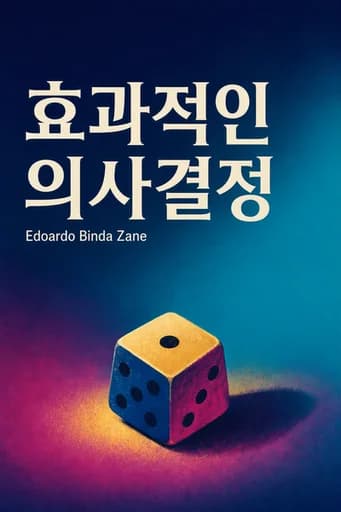
Discover Edoardo Binda Zane's practical guide to swift, effective decision-making. This hidden gem offers SWOT, PEST, and OODA Loop frameworks without overwhelming theory. What strategic technique are top professionals using that you haven't mastered yet?
Edoardo Binda Zane, author of Effective Decision-Making: How to Make Better Decisions Under Uncertainty and Pressure, is a leadership consultant and expert in high-pressure decision-making trained across Europe. Specializing in business strategy and self-help, his work focuses on equipping professionals with science-backed frameworks like the Recognition-Primed Decision model and OODA loop.
Binda Zane draws from his experience managing multimillion-euro projects and advising corporations, scaleups, and universities. A prolific author, he also wrote Emotional Intelligence For Leaders and Writing Proposals: A Handbook of What Makes Your Project Right for Funding, blending academic rigor with actionable insights from his Berlin-based consultancy.
His workshops boast a 61.5% average Net Promoter Score and are proven to deliver a minimum €12,000 ROI per organization within a year. Recognized for transforming complex psychological concepts into practical tools, Binda Zane’s methodologies are implemented by teams seeking resilience in dynamic markets, with his books serving as staples for managers navigating fast-paced environments.
Effective Decision-Making provides a toolkit for making confident choices under pressure, combining decision models like the OODA Loop and GROW framework with strategies to counter biases like confirmation bias. It emphasizes structured problem-solving, creative brainstorming, and team collaboration to navigate uncertainty while avoiding analysis paralysis.
This book is ideal for leaders, entrepreneurs, and teams needing to streamline decisions in high-stakes environments. It’s particularly valuable for those managing remote teams, rapid business pivots, or innovation-driven projects where clarity and speed are critical.
Yes—it offers actionable, research-backed techniques (like cost-benefit analysis and futures wheel mapping) without requiring extensive study. Professionals in fast-paced industries like tech, consulting, or startups will find its bias-mitigation tools especially practical.
Key models include:
It tackles biases like the Dunning-Kruger effect (overconfidence) and confirmation bias through exercises like Plus-Minus-Interesting assessments and decision trees. The author provides checklists to objectively evaluate options, reducing reliance on gut reactions.
Yes—it outlines protocols for collaborative problem-solving, including ideation sprints and impact assessment matrices to align diverse stakeholders. The “Strategic Clarity” section teaches how to balance speed and thoroughness in group decisions.
Case studies focus on business scenarios like risk assessment during expansions, conflict resolution in remote teams, and resource allocation under budget constraints. Tools like cost-benefit analysis are contextualized for agile project management and startup pivots.
While Kahneman’s work explores cognitive psychology in depth, Binda Zane prioritizes executable tactics for time-constrained professionals. Effective Decision-Making is more suited to readers seeking a playbook rather than theoretical insights.
Some reviewers note the book assumes baseline leadership experience, making it less accessible to entry-level professionals. Others highlight its tech-sector bias, though the author provides adaptation tips for nonprofits and government roles.
The “Pinpoint and Solve” section teaches rapid root-cause analysis using fishbone diagrams and 5 Whys techniques. It also details when to deploy heuristic shortcuts versus data-driven approaches to meet deadlines without sacrificing quality.
With remote work and AI-driven market shifts increasing decision complexity, the book’s hybrid human/analytical approach addresses contemporary challenges like decentralized team alignment and ethical AI integration. Updated case studies cover post-pandemic recovery strategies.
저자의 목소리로 책을 느껴보세요
지식을 흥미롭고 예시가 풍부한 인사이트로 전환
핵심 아이디어를 빠르게 캡처하여 신속하게 학습
재미있고 매력적인 방식으로 책을 즐기세요
Our brains often sabotage our decision-making without our knowledge.
Any decision-right or wrong-is better than the false safety of inaction.
Creativity requires suspending our brain's natural censoring process.
Speed matters.
Making decisions without understanding your context is like navigating without a map-you're merely hoping for the best.
Effective Decision-Making의 핵심 아이디어를 이해하기 쉬운 포인트로 분해하여 혁신적인 팀이 어떻게 창조하고, 협력하고, 성장하는지 이해합니다.
Effective Decision-Making을 빠른 기억 단서로 압축하여 솔직함, 팀워크, 창의적 회복력의 핵심 원칙을 강조합니다.

생생한 스토리텔링을 통해 Effective Decision-Making을 경험하고, 혁신 교훈을 기억에 남고 적용할 수 있는 순간으로 바꿉니다.
무엇이든 물어보고, 목소리를 선택하고, 진정으로 공감되는 인사이트를 함께 만들어보세요.

샌프란시스코에서 컬럼비아 대학교 동문들이 만들었습니다
"Instead of endless scrolling, I just hit play on BeFreed. It saves me so much time."
"I never knew where to start with nonfiction—BeFreed’s book lists turned into podcasts gave me a clear path."
"Perfect balance between learning and entertainment. Finished ‘Thinking, Fast and Slow’ on my commute this week."
"Crazy how much I learned while walking the dog. BeFreed = small habits → big gains."
"Reading used to feel like a chore. Now it’s just part of my lifestyle."
"Feels effortless compared to reading. I’ve finished 6 books this month already."
"BeFreed turned my guilty doomscrolling into something that feels productive and inspiring."
"BeFreed turned my commute into learning time. 20-min podcasts are perfect for finishing books I never had time for."
"BeFreed replaced my podcast queue. Imagine Spotify for books — that’s it. 🙌"
"It is great for me to learn something from the book without reading it."
"The themed book list podcasts help me connect ideas across authors—like a guided audio journey."
"Makes me feel smarter every time before going to work"
샌프란시스코에서 컬럼비아 대학교 동문들이 만들었습니다

Effective Decision-Making 요약을 무료 PDF 또는 EPUB으로 받으세요. 인쇄하거나 오프라인에서 언제든 읽을 수 있습니다.
Have you ever found yourself frozen at a critical decision point, unable to move forward? You're not alone. In today's fast-paced world, the ability to make sound decisions quickly often separates success from failure. What makes effective decision-making so challenging is that our brains - remarkable as they are - come with built-in flaws that sabotage our judgment without our awareness. Confirmation bias leads us to favor information supporting our preferred solutions while ignoring contradictory evidence. Meanwhile, the Dunning-Kruger effect creates meeting dynamics where the least competent person speaks with the most confidence, while skilled decision-makers second-guess themselves. These cognitive limitations make truly objective decisions nearly impossible without structured approaches. Even popular techniques like brainstorming prove counterproductive - research consistently shows that groups generate fewer and worse ideas than individuals working alone before coming together. The path forward? Remember William of Ockham's principle: among competing approaches, choose the simplest one that works. And perhaps most importantly, recognize that any decision - even an imperfect one - is better than the paralysis of indecision.