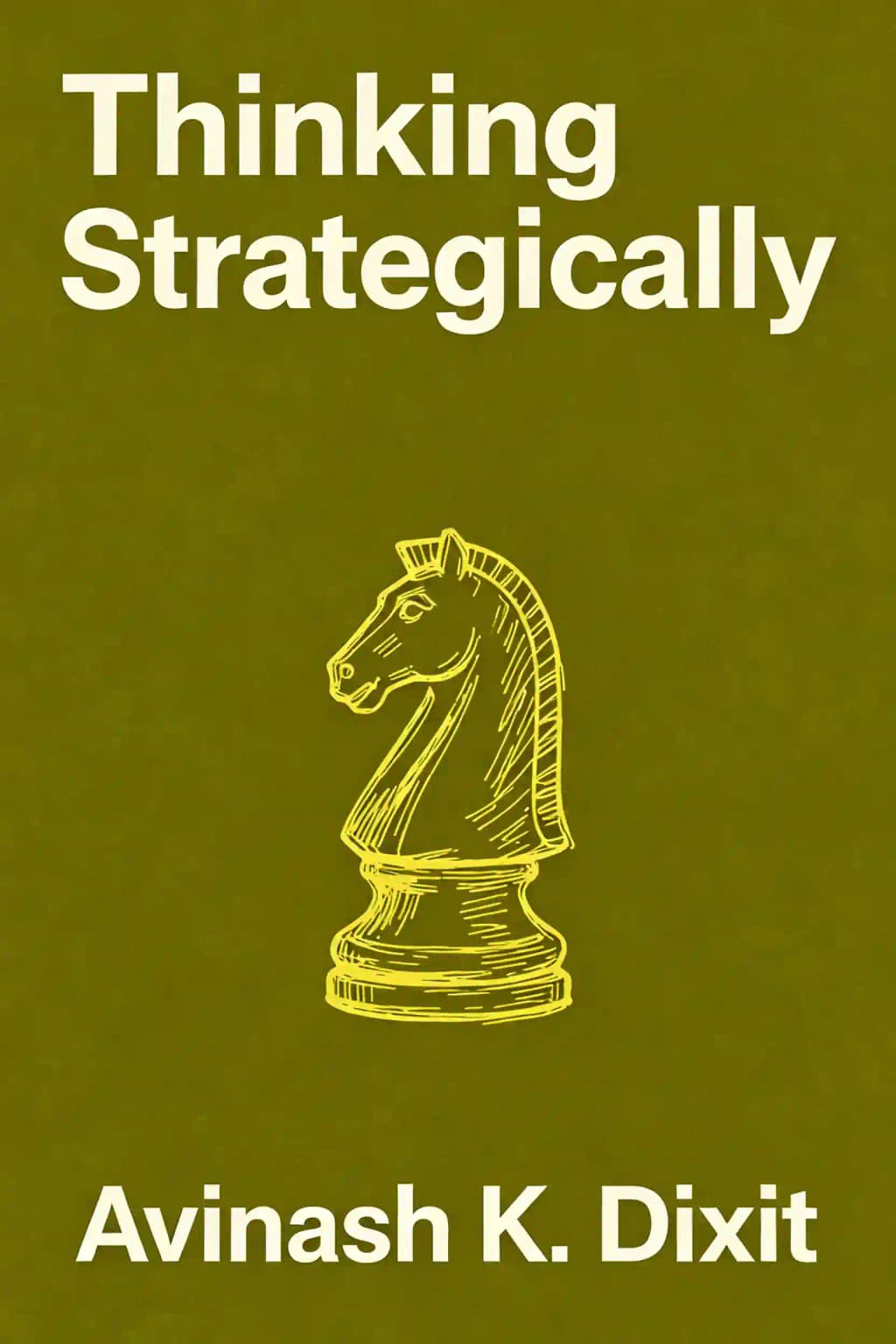
Masterful game theory made accessible. "Thinking Strategically" transforms business decisions, politics, and daily life with practical wisdom. A Financial Times Top Ten bestseller that Paul Samuelson endorsed as enjoyable and beneficial - your essential training for weighing possibilities in any competitive scenario.
Avinash Kamalakar Dixit, co-author of Thinking Strategically: The Competitive Edge in Business, Politics, and Everyday Life, is an internationally renowned economist and game theory pioneer. Born in Mumbai in 1944, Dixit combines academic rigor with real-world applicability in this business strategy classic, which applies game theory principles to competitive decision-making across industries.
As the John J. F. Sherrerd ’52 University Professor Emeritus at Princeton and former president of the American Economic Association, his work bridges economic theory and practical strategy, reflected in other seminal titles like The Art of Strategy and Games of Strategy—cornerstones of MBA curricula worldwide.
His research on investment uncertainty and institutional governance has influenced corporate boards and policymaking alike. Honored with India’s Padma Vibhushan and elected to the National Academy of Sciences, Dixit’s accessible yet profound frameworks continue shaping strategic thinking. Thinking Strategically remains a foundational text, translated into 15+ languages and recommended by executives and educators for its timeless insights into competitive dynamics.
Thinking Strategically explains game theory principles for optimizing decisions in competitive scenarios, from business to everyday life. It teaches readers to anticipate rivals' actions using concepts like dominant strategies, backward reasoning, and credible commitments. Through real-world examples, Dixit demonstrates how to craft winning strategies while accounting for others' countermoves.
Professionals in business, politics, or competitive fields will gain tactical insights, while general readers seeking sharper decision-making skills will find its non-technical approach accessible. The book suits anyone interested in understanding strategic interactions without advanced mathematics.
Key concepts include:
Dixit uses case studies like price-fixing cartels and negotiation tactics to show how strategic principles govern outcomes. For example, he explains why some companies succeed in collusion (credible threats) while others fail, and how to structure multi-stage bids to control corporate takeovers.
A dominant strategy outperforms all alternatives in every scenario. The book advises using such strategies when available and anticipating rivals' dominant moves to counter effectively. Examples include pricing wars where undercutting competitors becomes unavoidable.
Dixit explains how repeated interactions and long-term incentives (e.g., future penalties for cheating cartels) can foster cooperation, overcoming the dilemma's short-term conflict between individual and group rationality.
Some argue the book oversimplifies complex negotiations and underestimates emotional factors in decision-making. Critics also note it focuses heavily on zero-sum scenarios, offering less guidance for collaborative environments.
Both books simplify game theory, but The Art of Strategy includes more behavioral economics and psychological insights. Thinking Strategically emphasizes tactical frameworks for overtly competitive settings.
The book’s principles help navigate promotions, salary negotiations, and workplace competition. For example, using backward reasoning to map long-term career goals to present actions or employing credible commitments during job offer discussions.
Its frameworks remain critical for navigating AI-driven markets, geopolitical conflicts, and rapid industry disruptions. The rise of algorithmic competition makes anticipating rivals’ code-based strategies essential.
Pair with:
저자의 목소리로 책을 느껴보세요
지식을 흥미롭고 예시가 풍부한 인사이트로 전환
핵심 아이디어를 빠르게 캡처하여 신속하게 학습
재미있고 매력적인 방식으로 책을 즐기세요
Individual rational choices can lead to collectively inferior outcomes.
Look ahead and reason back.
Peace can be maintained through complex bilateral antagonisms.
Strategic thinking is fundamentally different from ordinary decision-making.
Thinking Strategically의 핵심 아이디어를 이해하기 쉬운 포인트로 분해하여 혁신적인 팀이 어떻게 창조하고, 협력하고, 성장하는지 이해합니다.
Thinking Strategically을 빠른 기억 단서로 압축하여 솔직함, 팀워크, 창의적 회복력의 핵심 원칙을 강조합니다.

생생한 스토리텔링을 통해 Thinking Strategically을 경험하고, 혁신 교훈을 기억에 남고 적용할 수 있는 순간으로 바꿉니다.
무엇이든 물어보고, 목소리를 선택하고, 진정으로 공감되는 인사이트를 함께 만들어보세요.

샌프란시스코에서 컬럼비아 대학교 동문들이 만들었습니다
"Instead of endless scrolling, I just hit play on BeFreed. It saves me so much time."
"I never knew where to start with nonfiction—BeFreed’s book lists turned into podcasts gave me a clear path."
"Perfect balance between learning and entertainment. Finished ‘Thinking, Fast and Slow’ on my commute this week."
"Crazy how much I learned while walking the dog. BeFreed = small habits → big gains."
"Reading used to feel like a chore. Now it’s just part of my lifestyle."
"Feels effortless compared to reading. I’ve finished 6 books this month already."
"BeFreed turned my guilty doomscrolling into something that feels productive and inspiring."
"BeFreed turned my commute into learning time. 20-min podcasts are perfect for finishing books I never had time for."
"BeFreed replaced my podcast queue. Imagine Spotify for books — that’s it. 🙌"
"It is great for me to learn something from the book without reading it."
"The themed book list podcasts help me connect ideas across authors—like a guided audio journey."
"Makes me feel smarter every time before going to work"
샌프란시스코에서 컬럼비아 대학교 동문들이 만들었습니다

Thinking Strategically 요약을 무료 PDF 또는 EPUB으로 받으세요. 인쇄하거나 오프라인에서 언제든 읽을 수 있습니다.
Life is a series of strategic interactions. From negotiating with your children to competing in business, from playing tennis to navigating international politics-success depends not just on what you do, but on how others respond to your actions. This fundamental insight forms the core of "Thinking Strategically." Unlike chopping wood, where the tree doesn't fight back, strategic situations involve intelligent counterparts actively working to anticipate your moves while you try to anticipate theirs. Consider why tennis players don't always serve to their opponent's weak side. If they did, the opponent would simply position themselves accordingly. Instead, top players mix up their serves unpredictably. Or why do politicians from opposing parties often converge toward similar positions? Because they're responding to the same strategic incentives, regardless of ideology. The classic "prisoners' dilemma" perfectly illustrates strategic thinking's challenges. Two suspects face interrogation separately. If both remain silent, each gets three years. If one confesses while the other stays silent, the confessor gets one year while the other gets twenty-five. If both confess, each gets ten years. Though mutual silence produces the best joint outcome, the individual incentive to confess is overwhelming. This leads both to confess, resulting in a worse collective outcome than if they'd cooperated. This pattern appears everywhere: nuclear disarmament negotiations, price wars between businesses, environmental conservation efforts. In each case, individual rational choices can lead to collectively inferior results. Understanding these dynamics isn't just academic-it's essential for navigating our interconnected world.