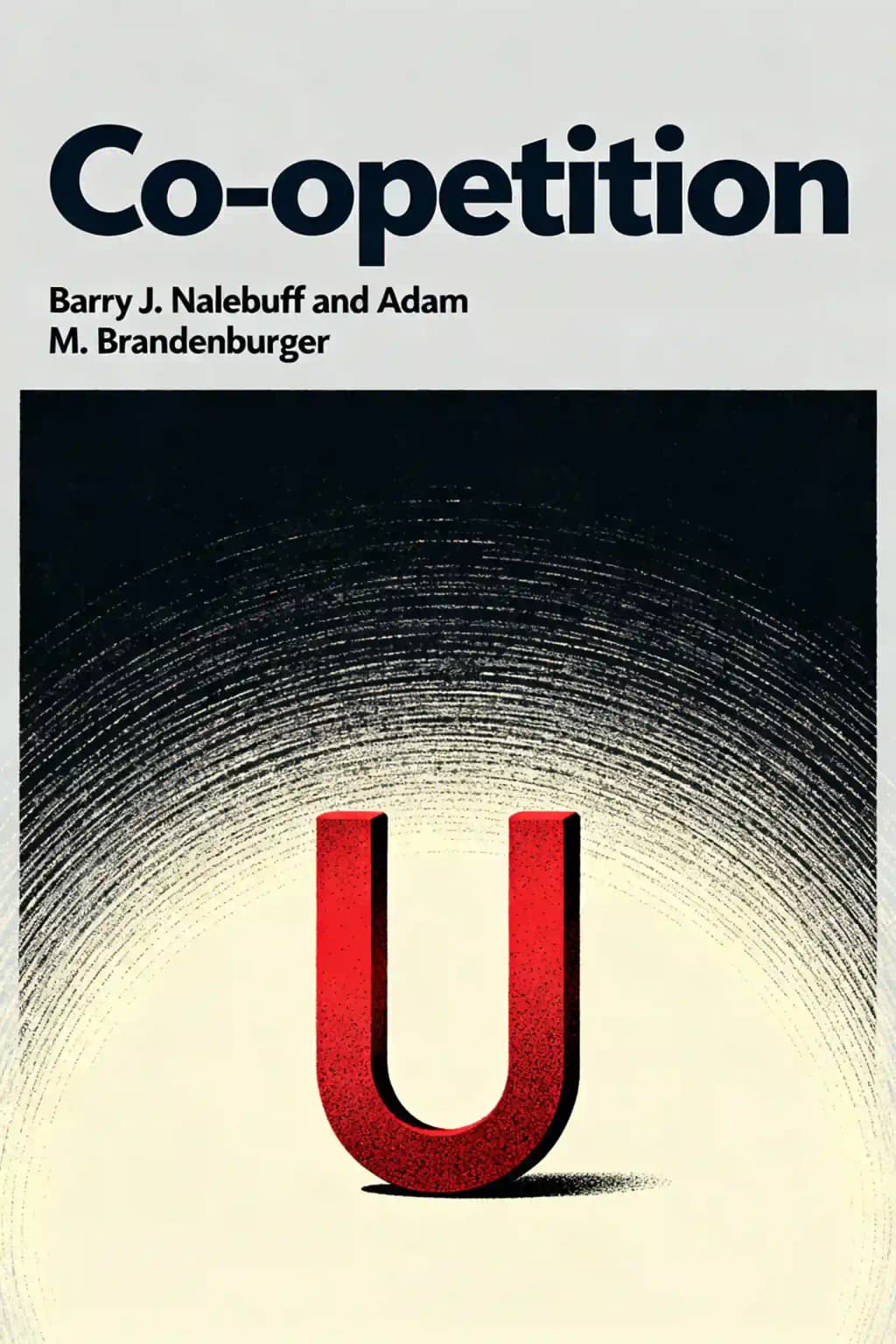
"Co-opetition" revolutionized business by merging competition and cooperation through game theory. Endorsed by Tom Peters, its strategies transformed giants like Intel and Nintendo. Can your company win by cooperating with rivals? Discover the counterintuitive framework that's reshaping industries worldwide.
Barry J. Nalebuff and Adam M. Brandenburger, the co-authors of Co-opetition, are pioneering strategists who revolutionized business thinking through the application of game theory. Together, they combined academic rigor with real-world insights to create this 1996 classic.
Nalebuff is the Milton Steinbach Professor at Yale School of Management, while Brandenburger is the J.P. Valles Professor at NYU Stern. Co-opetition redefined competitive strategy by demonstrating how businesses can thrive through the seemingly paradoxical combination of simultaneous cooperation and competition.
Both authors have individually authored influential works, including Thinking Strategically and The Art of Strategy (co-authored with Avinash Dixit), further blending game theory with practical decision-making frameworks. Their ideas have profoundly shaped MBA curricula and corporate strategies worldwide, with Co-opetition itself being featured in the Harvard Business Review and applied by leaders in Fortune 500 companies.
Nalebuff’s Split the Pie further extends their negotiation philosophy, while Brandenburger’s research on cognitive science and information theory continues to inform modern strategic models. Translated into more than 20 languages, Co-opetition remains a cornerstone text at top business schools around the globe.
Co-Opetition merges competition and cooperation through game theory, arguing businesses thrive by strategically collaborating with rivals, suppliers, and customers. Authors Adam Brandenburger and Barry Nalebuff introduce frameworks like the Value Net and PARTS to redesign industry dynamics, creating win-win outcomes. Examples include Intel and Microsoft’s symbiotic growth. The book challenges zero-sum thinking, offering tools to innovate beyond traditional rivalry.
Executives, entrepreneurs, and strategists seeking non-traditional approaches to competition will benefit. The book suits professionals in fast-evolving industries like tech, where partnerships (e.g., Apple and Samsung) drive mutual success. Academics studying game theory or business models also gain actionable insights.
Yes. Its principles remain vital for navigating digital transformation, AI partnerships, and global supply chains. The PARTS framework (Players, Added Value, Rules, Tactics, Scope) helps firms adapt to collaborative economies. A Business Weekly bestseller, it’s praised for blending theory with cases like Nintendo’s ecosystem strategy.
PARTS analyzes five levers to reshape business games:
This model helps firms like Tesla redefine automotive competition through open patents.
Unlike zero-sum guides, it emphasizes creating value with rivals. For example, Netflix partnered with telecom providers to expand streaming access, growing the market for all. The book’s game theory foundation contrasts with Michael Porter’s rivalry-centric models.
Some argue its frameworks oversimplify complex negotiations or require equal power among players. Critics note real-world alliances (e.g., Samsung-Apple patent disputes) often involve lopsided bargaining. However, the core idea of “changing the game” remains influential.
Startups can partner with larger firms for distribution (e.g., Spotify integrating with Facebook) or share R&D costs with rivals. The Value Net helps identify complementors—like how Uber leveraged Google Maps—to enhance offerings without direct competition.
The Value Net maps four stakeholders: Customers, Suppliers, Competitors, and Complementors (entities that enhance your product’s value). For instance, Adobe’s PDF format succeeded by making printers (complementors) adopt it freely, boosting ubiquity.
It advocates “co-innovating” with rivals to share risks. Pharma companies often collaborate on pre-competitive research (e.g., mRNA technology) while competing in drug commercialization. This mirrors the book’s “co-create, then compete” ethos.
These highlight balancing collaboration and rivalry.
Unlike Thinking Strategically (pure game theory), Co-Opetition focuses on reshaping industry dynamics. His ventures like Honest Tea reflect these principles—collaborating with Coca-Cola for distribution while retaining brand autonomy.
저자의 목소리로 책을 느껴보세요
지식을 흥미롭고 예시가 풍부한 인사이트로 전환
핵심 아이디어를 빠르게 캡처하여 신속하게 학습
재미있고 매력적인 방식으로 책을 즐기세요
Success doesn't necessarily come at others' expense.
Real success comes from creating the game you want.
The future belongs to organizations that can master both competition and cooperation.
Smart businesses actively develop complementary offerings.
Businesses often fixate on competitive relationships while overlooking complementary ones.
Co-Opetition : A Revolution Mindset That Combines Competition and Cooperation의 핵심 아이디어를 이해하기 쉬운 포인트로 분해하여 혁신적인 팀이 어떻게 창조하고, 협력하고, 성장하는지 이해합니다.
Co-Opetition : A Revolution Mindset That Combines Competition and Cooperation을 빠른 기억 단서로 압축하여 솔직함, 팀워크, 창의적 회복력의 핵심 원칙을 강조합니다.

생생한 스토리텔링을 통해 Co-Opetition : A Revolution Mindset That Combines Competition and Cooperation을 경험하고, 혁신 교훈을 기억에 남고 적용할 수 있는 순간으로 바꿉니다.
무엇이든 물어보고, 목소리를 선택하고, 진정으로 공감되는 인사이트를 함께 만들어보세요.

샌프란시스코에서 컬럼비아 대학교 동문들이 만들었습니다
"Instead of endless scrolling, I just hit play on BeFreed. It saves me so much time."
"I never knew where to start with nonfiction—BeFreed’s book lists turned into podcasts gave me a clear path."
"Perfect balance between learning and entertainment. Finished ‘Thinking, Fast and Slow’ on my commute this week."
"Crazy how much I learned while walking the dog. BeFreed = small habits → big gains."
"Reading used to feel like a chore. Now it’s just part of my lifestyle."
"Feels effortless compared to reading. I’ve finished 6 books this month already."
"BeFreed turned my guilty doomscrolling into something that feels productive and inspiring."
"BeFreed turned my commute into learning time. 20-min podcasts are perfect for finishing books I never had time for."
"BeFreed replaced my podcast queue. Imagine Spotify for books — that’s it. 🙌"
"It is great for me to learn something from the book without reading it."
"The themed book list podcasts help me connect ideas across authors—like a guided audio journey."
"Makes me feel smarter every time before going to work"
샌프란시스코에서 컬럼비아 대학교 동문들이 만들었습니다

Co-Opetition : A Revolution Mindset That Combines Competition and Cooperation 요약을 무료 PDF 또는 EPUB으로 받으세요. 인쇄하거나 오프라인에서 언제든 읽을 수 있습니다.
In 1996, when business strategy was still dominated by warfare metaphors, Barry Nalebuff and Adam Brandenburger introduced a revolutionary concept: co-opetition. This groundbreaking approach challenged the prevailing wisdom that business success requires others to fail. Instead, they demonstrated how companies could simultaneously compete and cooperate to create greater value for all participants. The concept resonated so powerfully that tech visionaries like Bill Gates and Andy Grove credited it with reshaping their strategic thinking. Consider how Apple and Samsung fiercely compete in smartphones while Samsung remains a key supplier of iPhone components. Or how automotive manufacturers collaborate on safety standards while competing for customers. These aren't contradictions-they're the fundamental reality of modern business. Success doesn't necessarily come at others' expense. The streaming industry exemplifies this perfectly: Netflix, Amazon Prime, and Disney+ compete vigorously for subscribers while collectively growing the overall market for digital entertainment. What makes this approach so powerful? It applies game theory-traditionally associated with zero-sum military strategy-to show how businesses can create win-win scenarios while still capturing their fair share of value. Unlike temporary business trends, game theory offers an enduring thinking framework that adapts to changing conditions, helping strategists analyze both competitive and cooperative scenarios.