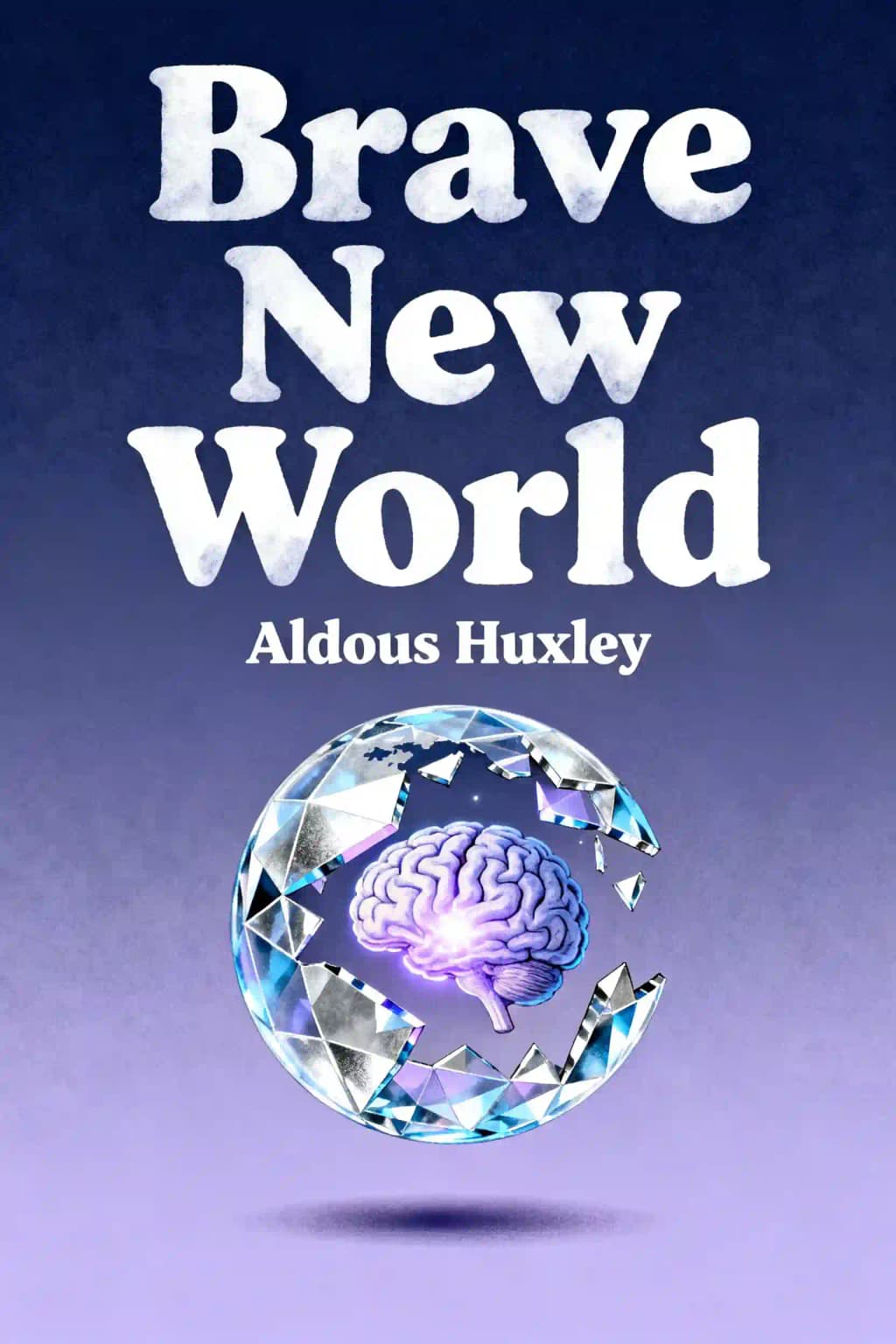
Brave New World
Overview of Brave New World
In Huxley's dystopian masterpiece - ranked fifth among the century's greatest novels - pleasure becomes control. Banned yet prophetic, it eerily predicted our addiction to technology and consumption. What's more terrifying: Orwell's brutal dictatorship or Huxley's seductive slavery?

Key Themes in Brave New World
- biological determinism
- technological escapism
- engineered social hierarchy
- consumerist conditioning
- loss of individuality
Quotes from Brave New World
Freedom is the true obscenity.
Oppression comes gift-wrapped as pleasure.
Everyone belongs to everyone else.
Ending is better than mending.
A gramme is better than a damn.
Characters in Brave New World
- Mustapha MondThe Controller who explains the World State
- Bernard MarxAn Alpha who feels isolated from society
- LeninaA woman who dates Henry Foster
- Henry FosterA man who dates Lenina
- FannyLenina's friend who warns her about monogamy
About the Author
About the Author of Brave New World
Aldous Huxley (1894–1963), the visionary British author of Brave New World, was a pioneering social critic and literary satirist whose dystopian novel reshaped 20th-century speculative fiction. Born into a family of renowned scientists—including his biologist grandfather Thomas Henry Huxley—Huxley blended scientific foresight with philosophical inquiry, exploring themes of technological tyranny, psychological conditioning, and societal conformity.
His partial blindness in youth diverted him from a medical career to literature, where works like Eyeless in Gaza and The Doors of Perception further cemented his reputation for merging speculative narratives with existential questions.
A California resident from 1937 until his death, Huxley expanded his explorations into mysticism and psychedelics, documented in essays like The Perennial Philosophy. Brave New World has sold over 15 million copies globally, been translated into 28 languages, and inspired countless adaptations, solidifying its status as a cornerstone of dystopian literature. His final novel, Island, offers a utopian counterpoint to Brave New World’s warnings, completing his lifelong examination of humanity’s fragile balance between progress and ethics.
Download Summary of Brave New World
Get the Brave New World summary as a free PDF or EPUB. Print it or read offline anytime.
FAQs About This Book
Brave New World (1932) depicts a dystopian future where society is controlled through genetic engineering, psychological conditioning, and pleasure-inducing drugs. Set in 2540 CE, the World State prioritizes stability over individuality, eradicating family, art, and free will. Key characters like Bernard Marx and John the Savage grapple with the dehumanizing effects of a society that sacrifices humanity for efficiency.
This novel suits readers interested in dystopian classics, critiques of technology-driven societies, or themes like government control vs. personal freedom. Fans of Orwell’s 1984 or Atwood’s The Handmaid’s Tale will find parallels in Huxley’s exploration of societal manipulation and loss of identity.
Yes. Huxley’s work remains a cornerstone of dystopian literature, offering sharp commentary on consumerism, scientific advancement, and authoritarianism. Though critiqued for its bleakness and controversial themes, its warnings about sacrificing morality for comfort remain urgently relevant.
- Government control: Citizens are genetically engineered and conditioned for predetermined roles.
- Technology vs. humanity: Science replaces natural reproduction and emotions.
- Freedom vs. happiness: Stability is enforced through soma (a pacifying drug) and suppressed individualism.
- Bernard Marx: An Alpha Plus who resists societal norms but succumbs to vanity.
- John the Savage: Raised outside the World State, he symbolizes natural human emotion.
- Mustapha Mond: A World Controller who defends the system’s dehumanizing logic.
- Genetic engineering: Embryos are scientifically altered to fit caste roles.
- Conditioning: Children learn societal values through sleep-teaching.
- Soma: A drug used to suppress dissent and ensure compliance.
While both critique totalitarianism, Huxley’s society controls through pleasure and distraction, whereas Orwell’s uses surveillance and fear. Brave New World warns about voluntary submission to comfort, while 1984 focuses on forced oppression.
The phrase, borrowed from Shakespeare’s The Tempest, is used ironically. John the Savage initially sees the World State as “brave” but later rejects its emptiness, highlighting the gap between technological progress and human fulfillment.
Some argue Huxley’s portrayal of promiscuity and drug use is immoral, while others find the characters underdeveloped. Critics also debate whether true happiness can exist without freedom or emotional depth.
The novel’s themes resonate with modern concerns: AI ethics, genetic manipulation, and social media’s role in pacifying populations. Its warning about trading autonomy for convenience mirrors debates on technology’s psychological costs.
Huxley warns that utopian ideals often mask dehumanization. The pursuit of stability through control sacrifices creativity, love, and individuality, reducing humans to cogs in a machine.
John’s exposure to Shakespearean ideals clashes with the World State’s shallow values. His eventual suicide underscores the incompatibility of raw human emotion with a sanitized, pleasure-driven society.
As Resident Controller, Mond embodies the regime’s logic. He defends the suppression of art, religion, and science, arguing that happiness requires the eradication of discomfort and ambition.





