Ethics: Demonstrated in Geometrical Order by Baruch Spinoza Summary

Overview of Ethics
Spinoza's "Ethics" - a revolutionary geometric proof of human nature that challenged 17th-century religious orthodoxy. Einstein called him his "spiritual ancestor," while Nietzsche found his deterministic universe both terrifying and liberating. Can understanding necessity actually make you free?
- God and Nature are one infinite substance governing all existence
- Human freedom comes from understanding divine necessity, not defying it
- Emotions are confused ideas; reason transforms passions into clarity
- Ethical living requires aligning actions with nature’s deterministic laws
- True virtue lies in pursuing knowledge of eternal truths
- Conatus—the drive to persist—defines existence and ethical purpose
- Free will is an illusion; self-awareness breaks mental bondage
- Joy emerges from loving God/Nature through intellectual comprehension
- Morality stems from comprehending desires, not abstract commandments
- Geometric logic reveals reality’s structure: definitions to cosmic unity
- Suffering diminishes when reason overpowers fleeting emotional reactions
- Spiritual liberation arises from seeing oneself as nature’s expression
About the Author of Ethics
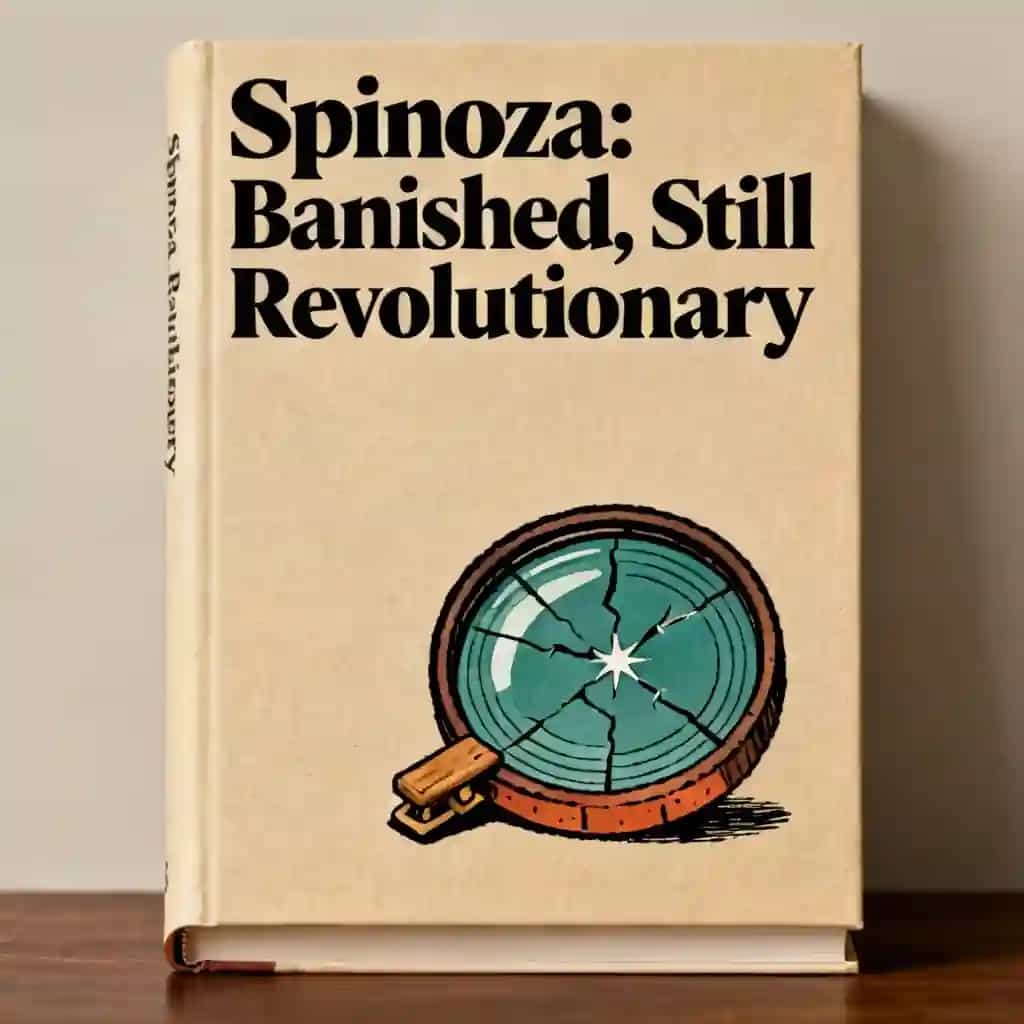
Baruch Spinoza (1632–1677), the visionary Dutch philosopher and rationalist thinker, authored Ethics, a foundational work in Western philosophy that combines metaphysics, epistemology, and moral philosophy. Born in Amsterdam to a Sephardic Jewish family, Spinoza’s unorthodox views on theology and deterministic universe led to his excommunication in 1656, freeing him to explore radical ideas about God, nature, and human freedom.
His philosophical system, presented in Ethics through geometric axioms and proofs, redefined ethical inquiry by grounding virtue in reason and the immutable laws of existence.
Spinoza’s influential Theological-Political Treatise (1670), which challenged scriptural authority, and his posthumously published Political Treatise further cemented his role as a pioneer of Enlightenment thought. A lens grinder by trade, Spinoza supported his intellectual pursuits through craftsmanship while corresponding with Europe’s leading thinkers.
His works, initially condemned, later inspired philosophers like Hegel, Nietzsche, and Einstein, with Ethics becoming a cornerstone of modern philosophical discourse. Translated into over 30 languages and continually studied in academic institutions worldwide, Ethics endures as a testament to Spinoza’s enduring legacy in reshaping humanity’s understanding of freedom, ethics, and the divine.
FAQs About Ethics
What is Ethics by Baruch Spinoza about?
Ethics systematically redefines God, nature, and human freedom through a geometric framework of definitions and proofs. Spinoza argues that God is identical with nature (Deus sive Natura), rejecting a transcendent deity, and posits that understanding natural laws empowers individuals to live ethically. The work merges metaphysics with practical guidance, advocating reason over superstition to achieve joy and liberation from destructive passions.
Who should read Ethics by Baruch Spinoza?
Philosophy students, seekers of Enlightenment-era rationalism, and readers exploring pantheism or deterministic worldviews will find it essential. Its dense, logical structure appeals to those interested in metaphysics, while its ethical insights resonate with anyone pursuing self-mastery through reason.
Is Ethics by Baruch Spinoza worth reading?
Yes, as a foundational text of modern philosophy, it challenges traditional religious and ethical frameworks. While demanding, its ideas on mind-body unity, determinism, and joy-through-understanding influenced thinkers like Einstein and Nietzsche.
What is Spinoza’s concept of God in Ethics?
Spinoza equates God with nature (Deus sive Natura), rejecting a personal deity. God is the infinite, impersonal substance underlying all existence, governed by immutable laws. This pantheistic view dissolves the distinction between creator and creation.
What does Spinoza mean by “conatus” in Ethics?
Conatus denotes every being’s innate striving to preserve and enhance its existence. For humans, this drive underlies desires, emotions, and ethical decisions. Joy arises when our conatus flourishes; sorrow stems from its obstruction.
How does Spinoza view human emotions in Ethics?
Emotions, like all natural phenomena, follow cause-effect laws. Passions like hatred or envy enslave us, but reason transforms them into active, empowering “affects.” Understanding emotions’ origins reduces their disruptive power.
What is the geometric method in Ethics?
Modeled on Euclid’s geometry, Spinoza structures arguments via definitions (e.g., “God”), axioms (self-evident truths), and deductive propositions. This method aims to eliminate ambiguity and ground philosophy in logical necessity.
What are Spinoza’s views on free will in Ethics?
He rejects free will, arguing human actions are determined by natural laws. True freedom means understanding these laws and aligning with them—liberation through knowledge, not arbitrary choice.
How does Ethics define good and evil?
Good enhances our power to act; evil diminishes it. These are not universal absolutes but relational concepts tied to an individual’s conatus. Virtue lies in pursuing what truly strengthens one’s being.
Why does Ethics critique traditional religion?
Spinoza condemns religions that promote fear, superstition, or anthropomorphic gods. True piety, he argues, involves studying nature’s laws rationally—a view that challenged 17th-century orthodoxy.
How does Ethics apply to modern life?
Its emphasis on reason over dogma, emotional self-awareness, and ecological interconnectedness (via Deus sive Natura) aligns with secular mindfulness practices and systems-thinking approaches to ethics.
What is the significance of “Deus sive Natura” in Ethics?
This phrase (“God or Nature”) encapsulates Spinoza’s pantheism: divinity isn’t separate from the physical world. Recognizing this unity allows humans to live harmoniously within nature’s constraints.
Feel the book through the author's voice
Turn knowledge into engaging, example-rich insights
Capture key ideas in a flash for fast learning
Enjoy the book in a fun and engaging way
Key Themes in Ethics
Quotes from Ethics
The greatest pride or the greatest despondency is the greatest ignorance of one's self.
The effort to understand is the first and only basis of virtue.
Emotion, which is suffering, ceases to be suffering as soon as we form a clear and precise picture of it.
"God, or Nature."
Characters in Ethics
Quick Summary Mode - Read or listen to Ethics Summary in 9 Minutes

Break down key ideas from Ethics into bite-sized takeaways to understand how innovative teams create, collaborate, and grow.

Flash Card Mode - Top 6 Insights from Ethics in a Nutshell

Distill Ethics into rapid-fire memory cues that highlight key principles of candor, teamwork, and creative resilience.

Fun Mode - Ethics Lessons Told Through 23-Min Stories

Experience Ethics through vivid storytelling that turns innovation lessons into moments you'll remember and apply.
Personalize Mode - Read or listen to Ethics Summary in 0 Minutes

Ask anything, pick the voice, and co-create insights that truly resonate with you.

From Columbia University alumni built in San Francisco
"Instead of endless scrolling, I just hit play on BeFreed. It saves me so much time."


"I never knew where to start with nonfiction—BeFreed’s book lists turned into podcasts gave me a clear path."


"Perfect balance between learning and entertainment. Finished ‘Thinking, Fast and Slow’ on my commute this week."
"Crazy how much I learned while walking the dog. BeFreed = small habits → big gains."
"Reading used to feel like a chore. Now it’s just part of my lifestyle."

"Feels effortless compared to reading. I’ve finished 6 books this month already."
"BeFreed turned my guilty doomscrolling into something that feels productive and inspiring."

"BeFreed turned my commute into learning time. 20-min podcasts are perfect for finishing books I never had time for."
"BeFreed replaced my podcast queue. Imagine Spotify for books — that’s it. 🙌"

"It is great for me to learn something from the book without reading it."
"The themed book list podcasts help me connect ideas across authors—like a guided audio journey."
"Makes me feel smarter every time before going to work"
From Columbia University alumni built in San Francisco
"Instead of endless scrolling, I just hit play on BeFreed. It saves me so much time."
"I never knew where to start with nonfiction—BeFreed’s book lists turned into podcasts gave me a clear path."
"Perfect balance between learning and entertainment. Finished ‘Thinking, Fast and Slow’ on my commute this week."
"Crazy how much I learned while walking the dog. BeFreed = small habits → big gains."
"Reading used to feel like a chore. Now it’s just part of my lifestyle."
"Feels effortless compared to reading. I’ve finished 6 books this month already."
"BeFreed turned my guilty doomscrolling into something that feels productive and inspiring."
"BeFreed turned my commute into learning time. 20-min podcasts are perfect for finishing books I never had time for."
"BeFreed replaced my podcast queue. Imagine Spotify for books — that’s it. 🙌"
"It is great for me to learn something from the book without reading it."
"The themed book list podcasts help me connect ideas across authors—like a guided audio journey."
"Makes me feel smarter every time before going to work"
"Instead of endless scrolling, I just hit play on BeFreed. It saves me so much time."
"I never knew where to start with nonfiction—BeFreed’s book lists turned into podcasts gave me a clear path."
"Perfect balance between learning and entertainment. Finished ‘Thinking, Fast and Slow’ on my commute this week."
"Crazy how much I learned while walking the dog. BeFreed = small habits → big gains."
"Reading used to feel like a chore. Now it’s just part of my lifestyle."
"Feels effortless compared to reading. I’ve finished 6 books this month already."
"BeFreed turned my guilty doomscrolling into something that feels productive and inspiring."
"BeFreed turned my commute into learning time. 20-min podcasts are perfect for finishing books I never had time for."
"BeFreed replaced my podcast queue. Imagine Spotify for books — that’s it. 🙌"
"It is great for me to learn something from the book without reading it."
"The themed book list podcasts help me connect ideas across authors—like a guided audio journey."
"Makes me feel smarter every time before going to work"
"Instead of endless scrolling, I just hit play on BeFreed. It saves me so much time."
"I never knew where to start with nonfiction—BeFreed’s book lists turned into podcasts gave me a clear path."
"Perfect balance between learning and entertainment. Finished ‘Thinking, Fast and Slow’ on my commute this week."
"Crazy how much I learned while walking the dog. BeFreed = small habits → big gains."
"Reading used to feel like a chore. Now it’s just part of my lifestyle."
"Feels effortless compared to reading. I’ve finished 6 books this month already."
"BeFreed turned my guilty doomscrolling into something that feels productive and inspiring."
"BeFreed turned my commute into learning time. 20-min podcasts are perfect for finishing books I never had time for."
"BeFreed replaced my podcast queue. Imagine Spotify for books — that’s it. 🙌"
"It is great for me to learn something from the book without reading it."
"The themed book list podcasts help me connect ideas across authors—like a guided audio journey."
"Makes me feel smarter every time before going to work"

Get the Ethics summary as a free PDF or EPUB. Print it or read offline anytime.