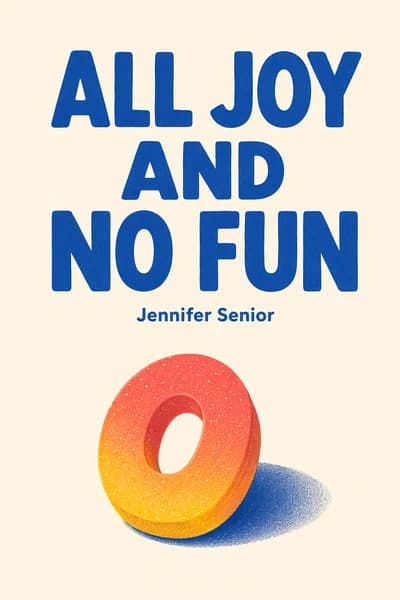
Jennifer Senior's bestselling exploration reveals why modern parenting feels so difficult yet rewarding. Endorsed by happiness expert Daniel Gilbert and discussed by Terry Gross and Steve Colbert, this book distinguishes fleeting happiness from profound joy - answering why we choose parenthood despite the chaos.
Jennifer Senior is the bestselling author of All Joy and No Fun: The Paradox of Modern Parenthood and a Pulitzer Prize-winning journalist renowned for her incisive explorations of family dynamics and social science.
A staff writer at The Atlantic and former columnist for The New York Times, Senior blends rigorous research with personal insight to dissect contemporary parenting’s joys and struggles. Her work, including the National Magazine Award-winning feature “What Bobby McIlvaine Left Behind” (later expanded into the book On Grief: Love, Loss, Memory), often bridges intimate storytelling and cultural critique.
A frequent commentator on NPR and featured speaker at venues like TED and the Aspen Ideas Festival, Senior draws from her 20+ years in journalism and lived experience as a parent to analyze societal shifts. All Joy and No Fun, a New York Times bestseller for eight weeks, has been translated into 12 languages and remains a seminal text on modern family life.
All Joy and No Fun examines how modern parenting reshapes adults’ lives, blending social science, history, and personal narratives. Jennifer Senior explores parenthood’s psychological toll, shifting family roles since the Industrial Revolution, and societal pressures like outsourcing childcare. Unlike prescriptive guides, it focuses on what parenting does to parents, addressing marital strain, identity shifts, and the tension between joy and exhaustion.
This book suits parents seeking deeper understanding of modern parenting’s challenges, sociologists studying family dynamics, and readers interested in cultural critiques. Its research-driven approach appeals to those tired of “how-to” guides and curious about broader societal trends impacting parenthood, work-life balance, and mental health.
Yes—it’s a New York Times bestseller praised for reframing parenting debates. Senior’s mix of relatable stories and academic rigor offers fresh insights into why parenting feels harder today, making it a standout in both self-help and social science genres. Daniel Gilbert (Stumbling on Happiness) calls it “indispensable”.
Senior avoids prescriptive solutions, instead analyzing systemic pressures like hyper-vigilant parenting norms and the decline of community support. She argues modern parents face unprecedented isolation, with tasks once shared broadly now falling solely on nuclear families—a shift linked to increased stress.
Senior critiques the “professionalization” of parenting, where experts replace communal wisdom, and the unrealistic expectation for parents to be both emotionally fulfilled and perpetually productive. She highlights how outsourcing childcare creates guilt while failing to alleviate workloads.
She cites studies showing parents report lower happiness than non-parents, contextualizing this with qualitative interviews. For example, she links marital dissatisfaction post-kids to intensified gender roles and the “second shift” of domestic labor.
Unlike Bringing Up Bébé or The Whole-Brain Child, Senior avoids advice-giving. Instead, she offers diagnostic analysis akin to Arlie Hochschild’s The Second Shift, focusing on systemic pressures rather than individual fixes.
A Pulitzer Prize-winning journalist for The Atlantic, Senior combines investigative rigor with personal experience. Her 2010 New York Magazine article on parental happiness laid the groundwork for this book, which spent eight weeks on the NYT bestseller list.
As remote work blurs home-life boundaries and mental health awareness grows, Senior’s insights into parental isolation and identity loss remain urgent. The book helps navigate post-pandemic parenting challenges, including hybrid schooling and shrinking social safety nets.
Some argue it overemphasizes middle-class experiences and undersells parental resilience. However, its candid exploration of ambivalence resonates broadly, offering validation over solutions—a strength for some, a limitation for others.
저자의 목소리로 책을 느껴보세요
지식을 흥미롭고 예시가 풍부한 인사이트로 전환
핵심 아이디어를 빠르게 캡처하여 신속하게 학습
재미있고 매력적인 방식으로 책을 즐기세요
Children are naturally "pashas of excess" with "too much desire; too little organization."
You must choose, again and again.
You only think about yourself. I never thought I'd have to raise a family alone.
It was our lack of connection. And the less connected I felt, the more I felt like I was going to snap.
All joy and no fun의 핵심 아이디어를 이해하기 쉬운 포인트로 분해하여 혁신적인 팀이 어떻게 창조하고, 협력하고, 성장하는지 이해합니다.
All joy and no fun을 빠른 기억 단서로 압축하여 솔직함, 팀워크, 창의적 회복력의 핵심 원칙을 강조합니다.

생생한 스토리텔링을 통해 All joy and no fun을 경험하고, 혁신 교훈을 기억에 남고 적용할 수 있는 순간으로 바꿉니다.
무엇이든 물어보고, 목소리를 선택하고, 진정으로 공감되는 인사이트를 함께 만들어보세요.

샌프란시스코에서 컬럼비아 대학교 동문들이 만들었습니다
"Instead of endless scrolling, I just hit play on BeFreed. It saves me so much time."
"I never knew where to start with nonfiction—BeFreed’s book lists turned into podcasts gave me a clear path."
"Perfect balance between learning and entertainment. Finished ‘Thinking, Fast and Slow’ on my commute this week."
"Crazy how much I learned while walking the dog. BeFreed = small habits → big gains."
"Reading used to feel like a chore. Now it’s just part of my lifestyle."
"Feels effortless compared to reading. I’ve finished 6 books this month already."
"BeFreed turned my guilty doomscrolling into something that feels productive and inspiring."
"BeFreed turned my commute into learning time. 20-min podcasts are perfect for finishing books I never had time for."
"BeFreed replaced my podcast queue. Imagine Spotify for books — that’s it. 🙌"
"It is great for me to learn something from the book without reading it."
"The themed book list podcasts help me connect ideas across authors—like a guided audio journey."
"Makes me feel smarter every time before going to work"
샌프란시스코에서 컬럼비아 대학교 동문들이 만들었습니다

All joy and no fun 요약을 무료 PDF 또는 EPUB으로 받으세요. 인쇄하거나 오프라인에서 언제든 읽을 수 있습니다.
Here's the uncomfortable truth: parents love their children desperately, yet parenting itself often makes them miserable. Studies consistently show that parents report lower happiness levels than their childless peers. They argue more with their partners, sleep less, and experience more anxiety. Yet when asked about life's greatest sources of meaning and joy, 85 percent point to their children without hesitation. This contradiction sits at the heart of modern parenthood-we've created a system where raising children has become more emotionally demanding than ever before, even as children have become "economically worthless but emotionally priceless." We're the first generation to parent without clear scripts, preparing children for futures we can't imagine, while juggling impossible expectations about work, marriage, and self-fulfillment. The result? A parenting experience that feels simultaneously essential and overwhelming, where love and exhaustion exist in constant tension.