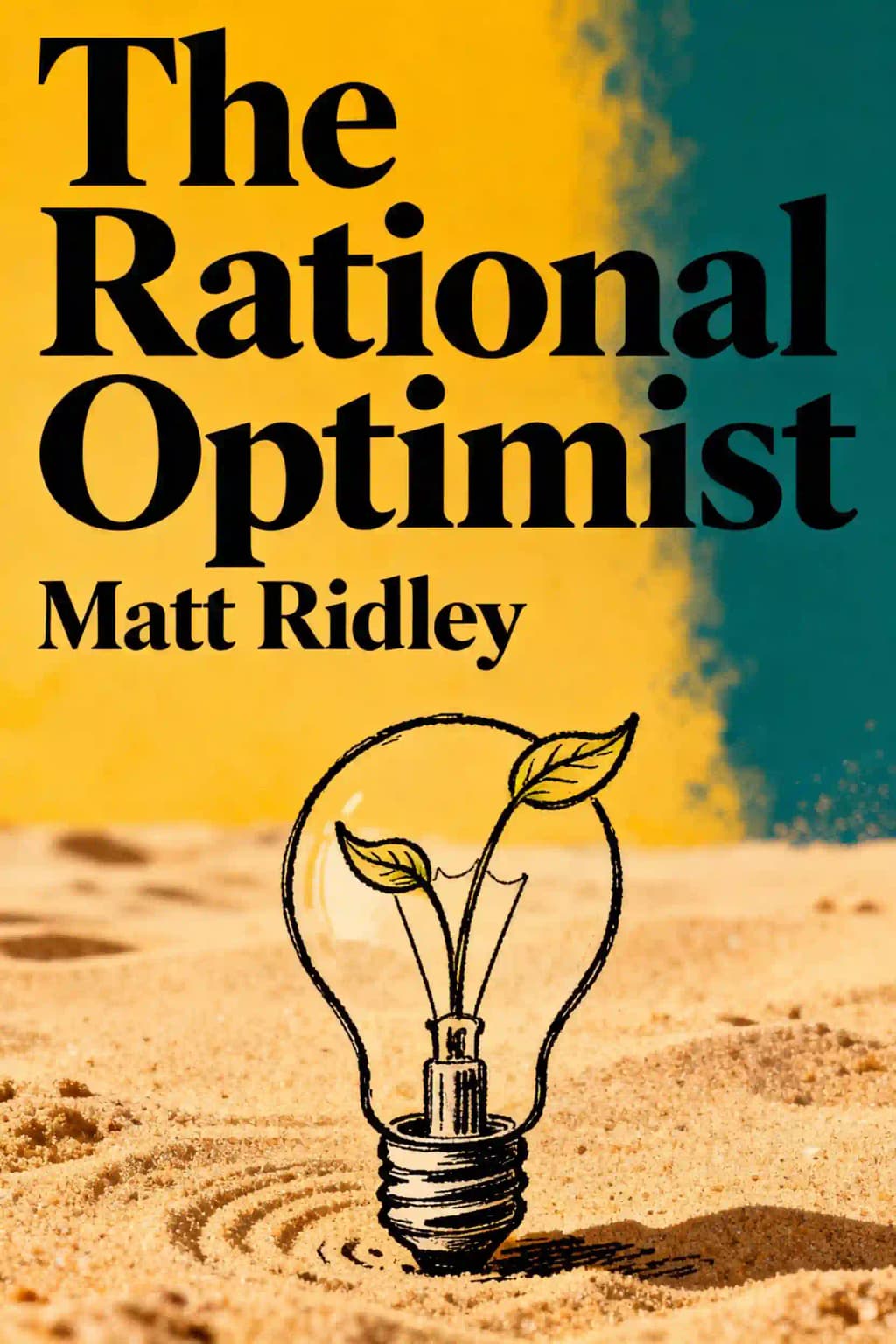
The Rational Optimist
Overview of The Rational Optimist
In "The Rational Optimist," Matt Ridley challenges global pessimism with compelling evidence of humanity's accelerating prosperity. Recommended by Bill Gates and Mark Zuckerberg, this provocative bestseller asks: What if our greatest days lie ahead? Discover why Steven Pinker calls it "delightful and fascinating."

Key Themes in The Rational Optimist
- cultural evolution
- specialization and exchange
- collective intelligence
- division of labor
- technological optimism
Quotes from The Rational Optimist
The magic happens when ideas meet and mate.
Self-sufficiency is poverty, not virtue.
The more people specialize and exchange, the wealthier we all become.
Modern consumers benefit not just from others' labor but from their inventions too.
Named one of the "Books of the Year" by both The Economist and Financial Times.
Characters in The Rational Optimist
- Matt RidleyAuthor and proponent of rational optimism
About the Author
About the Author of The Rational Optimist
Matt Ridley, author of The Rational Optimist: How Prosperity Evolves, is a British science writer, journalist, and bestselling author renowned for his contrarian perspectives on economics, evolution, and human progress.
With a PhD in zoology from Oxford University, Ridley blends scientific rigor with accessible storytelling to explore themes of innovation, trade, and societal advancement. His career spans roles as science editor at The Economist, columnist for The Wall Street Journal and The Times, and chairman of Northern Rock plc.
His other influential works, including Genome and The Red Queen, examine genetics and evolutionary biology, establishing him as a leading voice in science communication. A fellow of the Royal Society of Literature and member of the House of Lords, Ridley advocates for evidence-based policymaking.
His books have sold over 900,000 copies globally and been translated into 30 languages, cementing his reputation as a provocative thinker on humanity’s capacity for growth.
Download Summary of The Rational Optimist
Get the The Rational Optimist summary as a free PDF or EPUB. Print it or read offline anytime.
FAQs About This Book
The Rational Optimist argues that human progress thrives through trade, specialization, and collective intelligence. Matt Ridley uses historical examples to show how innovation and idea exchange have improved living standards, health, and technology over millennia. He challenges pessimism by demonstrating that prosperity grows when societies embrace collaboration and economic freedom.
This book suits readers interested in economics, history, or human development. It’s ideal for those seeking evidence-based counterarguments to modern pessimism, or anyone curious about how trade and innovation drive societal advancement. Policymakers and entrepreneurs will also find insights into fostering growth.
Yes, Ridley’s data-driven optimism offers a refreshing perspective on global progress. The book combines scholarly research with accessible storytelling, making it valuable for understanding long-term trends in health, energy, and technology. Critics praise its compelling rebuttal to doom-and-gloom narratives.
Trade enables specialization, allowing societies to innovate and scale productivity. Ridley argues that exchanging goods and ideas—not self-sufficiency—fuels advancements, citing ancient trade networks and modern globalization as catalysts for wealth and technological leaps.
Ridley highlights rising life expectancy, reduced poverty, and technological breakthroughs like agriculture and industrialization. He notes that even during crises, human ingenuity—such as vaccine development or green energy—prevents long-term decline.
Some argue Ridley underestimates challenges like climate change and inequality. Critics claim his focus on aggregate progress overlooks localized suffering and assumes market forces alone can solve systemic issues.
- “Ideas having sex”: Ridley’s metaphor for innovation through idea exchange.
- “Life is getting better”: A mantra underscoring his thesis on long-term prosperity trends.
He frames technology as a self-reinforcing force: each invention (e.g., the steam engine, internet) sparks new collaborations, accelerating problem-solving. This “collective brain” drives perpetual advancement.
Both books champion human progress using data, but Ridley emphasizes economic exchange as the primary driver, while Pinker focuses on reason and science. They jointly counter cultural pessimism with empirical optimism.
Amid concerns about AI, climate change, and political strife, Ridley’s thesis reminds readers that adaptability and innovation historically overcome crises. His arguments encourage long-term thinking in policy and business.
He argues top-down governance often stifles innovation compared to decentralized, market-driven solutions. However, he acknowledges the need for basic infrastructure and rule of law to enable trade.
The book explores 12 themes, including urbanization, energy transitions, and demographic shifts. Ridley ties these to the central idea that specialization and trust networks underpin societal resilience.





