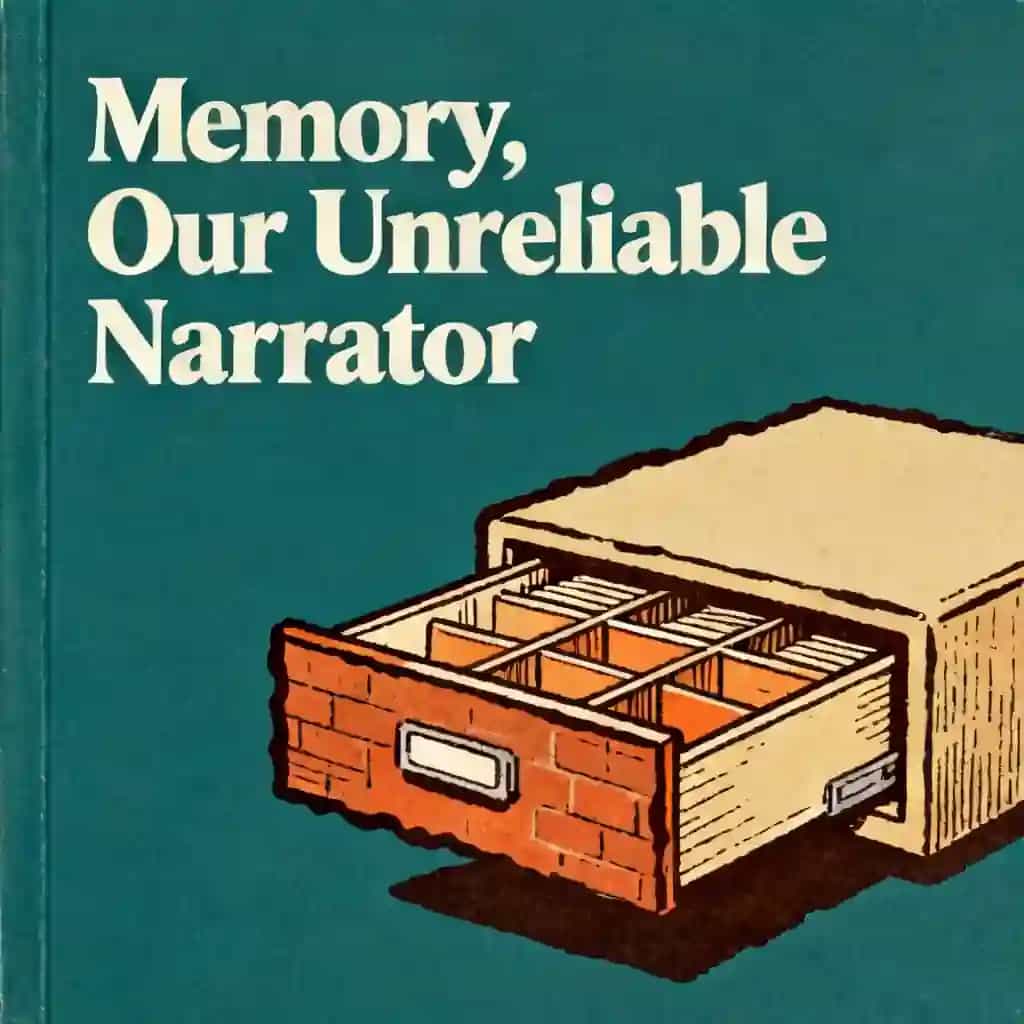
Pieces of Light: The New Science of Memory by Charles Fernyhough Summary

Overview of Pieces of Light
In "Pieces of Light," Charles Fernyhough reveals how memories aren't fixed recordings but stories we constantly rewrite. Shortlisted for the Royal Society Prize, this mind-bending journey makes you question: Is your most cherished memory actually real or brilliantly reconstructed fiction?
- How memory shapes identity through reconstructed past experiences
- Why siblings recall shared childhood events with conflicting details
- The science behind vivid false memories feeling authentic
- How sensory cues trigger autobiographical memory reconstruction
- Why aging affects memory quality more than quantity
- Charles Fernyhough redefines memory as present-tense storytelling
- How brain injuries reveal memory's narrative construction process
- Why flashbulb memories feel photographic but decay like others
- The role of imagination in filling memory gaps
- How cultural narratives shape personal remembrance patterns
- Why PTSD manifests as uncontrollable memory re-enactment
- Memory's fragility as evolutionary advantage for adapting perspectives
About the Author of Pieces of Light
Charles Fernyhough is a psychologist, writer, and professor at Durham University whose work explores memory, consciousness, and inner experience. His book Pieces of Light: The New Science of Memory combines cutting-edge neuroscience with personal narrative to examine how autobiographical memory shapes human identity. A leading voice in developmental psychology, Fernyhough directs Durham’s interdisciplinary Hearing the Voice project, investigating phenomena like inner speech and auditory hallucinations.
Fernyhough’s authority stems from both academic rigor and literary craftsmanship. His previous books include The Baby in the Mirror, a scientific memoir of early childhood development, and The Voices Within, an exploration of inner dialogue that builds on his Wellcome Trust-funded research.
A regular contributor to The Guardian, TIME Ideas, and the BBC, he translates complex psychological concepts into accessible narratives. Pieces of Light was shortlisted for the Royal Society Winton Prize for Science Books and has been translated into eleven languages, cementing Fernyhough’s status as a bridge between academic research and public understanding of cognition.
FAQs About Pieces of Light
What is Pieces of Light by Charles Fernyhough about?
Pieces of Light explores the science of autobiographical memory, arguing that memories are dynamically reconstructed each time we recall them—not static recordings. Fernyhough blends personal anecdotes, neurological research, and literary references to explain how memory intertwines with imagination, identity, and storytelling. The book challenges traditional views of memory as a fixed archive, emphasizing its fluid, creative nature.
Who should read Pieces of Light by Charles Fernyhough?
This book appeals to psychology enthusiasts, neuroscience students, and general readers interested in how memory shapes human experience. Its narrative style makes complex concepts accessible, while its blend of science and storytelling resonates with fans of Oliver Sacks or Rebecca Skloot. It’s particularly valuable for those exploring trauma, aging, or the ethics of memory manipulation.
Is Pieces of Light worth reading?
Yes, especially for its engaging synthesis of research and relatable storytelling. Fernyhough’s accessible prose demystifies topics like false memories and trauma’s impact on recall. While some scientific sections may challenge casual readers, the book’s insights into memory’s role in identity make it a standout in popular science.
What are the main ideas in Pieces of Light?
Key concepts include:
- Reconstructive memory: Each recollection rebuilds the past using present context.
- Neurological plasticity: Brain regions like the hippocampus dynamically encode and retrieve memories.
- False memories: External cues or suggestions can generate inaccurate recollections.
- Trauma and memory: Emotional intensity alters how events are stored and recalled.
How does Pieces of Light explain false memories?
Fernyhough illustrates how memories are susceptible to distortion through suggestion, imagination, or emotional bias. For example, vivid “flashbulb memories” (e.g., traumatic public events) often feel precise but erode over time. The book cites studies showing how easily false details integrate into autobiographical narratives.
What quotes from Pieces of Light summarize its themes?
- “Memory is about the present as much as it is about the past”: Emphasizes memory’s role in shaping current identity.
- “Remembering is an act of narrative imagination”: Highlights the creative process behind recollection.
How does Charles Fernyhough’s background influence Pieces of Light?
Fernyhough’s dual expertise as a psychologist (Durham University) and novelist enables a unique blend of rigorous science and lyrical storytelling. His research on inner speech and developmental psychology informs the book’s exploration of memory’s subjective nature.
How does Pieces of Light compare to other memory science books?
Unlike purely clinical texts, Fernyhough prioritizes narrative over jargon, akin to Oliver Sacks’ work. It diverges from Daniel Schacter’s The Seven Sins of Memory by emphasizing personal stories over systematic categorization, making it more accessible but less encyclopedic.
Can Pieces of Light help understand Alzheimer’s or dementia?
While not a focus, the book’s insights into memory fragility and neurological decline provide context for age-related conditions. Fernyhough discusses how brain damage disrupts memory’s “synergy,” offering indirect relevance to dementia research.
What criticisms exist about Pieces of Light?
Some reviewers note uneven pacing, with dense scientific passages interrupting narrative flow. A minority found the blend of memoir and academia disorienting, though most praise Fernyhough’s ability to humanize complex research.
How does Pieces of Light address childhood memories?
Fernyhough explores how early memories form fragmentary “pieces” influenced by later experiences. He debunks the myth of infantile amnesia, showing how sensory cues (smells, sounds) reactivate childhood recollections—even if partially fictionalized.
Why is Pieces of Light relevant in 2025?
As AI and neurotechnology advance, the book’s warnings about memory malleability gain urgency. Its lessons on misinformation, identity construction, and trauma recovery remain critical in an era of deepfakes and mental health crises.
Feel the book through the author's voice
Turn knowledge into engaging, example-rich insights
Capture key ideas in a flash for fast learning
Enjoy the book in a fun and engaging way
Key Themes in Pieces of Light
Quotes from Pieces of Light
Memories aren't faithful recordings but rather creative reconstructions.
Each recall becomes a new version of the original event.
Understanding memory as reconstruction is liberating.
We're not passive recipients of our pasts but active creators.
Our memories are built in space as much as in time.
Characters in Pieces of Light
Quick Summary Mode - Read or listen to Pieces of Light Summary in 9 Minutes

Break down key ideas from Pieces of Light into bite-sized takeaways to understand how innovative teams create, collaborate, and grow.

Flash Card Mode - Top 8 Insights from Pieces of Light in a Nutshell

Distill Pieces of Light into rapid-fire memory cues that highlight key principles of candor, teamwork, and creative resilience.

Fun Mode - Pieces of Light Lessons Told Through 23-Min Stories

Experience Pieces of Light through vivid storytelling that turns innovation lessons into moments you'll remember and apply.
Personalize Mode - Read or listen to Pieces of Light Summary in 0 Minutes

Ask anything, pick the voice, and co-create insights that truly resonate with you.

From Columbia University alumni built in San Francisco
"Instead of endless scrolling, I just hit play on BeFreed. It saves me so much time."


"I never knew where to start with nonfiction—BeFreed’s book lists turned into podcasts gave me a clear path."


"Perfect balance between learning and entertainment. Finished ‘Thinking, Fast and Slow’ on my commute this week."
"Crazy how much I learned while walking the dog. BeFreed = small habits → big gains."
"Reading used to feel like a chore. Now it’s just part of my lifestyle."

"Feels effortless compared to reading. I’ve finished 6 books this month already."
"BeFreed turned my guilty doomscrolling into something that feels productive and inspiring."

"BeFreed turned my commute into learning time. 20-min podcasts are perfect for finishing books I never had time for."
"BeFreed replaced my podcast queue. Imagine Spotify for books — that’s it. 🙌"

"It is great for me to learn something from the book without reading it."
"The themed book list podcasts help me connect ideas across authors—like a guided audio journey."
"Makes me feel smarter every time before going to work"
From Columbia University alumni built in San Francisco
"Instead of endless scrolling, I just hit play on BeFreed. It saves me so much time."
"I never knew where to start with nonfiction—BeFreed’s book lists turned into podcasts gave me a clear path."
"Perfect balance between learning and entertainment. Finished ‘Thinking, Fast and Slow’ on my commute this week."
"Crazy how much I learned while walking the dog. BeFreed = small habits → big gains."
"Reading used to feel like a chore. Now it’s just part of my lifestyle."
"Feels effortless compared to reading. I’ve finished 6 books this month already."
"BeFreed turned my guilty doomscrolling into something that feels productive and inspiring."
"BeFreed turned my commute into learning time. 20-min podcasts are perfect for finishing books I never had time for."
"BeFreed replaced my podcast queue. Imagine Spotify for books — that’s it. 🙌"
"It is great for me to learn something from the book without reading it."
"The themed book list podcasts help me connect ideas across authors—like a guided audio journey."
"Makes me feel smarter every time before going to work"
"Instead of endless scrolling, I just hit play on BeFreed. It saves me so much time."
"I never knew where to start with nonfiction—BeFreed’s book lists turned into podcasts gave me a clear path."
"Perfect balance between learning and entertainment. Finished ‘Thinking, Fast and Slow’ on my commute this week."
"Crazy how much I learned while walking the dog. BeFreed = small habits → big gains."
"Reading used to feel like a chore. Now it’s just part of my lifestyle."
"Feels effortless compared to reading. I’ve finished 6 books this month already."
"BeFreed turned my guilty doomscrolling into something that feels productive and inspiring."
"BeFreed turned my commute into learning time. 20-min podcasts are perfect for finishing books I never had time for."
"BeFreed replaced my podcast queue. Imagine Spotify for books — that’s it. 🙌"
"It is great for me to learn something from the book without reading it."
"The themed book list podcasts help me connect ideas across authors—like a guided audio journey."
"Makes me feel smarter every time before going to work"
"Instead of endless scrolling, I just hit play on BeFreed. It saves me so much time."
"I never knew where to start with nonfiction—BeFreed’s book lists turned into podcasts gave me a clear path."
"Perfect balance between learning and entertainment. Finished ‘Thinking, Fast and Slow’ on my commute this week."
"Crazy how much I learned while walking the dog. BeFreed = small habits → big gains."
"Reading used to feel like a chore. Now it’s just part of my lifestyle."
"Feels effortless compared to reading. I’ve finished 6 books this month already."
"BeFreed turned my guilty doomscrolling into something that feels productive and inspiring."
"BeFreed turned my commute into learning time. 20-min podcasts are perfect for finishing books I never had time for."
"BeFreed replaced my podcast queue. Imagine Spotify for books — that’s it. 🙌"
"It is great for me to learn something from the book without reading it."
"The themed book list podcasts help me connect ideas across authors—like a guided audio journey."
"Makes me feel smarter every time before going to work"

Get the Pieces of Light summary as a free PDF or EPUB. Print it or read offline anytime.