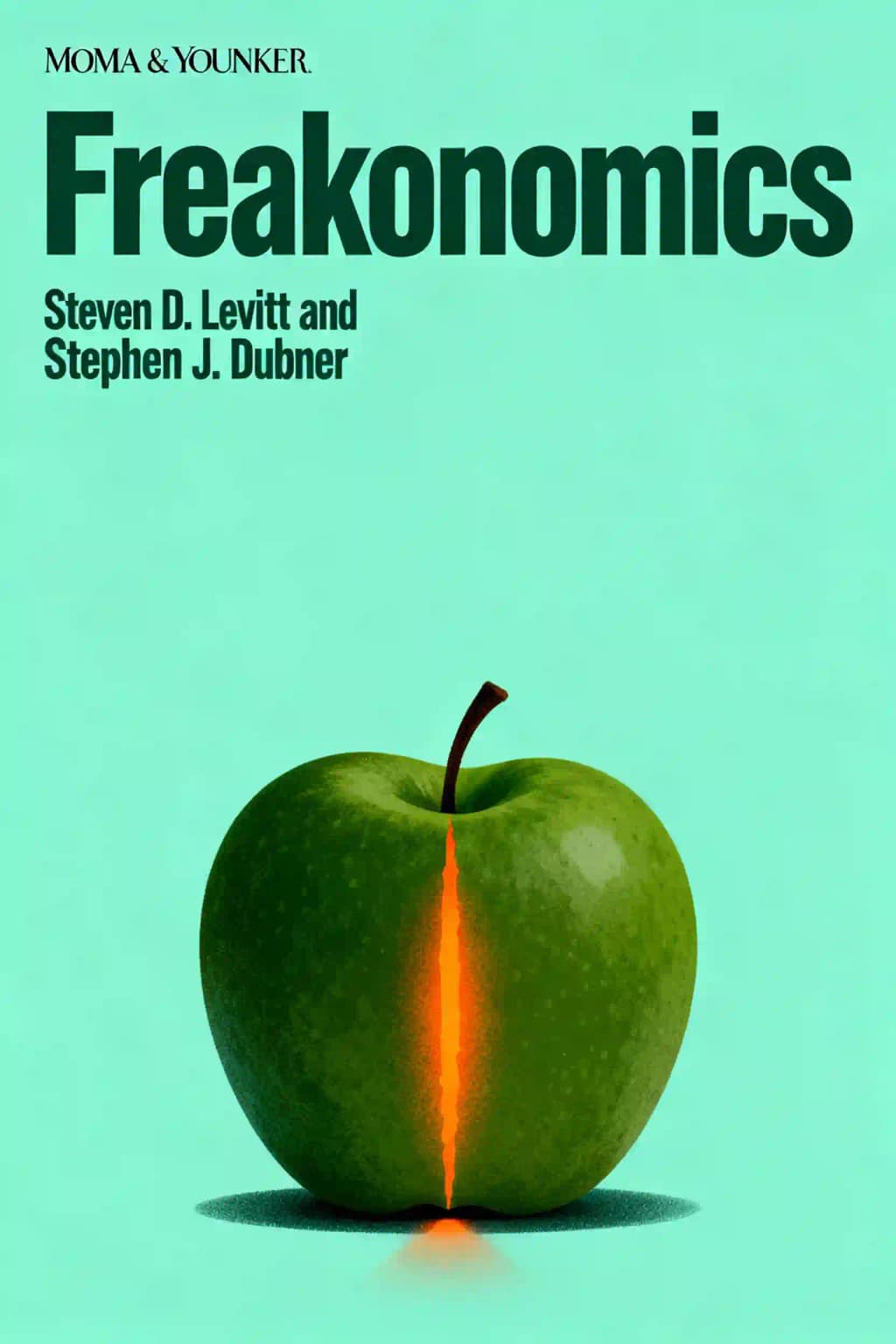
Freakonomics
A Rogue Economist Explores the Hidden Side of Everything
Overview of Freakonomics
Dive into the hidden side of everything with Freakonomics, the groundbreaking bestseller that applies economics to sumo wrestling, drug dealing, and baby names. Challenging conventional wisdom with data-driven insights, this cultural phenomenon sparked a documentary, radio show, and global conversations about the unexpected forces shaping our world.

Key Themes in Freakonomics
- incentive structures
- information asymmetry
- unconventional data analysis
- hidden motivations
- statistical detection
Quotes from Freakonomics
Morality, it could be argued, represents the way that people would like the world to work—whereas economics represents how it actually does work.
An incentive is simply a means of urging people to do more of a good thing and less of a bad thing.
Conventional wisdom is often wrong.
If morality represents how we would like the world to work, then economics shows us how it actually works.
Given the right incentives, almost anyone will cheat.
Characters in Freakonomics
- Steven D. LevittCo-author and economist
- Stephen J. DubnerCo-author and journalist
- Arne DuncanChicago schools CEO who investigated cheating
- Paul FeldmanBusinessman who ran an honor-system bagel study
- Gary BeckerNobel Prize-winning economist
About the Author
About the Author of Freakonomics
Steven D. Levitt and Stephen J. Dubner are the bestselling authors of Freakonomics: A Rogue Economist Explores the Hidden Side of Everything, renowned for merging economic analysis with unconventional social insights. Blending economics, sociology, and pop culture, their groundbreaking work examines hidden patterns in human behavior through themes like incentives, information control, and crime dynamics.
Levitt, a University of Chicago economist known for challenging conventional wisdom, partnered with Dubner, a New York Times journalist fascinated by counterintuitive storytelling, after their collaboration began with a 2003 profile that sparked widespread interest.
The duo expanded their work into the Freakonomics series, including SuperFreakonomics and Think Like a Freak, alongside the long-running Freakonomics Radio podcast, which explores everyday mysteries through an economic lens. Levitt’s academic rigor and Dubner’s narrative flair combine to make complex economic principles accessible to millions.
Translated into 40+ languages and selling over 5 million copies worldwide, Freakonomics remains a cultural touchstone that reshaped public understanding of decision-making and societal trends.
Download Summary of Freakonomics
Get the Freakonomics summary as a free PDF or EPUB. Print it or read offline anytime.
FAQs About This Book
Freakonomics explores hidden economic forces behind everyday phenomena using unconventional questions like "Why do drug dealers live with their moms?" and "What caused the 1990s crime drop?" It argues incentives drive human behavior, revealing surprising correlations (e.g., legalized abortion reducing crime) while debunking myths about parenting and societal norms.
Curious readers interested in economics, sociology, or data-driven storytelling will enjoy its blend of pop culture and academic rigor. Professionals in marketing, policy, or education gain insights into incentive design. The book’s accessible style suits both casual readers and analytical minds.
Yes—it reshapes how you interpret data and human behavior. With over 4 million copies sold, its provocative conclusions (e.g., "parenting techniques matter less than demographics") spark debate while offering actionable frameworks for critical thinking.
- Incentives rule behavior: Teachers cheat for bonuses; sumo wrestlers for rankings.
- Information asymmetry drives power: Real estate agents and the KKK manipulate secrets.
- Conventional wisdom often fails: Most drug dealers earn poverty wages.
- Correlation ≠ causation: Legalized abortion, not policing, cut crime.
Levitt controversially links falling crime to the 1970s Roe v. Wade decision, arguing unwanted children (more likely to become criminals) were disproportionately aborted. This contrasts with theories about policing or economic growth.
The abortion-crime hypothesis drew widespread criticism for oversimplifying socioeconomics and ignoring ethical implications. Critics argue Levitt underestimates systemic factors like lead paint reduction.
- "Morality represents the way we’d like the world to work; economics shows how it actually works."
- "Experts use informational advantage to serve their agenda."
These lines encapsulate its core theme: incentives trump ideals.
Both debias human decision-making, but Freakonomics focuses on societal incentives (economics), while Kahneman’s work explores cognitive psychology. They complement each other for understanding rationality’s limits.
Its framework applies to modern issues:
- AI ethics: How algorithms replicate hidden biases.
- Gig economy: Incentive structures for Uber drivers.
- Misinformation: Information control parallels KKK tactics.
- Oversimplifies complex issues (e.g., crime reduction).
- Cherry-picks data to support shocking conclusions.
- Lacks cohesive narrative beyond standalone chapters.
It expands economics beyond finance into sociology, education, and culture—calling it "the study of incentives." The book popularized applied microeconomics for mainstream audiences.
- Business: Design incentives that align employee/company goals.
- Parenting: Focus on socioeconomic factors over hyper-involvement.
- Policy: Test interventions with data, not assumptions.
When one party has more knowledge than another, enabling manipulation. Examples include real estate agents hiding low bids or the KKK’s secret rituals.
Names signal socioeconomic status but don’t determine success. A "destitute" name (e.g., DeShawn) correlates with poverty, but outcomes stem from systemic factors, not the name itself.