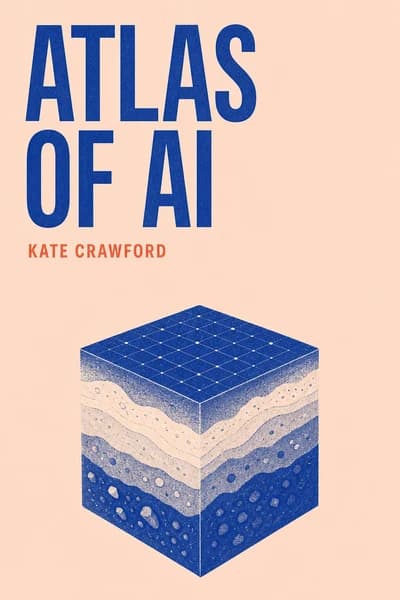
Atlas of AI
Overview of Atlas of AI
Kate Crawford's "Atlas of AI" exposes the hidden planetary costs of artificial intelligence. Called "a masterpiece" by MIT Technology Review editors, this Wall Street Journal top-five AI book reveals how our digital future fuels inequality and environmental devastation. What price are we really paying for AI?

Key Themes in Atlas of AI
- extractive capitalism
- technological environmental impact
- hidden labor exploitation
- algorithmic classification
- material infrastructure
Quotes from Atlas of AI
AI systems are not autonomous, rational, or able to discern truth.
AI is neither artificial nor intelligent-but rather a massive industrial system.
AI infrastructure is profoundly material and environmentally damaging.
Humans are increasingly treated like robots under AI systems.
Characters in Atlas of AI
- Kate CrawfordAuthor and researcher of AI's social impacts
- Lewis MumfordHistorian who conceptualized the 'megamachine'
About the Author
About the Author of Atlas of AI
Kate Crawford, author of Atlas of AI: Power, Politics, and the Planetary Costs of Artificial Intelligence, is a leading scholar of artificial intelligence’s social and political implications. Born in 1974, this Australian-American researcher and professor combines expertise in technology, history, and environmental studies to critique AI’s hidden costs.
As a Research Professor at USC Annenberg and Senior Principal Researcher at Microsoft Research, Crawford co-founded the AI Now Institute at NYU, pioneering interdisciplinary studies on AI ethics. Her work, including collaborations like Anatomy of an AI System (winner of the Beazley Design of the Year Award) and the Calculating Empires exhibition, merges academic rigor with visual storytelling to expose AI’s impacts on labor, inequality, and planetary systems.
Crawford’s influential research has shaped policy at the UN, the White House, and the European Parliament. Named to the 2023 TIME100 list of Most Influential People in AI, Atlas of AI has been translated into over 10 languages and won the Sally Hacker Prize. The book, praised by New Scientist and the Financial Times, reveals how AI infrastructures amplify ecological extraction and social inequity—themes grounded in her decades of advocacy for ethical tech governance.
Download Summary of Atlas of AI
Get the Atlas of AI summary as a free PDF or EPUB. Print it or read offline anytime.
FAQs About This Book
Atlas of AI by Kate Crawford is a critical examination of artificial intelligence’s hidden societal, environmental, and political costs. Crawford exposes how AI systems rely on exploitative labor practices, extractive mining for resources like lithium, and biased datasets, while amplifying surveillance and inequality. The book challenges myths of AI’s neutrality, urging ethical and equitable technological development.
This book is essential for policymakers, tech professionals, and students of AI ethics, as well as anyone concerned about AI’s societal impacts. Crawford’s insights into labor exploitation, environmental degradation, and algorithmic bias offer critical perspectives for those seeking to understand AI’s real-world consequences.
Yes—Crawford’s rigorously researched work provides a groundbreaking critique of AI’s planetary costs, from lithium mining to data colonialism. It’s praised for combining scholarly depth with accessible narratives, making it a vital resource for rethinking AI’s role in society.
Crawford argues that AI perpetuates power imbalances by:
- Exploiting natural resources (e.g., lithium mining in Thacker Pass)
- Relying on underpaid labor (e.g., Amazon Mechanical Turk)
- Training on biased datasets (e.g., ImageNet’s racial/gender flaws)
- Enabling state surveillance (e.g., military use of Palantir)
The book details AI’s environmental toll, linking cloud computing’s energy demands to fossil fuel reliance and highlighting lithium extraction’s ecological harm. Crawford critiques tech giants’ “greenwashing” and proposes sustainable alternatives.
Crawford reveals how AI depends on invisible labor, from content moderators to warehouse workers. She critiques platforms like Amazon Mechanical Turk for normalizing precarious gig work and eroding workers’ rights.
Crawford demonstrates how datasets like ImageNet encode racial and gender biases, often scraping personal data without consent. She warns that flawed training data reinforces systemic discrimination in facial recognition and hiring tools.
This chapter exposes military and surveillance applications of AI, including the Pentagon’s Project Maven and Palantir’s predictive policing tools. Crawford warns that AI strengthens state control, undermining democratic accountability.
Unlike technical primers, Atlas of AI prioritizes systemic critiques of AI’s infrastructure. It uniquely links environmental degradation, labor exploitation, and data colonialism, offering a holistic view absent in narrower ethical frameworks.
- “AI is neither artificial nor intelligent”: Crawford emphasizes AI’s reliance on human labor and natural resources.
- “Classification is a political act”: Highlights how labels in datasets enforce societal hierarchies.
Some scholars argue Crawford underestimates AI’s potential for positive change, while others note limited discussion of grassroots resistance movements. Critics also cite the book’s dense academic tone as a barrier for general readers.
As AI adoption accelerates in workplaces and governance, Crawford’s warnings about bias, surveillance, and environmental harm remain urgent. The book provides a framework for evaluating new AI policies and corporate claims.