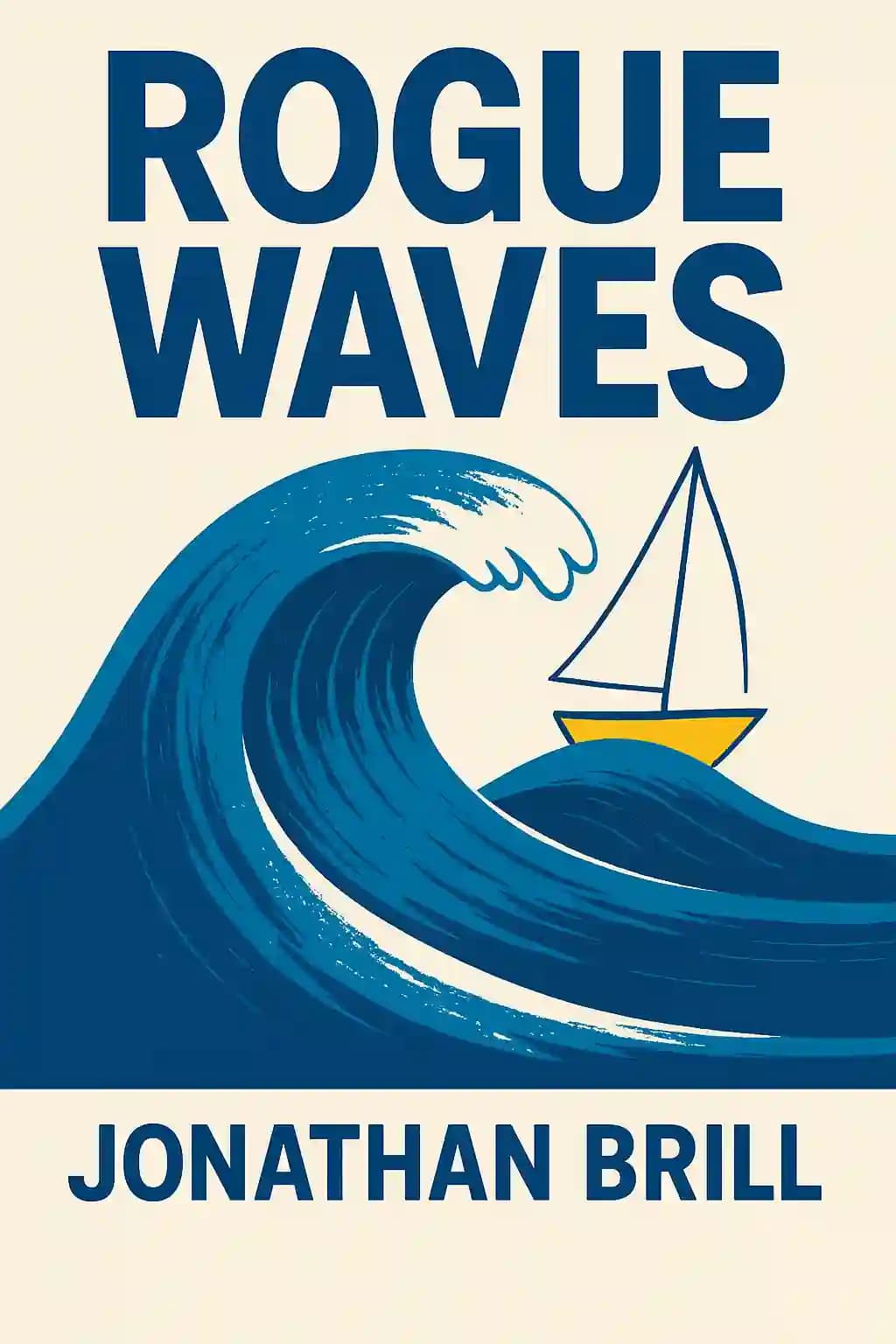
Rogue Waves
Future-Proof Your Business to Survive and Profit from Radical Change
Overview of Rogue Waves
In "Rogue Waves," Fortune 500 innovation expert Jonathan Brill reveals how to transform sudden market threats into profitable opportunities. Endorsed by Adam Grant, this actionable framework helps businesses navigate radical change. What if the next disruption isn't your downfall, but your biggest breakthrough?

Key Themes in Rogue Waves
- constructive interference
- systemic vulnerability
- strategic resilience
- trend convergence
- navigating uncertainty
Quotes from Rogue Waves
When rogue waves hit, conventional business wisdom crumbles.
Companies built for yesterday's storms [are] vulnerable to tomorrow's.
What's needed instead is resilience.
Organizations need similar capabilities to recover and respond faster than competitors when inevitable waves hit.
The failure usually isn't an individual but a process.
Characters in Rogue Waves
- Jonathan BrillAuthor and strategist specializing in uncertainty
- Michael PorterStrategist whose competitive frameworks are cited
- Carl IcahnInvestor used as a case study in strategic failure
About the Author
About the Author of Rogue Waves
Jonathan Brill, a #1 ranked futurist by Forbes and bestselling author, is the mind behind Rogue Waves. He is a renowned global futurist and transformation architect, as recognized by Harvard Business Review.
Rogue Waves explores the critical intersection of technology, geopolitical shifts, and economic trends, providing readers with strategies to navigate future uncertainties and build resilience in an ever-changing world. Drawing upon his extensive experience, Jonathan helps individuals and organizations anticipate and adapt to disruptive forces. His expertise has been sought by leading companies like Verizon and Samsung, guiding them to future-proof their growth strategies.
Brill is the author of Rogue Waves, a book lauded by The Economist and Adam Grant. A frequent speaker at prestigious events such as TED and J.P. Morgan conferences, he shares his insights on future trends and innovation. He also contributes regularly to Harvard Business Review. His thought leadership extends to appearances on major media outlets, including ABC and CNBC, where he provides expert commentary on emerging trends. Furthermore, he serves as an advisor to numerous companies, helping them navigate complex challenges and capitalize on new opportunities.
Jonathan's professional background includes significant roles at HP and Frost & Sullivan, where he focused on driving innovation and growth. Over the course of his career, he has invented over 350 products, generating $27 billion in revenue for his clients. This diverse experience informs his unique perspective on future trends and his ability to translate them into actionable strategies.
Download Summary of Rogue Waves
Get the Rogue Waves summary as a free PDF or EPUB. Print it or read offline anytime.
FAQs About This Book
Rogue Waves teaches businesses to survive and profit from radical change by likening unpredictable market shifts to ocean rogue waves. Jonathan Brill introduces the "ABCs of Resilient Growth"—Awareness, Behavior Change, and Culture Change—providing frameworks to anticipate disruptions, adapt operations, and foster innovation. The book combines real-world examples (e.g., Toyota’s post-tsunami recovery) with strategies for long-term resilience.
Business leaders, innovation champions, and decision-makers in large organizations will benefit most. It’s ideal for those committed to systemic operational shifts, risk mitigation, and leveraging chaos for growth. Curious readers interested in global trends like AI, automation, and geopolitical shifts will also gain actionable insights.
Yes, if you seek actionable frameworks to future-proof your organization. Endorsed by Adam Grant as “an actionable framework for driving change,” it balances theory with tools like environmental scanning and iterative experiments. However, its focus on large-scale cultural shifts may overwhelm smaller teams.
- Awareness: Scan for emerging risks (e.g., technological, social, or economic undercurrents).
- Behavior Change: Test adaptive strategies through rapid experimentation.
- Culture Change: Embed resilience into organizational DNA by rewarding innovation and agility.
This triad helps businesses turn volatility into advantage.
Brill compares sudden, catastrophic business challenges (e.g., COVID-19, cybersecurity breaches) to rogue waves—unpredictable but survivable with preparation. The metaphor underscores the need for proactive risk detection and adaptive strategies, arguing that navigating these “waves” separates industry leaders from casualties.
- Environmental Scanning: Identify early indicators of disruption.
- Resilience Hierarchy: Prioritize risk mitigation, operational flexibility, and cultural adaptability.
- Iterative Experimentation: Use small-scale pilots to test responses to hypothetical crises.
These tools aim to convert uncertainty into strategic opportunity.
Some argue its focus on large organizations with ample resources limits applicability for startups. Critics also note the ABCs framework, while comprehensive, requires sustained leadership commitment, which may deter short-term-focused teams.
A top-ranked futurist by Forbes and “transformation architect” per Harvard Business Review, Brill directed long-term strategy at HP, advised Fortune 50 companies, and co-invented over 350 products. His expertise spans AI, geopolitical trends, and crisis resilience.
Unlike generic guides, Rogue Waves emphasizes systemic overhauls rather than incremental fixes. It aligns with Antifragile by Nassim Taleb but adds a structured playbook for organizational change, blending futurism with tactical steps.
Brill advocates embedding AI into strategic planning (e.g., simulating market shocks) and upskilling teams to leverage automation. The book’s culture-first approach aligns with his talk AI on Your Org Chart, which stresses aligning technology with human adaptability.
“Resilience is your new strategy for growth.” This encapsulates the book’s thesis: surviving chaos isn’t enough—thriving requires redesigning operations to harness volatility.
With AI, climate shifts, and geopolitical instability accelerating, Brill’s frameworks help leaders navigate compounding risks. The 2025 edition updates case studies, reflecting post-pandemic supply chain reforms and generative AI’s impact.
For resilience-building, pair with Antifragile (Nassim Taleb) or The Prepared Leader (Erika H. James). For innovation strategies, try Loonshots (Safi Bahcall) or Leapfrogging (Soren Kaplan).





