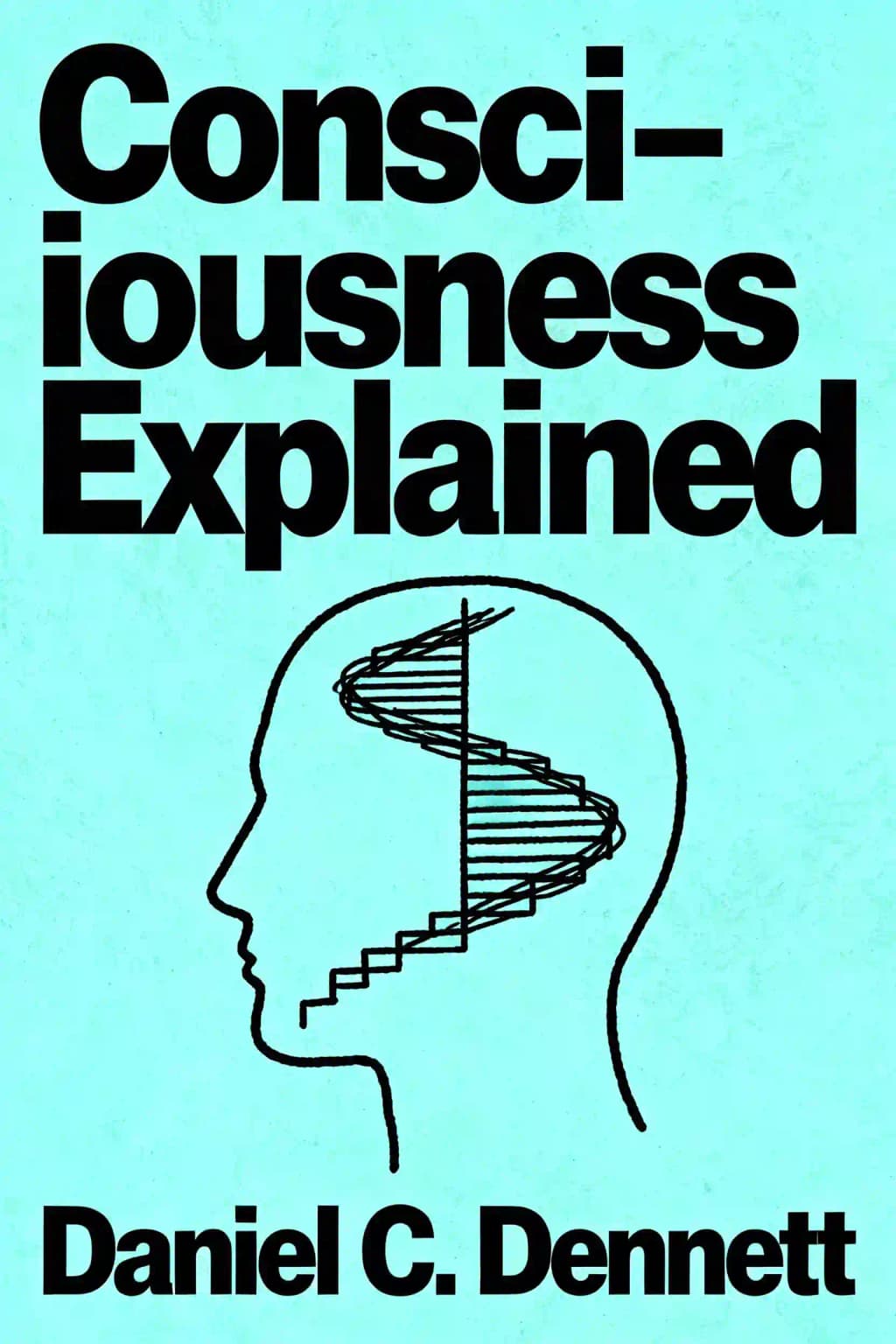
Consciousness Explained
Overview of Consciousness Explained
In "Consciousness Explained," Dennett dismantles the mind's greatest mystery. Richard Dawkins praised its "torrent of stimulating thoughts" while Scientific American called it "the best philosophical work in decades." Can consciousness truly be explained, or is Dennett's radical theory just beginning the conversation?

Key Themes in Consciousness Explained
- multiple drafts model
- cartesian theater critique
- memetic evolution
- joycean machine
- functionalist theory of mind
Quotes from Consciousness Explained
There is no such thing as phenomenology!
Consciousness didn't appear suddenly but evolved gradually from simpler precursors.
Our minds themselves are artifacts created when memes restructure our brains.
Nature selected for lucky anticipators.
This self-perception creates a feedback loop.
Characters in Consciousness Explained
- Daniel C. DennettAuthor and philosopher of mind
- James JoyceAuthor whose writing style named a mental model
- Douglas HofstadterScholar who provided an alternative view on the book
About the Author
About the Author of Consciousness Explained
Daniel Clement Dennett III (1942–2024), author of Consciousness Explained, was a renowned philosopher and cognitive scientist whose work reshaped modern understanding of the mind. A University Professor and co-director of the Center for Cognitive Studies at Tufts University, Dennett bridged philosophy with evolutionary biology and neuroscience, earning recognition as one of the "Four Horsemen of New Atheism." His groundbreaking 1991 book combines philosophy, psychology, and artificial intelligence to challenge traditional views of consciousness through his "multiple drafts model," positioning it as a cornerstone of philosophy of mind.
Dennett’s authority stemmed from his Oxford education under Gilbert Ryle and decades of interdisciplinary research. Notable works like Darwin’s Dangerous Idea (1995), which explores evolution’s cultural implications, and Breaking the Spell (2006), analyzing religion’s societal role, further cemented his reputation for blending rigorous analysis with accessible prose. His ideas influenced academic circles and public discourse alike, with appearances on major platforms like TED and contributions to The New York Times.
Consciousness Explained has sold over 500,000 copies worldwide and been translated into 20+ languages, remaining essential reading in cognitive science. Dennett’s other works, including Intuition Pumps and Other Tools for Thinking and From Bacteria to Bach and Back, are also summarized on this site.
Download Summary of Consciousness Explained
Get the Consciousness Explained summary as a free PDF or EPUB. Print it or read offline anytime.
FAQs About This Book
Consciousness Explained challenges traditional views of consciousness, proposing the "multiple drafts" model where parallel brain processes create coherent experiences without a central "Cartesian theater." Dennett rejects qualia (subjective sensory experiences) as incoherent and argues consciousness arises from neural computations. The book blends philosophy, neuroscience, and evolutionary biology to dismantle dualism and reframe selfhood as a narrative construct.
This book suits philosophy enthusiasts, cognitive scientists, and readers interested in debates about consciousness. Its technical arguments appeal to academics, but accessible examples (like visual blind spots and "time smears") engage curious laypeople. Critics of dualism or fans of Dennett’s atheist writings (e.g., Darwin’s Dangerous Idea) will find it particularly compelling.
Yes, for its groundbreaking critique of consciousness studies. While dense, Dennett’s thought experiments (e.g., "heterophenomenology") and humor make complex ideas digestible. Critics argue it oversimplifies subjective experience, but its influence on neuroscience and philosophy remains unmatched. Rated 4.1/5 on Goodreads, readers praise its rigor but note its challenging prose.
Dennett’s model claims consciousness emerges from competing neural narratives ("drafts") processed in parallel. Unlike a central "theater," these drafts are edited over time, with no single "true" version. Key features:
- No Cartesian theater: Decisions arise from distributed brain regions.
- Temporal smears: Perception integrates staggered sensory signals.
- Retroactive edits: The brain rewrites experiences post-hoc.
Dennett argues qualia—private, ineffable sensations like "redness"—are a philosophical illusion. He claims their purported properties (incorrigibility, privacy) are contradictory, making the concept incoherent. By dismissing qualia, he eliminates the "hard problem" of consciousness, reducing it to solvable neural computations.
Dennett views the self as a story the brain constructs to unify experiences. Like a "center of narrative gravity," it’s a useful fiction that organizes memories and intentions. This aligns with his rejection of dualism, emphasizing the brain’s physical processes over a mystical soul.
Critics accuse Dennett of "greedy reductionism," oversimplifying subjective experience. Some philosophers (e.g., David Chalmers) argue he ignores the "hard problem" of why consciousness feels like something. Religious thinkers critique his atheist framing, while readers note his verbose style.
Dennett later expands on free will in Freedom Evolves, but here he lays groundwork: conscious choices stem from deterministic brain processes, not a non-physical "will." Decisions emerge from competing neural drafts, with no single decision-maker—a view challenging traditional notions of autonomy.
Key metaphors include:
- Cartesian theater: A flawed model of consciousness as a central viewer.
- Multiple drafts: Competing neural narratives.
- Stalinesque vs. Orwellian revisions: Post-hoc brain edits akin to propaganda.
The book spurred research into distributed consciousness models, impacting fields like AI and cognitive psychology. Its rejection of dualism aligns with brain imaging studies showing decentralized decision-making. However, neuroscientists debate its dismissal of subjective reports.
Though detailed in later works, the intentional stance—interpreting entities as rational agents with beliefs/desires—supports his consciousness model. By treating the brain as a "predictive machine," he avoids dualist explanations, framing mental states as practical shortcuts.
Less technical than Darwin’s Dangerous Idea but more rigorous than Intuition Pumps, it bridges his cognitive science and philosophy work. Unlike Breaking the Spell (focused on religion), it targets consciousness’s mechanics, though all share his materialist worldview.