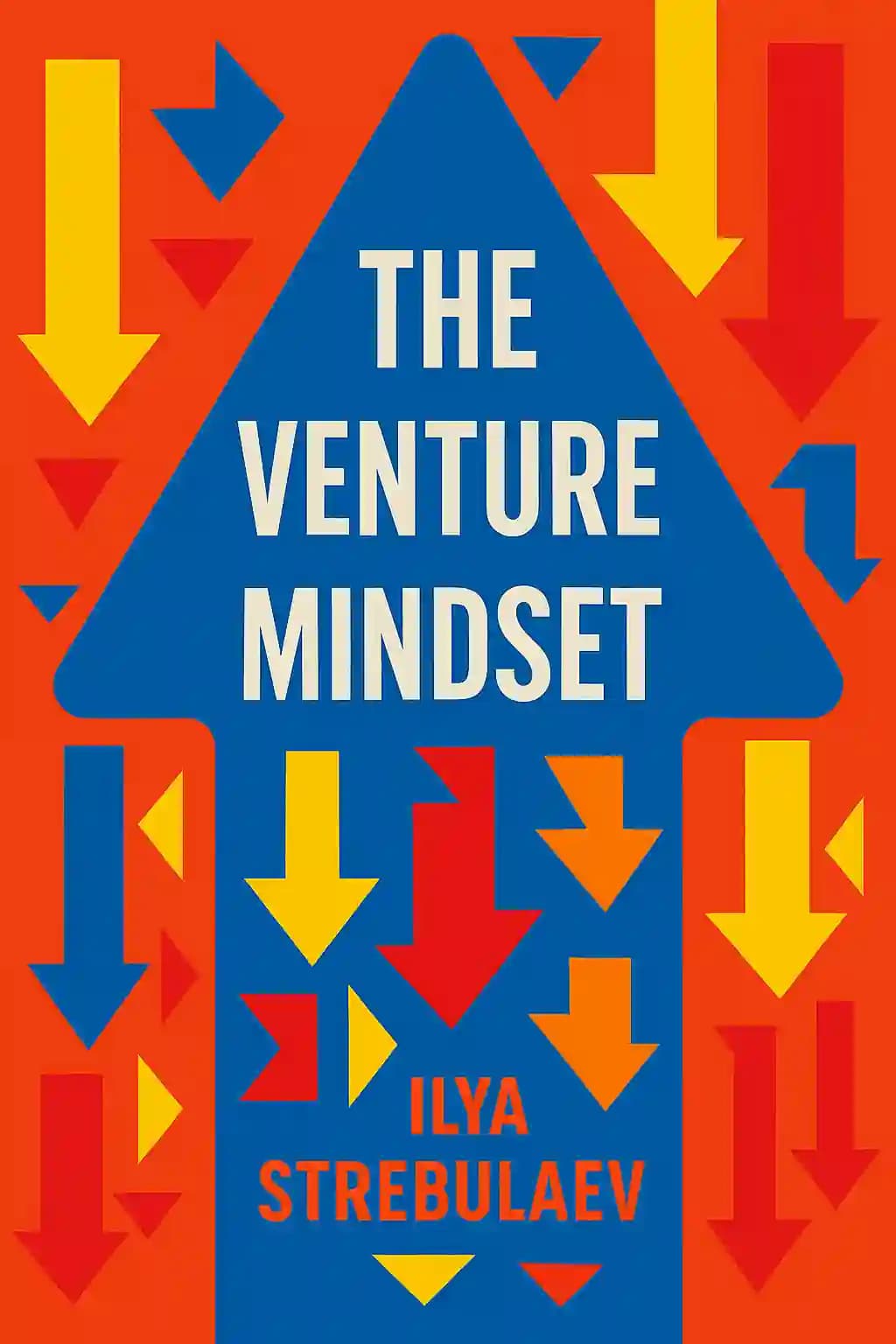
The Venture Mindset
How to Make Smarter Bets and Achieve Extraordinary Growth
Overview of The Venture Mindset
Stanford professor Ilya Strebulaev's bestselling "Venture Mindset" reveals how thinking like VCs drives extraordinary growth. What counterintuitive strategy did Google's Eric Schmidt call "full of powerful, practical lessons"? Learn the nine principles that transform failure into innovation.

Key Themes in The Venture Mindset
- contrarian investing
- power law returns
- innovation portfolio management
- asymmetric risk
- venture capital methodology
Quotes from The Venture Mindset
VCs fear missing the next Google far more than backing failures.
Failure [is] an essential part of finding extraordinary success.
The Venture Mindset requires actively seeking opportunities in unexpected places.
Great innovations rarely emerge from within corporate walls.
Characters in The Venture Mindset
- Ilya StrebulaevAuthor and expert on venture capital mindsets
- Alex DangAuthor and expert on corporate innovation
- Eric YuanFounder of Zoom and case study in persistence
- Pejman NozadRug seller turned successful venture capitalist
- Bill GurleyProminent VC known for the 'home run' philosophy
About the Author
About the Author of The Venture Mindset
Ilya Strebulaev and Alex Dang, co-authors of The Venture Mindset, are renowned experts in innovation strategy and venture capital principles.
Strebulaev is the David S. Lobel Professor of Private Equity at Stanford Graduate School of Business. He founded Stanford’s Venture Capital Initiative and is widely recognized as the foremost academic authority on VC decision-making.
Dang, a seasoned technology executive, led transformative initiatives at Amazon and advised global corporations as a McKinsey partner. Their book blends decades of research and real-world experience to teach organizations how to adopt risk-smart frameworks from top venture capitalists.
Strebulaev’s groundbreaking work has been featured in The Wall Street Journal, Harvard Business Review, and Bloomberg, while Dang’s operational expertise spans AI-driven ventures and scalable digital ecosystems. The book has earned praise from industry leaders like former Google CEO Eric Schmidt and was highlighted by the Financial Times for its timely insights on navigating AI disruption.
Both authors frequently lead executive workshops for Fortune 500 companies and governments seeking to cultivate innovation.
Download Summary of The Venture Mindset
Get the The Venture Mindset summary as a free PDF or EPUB. Print it or read offline anytime.
FAQs About This Book
The Venture Mindset outlines a revolutionary approach to innovation inspired by Silicon Valley’s venture capital strategies. It teaches nine principles for making smarter decisions, embracing calculated risks, and fostering long-term growth, such as prioritizing teams over ideas, encouraging dissent, and cutting losses early. The book blends real-world examples (Netflix, MIT) with research to show how organizations can adopt this mindset for disruptive success.
Entrepreneurs, corporate leaders, investors, and innovation-focused professionals will benefit most. The book offers actionable strategies for venture capitalists seeking sharper decision-making, corporate teams aiming to overcome bureaucracy, and startups navigating scalability challenges. It’s particularly relevant for those in tech, finance, or industries undergoing rapid disruption.
Yes—it combines academic rigor with engaging storytelling, making complex concepts accessible. The nine principles, like “pattern recognition” and “staged investments,” are backed by Stanford research and case studies. Readers praise its practicality for decision-making in fast-paced environments, though critics note it leans heavily on Silicon Valley paradigms.
The framework includes:
- Embrace failure as a learning tool
- Source ideas from diverse networks
- Prioritize strong teams over specific ideas
- Cultivate expertise for pattern recognition
- Say “no” frequently to focus on high-potential bets
- Encourage debate to avoid groupthink
- Use staged investments to mitigate risk
- Align incentives for long-term success
- Extend time horizons for breakthrough innovation.
Notable quotes include:
- “Failure isn’t an endpoint—it’s a diagnostic tool.”
- “The best ideas often come from the edges of your network.”
- “Venture success is 10% idea, 90% execution.”
These emphasize resilience, external collaboration, and execution—core themes explored through case studies like Netflix’s pivot from DVDs to streaming.
While Atomic Habits focuses on individual behavior change, The Venture Mindset targets organizational decision-making. Strebulaev’s work emphasizes systemic innovation frameworks (e.g., staged investments, dissent cultures) versus Clear’s micro-habit strategies. Both advocate long-term thinking, but The Venture Mindset is tailored for teams and investors.
Some argue the principles are easier for VC-funded startups to adopt than traditional corporations. Others note the book underplays the role of luck in venture success. However, its structured approach to risk management and team dynamics is widely praised.
As a Stanford finance professor and founder of the Stanford GSB Venture Capital Initiative, Strebulaev combines 20+ years of academic research with insights from advising firms like Netflix. This dual expertise ensures rigorous analysis of VC trends and practical corporate applications.
Yes—principles like incentivizing long-term outcomes and decentralizing idea generation are tested in sectors from healthcare to wine production. The book cites MIT’s chemical engineering breakthroughs and traditional winemakers adopting iterative experimentation as cross-industry examples.
With AI accelerating disruption, its focus on adaptive decision-making helps organizations navigate uncertainty. The “staged investments” principle aligns with lean startup methodologies dominating AI deployment, while “pattern recognition” guides leaders in evaluating emerging tech risks.
It teaches investors and leaders to identify success signals by analyzing historical data and market trends. For example, VCs assess founder grit and market timing—not just business plans. The book illustrates this with case studies of unicorn startups that passed pattern-based screening.
It reframes failure as a necessary step for innovation, advocating “fast failure” tactics like killing underperforming projects early. Examples include Google’s discontinued projects (e.g., Stadia) freeing resources for AI advancements—a concept backed by Stanford’s venture research.