Ryan Holiday's explosive expose reveals how media manipulators manufacture "news" that shapes our reality. Called "astonishing" by Financial Times, this cult classic predicted fake news years before it dominated headlines. Want to see how easily you're being deceived every day?
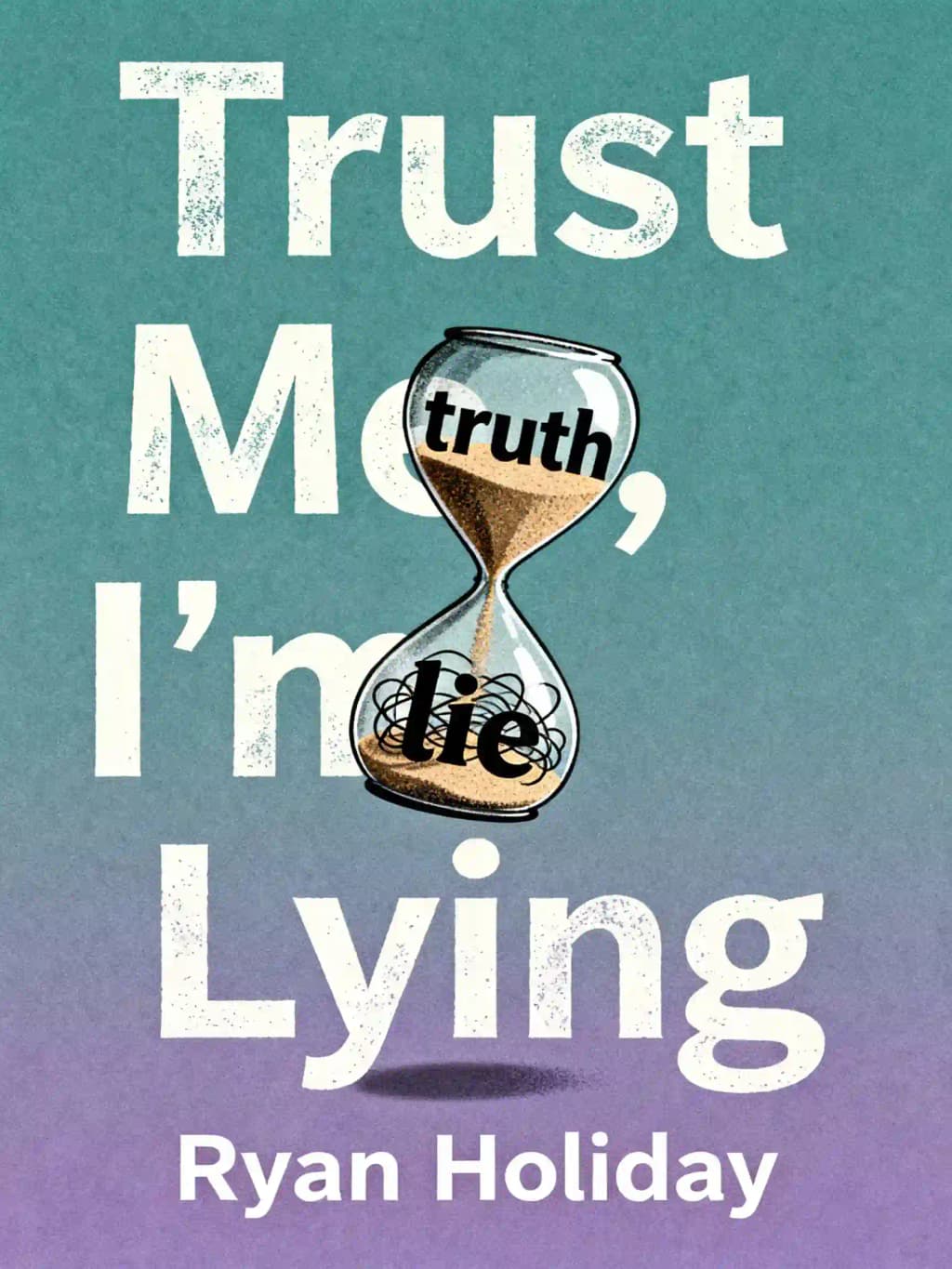
Ryan Holiday (born 1987) is the American bestselling author of Trust Me, I’m Lying: Confessions of a Media Manipulator, a blistering exposé on digital media and modern propaganda.
A media strategist turned philosopher, Holiday draws from his early career as director of marketing for American Apparel and founder of Brass Check consulting agency, where he advised brands like Google and authors like Tim Ferriss. His expertise in manipulating online narratives—chronicled in this 2012 investigative memoir—laid groundwork for his later Stoicism-focused works including The Obstacle Is the Way and The Daily Stoic, which have collectively sold over two million copies worldwide.
Holiday’s insights appear in The New York Times, Forbes, and his Daily Stoic platform, blending ancient philosophy with modern self-improvement. Translated into 30+ languages, his books redefined practical philosophy for leaders in sports, tech, and politics. Trust Me, I’m Lying remains a cult classic among media professionals and skeptics navigating today’s attention economy.
Trust Me, I’m Lying exposes how blogs and media outlets prioritize sensationalism over truth, driven by Ryan Holiday’s firsthand experience manipulating outlets as a marketer. It reveals tactics like planting fake stories in low-verification blogs, exploiting "iterative journalism," and using controversy to fuel virality. The book critiques the media ecosystem’s incentives that distort public perception.
Marketers, PR professionals, journalists, and media consumers will benefit from Holiday’s insider perspective on digital misinformation. It’s particularly valuable for those seeking to understand how viral narratives are engineered or anyone skeptical of modern media’s reliability.
Yes. Despite being published in 2012, its analysis of clickbait economics, algorithmic amplification, and media manipulation remains critical for navigating today’s misinformation landscape. Holiday’s case studies, like fabricating controversies for clients, offer timeless lessons about digital trust erosion.
Holiday vandalized a billboard for Tucker Max’s movie, photographed the damage, and leaked it to bloggers as “outrage.” The story spread to national outlets without verification, illustrating how staged events drive viral cycles.
Critics argue Holiday’s tactics (e.g., creating fake email accounts to plant stories) cross ethical lines. Others note some examples feel dated in 2025, given platform algorithm changes. However, its core message about media incentives remains widely cited.
The book foreshadowed today’s “fake news” crises by explaining how easily fabricated stories exploit media pipelines. Its insights into confirmation bias and virality mechanics help contextualize disinformation in social media eras.
Unlike his Stoicism-focused works (The Obstacle Is the Way), this debut book is a confessional exposé on media ethics. It blends tactical transparency with societal critique, offering a darker counterpart to his later philosophical guides.
Holiday argues bloggers face intense pressure to publish quickly, often relying on press releases or tips without verification. This makes them easy targets for manipulators seeking to “trade up” fabricated stories to larger outlets.
The media ecosystem prioritizes engagement over truth, creating a distorted reality. Readers are urged to critically assess sources, recognize manipulation patterns, and question sensational narratives.
著者の声を通じて本を感じる
知識を魅力的で例が豊富な洞察に変換
キーアイデアを瞬時にキャプチャして素早く学習
楽しく魅力的な方法で本を楽しむ
My job is to deceive.
I was feeding a monster I couldn't control.
Blogs have become our newswires.
The site covering the most content wins.
Traffic more profitable than truth.
『Trust Me, I'm Lying』の核心的なアイデアを分かりやすいポイントに分解し、革新的なチームがどのように創造、協力、成長するかを理解します。
鮮やかなストーリーテリングを通じて『Trust Me, I'm Lying』を体験し、イノベーションのレッスンを記憶に残り、応用できる瞬間に変えます。
何でも質問し、学習スタイルを選び、自分に本当に響くインサイトを一緒に作れます。

"Instead of endless scrolling, I just hit play on BeFreed. It saves me so much time."
"I never knew where to start with nonfiction—BeFreed’s book lists turned into podcasts gave me a clear path."
"Perfect balance between learning and entertainment. Finished ‘Thinking, Fast and Slow’ on my commute this week."
"Crazy how much I learned while walking the dog. BeFreed = small habits → big gains."
"Reading used to feel like a chore. Now it’s just part of my lifestyle."
"Feels effortless compared to reading. I’ve finished 6 books this month already."
"BeFreed turned my guilty doomscrolling into something that feels productive and inspiring."
"BeFreed turned my commute into learning time. 20-min podcasts are perfect for finishing books I never had time for."
"BeFreed replaced my podcast queue. Imagine Spotify for books — that’s it. 🙌"
"It is great for me to learn something from the book without reading it."
"The themed book list podcasts help me connect ideas across authors—like a guided audio journey."
"Makes me feel smarter every time before going to work"

Trust Me, I'm Lyingの要約をPDFまたはEPUBで無料でダウンロード。印刷やオフラインでいつでもお読みいただけます。
Trust Me, I'm Lying reveals the dark machinery behind our news cycle. As a former media manipulator, Ryan Holiday traded in deception-manufacturing fake controversies, planting stories, and watching fiction become accepted fact. From orchestrating nationwide protests against Tucker Max's movie to creating outrage while marketing for American Apparel, he perfected what he calls "trading up the chain": planting stories on small blogs that eventually reach major outlets through a predictable pattern of recursion. The economics are simple: blogs need traffic to survive, truth is secondary, and anyone who understands this system can exploit it. Eventually, Holiday realized he was feeding a monster beyond his control-one that devours truth itself and has real-world consequences for innocent people caught in its jaws.
The news ecosystem has fundamentally transformed. What begins online ends offline. Though millions of blogs exist, a handful of influential ones wield immense power because they're read by media elites. Radio hosts and news anchors who once cited newspaper headlines now repeat what they read on blogs. This creates a hidden cycle that determines our cultural references, celebrities, and news itself. Consider Tim Pawlenty's presidential "candidacy" nearly two years before the 2012 election. With no campaign director or donors, he somehow had a Politico reporter documenting his every move. The New York Times didn't cover Pawlenty directly-they covered Politico covering him. This wasn't journalism; it was a traffic-generating scheme. Political blogs know their advertising revenue increases during elections, so they manufacture election cycles earlier and earlier. When a blog like Politico "leaps forward," their arbitrary coverage choice becomes legitimized, gaining real supporters who donate real time and money. The cycle repeats across all topics: blogs need traffic, reality doesn't align with their needs, so they create artificial content that impacts actual events.
The online media business model is brutally simple: traffic equals money. Sites earn revenue through advertisements paid by impression. Since publishers and advertisers can't distinguish between engaged readers and accidental visitors, all pageviews are equally valuable. This creates a single-minded focus on increasing traffic by any means necessary. TMZ revolutionized this approach by turning scoop-gathering into a science, generating nearly $20 million annually through major exclusives. Since genuine scoops are rare, blogs perfected the "pseudo-exclusive"-taking ownership of stories broken elsewhere. One of Gawker's biggest hits-Tom Cruise Scientology videos generating 3.2 million views-was actually unearthed by journalist Mark Ebner, who received no credit when Gawker posted them first. The real business model isn't sustainable revenue but acquisition. Blogs chase traffic growth over solid financials because they're positioning for buyouts. Examples abound: AOL bought Huffington Post ($315 million) and TechCrunch ($30 million); Discovery acquired TreeHugger ($10 million); Conde Nast purchased Ars Technica ($20+ million). This creates an environment where ethical corners are cut and conflicts of interest flourish-all serving the ultimate goal of building influence that can be sold to larger media companies.
In this ecosystem where traffic trumps truth, manipulators thrive by exploiting structural vulnerabilities: 1. **Exploit Blogger Poverty**: Bloggers earn as little as $4-12 per post or depend on pageview metrics for survival. This creates perfect conditions for manipulation through free products, access, or help building a blogger's personal brand. 2. **Tell Them What They Want to Hear**: Online verification standards have collapsed. Anonymous tips, fabricated memos, and press releases often appear word-for-word in news accounts because they do the entire job for time-starved bloggers. 3. **Provide Viral Content**: Research confirms that anger drives sharing-one standard deviation increase in an article's anger rating equals three additional hours as the lead story on major sites. Positive emotions work too, but sadness kills virality completely. 4. **Help Them Trick Their Readers**: Loaded-question headlines drive traffic while avoiding accountability. As Gawker's Nick Denton instructed writers: "When examining a dubious claim, don't dismiss it with a skeptical headline... You set up a mystery-and explain it after the link." 5. **Understand the One-Off Problem**: Like 19th-century newspapers sold on street corners, blogs must fight for attention daily with sensational headlines and content, creating perfect opportunities for manipulators to craft news that sells.
The consequences of this system extend far beyond selling products or generating clicks. Consider Shirley Sherrod, who lost her job at the Department of Agriculture after Andrew Breitbart posted a deceptively edited video making her appear racist, when her speech was actually about overcoming prejudice. The manipulated clip spread rapidly from blogs to mainstream media, causing a national controversy that even President Obama addressed. For media outlets, such controversies are actually profitable, generating three stories instead of one: the accusation, the reversal, and the discussion about the controversy itself. Despite early hopes that blogs would enhance democracy, they've established their own tyranny of distraction. Americans spend eight hours daily online, fifty billion minutes daily on Facebook, with nearly a quarter of internet browsing on social media and blogs. The web's supposed empowerment is illusory-content is engineered to "bait, distract, and capture" users' attention to sell to advertisers.
The link economy fails through a fundamental flaw: combining traditional journalism's "delegation of trust" with the web's habit of linking to content without verification. This creates a recursive system vulnerable to manipulation, as when an Irish student planted a fake Maurice Jarre quote on Wikipedia that spread to legitimate obituaries worldwide. Though Wikipedia editors quickly removed the fabrication, the quote had already contaminated numerous publications including The Guardian. "Iterative journalism"-publishing first and verifying later-is a dangerous pseudo-philosophy masking naked greed. Getting bloggers to issue corrections requires either obsequious flattery or aggressive confrontation. Even when corrections appear, they typically come long after most traffic has occurred, buried where few readers see them. Beyond factual errors, corrections rarely address when entire premises of stories are wrong, not just details.
We now inhabit what Holiday calls an "age of no-authority" where knowledge itself has become an empty shell: "Our facts aren't fact, they are opinions dressed up like facts. Our opinions aren't opinions; they are emotions that feel like opinions. Our information isn't information; it's just hastily assembled symbols." When reading blogs, understand their coded language. "According to a tipster" often means someone like Holiday tricking them. "We're hearing reports" could mean random Twitter mentions. "Leaked documents" usually means someone emailed a blogger fabricated information. "BREAKING" stories reach readers too soon, without fact-checking. "EXCLUSIVE" typically indicates favorable coverage arrangements with sources. The cumulative effect is unreality-we're surrounded by illusions that make us lash out at others while confusing advertising with art. News cannot be instant, free, or reduced to 140 characters without losing its value. The choice of what to do with this knowledge is now yours: will you continue consuming media uncritically, or will you question the system that profits from your attention at the expense of truth itself?