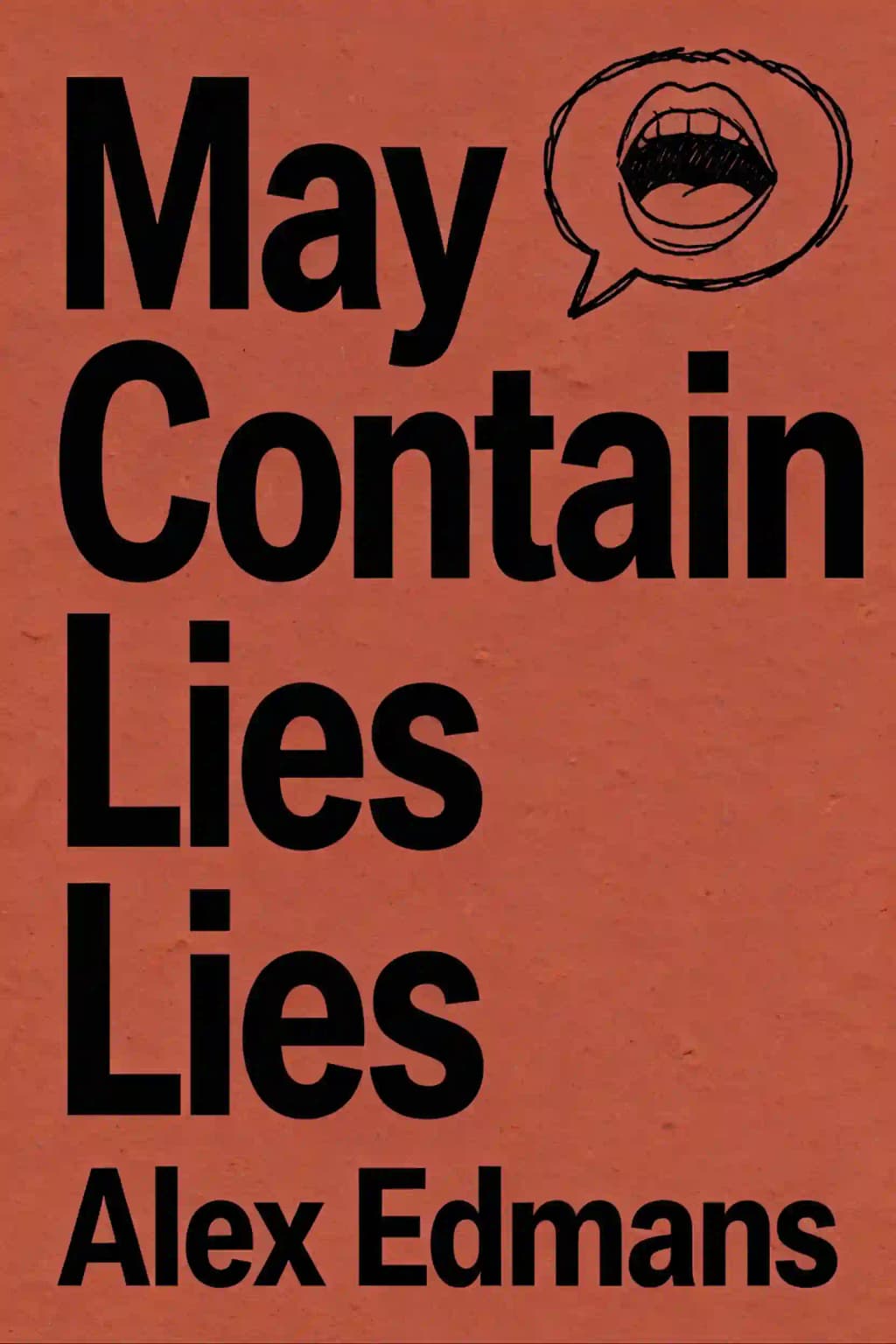
In "May Contain Lies," finance professor Alex Edmans reveals how our biases make us vulnerable to misinformation. Featured in Wall Street Journal and endorsed by Adam Grant, this guide introduces the "ladder of misinference" - your essential toolkit for navigating today's deceptive information landscape.
Alex Edmans is the author of May Contain Lies: How Stories, Statistics, and Studies Exploit Our Biases – And What We Can Do About It. He is a globally recognized finance professor and behavioral economics authority.
Edmans is a Professor of Finance at London Business School and an MIT-trained Fulbright Scholar. He merges academic expertise—honed through roles at Wharton and Morgan Stanley—with groundbreaking research on corporate decision-making, data interpretation, and ethical business practices.
His work, including the Financial Times Business Book of the Year Grow the Pie: How Great Companies Deliver Both Purpose and Profit (translated into nine languages), challenges conventional wisdom on profit-driven strategies and misinformation.
Edmans’ TED talks on trust and social responsibility have amassed nearly 3 million views. His contributions to the Wall Street Journal and Harvard Business Review underscore his influence.
A Fellow of the British Academy and advisor to global institutions, he bridges rigorous analysis with actionable insights for leaders navigating complex information landscapes.
May Contain Lies examines how biases distort our interpretation of stories, statistics, and studies, leading to misinformation. Economist Alex Edmans uses real-world examples—like the Deepwater Horizon disaster and a fraudulent wellness guru—to illustrate how people confuse anecdotes for evidence. The book provides tools to critically analyze data relationships and causality, helping readers make informed decisions.
This book is essential for professionals, policymakers, and anyone navigating today’s information-saturated world. It’s particularly valuable for those seeking to improve critical thinking skills, discern factual accuracy in media, or avoid manipulation by biased narratives. Educators and students will also benefit from its frameworks for evaluating evidence.
Yes—Edmans combines rigorous analysis with engaging storytelling, making complex concepts like causal inference accessible. The book’s actionable advice, such as identifying “ladder of misinference” biases (e.g., mistaking data for proof), offers lifelong tools for smarter decision-making. Case studies, like a wrongful conviction due to confirmation bias, underscore its real-world relevance.
Edmans details four key biases: conflating statements with facts, facts with data, data with evidence, and evidence with proof. He demonstrates how these distortions fuel misinformation, using examples like the 10,000-hour rule’s misapplication and diets based on flawed studies.
The book advocates skepticism toward emotionally charged claims and teaches readers to scrutinize sources, sample sizes, and causal relationships. For instance, Edmans critiques the “side of a bus” fallacy—assuming bold claims (like political slogans) are factual without verification.
Notable examples include BP’s Deepwater Horizon oil spill (highlighting leadership overconfidence), a wrongful 20-year imprisonment due to confirmation bias, and the rise and fall of the Cambridge Diet. These illustrate how misinformation spreads when biases override evidence.
Edmans emphasizes analyzing relationships between data points, not just individual statistics. He introduces frameworks to distinguish correlation from causation and assess study limitations, helping readers avoid pitfalls like survivorship bias or cherry-picked data.
This concept describes the progressive errors in reasoning: treating opinions as facts, isolated facts as comprehensive data, data as validated evidence, and evidence as irrefutable proof. Edmans shows how each step amplifies misinformation risks.
Yes—Edmans dissects how Malcolm Gladwell’s popularized “10,000-hour rule” (from Outliers) oversimplifies original research. The book argues that deliberate practice alone doesn’t guarantee expertise, highlighting flawed interpretations of Anders Ericsson’s studies.
The book warns against relying on charismatic leadership narratives or cherry-picked KPIs. For example, it critiques companies that prioritize short-term metrics over long-term sustainability, using Enron-style failures as cautionary tales.
Key lines include:
These underscore the book’s theme of skeptical, evidence-based inquiry.
Amid AI-driven misinformation and polarized media, Edmans’ tools help navigate complex issues like climate debates or healthcare trends. The book’s focus on causal reasoning is crucial for evaluating emerging technologies and policy claims.
著者の声を通じて本を感じる
知識を魅力的で例が豊富な洞察に変換
キーアイデアを瞬時にキャプチャして素早く学習
楽しく魅力的な方法で本を楽しむ
Smart people believe ridiculous things.
Reality is rarely binary.
A statement is not necessarily fact.
Confirmation bias doesn't just affect desperate individuals.
Atkins didn't need to be scientifically correct; he simply needed to be extreme.
『May Contain Lies』の核心的なアイデアを分かりやすいポイントに分解し、革新的なチームがどのように創造、協力、成長するかを理解します。
『May Contain Lies』を素早い記憶のヒントに凝縮し、率直さ、チームワーク、創造的な回復力の主要原則を強調します。

鮮やかなストーリーテリングを通じて『May Contain Lies』を体験し、イノベーションのレッスンを記憶に残り、応用できる瞬間に変えます。
何でも質問し、声を選び、本当にあなたに響く洞察を一緒に作り出しましょう。

"Instead of endless scrolling, I just hit play on BeFreed. It saves me so much time."
"I never knew where to start with nonfiction—BeFreed’s book lists turned into podcasts gave me a clear path."
"Perfect balance between learning and entertainment. Finished ‘Thinking, Fast and Slow’ on my commute this week."
"Crazy how much I learned while walking the dog. BeFreed = small habits → big gains."
"Reading used to feel like a chore. Now it’s just part of my lifestyle."
"Feels effortless compared to reading. I’ve finished 6 books this month already."
"BeFreed turned my guilty doomscrolling into something that feels productive and inspiring."
"BeFreed turned my commute into learning time. 20-min podcasts are perfect for finishing books I never had time for."
"BeFreed replaced my podcast queue. Imagine Spotify for books — that’s it. 🙌"
"It is great for me to learn something from the book without reading it."
"The themed book list podcasts help me connect ideas across authors—like a guided audio journey."
"Makes me feel smarter every time before going to work"

May Contain Liesの要約をPDFまたはEPUBで無料でダウンロード。印刷やオフラインでいつでもお読みいただけます。
A young Australian woman named Belle Gibson built an empire on a lie. She claimed to have cured her terminal brain cancer through natural methods, turning her story into a bestselling cookbook and a wellness app that hit 200,000 downloads. She earned nearly half a million dollars in eighteen months. Apple featured her prominently on the Apple Watch launch. There was just one problem: Belle never had cancer. Not even a mild case. Her entire story was fabricated. What's truly unsettling isn't that Belle lied-it's that so many believed her without question. Sophisticated technology companies, major publishers, and countless media outlets never bothered to verify her medical records. Why? Because her story told us what we desperately wanted to hear: that willpower and lifestyle changes could conquer our most terrifying diseases. This is confirmation bias at work-our tendency to embrace claims that align with what we want to believe while dismissing evidence that challenges our worldview.




