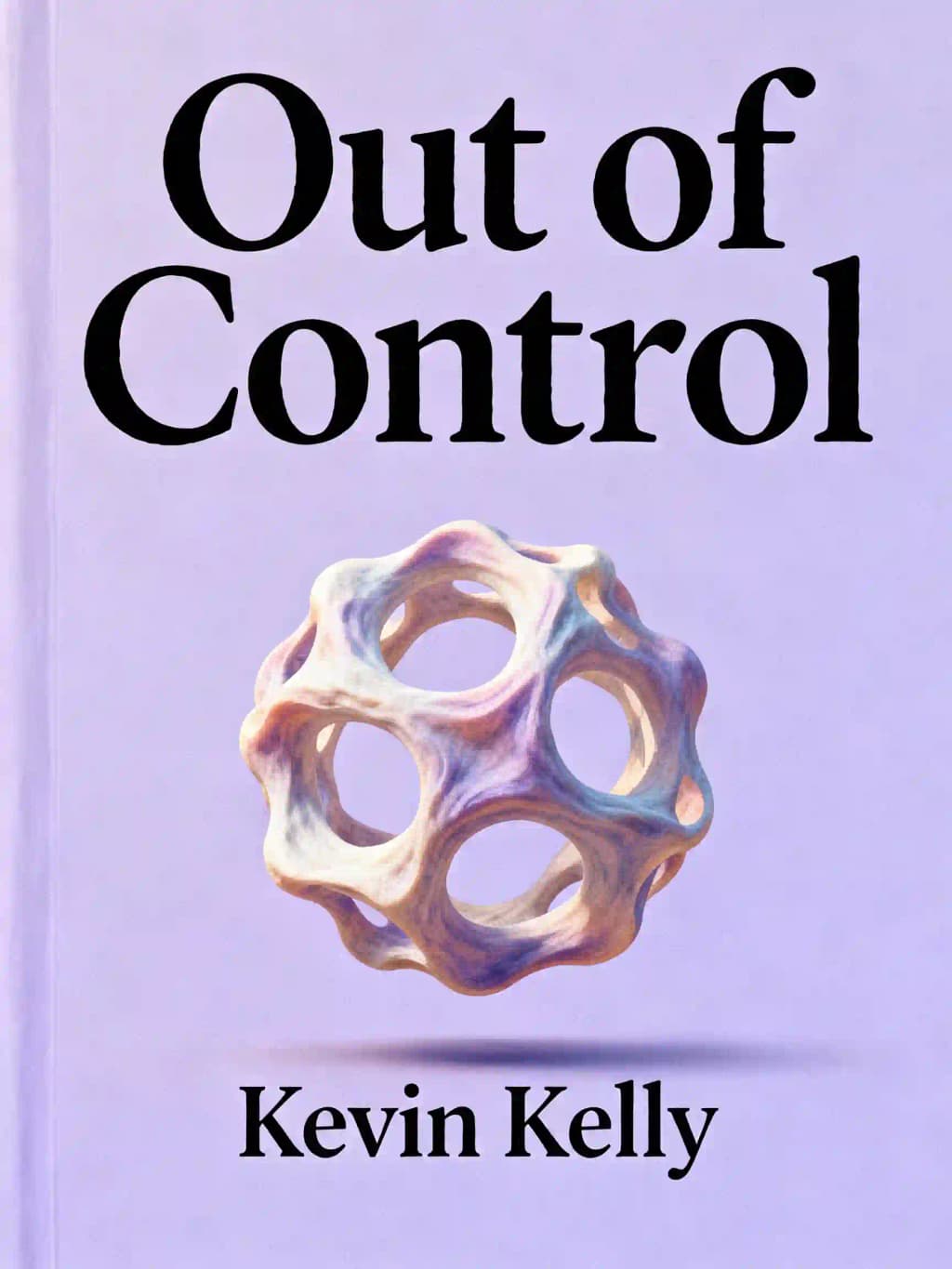
Before "The Matrix" creators made it required reading, Kevin Kelly's "Out of Control" revolutionized how we understand technology and biology's convergence. This prophetic 1994 masterpiece - praised by Brian Eno as "more gripping than sci-fi" - reveals why our future depends on embracing chaos.
Kevin Kelly, bestselling author of Out of Control and founding executive editor of Wired magazine, is a pioneering futurist and technology philosopher.
His seminal 1994 work explores the intersection of decentralized systems, biology, and technology—themes rooted in his decades of analyzing emerging trends as a leader in digital culture.
Kelly co-founded Wired in 1993, shaping it into an award-winning publication, and later co-chaired The Long Now Foundation, advocating for long-term thinking. His expertise spans multiple bestselling books, including The Inevitable (a New York Times bestseller on tech trends) and What Technology Wants, which examines technology’s evolutionary role.
Kelly’s insights are regularly featured in The New York Times, TED Talks, and his influential Cool Tools blog, which curates innovative resources for millions of monthly readers. Out of Control remains a foundational text in tech philosophy, hailed by Fortune as “required reading for all executives” for its prescient analysis of networked systems.
Out of Control: The New Biology of Machines, Social Systems, and the Economic World explores how biological principles like emergence, self-organization, and swarm intelligence shape technology, economics, and complex systems. Kevin Kelly argues that human-made systems (machines, organizations) increasingly resemble biological organisms, requiring decentralized control and adaptive strategies. Themes include cybernetics, chaos theory, and the convergence of nature and technology.
This book is ideal for readers interested in systems theory, futurism, or interdisciplinary science. Entrepreneurs, technologists, and academics will gain insights into managing decentralized systems, while enthusiasts of biology, AI, and economics will appreciate its exploration of complexity and emergent behavior.
Yes, particularly for its prescient analysis of decentralized systems and their relevance to modern challenges like AI and networked economies. Critics praise its “mind-expanding” scope, though some note its techno-utopian leanings.
Key ideas include:
Kelly uses bee swarms and ant colonies to illustrate how collective intelligence emerges from individual simplicity. This metaphor applies to economies, AI networks, and organizational behavior, advocating for decentralized problem-solving over top-down control.
Some argue the book overlooks power dynamics in decentralized systems and leans too optimistically on biological metaphors for human-made structures. Others note its dense examples may overwhelm casual readers.
Kelly foresaw AI’s reliance on emergent behavior and adaptive learning, comparing it to evolutionary processes. He suggests AI systems, like ecosystems, thrive when designed to self-organize rather than follow rigid programming.
A vivisystem combines biological and engineered traits, such as self-repairing robots or adaptive algorithms. Kelly posits that future technologies will mirror organic systems’ resilience and flexibility.
The book parallels decentralized markets (e.g., cryptocurrency) with ecological systems, emphasizing bottom-up innovation and the “invisible hand” of adaptive networks over centralized planning.
Self-organization—seen in flocking birds or viral content—shows how order arises without central control. Kelly argues this principle is key to managing complex technologies and social platforms.
While The Inevitable (2016) focuses on tech trends, Out of Control provides the foundational theory, linking biology and innovation. Both emphasize adaptability but differ in scope.
Its themes resonate in AI governance, decentralized finance, and climate resilience strategies. Kelly’s ideas on distributed systems offer frameworks for tackling modern systemic risks.
著者の声を通じて本を感じる
知識を魅力的で例が豊富な洞察に変換
キーアイデアを瞬時にキャプチャして素早く学習
楽しく魅力的な方法で本を楽しむ
Nature is yielding her mind to us-we're taking her logic.
This is the bargain all gods must accept: surrendering sovereignty over their finest creations.
Like gardeners rather than engineers, we must learn to nurture and guide rather than dictate and command.
The marvel of hive mind is that no one controls it, yet an invisible hand governs.
We don't ask how machines are going to entertain us. We ask, how can we entertain them?
『Out of Control』の核心的なアイデアを分かりやすいポイントに分解し、革新的なチームがどのように創造、協力、成長するかを理解します。
『Out of Control』を素早い記憶のヒントに凝縮し、率直さ、チームワーク、創造的な回復力の主要原則を強調します。

鮮やかなストーリーテリングを通じて『Out of Control』を体験し、イノベーションのレッスンを記憶に残り、応用できる瞬間に変えます。
何でも質問し、声を選び、本当にあなたに響く洞察を一緒に作り出しましょう。

"Instead of endless scrolling, I just hit play on BeFreed. It saves me so much time."
"I never knew where to start with nonfiction—BeFreed’s book lists turned into podcasts gave me a clear path."
"Perfect balance between learning and entertainment. Finished ‘Thinking, Fast and Slow’ on my commute this week."
"Crazy how much I learned while walking the dog. BeFreed = small habits → big gains."
"Reading used to feel like a chore. Now it’s just part of my lifestyle."
"Feels effortless compared to reading. I’ve finished 6 books this month already."
"BeFreed turned my guilty doomscrolling into something that feels productive and inspiring."
"BeFreed turned my commute into learning time. 20-min podcasts are perfect for finishing books I never had time for."
"BeFreed replaced my podcast queue. Imagine Spotify for books — that’s it. 🙌"
"It is great for me to learn something from the book without reading it."
"The themed book list podcasts help me connect ideas across authors—like a guided audio journey."
"Makes me feel smarter every time before going to work"

Out of Controlの要約をPDFまたはEPUBで無料でダウンロード。印刷やオフラインでいつでもお読みいただけます。
A beekeeper stands before his hive, watching thousands of workers stream in and out like breath itself. The colony pulses with warmth-95 degrees, though each individual bee is cold-blooded. Something remarkable has emerged here, something that exists nowhere in the individual insects themselves. This is the paradox at the heart of our technological future: the most powerful systems aren't controlled from the top down, but grow from the bottom up, like gardens rather than machines. We're entering an era where our creations will surprise us, adapt without permission, and evolve beyond our blueprints. The question isn't whether we can control this transformation-it's whether we're wise enough to let go.