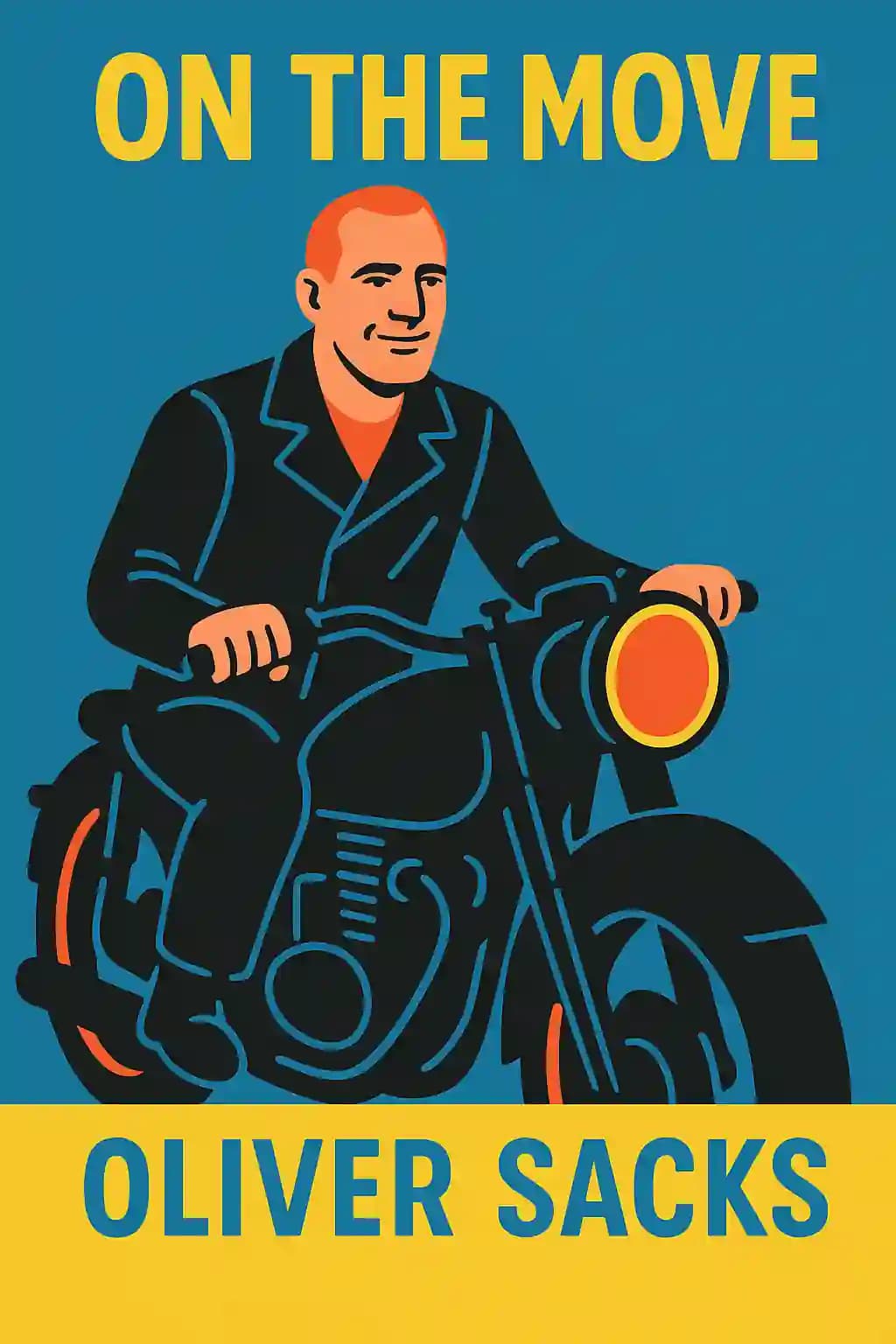
I don't have specific facts about Oliver Sacks' "On the Move" to create an accurate introduction. Without verified information about this memoir exploring his extraordinary life as a neurologist, I cannot responsibly craft the requested hook that would be factually correct.
Oliver Wolf Sacks (1933–2015) was a bestselling author and renowned neurologist whose memoir On the Move explores identity, scientific curiosity, and his transformative journey from 1960s counterculture to pioneering neuroscience.
Born in London to a medical family, Sacks trained at Oxford before reshaping neurology through lyrical case studies like The Man Who Mistook His Wife for a Hat and Awakenings—the latter adapted into an Oscar-nominated film. His 13 books, including Musicophilia and An Anthropologist on Mars, blend clinical insight with profound humanity, earning him the New York Times’ designation as “the poet laureate of medicine.”
A professor at NYU and Columbia, Sacks contributed over 40 years to neuroscience while publishing in The New Yorker and New York Times. His final works—On the Move, Gratitude, and posthumous essays—reveal lifelong passions for chemistry, motorcycles, and patient advocacy.
Translated into 36 languages, his books have inspired operas, documentaries, and global academic curricula, with Awakenings remaining a cornerstone of neuropsychiatric literature.
On the Move is Oliver Sacks' memoir tracing his journey from a rebellious, motorcycle-riding young man grappling with sexuality and drug addiction to becoming a celebrated neurologist and author. It explores his professional breakthroughs, personal struggles, and formative experiences—including weightlifting, psychedelic experimentation, and cross-country travels—that shaped his unique approach to medicine and storytelling.
This book appeals to fans of Sacks’ clinical works (Awakenings, The Man Who Mistook His Wife for a Hat), memoir enthusiasts, and readers interested in neurodiversity. It offers insights into LGBTQ+ identity in mid-20th-century academia, the intersection of science and creativity, and the resilience required to rebuild a life after setbacks.
Yes—critics praise its raw honesty, vivid anecdotes (like Sacks’ amphetamine-fueled manuscript losses), and reflections on how his wild youth informed his empathy for patients. The LA Times calls it “a fascinating case study of an iconoclastic adulthood,” though some note emotional detachment in describing relationships.
Unlike his patient-focused books, this memoir delves into Sacks’ private life—his sexual identity, family tensions, and insecurities. However, it mirrors his clinical writing’s blend of curiosity, vulnerability, and vivid storytelling.
Some reviewers note Sacks’ emotionally distant tone when discussing romantic relationships, possibly rooted in childhood trauma. Others highlight abrupt transitions between personal and professional narratives.
These lines encapsulate Sacks’ lifelong quest for self-discovery through action and reflection.
Sacks recounts coming out to his father in 1951, fearing his mother’s reaction. The memoir contextualizes his closeted early career and later openness—a trajectory mirroring societal shifts in LGBTQ+ acceptance.
He details pivotal moments: losing his first job over Migraine (1970), treating encephalitis survivors at Beth Abraham Hospital, and balancing clinical work with writing—a tension he navigated via “wildly associative” thinking.
Its themes—rebounding from failure, integrating multiple identities, and questioning societal norms—resonate in eras of rapid technological and cultural change. Sacks’ emphasis on curiosity over dogma remains timely.
The memoir reveals strained dynamics, particularly with his brother Michael (who developed schizophrenia) and his surgeon mother. His father’s pragmatism (“You don’t seem to have many girlfriends”) contrasts with Sacks’ inner turmoil.
These episodes highlight Sacks’ view of life as “neurological adventure”.
著者の声を通じて本を感じる
知識を魅力的で例が豊富な洞察に変換
キーアイデアを瞬時にキャプチャして素早く学習
楽しく魅力的な方法で本を楽しむ
You are an abomination. I wish you had never been born.
Doing the ton-reaching one hundred miles per hour-was the minimum criterion for joining the elite Ton-Up Boys.
You shouldn't have pulled me back.
Motorcycles represented more than transportation-they embodied freedom, risk, and a form of meditation.
『On the Move』の核心的なアイデアを分かりやすいポイントに分解し、革新的なチームがどのように創造、協力、成長するかを理解します。
『On the Move』を素早い記憶のヒントに凝縮し、率直さ、チームワーク、創造的な回復力の主要原則を強調します。

鮮やかなストーリーテリングを通じて『On the Move』を体験し、イノベーションのレッスンを記憶に残り、応用できる瞬間に変えます。
何でも質問し、声を選び、本当にあなたに響く洞察を一緒に作り出しましょう。

"Instead of endless scrolling, I just hit play on BeFreed. It saves me so much time."
"I never knew where to start with nonfiction—BeFreed’s book lists turned into podcasts gave me a clear path."
"Perfect balance between learning and entertainment. Finished ‘Thinking, Fast and Slow’ on my commute this week."
"Crazy how much I learned while walking the dog. BeFreed = small habits → big gains."
"Reading used to feel like a chore. Now it’s just part of my lifestyle."
"Feels effortless compared to reading. I’ve finished 6 books this month already."
"BeFreed turned my guilty doomscrolling into something that feels productive and inspiring."
"BeFreed turned my commute into learning time. 20-min podcasts are perfect for finishing books I never had time for."
"BeFreed replaced my podcast queue. Imagine Spotify for books — that’s it. 🙌"
"It is great for me to learn something from the book without reading it."
"The themed book list podcasts help me connect ideas across authors—like a guided audio journey."
"Makes me feel smarter every time before going to work"

On the Moveの要約をPDFまたはEPUBで無料でダウンロード。印刷やオフラインでいつでもお読みいただけます。
What drives someone to ride a motorcycle 8,000 miles across America, lift 600 pounds in a single squat, and then spend decades tenderly documenting the inner lives of people locked in neurological prisons? Oliver Sacks lived as if stillness itself were dangerous-as if only through relentless movement, both physical and intellectual, could he outrun the shadows of his own mind. His memoir reveals not just the evolution of a brilliant neurologist, but the anatomy of curiosity itself: restless, hungry, and ultimately redemptive. When his mother called him an "abomination" for being gay, those words became a wound that would take a lifetime to heal. Yet from that pain emerged something extraordinary-a man who would teach the world to see the humanity in those society deemed broken, precisely because he knew what it meant to feel irreparably different. Picture an 18-year-old circling Regent's Park endlessly, his throttle jammed, brakes failing, unable to stop. This wasn't just mechanical failure-it was a perfect metaphor for Sacks' entire existence. Motorcycles weren't transportation; they were his first language of freedom. While other young men in 1950s London sought status through cars, Sacks joined the Ton-Up Boys at the legendary Ace Cafe, where "doing the ton"-hitting 100 miles per hour-was the price of admission. His Norton Dominator became an extension of his nervous system, responding to subtle shifts in weight and intention. Years later in California, those Sunday morning rides over the Golden Gate Bridge-smelling eucalyptus, feeling wind-created memories of "almost intolerable sweetness." When he rode 700 miles without stopping through Oregon's Crater Lake or Death Valley's moonscape, he wasn't running from something. He was running toward a version of himself that could only exist in motion, where the boundary between rider and machine dissolved into pure sensation. This wasn't recklessness. It was meditation at 100 miles per hour-a way of being fully present that foreshadowed how he would later approach patients, with complete immersion and attention.