第1章
The Science Behind Our Most Profound Connection
When Harry Harlow conducted his famous "wire mother" experiments in the 1950s, showing that infant monkeys preferred a cloth-covered surrogate that offered no food over a wire one that did, the scientific community was stunned. The results contradicted the behaviorist dogma that attachment was merely about satisfying hunger. This revolutionary finding helped launch a scientific revolution that continues today. "A General Theory of Love" has become a cornerstone text in this field, cited by relationship therapists, neuroscientists, and even tech executives like Elon Musk, who once tweeted that it helped him understand human connection. The book's insights have influenced everything from parenting advice to corporate team-building strategies, offering a rare bridge between cutting-edge neuroscience and the deeply human experience of love.
第2章
The Three-Layered Brain: Our Evolutionary Inheritance
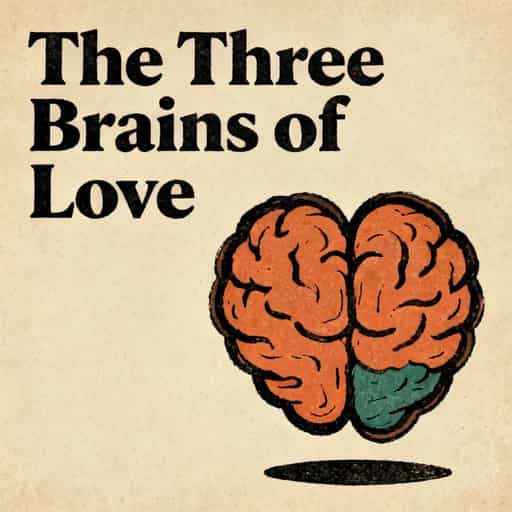
The human brain isn't a single unified organ but rather three distinct brains nested within each other, each emerging from a different evolutionary era. This "triune brain" architecture, first identified by neuroscientist Dr. Paul MacLean in the 1960s, provides a compelling framework for understanding the complex and often contradictory nature of human behavior, especially in matters of love and attachment.
At our core sits the reptilian brain, essentially an elaboration of the spinal cord that evolved roughly 500 million years ago. This ancient structure controls vital autonomic functions like breathing, heartbeat, blood pressure, and body temperature. While primitive, it's responsible for our basic survival behaviors including territorial defense, mating rituals, and establishing social hierarchies. When we witness seemingly irrational territorial behaviors in humans - from workplace politics to national conflicts - we're seeing the influence of this ancient brain designed for asocial carnivores. The reptilian brain operates on instinct and routine, resistant to innovation and largely immune to reason.
The second brain, the limbic system, emerged approximately 200 million years ago and marks the evolutionary divide between reptiles and mammals. This revolutionary development, featuring structures like the hippocampus (memory), amygdala (emotion), and cingulate gyrus (social awareness), transformed mere reproduction into nurturing behavior. While reptiles show complete indifference to their offspring after laying eggs, mammals form intricate social bonds and family groups. The limbic brain enables powerful emotional experiences: the universal separation cry when mothers are removed from their young, the joy of play, and the comfort of social grooming. Play itself - a uniquely mammalian activity - serves as a kind of physical poetry, saying one thing while meaning another, like the mock aggression of wrestling puppies.
Our largest and newest brain, the neocortex, has expanded dramatically in humans over the past 2 million years, now comprising about 80% of brain volume. This massive structure - essentially two symmetrical sheets of neural tissue crumpled to fit inside the skull - enables our most sophisticated capabilities: speaking, writing, planning, abstract reasoning, and conscious motor control. The neocortex gives us our sense of self and enables complex culture through symbolic thought and language. However, despite appearing to be the seat of conscious will, research reveals surprising limitations: readiness waves in the brain precede conscious decisions to move by several hundred milliseconds, suggesting our sense of free will may sometimes be an after-the-fact rationalization.
This fragmented brain architecture explains many human paradoxes, particularly why we cannot simply command our emotional lives as we control our limbs. The emotional brain operates largely beyond the reach of logic - we cannot will ourselves to love someone or feel happy through rational decision alone. Only our newest brain traffics in reason and language, creating a perpetual translation problem when trying to verbalize feelings, which, as Emily Dickinson noted, often "begins as a lump in the throat" rather than a coherent thought. This layered structure helps explain why emotional intelligence often operates independently of intellectual intelligence, and why matters of the heart frequently defy rational analysis.
第3章
Limbic Resonance: The Symphony Between Hearts
Have you ever walked into a room and immediately sensed the emotional atmosphere? This isn't mysticism but your limbic brain at work. Mammals possess an extraordinary capacity called limbic resonance-the ability to tune into and match the emotional states of others. This sophisticated neural mechanism allows us to feel what others feel, creating an invisible bridge between minds and hearts.
Darwin pioneered the scientific study of emotion after publishing "The Origin of Species," treating emotions as evolutionary adaptations with survival value. His groundbreaking work, "The Expression of Emotions in Man and Animals," documented how emotional expressions serve vital social and survival functions across species. His approach was validated decades later when Paul Ekman and Carroll Izard confirmed that facial expressions are universal across all cultures. Ekman's studies of isolated New Guinea tribes revealed they made identical emotional expressions as Americans despite cultural isolation, demonstrating six basic emotions: happiness, sadness, fear, disgust, anger, and surprise. Further proof of innate expressiveness comes from congenitally blind babies who smile despite never seeing faces, and even display the same range of expressions as sighted infants.
This universal emotional language extends beyond humans to other mammals, who display recognizable expressions, suggesting they too might experience feelings. While reptiles possess rudimentary emotion, mammals developed limbic resonance-a symphony of mutual exchange where two mammals attune to each other's internal states. This evolutionary advancement enabled more sophisticated social bonds and group cooperation essential for survival.
The resonance creates the wordless harmony we see between mothers and infants, lovers, and even humans and pets. Because limbic states leap between minds, feelings become contagious, allowing emotions to spread through crowds - explaining phenomena like mass panic or collective joy at sporting events. This ancient mind-reading ability remains fundamental to human connection, though modern life often obscures it through digital interfaces and social isolation.
Babies are particularly adept at this emotional attunement. They're fascinated by faces, constantly monitoring their mothers' expressions to interpret the world. In the landmark "visual cliff" experiment, infants approaching an apparent drop-off gauge danger by reading their mother's face - proceeding if she looks encouraging, retreating if she appears fearful. Babies demand not just expressions but synchrony-they become distressed by even slight delays in emotional responsiveness, as demonstrated in the "still face" experiments where mothers temporarily maintain neutral expressions.
When the limbic brain malfunctions, we see what healthy emotionality enables. Sixteen-year-old "Evan" with Asperger's syndrome couldn't intuit social rules, standing too close, speaking too loudly, and making inappropriate gestures. People with such conditions remain emotionally tone-deaf to social subtleties and sometimes to their own emotions, revealing how limbic deficits create profound isolation in our relentlessly social world. Similar challenges appear in conditions like alexithymia, where individuals struggle to identify and describe their own emotional states, highlighting how crucial limbic resonance is for both self-awareness and social connection.
Research in interpersonal neurobiology continues to reveal how this emotional attunement shapes brain development, mental health, and relationship quality throughout life. From infant attachment to adult intimacy, our capacity for limbic resonance underlies our deepest connections and most meaningful experiences.
第4章
Limbic Regulation: The Open-Loop System of Human Physiology
Contrary to what medical textbooks teach, our bodies are not self-contained units. Human physiology operates partly as an open-loop system, with vital functions dependent on input from others. While some bodily systems self-regulate (like blood pH or body temperature), others require external calibration-like women whose menstrual cycles synchronize when they live together, or infants who require caregivers to regulate their biological rhythms. This interdependence extends throughout our lives, though its manifestations become more subtle with age.
This "limbic regulation" involves the mutual exchange of physiologic information between individuals, allowing them to adjust each other's neural rhythms. One person transmits regulatory information that alters hormone levels, cardiovascular function, sleep rhythms, and immune function in another, who simultaneously provides reciprocal regulation. This exchange occurs through multiple channels: visual cues, vocal tonality, touch, and even subtle chemical signals we're not consciously aware of. For example, couples who sleep together often synchronize their heart rates and breathing patterns, while mothers can lower their infants' cortisol levels through gentle touch.
When attachment bonds rupture, mammals display universal physiological responses that unfold in two phases: protest and despair. In the protest phase, a separated puppy paces, barks, and attempts escape-behaviors mirrored in human adults experiencing romantic rejection through frantic calls and messages. This phase features elevated heart rate, body temperature, and stress hormones. The body mobilizes its resources as if facing a life-threatening emergency, flooding the system with cortisol and adrenaline, while sleep becomes elusive and appetite erratic.
If separation continues, mammals enter the despair phase, characterized by lethargy, decreased appetite, and rejection of social contact. Physiologically, despair brings disrupted bodily rhythms-irregular heartbeats, disturbed sleep patterns with less REM sleep, shifted circadian rhythms, decreased growth hormone, and altered immune function. The body essentially enters a conservation mode, shutting down non-essential functions and withdrawing from social engagement.
In 1968, Myron Hofer accidentally discovered that rat pups separated from their mothers showed dramatically reduced heart rates. Through meticulous experiments, he found that each maternal attribute regulated a specific physiological function in her offspring: body warmth and scent controlled activity level, tactile stimulation determined growth hormone levels, milk delivery fixed heart rate, and feeding periodicity modulated sleep-wake states. Further research revealed that even the mother's breathing patterns influenced her pups' respiratory development.
This revealed that the mother-infant bond consists of separate regulatory pathways, each controlling distinct bodily functions. When separation occurs, the infant loses all these organizing channels simultaneously, causing physiological collapse. The rate of disintegration varies by age-infants deteriorate within hours, older children within days or weeks, adults over months or years-but the eventual slide is inevitable for all social mammals. This explains why premature infants in incubators thrive better with skin-to-skin contact, and why elderly individuals in nursing homes live longer when given plants or animals to care for.
Studies consistently show that social isolation triples death rates after heart attacks, while strong social support doubles survival rates for cancer patients. Research has found that lonely people have higher blood pressure, increased inflammatory markers, and compromised immune function. This biological interdependence explains why isolation is so devastating and why stable relationships are essential for health-not because we should need others, but because our limbic brains literally cannot function optimally without them. Even in our digital age, virtual connections cannot fully replace the physiological benefits of in-person human contact.
第5章
The Dual Memory Systems: How We Learn to Love
Why do we often repeat relationship patterns despite our best intentions? The answer lies in how our brains store emotional information. The brain contains two distinct memory systems, each with different properties and purposes.
Explicit memory encodes autobiographical recollections and discrete facts, allowing us to access past knowledge with a moment's mental sift. Though swift and capacious, it creates a false sense of accuracy while often being erroneous-the brain cannot reliably distinguish between recorded experience and internal fantasy. This memory system's hardware centers in the temporal area, particularly the hippocampus.
The second system, implicit memory, operates beneath conscious awareness. Researchers demonstrated this through a weather prediction experiment where subjects viewed abstract cues and had to forecast rain or shine. Though the relationship between cues and outcomes was too complex for logical deduction, participants achieved 70% accuracy after just fifty trials, developing an intuitive feel for patterns their conscious minds couldn't grasp.
These dual memory systems develop at different rates. Explicit memory structures are immature at birth and require years to become fully functional, while implicit memory operates even before birth. As we age, explicit memory degenerates while implicit memory remains robust-explaining why we never forget how to ride a bike.
This distinction is crucial for understanding emotional development. A child absorbs relationship patterns unconsciously, distilling principles from consistent experiences-whether healthy or dysfunctional. These implicit patterns, not specific remembered events, determine our adult relationship behaviors.
We recognize artistic styles like Matisse's not through explicit knowledge but through implicit memory-the neural patterns formed by repeated exposure. Without formal art education, we develop an intuitive sense of what "feels like" a particular artist's work. This same implicit learning process shapes our capacity for love.
In childhood, we extract emotional patterns from relationships that become powerful Attractors, teaching us what relationships are, how they function, and whom to choose. If a parent loves healthily, that becomes our template; anomalous love makes its "ineradicable limbic stamp." We attach to whoever is there regardless of merit, and as adults our hearts lean toward these familiar patterns. We unconsciously select partners who match our emotional prototypes, often with remarkable precision, even when those patterns are dysfunctional.
第6章
Limbic Revision: How Love Changes the Brain
Memory formation follows Donald Hebb's model where neurons that fire together become more strongly linked. In a neural network, initially weak connections between neurons strengthen when they activate simultaneously in response to stimuli. These reinforced pathways allow the same pattern to be reactivated later-constituting memory.
Unlike books or CDs that physically store information for years, neurons fire for mere milliseconds. The present exists in active firing patterns while the past lies dormant in connection strengths. Every experience subtly rewires our brain's microscopic structure, transforming who we are. Minor events cause transitory alterations while formative experiences establish resilient patterns that last a lifetime.
Neural networks develop specialized structures through repeated activation patterns. Neurons that fire together form tight bonds, while those that never synchronize begin to suppress each other. The once uniform network fractures into competing groups where team members stimulate each other while opposing squadrons fight for dominance.
In the brain, neurons connect to thousands of others, creating a vast communication network. Compatible networks stimulate each other while dissonant ones compete. This creates emotional memory patterns that transcend linear time. When one network activates, it immediately encourages compatible networks-think "dog" and your brain activates networks for "German shepherd," "golden retriever," "walk," "bone," and "flea."
For limbic creatures, emotions form a principal dimension of these associative networks, with each feeling reviving memories of its prior occurrences through sympathetic reverberation. This explains why happy people remember happy times, while depressed people recall only despair. Strong emotions can completely suppress opposing networks, making contradictory memories temporarily inaccessible.
As neural networks encounter more experiences, they develop quirks that complicate human love. The brain's memory system operates through Attractors-powerful patterns that can warp perception like Einstein's theory of relativity shows mass warping space. These Attractors create force fields in our minds that bend the trajectory of thoughts venturing near them, even altering how time seems to flow.
Our emotional magnets not only attract compatible partners but also enhance matching qualities in them, creating collaborative realities that reinforce our earliest limbic lessons. After childhood's formative years, emotional learning doesn't stop but significantly slows. The brain's plasticity declines after adolescence, and existing neural Attractors easily overwhelm new configurations.
第7章
The Healing Power of Relationship
Throughout the twentieth century, two factions warred over the mind. The "biological" group sees mental events as physical brain phenomena requiring physical remedies like medications. The "psychological" cadre views emotional disturbances flowing from an intangible realm of memory and relationships, advocating various psychotherapies.
Both are correct, yet incomplete. Dividing the mind into "biological" and "psychological" is as fallacious as classifying light as either particle or wave. The emotional mind transcends this dualism-physical mechanisms produce our experience, and experience remodels our neurons. Psychotherapy is not mere conversation but a somatic state of relatedness that alters brain physiology.
Therapy's most ambitious aim is revising the neural code directing emotional life-altering the microanatomy of another person's brain. The limbic brain doesn't yield to insight but responds to the force of another person's Attractors through limbic connection. Psychotherapy changes people because one mammal can restructure the limbic brain of another.
A person cannot simply choose to desire a certain kind of relationship. Self-help books are like car repair manuals-reading them doesn't fix anything. Overhauling emotional knowledge requires the messy experience of a limbic bond. An attuned therapist feels the pull of a patient's limbic Attractors, temporarily inhabiting their emotional world not just to observe but to alter.
Through this intimate limbic exchange, therapy becomes "the ultimate inside job"-the therapist waits for moments to move the relationship in a different direction. Each emotional mind forms within the force field of parental Attractors. Progress in therapy is iterative-each successive push moves the patient's virtuality away from native Attractors toward the therapist's.
With enough repetition, these new neural pathways consolidate into novel Attractors, changing identity itself. Therapy isn't about elevating Reason over Passion but replacing unworkable intuitions with functional ones. While patients hunger for explanations, insight is merely "the popcorn of therapy"-the mutual journey is the movie.
Revising limbic Attractors takes vast amounts of time-three, five years, sometimes more. People blanch at this temporal and financial commitment, comparable to a college education. The tantalizing mirage of short, inexpensive psychotherapy has lured many, but the architecture of the emotional mind makes effective fast-food therapy as mythical as the unicorn.
The neocortex rapidly masters information, but the limbic brain requires mountains of repetition. The courage required for true therapy is remarkable-a patient surrenders the life he knows to be changed in ways he cannot envision, guided by someone he has reason to mistrust. As Richard Selzer noted about surgery, only human love keeps this from being the act of two madmen.
第8章
When Culture Collides with Biology: Modern Challenges to Connection
American culture traditionally severs the vital limbic connection between parents and infants at night by insisting on separate sleeping arrangements. This practice stands in stark contrast to most global and historical norms, where cosleeping is standard. Pediatricians like Spock and Ferber have campaigned against family beds, citing dubious Freudian theories about children feeling "overly stimulated" or "too powerful."
Evolutionary psychologists counter that babies naturally fear sleeping alone because throughout human history, nocturnal isolation often meant disaster. Sleep researcher James McKenna discovered that cosleeping mothers and infants share synchronized physiological rhythms that may be life-sustaining. This could explain why the United States has the world's highest SIDS rate-ten times Japan's and one hundred times Hong Kong's-while societies with widespread cosleeping have the lowest incidence.
Modern American culture fundamentally misunderstands the limbic requirements of love. A child tunes into parents' emotional patterns and stores them, later falling in love with partners who match these patterns with astonishing accuracy. Our culture overvalues the intoxicating state of being "in love"-that prismatic blindfold that rewrites reality and combines three elements: feeling the other uniquely fits, desiring skin-to-skin proximity, and disregarding all else. But "in love" merely brings people together; true relatedness can only blossom after its waning.
"Loving" is limbically distinct from "in love." Loving is mutuality and synchronous attunement that depends on knowing the other deeply. People's ability to love varies with their proficiency at reading another's emotional landscape-a skill learned in childhood through steady limbic connection with resonant parents.
When a society undermines limbic mechanisms, it unleashes a cascade of predictable afflictions. Children deprived of limbic resonance never learn to sense with their emotional brains or tune into themselves and others. Without sufficient limbic regulation, they cannot internalize emotional balance, growing into fragile adults uncertain of their identities and vulnerable to internal chaos.
Anxiety and depression are the first consequences of these limbic omissions-both now epidemic in America, costing over $50 billion each annually. Depression rates have risen steadily since 1960, with youth suicide rates tripling. People lacking a stable emotional center desperately seek external orientation, leading to superficiality and narcissism. When depth is unavailable, appearances become paramount-explaining our culture's obsession with image over substance.
第9章
The Enduring Power of Connection in a Disconnected World
Our culture has become an extended experiment in depriving people of what they crave most. Modern society trades communal bonds for prosperity, with each technological advancement demanding further surrender of relationships. Without the biological anchor of communal ties, we are "flung outward, singly, into the encroaching dark."
Science is now ready to discard outmoded models of the emotional mind, just as astronomers once abandoned Ptolemy's geocentric universe. The old psychological constructs-id, ego, Oedipus-are fading like summer stars before dawn, replaced by empirical discoveries about the brain's emotional architecture.
While the old models served faithfully for a time, they cannot explain enough. They creak under the pressure of inconsistencies they cannot address. Our culture has been dazzled by the neocortex's logical capacities, despite emotions reaching back 100 million years compared to cognition's mere hundred thousand. We've tried to live within a fanciful construction that flies Reason's banner, but this structure proves inhospitable to the glorious illogic of human lives.
Limbic resonance, regulation, and revision define our emotional existence-they are the walls and towers of the neural edifice evolution built for mammals. Our intellect remains largely blind to them, causing those guided solely by Reason to stumble painfully against love's unforgiving architecture. Though our culture may oppose them, people can still lead successful lives by cultivating the connections their limbic brains demand.
Science alone cannot define and lay bare the human soul-only in concert with art does it become precise enough. Both are metaphors through which we strive to know ourselves, illuminating inner landscapes with flashes that inspire but require unending rediscovery. The most we can ask is that science occasionally open a door allowing us to glimpse the bounteous secrets inside. Those with wisdom will heed their hearts, draw strength from relatedness, and raise their children to do likewise.
The tragedy of our disconnected culture lies in knowing these sad outcomes once held potential for greatness. Our children, with their pliable neurons, carry humanity's hope-they can create the next world or annihilate it, and will do so in our names. By understanding the science of love, we can choose to create a world that honors our true nature as social creatures, designed not for isolation but for the profound connections that make us fully human.







![[a-general-theory-of-love-by-thomas-lewis:c0000] A General Theory of Love p1-1](/_next/image?url=https%3A%2F%2Fd1y2du6z1jfm9e.cloudfront.net%2Fassets%2Fpodcast%2Fblue.png&w=1024&q=50)