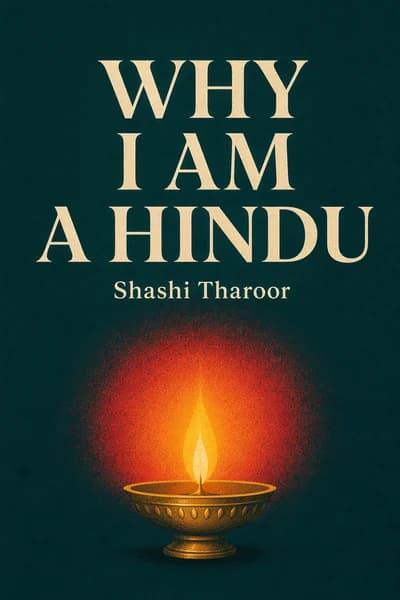
Why I am a Hindu
Panoramica di Why I am a Hindu
In "Why I Am a Hindu," politician-scholar Shashi Tharoor reclaims Hinduism's inclusive essence from rigid Hindutva politics. What faith unites a billion people yet remains so misunderstood? Discover why India's secular democracy depends on understanding true Hinduism's tolerant, philosophical core.

Temi chiave in Why I am a Hindu
- pluralistic hinduism
- religious tolerance
- indian secularism
- spiritual openness
- hindu identity
Citazioni da Why I am a Hindu
Hinduism lacks fundamentals-no founder, no church, no compulsory beliefs, no single sacred book.
Hinduism teaches not just tolerance but acceptance.
God is everywhere, within and outside us, transcending time and space, without beginning or end, form or shape.
Gods are intimate presences.
That which exists is One; the sages call It by various names.
Personaggi di Why I am a Hindu
- Shashi TharoorAuthor, intellectual, and former UN diplomat
- Swami VivekanandaHindu philosopher who emphasized acceptance
- YajnavalkyaVedic sage who discussed the nature of Brahman
- GaneshDeity and central figure of the author's devotion
Sull'autore
Sull'autore di Why I am a Hindu
Shashi Tharoor, author of Why I Am a Hindu, is a bestselling Indian politician, diplomat, and prolific writer renowned for his incisive explorations of Indian history, culture, and identity.
Born in London in 1956 and raised in India, Tharoor holds a PhD from Tufts University and served for 29 years at the United Nations, including as Under-Secretary-General. His works, spanning fiction and nonfiction, often critique colonialism and examine India’s socio-political evolution.
Why I Am a Hindu blends personal reflection with historical analysis to dissect Hindu philosophy and its modern relevance, reflecting Tharoor’s lifelong engagement with India’s pluralistic heritage. His acclaimed titles include An Era of Darkness (Sahitya Akademi Award winner) and Inglorious Empire, a Sunday Times bestseller that amplified global debates on colonialism.
A Congress Party MP since 2009, Tharoor’s 2015 Oxford Union speech on British reparations went viral, cementing his status as a leading intellectual. His books have been translated into over 30 languages and are widely cited in academic and political discourse.
Scarica il riassunto di Why I am a Hindu
Ottieni il riassunto di Why I am a Hindu in formato PDF o EPUB gratuito. Stampalo o leggilo offline quando vuoi.
FAQ su questo libro
Why I Am a Hindu explores Hinduism’s 4,000-year history, philosophical foundations, and modern political challenges. Shashi Tharoor defends Hinduism’s pluralistic traditions while critiquing the rise of Hindu nationalism (Hindutva), arguing that politicized interpretations threaten India’s secular identity. The book blends personal reflections, scholarly analysis, and calls to reclaim Hinduism’s tolerant ethos.
This book suits readers interested in Hinduism’s spiritual depth, Indian sociopolitical dynamics, or religious tolerance debates. It’s valuable for historians, policymakers, and anyone seeking to understand Hindu identity beyond stereotypes. Tharoor’s accessible prose caters to both laypersons and academics.
Yes—it offers a nuanced examination of Hinduism’s diversity, critiques religious extremism, and highlights Tharoor’s erudite perspective. While some critics note its politically charged tone, the book remains essential for grasping India’s cultural-religious landscape.
Tharoor contrasts Hinduism’s inherent pluralism and adaptability with Hindutva’s exclusionary nationalism. He argues that Hinduism’s lack of rigid dogma fosters inclusivity, whereas Hindutva weaponizes religion for divisive political agendas, undermining India’s secular fabric.
- Brahman: The genderless, universal soul central to Hindu spirituality.
- Swami Vivekananda’s teachings: The importance of personal spiritual paths over dogma.
- Sanatana Dharma: Hinduism’s “eternal way” of embracing diverse beliefs and practices.
He condemns Hindutva for distorting Hinduism into a monolithic, militant identity. Tharoor warns that equating Hindu pride with nationalism risks marginalizing minorities and eroding India’s multicultural legacy.
Tharoor describes Hinduism as a “flowing river” adaptable to individual and historical contexts. He rejects caste-based discrimination and fatalism while celebrating rituals, mythology, and the faith’s syncretic traditions.
- The absence of a single founder or centralized authority.
- The acceptance of atheism and skepticism within Hindu philosophy.
- Historical critiques of caste and gender inequality by Hindu reformers.
As global debates on religious nationalism intensify, Tharoor’s defense of pluralism resonates. The book provides a framework to counter extremist ideologies while reaffirming Hinduism’s capacity for renewal.
He underscores Hinduism’s historical tolerance of interfaith dialogue, citing its ability to absorb Buddhist, Islamic, and Christian influences without conflict. Tharoor views this openness as antithetical to Hindutva’s exclusivity.
The book references Hindu scriptures (Vedas, Upanishads, Bhagavad Gita), modern reformers like Vivekananda and Gandhi, and critiques of colonial-era distortions of Hindu practices.
Some scholars argue Tharoor oversimplifies Hindutva’s appeal or downplays Hinduism’s internal contradictions. Others praise his vision but question its practicality in polarized politics.
Hinduism’s strength lies in its adaptability and inclusivity—qualities endangered by politicized extremism. Tharoor urges Hindus to embrace their faith’s diversity and reject ideologies that equate religious identity with nationalism.