Capitolo 1
The Economics of the Everyday: A Journey Through Freakonomics' Blog Archives
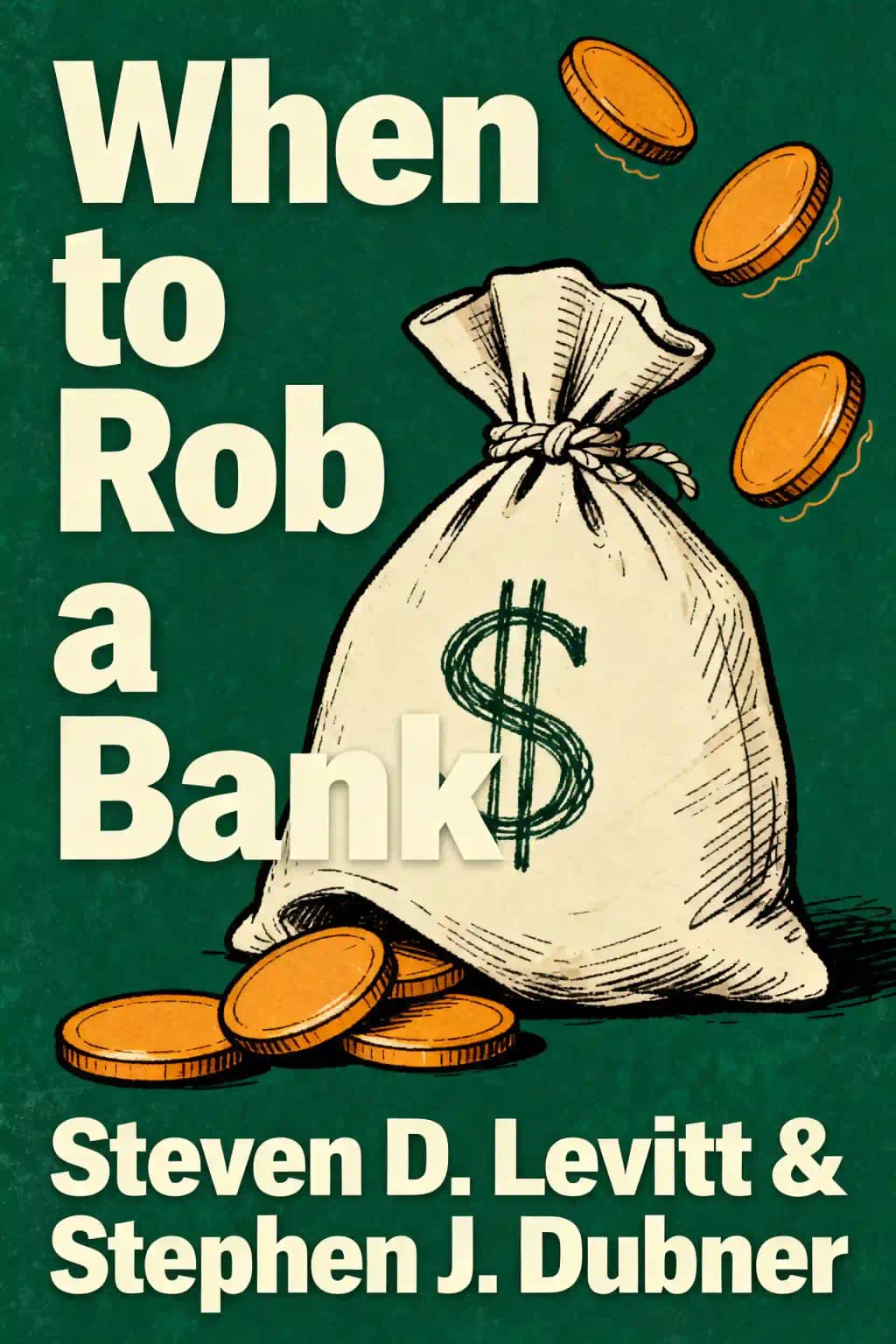
Steven Levitt and Stephen Dubner's "When to Rob a Bank" has become a cultural phenomenon since its 2015 release, joining their wildly successful Freakonomics series that has sold over 7 million copies worldwide. The book has garnered praise from unlikely quarters-Bill Gates called it "surprisingly useful for understanding the modern world," while Malcolm Gladwell noted it "changes how you see everything." Curated from over 8,000 blog posts written across a decade, this collection represents the authors' most provocative, insightful, and entertaining explorations of everyday economics. What makes this compilation particularly fascinating is how it captures the authors' unfiltered thoughts-more casual, personal, and speculative than their carefully researched books-giving readers unprecedented access to how these economic minds process the world in real-time.
Capitolo 2
The Unexpected Economics of Terrorism, Taxes, and Public Services
What would happen if someone publicly discussed the most effective terrorism strategies? Levitt found out when he posted about potential terrorist approaches, suggesting that twenty snipers randomly shooting people across America would create devastating psychological impact while requiring minimal resources. The post generated immediate outrage, with readers calling him both a moron and a traitor. His follow-up clarified an important point: terrorists surely already consider these strategies, and the fact that we haven't seen such attacks suggests either terrorist incompetence or different objectives entirely.
This provocative thought experiment highlights a crucial insight about terrorism economics: we're largely powerless against low-grade, low-tech terror. The real damage comes not from casualties (which are statistically small compared to other causes of death) but from the fear itself and our costly overreactions. Levitt concludes that either government anti-terror efforts have been remarkably successful, or the actual terror risk is much lower than we believe and we're overspending on fighting it.
The authors apply similar counterintuitive thinking to government services. They note the IRS's puzzling inefficiency-outsourcing tax collection to agencies that keep 22-24 cents per dollar when hiring more agents would cost pennies per dollar collected. Former IRS commissioner Charles Rossotti told Congress they could collect $9 billion yearly while spending just $296 million, yet Congress refuses to fund this effort. The explanation? Political fear of being seen as supporting a more vigorous IRS.
Public libraries offer another fascinating case study. While beloved institutions, they represent a model that would be impossible to create today. Publishers would likely fight against selling one copy for unlimited borrowing, instead demanding licensing fees-perhaps $20 to own a book plus $2 yearly for circulation. Like many evolved systems, if libraries were being created from scratch today, they'd look nothing like they do now.
Even academic tenure comes under scrutiny. The authors argue it creates distorted incentives-strong early in careers but weak afterward. The idea that tenure protects politically unpopular scholarship seems ludicrous; it mainly protects scholars doing no work or terrible work. In performance-based fields like professional sports or trading, tenure would be unthinkable. Levitt suggests he'd happily trade his tenure for a $15,000 raise.
Capitolo 3
What's In a Name? Identity Economics and Social Patterns
Names reveal fascinating economic and social patterns. The authors share a disturbing collection from a Texas woman who documented crime reports with one striking commonality: perpetrators with the middle name Wayne. The collection included over twenty examples of homicides, assaults, thefts, and sex crimes, plus similar patterns with rhyming names like DeWayne, Duane, and Dwayne.
Naming trends can spread with remarkable speed through cultural transmission. In 2005, 4,457 baby girls were named "Nevaeh"-"Heaven" spelled backward-making it the seventieth most popular girl's name in America. This phenomenon traces to a single event: Christian rock star Sonny Sandoval of P.O.D. appearing on MTV in 2000 with his daughter Nevaeh. The name exploded from just 8 instances in 1999 to thousands within a few years.
Even natural disasters don't follow predictable naming patterns. After Hurricane Katrina devastated New Orleans, one might expect the name to be abandoned. While it did drop significantly overall-from number 247 to number 382 on the list of girls' names-850 babies were still named Katrina the following year. More surprisingly, in Louisiana and Mississippi, the states most affected by the hurricane, the name actually increased in popularity, perhaps as an affirmation of survival or to commemorate those affected.
The authors also explore aptonyms-names that match one's profession. Their contest uncovered gems like Paige Worthy the fact-checker (if a fact doesn't get past her, it's not page-worthy!), Limberhand the Masturbator (from an Idaho court case), Eikenberry the funeral director (pronounced "I can bury"), Justin Case the insurance agent, and Chip Silvertooth the dentist.
Capitolo 4
The Hidden Logic of Pricing: From Gas to Kidneys
Economists see prices as the organizing logic of our world rather than just numbers on tags. This perspective reveals surprising insights about how markets function-or malfunction. For instance, Houston physician Dr. Cyril Wolf discovered shocking price disparities for generic medications: while chains like Walgreens charged $115-117 for 90 tablets of generic Prozac, warehouse stores like Costco charged only $12-15 for the identical medication. Many patients, particularly retirees, simply fill prescriptions at familiar pharmacies, assuming prices are similar everywhere-a perfect example of information asymmetry and price discrimination.
The Internet has transformed markets with information asymmetries. When shopping for a new car, the authors found that within minutes using sites like TrueCar and Edmunds, they could solicit competing quotes from dealerships. The offers quickly escalated to better deals, with one offering $1,300 under invoice and another beating that by hundreds more-all before leaving the house.
Even bounties follow economic principles. When the Senate voted 87-1 to raise the Osama bin Laden bounty from $25 million to $50 million, it highlighted an interesting economic principle: while such a sum is unthinkably large to a Pakistani peasant, it's negligible compared to the $10 billion monthly Iraq war expenditure. However, doubling the bounty likely wouldn't persuade anyone who wasn't already tempted by $25 million. The bigger issue is credibility-potential informants probably doubt they'd actually receive payment.
Corporate secrets have their own economic calculus. When Coca-Cola employees attempted to sell secrets to Pepsi, Pepsi turned them in rather than exploit the opportunity. This wasn't just ethical behavior-it was sound economics. If Pepsi published Coke's formula, allowing anyone to make identical products, Coke prices would plummet, but this would also damage Pepsi as consumers would switch to cheaper Coke. If Pepsi instead kept the formula secret and made their own identical product, economic theory suggests these "perfect substitutes" would trigger fierce price competition, driving down profits for both companies.
Even seemingly irrational pricing can be explained through economics. At Harold's Chicken Shack, the pricing structure defies logic: a two-wing meal costs $3.03, three wings $4.50, four wings $5.40, five wings $5.95, and six wings $7.00. This means the third wing costs $1.47 more, the fourth wing only $0.90 more, the fifth wing just $0.55 more, but then the sixth wing jumps to $1.05 more. While economists typically try to rationalize such pricing, the authors conclude that whoever set these prices was simply confused-a reminder that businesses are made up of people, and if people are generally confused by economics, that confusion inevitably carries over to firms.
Capitolo 5
The Psychology of Risk: Why We Fear the Wrong Things
People consistently misunderstand and misjudge risks due to cognitive biases and media emphasis on rare events. According to CDC data, horseback riding has a higher rate of serious injury per riding hour than motorcycling or automobile racing. Many horse-related injuries involve alcohol, similar to motor vehicle accidents. These accidents receive less attention because they typically occur on private property, involve single individuals, don't generate police reports, and appeal less to those who might call attention to unsafe activities.
Security theater pervades modern life, creating needless hassle without apparent benefit. Examples include overzealous bank fraud algorithms that freeze accounts unnecessarily, password-protected school contact lists containing only basic information, and most absurdly, a padlocked diaper-changing station in Philadelphia's train station requiring an attendant's combination. Such measures likely stem from anomalous incidents that frightened someone or triggered legal concerns.
Media coverage often creates fear disproportionate to actual threats. In 2005, "peak oil" doomsday predictions dominated headlines, with experts warning we'd soon run out of oil. The authors argued that markets naturally respond to scarcity through price mechanisms-as oil prices rise, demand decreases, production increases, and substitutes emerge. Like shark attack coverage, media reporting on peak oil created fear disproportionate to the actual threat. Ironically, by 2015, technological advances would make the U.S. the world's largest oil producer.
Even obesity risks may be misunderstood. While conventional wisdom treats obesity as a looming health crisis, some researchers argue that obesity dangers are inflated by medical and commercial interests. However, the authors point to a deadly Lake George tour boat accident where outdated passenger weight standards (140 pounds vs. the actual 174-pound average) contributed to twenty deaths when the overloaded vessel capsized.
Nobel Prize-winning psychologist Daniel Kahneman explains that immediate, imaginable consequences often outweigh vague, delayed ones in our decision-making. This helps explain why we often fear the wrong things-strangers instead of acquaintances, terrorism instead of heart disease. Statistics show that most murders, rapes, and child abductions are committed by people known to the victims, not strangers, yet our brains fixate on dramatic "black swan" events rather than more common dangers.
Capitolo 6
The Economics of Cheating: From Sports to Tax Evasion
Cheating represents "a primordial economic act: getting more for less," and people will cheat even when stakes are low, especially without punishment. A Washington "hottest media folks" contest was rigged by software bots voting thousands of times for certain candidates. Cheating becomes particularly appealing in consequence-free environments.
People lie easily, even in low-stakes situations like claiming to have read books they haven't. Examining data from Mexico's Oportunidades welfare program, applicants predictably underreported valuable possessions (83% hid car ownership), but surprisingly also overreported basic amenities they lacked-39% without toilets claimed to have them, despite this potentially disqualifying them from benefits. This embarrassment-driven "lie of reputation" reveals how self-reported data in any context is deeply unreliable.
Creative cheating systems emerge in various contexts. In Mumbai, where commuter trains serve six million passengers daily but can't check everyone's tickets, "ticketless travelers" created an insurance system. For 500 rupees (about $11), you join an organization that will refund 100% of any fine you receive for traveling without a ticket.
Even the postal service has economically rational approaches to cheating. When an unstamped chain letter marked "Exempt from postage: Guinness Book of World Records attempt" was delivered, the authors discovered the USPS simply doesn't catch many unstamped letters. This makes economic sense-when most letters have stamps, the marginal benefit of checking each one with 100% accuracy becomes infinitesimal.
Sports cheating may actually enhance entertainment value. While reading through the sports section during a lull between seasons, the authors noticed how many articles focused not on games themselves but on the cheating surrounding them-from Andy Pettitte's HGH apology to Bill Belichick's taping denials to cycling's doping scandals. Perhaps this cat-and-mouse element adds a compelling layer to sports. We condemn cheating morally but secretly embrace it as part of the win-at-all-costs mentality that makes athletes great.
Tax cheating reveals systemic problems. When smart, accomplished people like Tom Daschle, Nancy Killefer, and Tim Geithner fail to properly pay their taxes, what does it reveal about our tax code? If they were intentionally cheating until caught through high-level scrutiny, then tax cheating is too easy. If they made honest mistakes, the tax code isn't working. Most likely, it's some combination-both too easy to cheat and fundamentally dysfunctional.
Capitolo 7
Environmental Economics: Counterintuitive Green Truths
Environmental choices are rarely as simple as they first appear. Just as the paper-versus-plastic bag debate has shifted over time with more careful accounting, even walking versus driving isn't straightforward. Environmentalist Chris Goodall calculates that walking 1.5 miles and replacing those calories by drinking a cup of milk produces greenhouse emissions roughly equal to driving the same distance. With two people making the trip, driving becomes the more planet-friendly option due to the emissions connected with food production and delivery.
The locavore movement fails to recognize that specialization is ruthlessly efficient. Weber and Matthews of Carnegie Mellon found that food production contributes 83% of greenhouse gas emissions while transportation represents only 11%. They concluded that shifting just one day per week from red meat and dairy to chicken, fish, eggs, or vegetables achieves more environmental benefit than buying all local food. The authors' $12 homemade ice cream experiment demonstrated how inefficient individual production can be compared to commercial alternatives that offer variety, quality, and lower prices through economies of scale.
Food packaging, often criticized by environmentalists, serves critical functions beyond protection. It significantly extends shelf life-cucumber wrap increases shelf life from 3 to 14 days, while packaged apples reduce damage by 27%. In our globalized food system, this preservation prevents waste. When food rots, it produces methane in landfills, a greenhouse gas 20 times more potent than carbon dioxide, while packaging doesn't. Consumers discard six times more food than packaging, and food waste produces three times the carbon dioxide as packaging waste.
Despite his climate activism, Bill McKibben and his organization 350.org won't actively promote veganism, even though it's potentially the most effective way to combat climate change. Environmental activists remain oddly agnostic about meat for several reasons. First, modern environmentalism depends on high-profile media moments, while veganism is a quiet personal choice poorly suited to sensational publicity. Second, meat-eating environmentalists prefer rotational grazing as a solution, which appeals aesthetically by mimicking natural patterns. Finally, meat represents personal choice and freedom, while coal plants symbolize oppressive intrusions into our lives.
While conspicuous consumption signals wealth, "conspicuous conservation" signals environmental virtue. The Toyota Prius exemplifies this phenomenon-unlike other hybrids that look identical to their conventional counterparts, the Prius's distinctive design serves as a visible badge of greenness, particularly valuable to owners in environmentally conscious neighborhoods where being seen as eco-friendly carries social currency.
Capitolo 8
The Hidden Economics of Crime, Risk, and Decision-Making
Bank robbery economics reveal surprising patterns. FBI statistics show Fridays are the most common day for bank robberies, while morning heists yield significantly more money than afternoon ones ($5,180 vs. $3,705). The average U.S. bank robber earns $4,120 when successful but faces a 35% arrest rate. British robbers earn substantially more (around $18,000 per person) but still face high arrest rates, leading economists to conclude bank robbery is "frankly, rubbish" as a profitable occupation.
Prison studies demonstrate fascinating psychological effects. In one experiment, researchers had inmates flip coins and report how many times they got "heads" (with more heads earning more money). Half the prisoners were first asked about their convictions while the other half were asked about TV viewing habits. The conviction-reminded group reported 66% heads versus 60% for the TV group-showing how criminal identity priming increased dishonesty. Regular citizens in the same game reported 56% heads. Remarkably, prisoners asked about TV behaved more like regular citizens than like the conviction-primed prisoners.
Gun policy debates benefit from economic analysis. The evidence on gun bans is inconclusive, with studies reaching opposite conclusions depending on which control groups are selected. In Chicago and D.C., both with gun bans, 80% of homicides still involved firearms (compared to 68% nationwide), suggesting these bans are ineffective. Citywide gun bans fail because of black markets and existing gun stocks. Instead, harsh mandatory sentencing for gun crimes shows evidence of reducing gun violence without restricting law-abiding gun owners.
Football coaches exhibit extreme loss aversion, fearing criticism from a failed risky play more than valuing praise from a successful one. This made Kansas City Chiefs coach Dick Vermeil's decision particularly notable when, with five seconds left and trailing by three points, he chose to go for a touchdown from the one-yard line rather than kick a field goal to force overtime. His gamble paid off when Larry Johnson scored, giving the Chiefs the victory. The decision made national headlines precisely because such risk-taking is so rare among coaches who typically make conservative choices to avoid criticism.
Home-field advantage is real across all major sports, ranging from 53.9% in MLB to a striking 69.1% in MLS. But contrary to popular belief, the advantage doesn't come from players sleeping in their own beds or familiarity with the field. According to Moscowitz and Wertheim's research, the primary driver is referee bias-not conscious favoritism, but officials unconsciously responding to crowd emotion. The most compelling evidence comes from German soccer, where home-field advantage decreases in stadiums with running tracks that separate crowds from officials.
Capitolo 9
The Economics of Human Behavior: From Charity to Happiness
American charitable giving for natural disasters reveals stark disparities that challenge notions of pure altruism. While Americans donated $5.3 billion after Hurricane Katrina (1,833 deaths), they gave only $1.92 billion following the 2004 Asian tsunami (220,000 deaths) and a mere $150 million after the 2005 Pakistan earthquake (73,000 deaths). Media coverage dramatically impacts donations-each additional minute of nightly news coverage increases donations by 13.2%, while a 700-word newspaper story raises them by 18.2%. Research even shows that for door-to-door solicitation, the single most effective factor is having an attractive blonde woman making the request.
When faced with the dilemma of how to distribute disposable income between a street vendor and a beggar, notable thinkers offer contrasting perspectives. Tyler Cowen argues against giving to beggars as it encourages more begging long-term. Mark Cuban simply keeps walking, seeing no reason to hand over money on street corners. Barbara Ehrenreich cites Jesus's teachings about giving without judgment. Nassim Taleb rejects the question entirely as artificially isolated from context when real-life decisions depend on sequence, personal chemistry, and recent experiences.
While we expect financial incentives to motivate workers in various fields, we oddly assume children should be motivated by distant future rewards. Field experiments testing whether immediate financial incentives could improve student test performance showed that immediate payment was crucial-promised rewards delivered a month later produced no improvement. The most effective approach was giving money before the test and taking it back if standards weren't met, confirming the psychological principle of "loss aversion." For younger children, trinkets like trophies worked well, but older students responded only to cash incentives.
Despite tremendous economic and social progress for women over the past thirty-five years-including reproductive control, educational gains, reduced wage gaps, and longer lifespans-research reveals a paradox: women report being less happy today than thirty-five years ago, especially relative to men. This pattern holds across working women, stay-at-home moms, married and single women, and education levels, with older women showing steeper declines than younger ones. Only black women report increased happiness. Possible explanations include inflated expectations from the feminist movement leading to disappointment, women's lives becoming more like traditionally less-happy men's lives, reduced social pressure to pretend to be happy, or simply that self-reported happiness measures are fundamentally flawed.
Capitolo 10
Freakonomics in Action: Applying Economic Thinking to Everyday Life
The authors demonstrate how economic thinking can transform our understanding of seemingly ordinary situations. During a trip to China, Levitt observed extreme labor redundancy-five people doing jobs one American would handle. Most striking was his experience buying baby formula, where four eager saleswomen surrounded him for ten minutes to help with a four-dollar purchase. His guide later explained they weren't store employees but representatives hired by competing formula manufacturers to steer customers toward their brands, revealing a competitive market strategy where stealing business from rivals justified the staffing expense.
Pirate economics reveals rational behavior behind seemingly brutal practices. Pirates treated prisoners well not from kindness but economic calculation. They needed to encourage merchant ships to surrender peacefully by establishing a reputation for fair treatment of compliant captives, while reserving brutal treatment for those who resisted. This strategic behavior reduced their costs by avoiding battles. Contrary to popular belief, pirates never made anyone "walk the plank"-there's no historical evidence for this practice in 17th or 18th century piracy.
Racial discrimination persists in modern markets. Economists conducted a natural field experiment placing hundreds of online ads selling iPods, randomly varying whether the hand holding the device was black, white, or tattooed. The results revealed significant discrimination: black sellers received 13% fewer responses and 17% fewer offers than white sellers. Even when receiving offers, black sellers got 2-4% lower prices. Buyers showed less trust toward black sellers, being less likely to include their names in emails, accept mail delivery, and more likely to express payment concerns.
Television viewing habits between black and white Americans have converged dramatically. While historically Monday Night Football was the only show that ranked in the top ten for both demographics (with shows like Seinfeld never even cracking the top fifty for black viewers), recent Nielsen ratings show remarkable overlap. The top shows for both groups now include Grey's Anatomy, Dancing with the Stars, CSI series, and Sunday Night Football. None of the top shows for either group features predominantly black casts, though many include black characters.
Throughout these diverse topics, the authors maintain their signature approach: questioning conventional wisdom, examining data-driven insights, and revealing the hidden economic forces that shape our daily lives. Their blog-turned-book demonstrates how economic thinking can illuminate everything from terrorism strategies to tipping flight attendants, from naming babies to pricing chicken wings. By turning their economist's eye toward the everyday, they transform mundane observations into fascinating revelations about human behavior and the invisible incentives that drive our world.