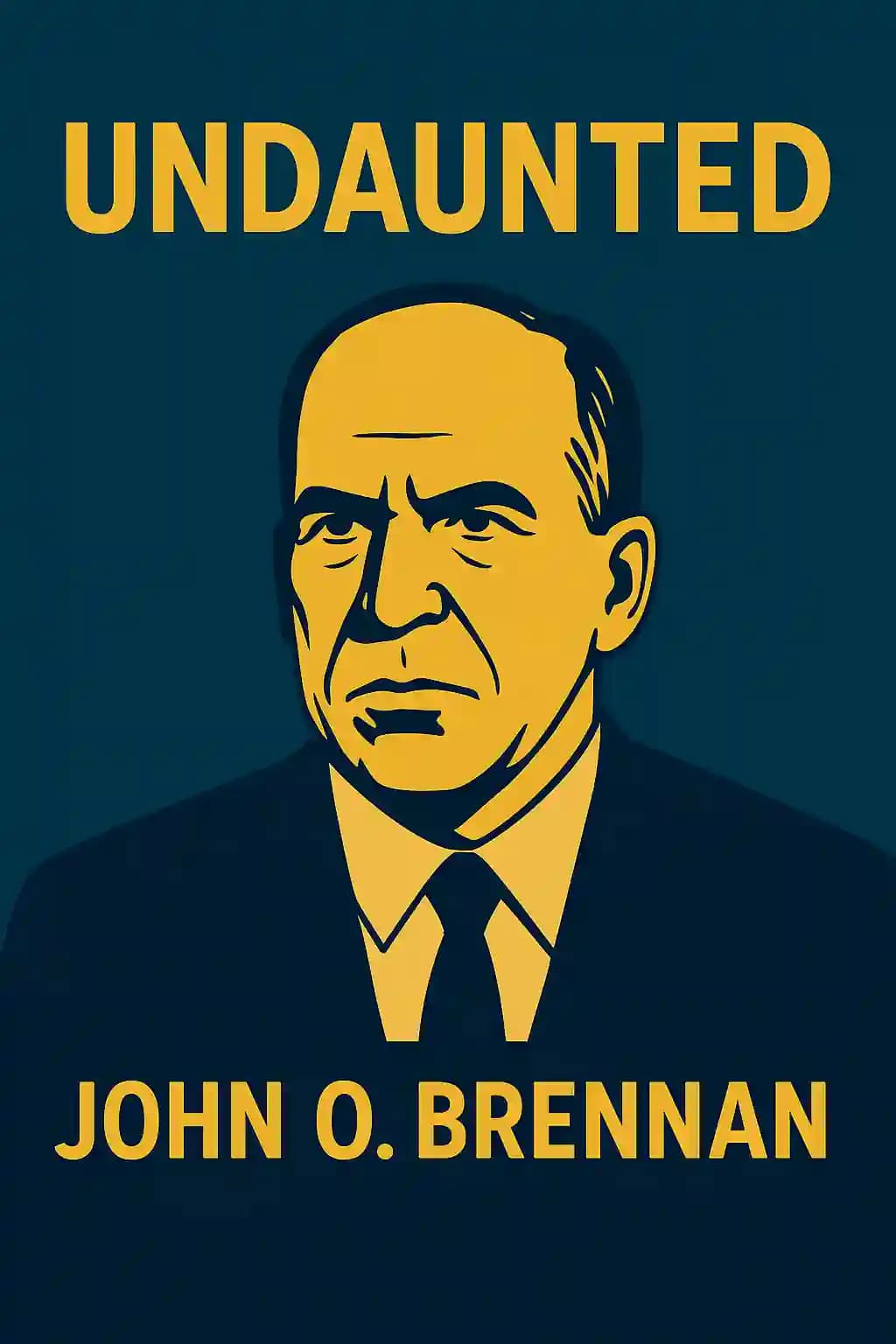
Former CIA Director Brennan's insider account reveals the hunt for Bin Laden, Russian election interference, and intelligence battles that shaped America. Endorsed by Obama as "one of the most patriotic public servants," this bestseller exposes the hidden world protecting democracy.
John Owen Brennan, former Director of the Central Intelligence Agency (2013–2017) and a pivotal figure in U.S. national security, unveils his insider perspective in the memoir Undaunted: My Fight Against America’s Enemies, At Home and Abroad.
A 25-year CIA veteran, Brennan served as station chief in Saudi Arabia, counterterrorism advisor to President Barack Obama, and architect of post-9/11 intelligence reforms, grounding this political autobiography in firsthand experience with covert operations and high-stakes policymaking.
The book explores themes of ethical leadership, counterterrorism strategy, and the complexities of safeguarding democracy, informed by Brennan’s roles in landmark events like the Bin Laden raid and responses to Russian election interference.
Educated at Fordham University and the University of Texas at Austin, he later contributed to academia as a Distinguished Non-Resident Scholar at UT Austin and advised global organizations like Kissinger Associates. Undaunted has been recognized for its unvarnished accounts of intelligence tradecraft and its critique of political pressures shaping national security.
Undaunted is John Brennan’s memoir detailing his 30+ years in U.S. intelligence, including his tenure as CIA Director under President Obama. It provides insider accounts of pivotal events like the Osama Bin Laden raid, Russian election interference, and debates over enhanced interrogation techniques. Brennan reflects on the CIA’s successes, internal challenges, and his personal struggles to uphold integrity in a politically charged environment.
This book is ideal for readers interested in national security, intelligence operations, or modern political history. Policymakers, students of Middle Eastern affairs, and those exploring ethical leadership in government will find Brennan’s firsthand perspectives on counterterrorism, presidential decision-making, and bureaucratic challenges particularly valuable.
Yes, for its unvarnished look at U.S. intelligence post-9/11. Brennan’s candor about CIA controversies—such as waterboarding and partisanship’s impact on national security—adds depth. Critics note potential bias in his Trump-era critiques, but the book remains a key resource for understanding intelligence-policy dynamics.
Brennan portrays the raid as a meticulous, interagency effort fueled by years of intelligence gathering. He highlights the CIA’s analytical rigor in confirming Bin Laden’s location and the high-stakes deliberations within the Obama administration before the operation. The account underscores the risks and moral weight of such missions.
Brennan details early CIA warnings about Russian cyber campaigns to undermine U.S. democracy. He criticizes the Trump administration’s reluctance to address the threat publicly, framing it as a failure to prioritize national security over political optics.
He acknowledges the moral ambiguity of methods like waterboarding post-9/11 but argues they were sanctioned by legal memos at the time. Brennan emphasizes his later efforts to end these practices, calling them incompatible with American values and the CIA’s long-term credibility.
Brennan depicts Obama as a deliberative leader who valued intelligence rigor but sometimes hesitated on decisive actions. Their partnership focused on restoring the CIA’s analytical reputation after Iraq War missteps, though Brennan admits occasional frustration with bureaucratic inertia.
Brennan warns that politicization of intelligence—such as congressional interference in investigations or Trump’s dismissal of Russian threats—undermines public trust. He advocates for nonpartisan stewardship of security agencies to preserve their operational integrity.
Key themes include adapting to geopolitical shifts, balancing transparency with secrecy, and maintaining ethical clarity under pressure. Brennan stresses the importance of mentoring younger analysts and learning from failures like intelligence oversights during the Arab Spring.
Unlike more technical accounts, Brennan blends career retrospective with political commentary. It’s closer to Leon Panetta’s Worthy Fights in its focus on Obama-era security decisions but stands out for its critiques of Trump and details about modern cyber threats.
He cites insularity, resistance to reform, and overclassification as persistent issues. The book calls for better interagency collaboration, public engagement to counter misinformation, and recruiting diverse talent to address evolving threats like disinformation and AI.
Senti il libro attraverso la voce dell'autore
Trasforma la conoscenza in spunti coinvolgenti e ricchi di esempi
Cattura le idee chiave in un lampo per un apprendimento veloce
Goditi il libro in modo divertente e coinvolgente
That sounds like blackmail.
Do what is necessary to keep the country safe.
Essential reading for understanding America's intelligence community.
Brennan found they greatly admired Americans as a bulwark against Soviet expansionism.
Scomponi le idee chiave di Undaunted in punti facili da capire per comprendere come i team innovativi creano, collaborano e crescono.
Vivi Undaunted attraverso narrazioni vivide che trasformano le lezioni di innovazione in momenti che ricorderai e applicherai.
Chiedi qualsiasi cosa, scegli il tuo stile di apprendimento e co-crea intuizioni che risuonano davvero con te.

Creato da alumni della Columbia University a San Francisco
"Instead of endless scrolling, I just hit play on BeFreed. It saves me so much time."
"I never knew where to start with nonfiction—BeFreed’s book lists turned into podcasts gave me a clear path."
"Perfect balance between learning and entertainment. Finished ‘Thinking, Fast and Slow’ on my commute this week."
"Crazy how much I learned while walking the dog. BeFreed = small habits → big gains."
"Reading used to feel like a chore. Now it’s just part of my lifestyle."
"Feels effortless compared to reading. I’ve finished 6 books this month already."
"BeFreed turned my guilty doomscrolling into something that feels productive and inspiring."
"BeFreed turned my commute into learning time. 20-min podcasts are perfect for finishing books I never had time for."
"BeFreed replaced my podcast queue. Imagine Spotify for books — that’s it. 🙌"
"It is great for me to learn something from the book without reading it."
"The themed book list podcasts help me connect ideas across authors—like a guided audio journey."
"Makes me feel smarter every time before going to work"
Creato da alumni della Columbia University a San Francisco

Ottieni il riassunto di Undaunted in formato PDF o EPUB gratuito. Stampalo o leggilo offline quando vuoi.
What transforms a working-class kid from New Jersey who once dreamed of becoming "the first American pope" into the director of the CIA? John Brennan's journey reveals something profound about American public service-it's rarely a straight line, and the most important qualifications aren't always found in resumes. His father, an Irish immigrant who worked as a machinist, taught him that integrity wasn't negotiable. His mother showed him that hard work opened doors. These weren't abstract lessons delivered over dinner-they were lived daily in a household where young John worked odd jobs from age ten, learning that nothing worthwhile comes easy. When he got cut from his high school basketball team three years running, he didn't quit. He kept showing up until the coach had no choice but to give the persistent kid a spot. That same stubborn determination would later define his approach to counterterrorism, where giving up wasn't an option when American lives hung in the balance.
Intelligence work isn't born in classified briefing rooms-it's cultivated through unexpected encounters and uncomfortable truths. During Brennan's sophomore year at Fordham, a course on Middle Eastern politics ignited something deeper than academic interest. It led him to spend a transformative year in Cairo in 1975, where he discovered that the world's complexities couldn't be understood from textbooks alone. Walking Egyptian streets, practicing Arabic with shopkeepers, traveling to Israel and Palestinian territories during holiday breaks-these experiences taught him that effective intelligence requires genuine cultural understanding, not just data collection. But here's where Brennan's story takes an interesting turn. When he finally joined the CIA after graduate school, his first assignment as a case officer revealed a troubling reality. A seasoned operative named Jack, reeking of alcohol, casually suggested using blackmail to keep foreign assets cooperative. "That sounds like blackmail," Brennan responded, shocked. Jack's angry retort-that they needed to "do what is necessary"-crystallized a fundamental tension: Where's the line between protecting America and betraying its values? After some embarrassing operational mistakes (like wearing a light tan suit during winter surveillance training when everyone else dressed in dark overcoats), Brennan requested transfer to the analytic side. Sometimes knowing your limitations is more valuable than pretending you don't have them.
September 11, 2001 arrived like a nightmare you can't wake from. Brennan was in George Tenet's conference room when the first plane hit. Watching the second impact on television, they instantly knew-al-Qa'ida. As the Pentagon burned and Flight 93 crashed in Pennsylvania, Tenet ordered headquarters evacuated. Brennan walked empty hallways ensuring everyone got out safely, while counterterrorism staff refused to leave their posts despite the danger. What do you do when everything changes in a single morning? The aftermath brought moral challenges that still haunt Brennan decades later. In August 2002, he read cables describing Abu Zubaydah's waterboarding-graphic accounts of repeated sessions that made him physically ill. Walking to a secluded parking lot corner, he thought, "My God, what are we doing?" He shared concerns with colleagues and Director Tenet, who insisted everything was Justice Department-approved. But years later, Brennan would call his failure to speak more forcefully his "most egregious sin of omission," vowing never to remain silent again. It's a haunting admission-sometimes the mistakes that matter most aren't what we do, but what we fail to say when it matters.
By early 2011, the CIA had located a suspicious compound in Abbottabad, Pakistan, near the country's Military Academy. They believed Bin Laden's personal courier lived there, possibly with Bin Laden himself. But "believed" and "knew" are vastly different things in intelligence work. A red team assessment put the probability of Bin Laden's presence at just 40%. Vice President Biden and Defense Secretary Gates worried about risking American lives on uncertain intelligence. CIA Director Panetta strongly advocated for the raid. President Obama made his decision with characteristic pragmatism: "The odds are fifty-fifty... Even if it's only forty percent, that's forty percent more than we've ever had before." On May 1, 2011, Brennan and other officials gathered in the Situation Room, watching the operation unfold through communications links. When word came at 3:50 PM that "Geronimo" was dead, there was no celebration-just profound relief. The most harrowing part was waiting for forces to return safely through Pakistani airspace, knowing that discovery could trigger an international crisis. When Brennan left the White House at 1:00 AM, crowds outside were chanting "USA" and "CIA," bringing tears to his eyes. After a decade of hunting, America had finally eliminated the 9/11 mastermind. But the war on terror was far from over.
By early 2016, U.S. intelligence detected foreign services hacking presidential campaign networks. When DCLeaks.com and Guccifer 2.0 (Russian intelligence fronts) released thousands of stolen Democratic emails in June, the scale became unprecedented-deliberate political sabotage designed to damage Hillary Clinton and boost Donald Trump. On August 4, Brennan confronted FSB Director Bortnikov, warning that continued interference would damage relations for years. Bortnikov denied everything. When Brennan personally briefed congressional Gang of Eight leaders, Mitch McConnell's response was stunning-he suggested the CIA was fabricating claims to prevent Trump's election. Brennan was gobsmacked. How do you protect democracy when political leaders refuse to acknowledge inconvenient threats? After Trump's victory, intelligence agencies assessed with high confidence that Putin had ordered an influence campaign to undermine American democracy and help Trump win. The day after inauguration, Brennan watched Trump visit CIA headquarters. Initially pleased, he became physically nauseated as Trump launched into political talk about his election victory and inaugural crowd size-against the backdrop of the Memorial Wall honoring fallen officers. Brennan released a statement calling Trump's "despicable display of self-aggrandizement" deeply saddening and angering.
After leaving government, Brennan became one of Trump's most vocal critics. When Trump fired FBI Deputy Director Andy McCabe just before retirement, Brennan tweeted that Trump would "take your rightful place as a disgraced demagogue in the dustbin of history." After Trump's Helsinki press conference siding with Putin over U.S. intelligence, Brennan called his behavior "nothing short of treasonous." Trump retaliated by revoking his security clearances through an unprecedented presidential directive. Why risk reputation and endure threats? Because some things matter more than personal comfort. Brennan watched the party of Lincoln become "completely debased," unwilling to confront shameful behavior. The Mueller report later corroborated intelligence findings about Russian interference, vindicating warnings many had dismissed as partisan attacks. In a democracy, speaking truth to power isn't just a right - it's a responsibility. Brennan's journey from blue-collar New Jersey to the CIA's highest office taught him that integrity isn't situational. The values his immigrant father instilled - honesty, hard work, persistence - don't evaporate when political winds shift. Whether briefing presidents or calling them out, the obligation remains: tell the truth, even when unwelcome. Especially when unwelcome. Brennan concluded his memoir with one word capturing his entire career: "undaunted." In an era when too many choose silence over principle, that stubborn refusal to back down might be the most important lesson of all.