Capitolo 1
The Artwork That Lost Its Soul: Benjamin's Vision of Mechanical Reproduction
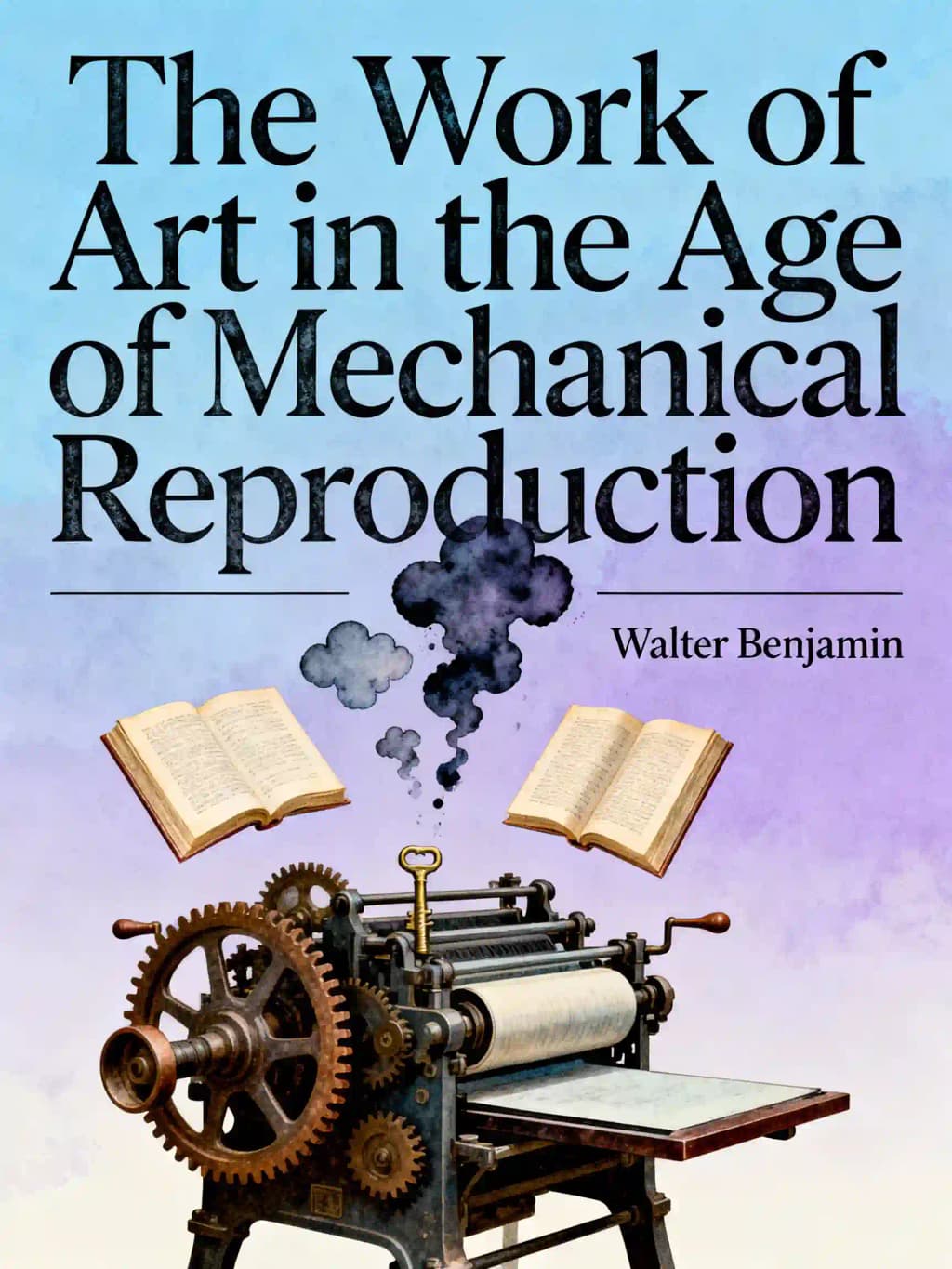
In an age where anyone can access the Mona Lisa with a single click, what happens to the mystical power of art? Walter Benjamin's groundbreaking 1935 essay "The Work of Art in the Age of Mechanical Reproduction" remains one of the most influential texts in art theory and cultural criticism. The essay predicted with uncanny accuracy how technologies would transform our relationship with art and culture. Beloved by cultural theorists and media scholars alike, Benjamin's work has influenced figures from Susan Sontag to John Berger, and continues to shape how we understand everything from Instagram filters to NFTs. Though written nearly a century ago, its insights feel startlingly contemporary-Benjamin was essentially theorizing the digital revolution before computers even existed. What makes this essay particularly fascinating is how it connects art theory to political resistance against fascism, arguing that the way we consume art has profound implications for how power operates in society. As we navigate today's digital landscape of endlessly reproducible content, Benjamin's questions about authenticity, presence, and cultural authority have never been more relevant.
Capitolo 2
The Fading Aura: Art's Loss of Mystical Authority
Art has always been reproducible in some form-students copying masters, craftsmen making replicas-but technological reproduction represents something fundamentally different. While Greeks could mass-produce sculptures through casting and embossing, most art remained unique until the invention of woodcut printing. Each technological breakthrough accelerated this process: woodcuts gave way to copper engravings, then lithography in the early 1800s, which revolutionized graphic art by allowing it to accompany everyday life with fresh images. Photography soon surpassed lithography, transferring artistic responsibility from the hand to the eye looking through a lens. Film further accelerated this process, capturing images at the speed of speech.
What's lost when we reproduce art technologically? Benjamin identifies it as the "aura"-the artwork's unique presence in time and space, its authentic existence with a complete history of physical changes and ownership. Even the most perfect reproduction lacks this "here and now" quality of the original. When we photograph Michelangelo's David or digitize a Bach concerto, we strip away its singular existence in a specific context. The reproduction can travel where the original cannot-bringing art to viewers rather than viewers to art-but in doing so, it detaches the artwork from tradition.
This transformation connects deeply to mass movements of Benjamin's time. As populations urbanized and technologies advanced, people increasingly desired to bring things "closer" both spatially and humanly. Modern perception increasingly values reproduction over uniqueness, stripping objects of their protective "sheath" and shattering their aura. This orientation of reality toward masses-and masses toward reality-transforms not just how we think about art but how we see the world itself. The photograph of a mountain range is fundamentally different from standing before that mountain and experiencing its presence, its distance, its weather. The reproduction makes art accessible but removes the element of reverence that once surrounded unique objects.
Capitolo 3
From Ritual to Politics: Art's Changing Social Function
Art's uniqueness was originally inseparable from its role in ritual, deeply embedded in the fabric of ancient societies. Ancient Venus statues exemplified this dual nature - serving as objects of divine worship for Greeks who saw in them the embodiment of beauty and love, while medieval clerics viewed these same figures as threatening idols of paganism. Both cultures, despite their opposing interpretations, recognized these artifacts' singular presence and power. The "one-of-a-kind" value of genuine art has foundations in ritual utility, whether magical or religious, from Egyptian tomb paintings to Aztec ceremonial masks. Even Renaissance art, while seemingly secularizing beauty through humanism and scientific perspective, remained tethered to these ritual foundations through religious commissions and spiritual symbolism.
When photography emerged in the 19th century alongside socialist movements, art faced an unprecedented existential crisis. The ability to mechanically reproduce images challenged the very notion of artistic authenticity. The "l'art pour l'art" (art for art's sake) movement arose as a defensive reaction-essentially creating a theology of art that rejected social function in favor of pure aesthetics. But technological reproducibility ultimately freed art from ritual dependency, democratizing access to images and creating new possibilities for artistic expression. With infinitely reproducible works like photographs, lithographs, and later digital images, traditional notions of genuineness lost their meaning. The critical question shifted from "Is it authentic?" to "What does it do?"
As art's ritual foundation eroded, its social function transformed dramatically from ritual to politics. Religious art commanded reverence through its uniqueness and sacred status; political art demands engagement through its accessibility and message. A cathedral fresco seen by few pilgrims operates fundamentally differently from a protest poster reproduced by the thousands. This transformation manifested in various ways - from Diego Rivera's public murals addressing social justice to John Heartfield's anti-Nazi photomontages distributed as magazine covers.
The balance between what Benjamin calls "cultic value" and "display value" shifted dramatically through history. Cultic value emphasizes the artwork's mere existence over its visibility-like Stone Age cave paintings in remote locations, made more for spirits than human viewers. Many religious artworks were deliberately concealed: god statues accessible only to priests, veiled Madonna images unveiled only on holy days, and cathedral sculptures placed so high they were invisible from ground level. As art gradually separated from religious ritual, display opportunities increased exponentially. Panel paintings proved more portable and displayable than fixed mosaics; symphonic music more accessible than masses confined to church settings. Technological reproduction enormously increased this displayability, from printed reproductions to digital screens, causing a qualitative shift where art became primarily something to be seen, shared, and discussed rather than revered in isolation. This democratization of art transformed it from an object of worship to a medium of social discourse and political expression.
Capitolo 4
Photography's Revolution: From Portraits to Evidence
Photography represents the first truly revolutionary medium in Benjamin's analysis, marking the critical turning point where display value begins to triumph over cultic value. Early portrait photography still retained traces of aura-capturing a fleeting human expression with melancholic beauty. The faces in daguerreotypes seem to look back at us across time with an uncanny presence that later photography would lose. These early portraits, often taking several minutes of exposure time, required subjects to remain perfectly still, creating an intensity of gaze and presence that became legendary. The resulting images possessed a ghostly quality that seemed to bridge past and present, lending them a quasi-religious significance for many viewers.
When Eugene Atget photographed deserted Paris streets around 1900, something fundamental changed. His systematic documentation of old Paris - its shop windows, courtyards, and empty boulevards - weren't meant for artistic contemplation but functioned more like evidence at a crime scene. These images became historical documentation with hidden political significance, capturing a city on the verge of massive modernization. Atget's photographs of soon-to-be-demolished neighborhoods and vanishing architectural details served as both archive and indictment. Rather than inviting free-floating contemplation, they demanded specific interpretation and action.
This shift accelerated as illustrated journals began adding captions to photographs-creating signposts for how images should be understood. Publications like "The Worker Photographer" and "AIZ" used photo-essays with detailed captions to shape political consciousness. Captions became increasingly directive, telling viewers what to see rather than allowing open interpretation. The combination of image and text created a new form of visual literacy, where meaning was constructed through their interaction. Film would take this even further, with sequences of images dictating precise interpretations through montage and narrative structure, as demonstrated in the works of Soviet filmmakers like Eisenstein.
The nineteenth-century dispute between painting and photography over artistic merit now seems misguided-both sides failed to grasp the historical transformation underway. While painters worried about photography's technical precision threatening their livelihood, and photographers attempted to imitate painterly effects, the real significance wasn't whether photography qualified as "art" but how it fundamentally altered art's function in society. By freeing art from ritual, technological reproduction permanently extinguished its autonomy. Art could now serve new purposes, reach new audiences, and create new forms of experience, from mass political movements to advertising and entertainment.
Early film theorists made similar mistakes, attempting to elevate film to "art" by invoking cultic elements. Abel Gance compared film to hieroglyphics, while others likened it to prayer or mystical experience. Severin-Mars spoke of film as having a religious quality akin to medieval cathedrals. These reactionary interpretations sought meaning in the supernatural rather than recognizing film's true revolutionary potential to transform how we see and understand the world. The power of film lay not in its ability to create new rituals, but in its capacity to analyze and reveal reality in unprecedented ways, showing viewers what had previously escaped notice in the flow of everyday life.
Capitolo 5
The Actor's Exile: Performance in the Age of Film
Film transformed not just how we view art but how performance itself functions in fundamental ways. The stage actor presents directly to an audience, engaging in an intimate dialogue of energy and response, adjusting their delivery, timing, and emotional intensity based on the immediate feedback from the crowd. This living connection between performer and audience has been the essence of theater for millennia. The screen actor's performance, however, is mediated by equipment-the camera stands between performer and audience, continuously commenting on the performance through movements, angles, and techniques like close-ups, creating an entirely new language of dramatic expression.
This technological intervention creates a profound alienation that Luigi Pirandello described as exile-the actor becomes separated from both stage and self, reduced to a mute image captured in time. The film actor must operate without his aura, that ineffable quality inseparable from physical presence that allows an immediate connection with the audience. Unlike theater, where actors command their space and timing, film treats actors as props selected for character traits and placed appropriately within the frame. The screen actor's performance isn't whole but fragmented-lighting requirements, multiple takes, montage techniques, and directorial choices break performances into discrete episodes assembled later in editing.
The actor's alienation stems from the unprecedented transportability of his image-his reflection separated from himself and carried to distant audiences across time and space. Always conscious of this market of consumers who will view the performance repeatedly in different contexts, the actor experiences a unique unease before the camera. Film capital responds to this "shrivelling of aura" by artificially inflating personality through elaborate star culture, creating larger-than-life personas through publicity, marketing, and carefully managed public appearances, preserving only the commodity character of personal magic.
Yet film simultaneously democratizes performance in ways previously unimaginable. Just as newspapers opened correspondence columns to readers, effectively blurring the distinctions between professional writers and readers, film allows ordinary people to become extras, bit players, or even subjects of documentaries. In Soviet Russia, this democratic potential was explored through films featuring workers and peasants portraying themselves through their daily labor, creating a new form of social realism. Meanwhile, Western capitalism primarily exploited film's capabilities through spectacular entertainment and escapist illusions, though even here, the medium's democratic potential occasionally emerged through neorealist movements and documentary traditions. This fundamental tension between democratization and commodification remains central to film's social function, shaping both its artistic development and its role in modern society.
The transformation of performance through film technology has had lasting implications for acting technique itself. Method acting, for instance, evolved partly in response to the camera's intimate gaze, which exposed any hint of artificiality. This led to more naturalistic performance styles that continue to influence both screen and stage acting today.
Capitolo 6
Film's Penetrating Eye: The Optical Unconscious
Film creates a previously inconceivable spectacle that cannot be assigned to a single viewpoint. Unlike theater, which acknowledges the point where illusion breaks down - the edge of the stage, the visible wings, the physical presence of actors - film has no such point. Its illusory nature derives from editing, which seamlessly stitches together disparate moments and perspectives into a continuous whole. The camera penetrates reality so deeply that reality's pure aspect emerges only through special procedures: shooting with adapted equipment like macro lenses, high-speed cameras, and specialized lighting, then assembling shots according to new principles that transcend natural human perception.
Benjamin draws a fascinating parallel between the cameraman/painter relationship and the surgeon/magician relationship. The surgeon/cameraman penetrates the subject's tissue, working directly with the internal mechanics while maintaining analytical distance. In contrast, the magician/painter maintains natural distance, creating effects through gesture and suggestion. The painter creates a whole image that presents reality as it appears to human vision; the cameraman produces fragments that are reassembled according to new laws of perception and temporality. Film's significance lies in providing the camera-free aspect of reality people demand from art precisely by using the camera to thoroughly penetrate that reality, creating a new form of vision that paradoxically feels more natural than nature itself.
This penetration reveals what Benjamin calls the "optical unconscious"-aspects of reality visible to the camera but not to the naked eye. Just as Freudian theory revealed the unconscious in everyday slips of the tongue, nervous tics, and dreams, film exposes previously unnoticed aspects of the sensory world that exist below the threshold of conscious perception. Through close-ups, unusual angles, slow-motion, time-lapse, and other techniques, film reveals dimensions of reality that existed but remained imperceptible to ordinary vision. A simple walking gesture becomes a complex ballet of muscle movements; a familiar face becomes a landscape of texture and emotion.
Film liberates us from spatial and temporal limitations, expanding our perceptual world by showing familiar environments from transformative perspectives. A close-up of a flower reveals intricate patterns invisible to casual observation, transforming common petals into alien landscapes of color and form. Slow-motion captures the precise moment a drop of water hits a surface, revealing the complex dance of liquid physics typically too fast for human perception. Tracking shots create fluid movement through space impossible in ordinary perception, allowing viewers to float through environments with ghostly freedom. Aerial shots reveal patterns in landscapes invisible from ground level, while microscopic photography opens windows into previously invisible worlds. These techniques don't just enhance reality-they reveal entirely new dimensions of it, creating what Benjamin calls a "different nature" that speaks to the camera rather than to the eye. This technological vision paradoxically brings us closer to understanding the hidden complexity of our natural world.
Capitolo 7
Shock and Distraction: New Modes of Reception
The crude excesses of "decadent" artistic periods often spring from art's richest historical forces, generating demands that can only be fully satisfied by future technological advances. This pattern is particularly evident in the relationship between Dadaism and film. Dadaism attempted to create effects later achieved naturally by film, but using traditional mediums of painting and literature. The Dadaists deliberately destroyed the aura of their works through radical techniques, incorporating everyday objects like buttons, train tickets, newspaper clippings, and linguistic detritus into their art. Artists like Kurt Schwitters and Marcel Duchamp transformed mundane objects into provocative artistic statements, challenging the very notion of what constituted art.
Unlike contemplative traditional art that invited quiet reflection, Dadaist works functioned as projectiles striking viewers with calculated force, acquiring a tactile quality that anticipated film's distracting element. These works demanded immediate, visceral reactions rather than measured aesthetic appreciation. Through techniques like collage and photomontage, Dadaists created jarring juxtapositions that assaulted viewers' sensibilities, breaking down traditional artistic hierarchies.
Film's rapidly changing images prevent contemplative immersion in ways that Dadaists could only dream of achieving. As French critic Georges Duhamel famously complained, "I can no longer think what I wish to think. The moving images substitute themselves for my own thoughts." This constant shifting of images creates a shock effect that Dadaism had attempted but could only achieve within the moral sphere. Film's technical structure - its rapid cuts, multiple angles, and temporal manipulation - fully realizes this physical shock effect, training viewers in a new mode of perception better suited to modern life's accelerated pace and fragmentary nature.
This shift represents a fundamental change in how audiences receive art. The mass audience has become a matrix generating new responses, with quantity transforming into quality through collective experience. Traditional critics dismiss film as mere distraction for "helots" - the masses they consider incapable of proper concentration or thought - thereby reviving the old opposition between distraction (associated with the masses) and contemplative immersion (reserved for cultural connoisseurs). Yet this distinction demands closer examination in light of modern conditions.
While contemplation involves the viewer entering into the artwork's space, the distracted mass absorbs the artwork into itself through casual observation and habitual exposure. Architecture provides the clearest historical example of reception in distraction - buildings are received both tactilely and optically, more through everyday use and habit than conscious attentiveness. People experience architecture primarily through casual observation while moving through spaces, rather than through focused contemplation of facades or floor plans.
This distracted reception becomes increasingly crucial during historical upheavals when traditional visual contemplation alone cannot solve modern perceptual challenges. Film serves as the practice instrument for this new reception mode, meeting the audience halfway through calculated shock effects while cultivating an appraising yet distracted stance. Through techniques like montage, close-ups, and varying camera angles, film trains viewers in new ways of seeing and processing information - a mode of perception increasingly necessary for navigating the sensory bombardment of modern urban life, from advertising to traffic to the general acceleration of daily experience.
Capitolo 8
The Politics of Aesthetics: Fascism's Dangerous Spectacle
Benjamin's analysis culminates in a profound warning about fascism's sophisticated exploitation of new aesthetic forms. Increasing proletarianization and mass formation represent two intertwined aspects of the same historical process, as industrial capitalism creates both an expanding working class and new forms of mass culture. Fascism skillfully organizes these emerging masses without fundamentally changing the property relations they seek to abolish, instead offering them expression through carefully orchestrated spectacle rather than genuine economic justice. This manipulation manifests in elaborate leader cults, choreographed mass rallies, and the transformation of political participation into theatrical performance.
The aestheticization of politics under fascism operates through multiple channels. In Nazi Germany, for instance, the Nuremberg rallies combined architectural grandeur, synchronized movement, dramatic lighting, and film documentation to create an overwhelming sensory experience. The masses become both performers and spectators in their own subjugation, finding a false sense of empowerment in their collective submission to aesthetic spectacle. This process transforms legitimate political grievances into carefully managed emotional catharsis.
War becomes the ultimate culmination of aestheticized politics, providing a destructive goal for mass movements while preserving traditional ownership structures. F.T. Marinetti's Futurist manifesto exemplifies this dangerous fusion, celebrating war as beautiful for establishing human dominion over machines and achieving the "metallization of the human body." His vivid imagery of meadows transformed by the "fiery orchids of machine-guns" reveals how aesthetic appreciation can be perverted to glorify violence. This marriage of technology, aesthetics, and violence reaches its apex in fascist spectacle, where destruction becomes a form of creative expression.
Benjamin's concern with fascism's aestheticization of politics reveals the urgent political stakes of his analysis. The transformation of art through mechanical reproduction isn't merely a cultural or aesthetic question but a deeply political one that shapes mass consciousness. New technologies of reproduction, particularly film and photography, create unprecedented possibilities for both liberation and control. How societies respond to these new forms of perception and reception fundamentally shapes their political possibilities.
The essay's political dimension becomes particularly clear in Benjamin's detailed discussion of how film corresponds to modern perception. Mass reproduction particularly suits the reproduction of masses themselves-in rallies, sports events, war, and political spectacles. The camera's ability to fragment and reassemble reality becomes a powerful tool for manipulating how people understand their social world. Through techniques like montage, close-ups, and slow motion, film can create powerful emotional effects and shape collective understanding. When combined with fascist ideology, these techniques create dangerous illusions of unity and purpose while preserving and obscuring exploitative economic relations. This manipulation of mass media and aesthetic experience serves to pacify political resistance through the provision of carefully managed spectacular satisfactions.
Capitolo 9
Beyond Reproduction: Art's Revolutionary Potential
Despite his concerns about fascism's exploitation of new media, Benjamin remains hopeful about art's revolutionary potential. The technological reproducibility that destroys aura also creates new possibilities for democratic participation and critical engagement. Film's capacity to reveal the optical unconscious can serve emancipatory purposes, showing people aspects of their reality previously hidden from view.
Benjamin notes how film democratizes performance-just as newspapers opened correspondence columns to readers, blurring writer/reader distinctions, film allows ordinary people to become extras or even subjects. In Soviet Russia, some films featured people portraying themselves through their labor, suggesting alternative uses of film technology outside capitalist spectacle.
The essay's dialectical approach refuses simple nostalgia for auratic art or uncritical celebration of new media. Instead, Benjamin traces how technological changes create both dangers and opportunities. The same forces that enable fascist spectacle also enable new forms of critical consciousness and collective experience.
Benjamin's analysis anticipates many later developments in media theory and cultural criticism. His concept of aura prefigures later discussions of simulation and authenticity in postmodern theory. His attention to how media reshape perception anticipates Marshall McLuhan's famous dictum that "the medium is the message." His concern with the political implications of aesthetic forms remains central to contemporary discussions of media power.
What makes "The Work of Art in the Age of Mechanical Reproduction" so enduring is its recognition that technological changes don't just alter how we distribute art but transform what art is and how we experience it. As we navigate today's digital landscape-where images, sounds, and texts circulate globally at unprecedented speed-Benjamin's insights about aura, reproduction, and reception remain essential tools for understanding our changing relationship to culture. His work reminds us that questions of aesthetics are never separate from questions of politics, and that how we see shapes what we can imagine and create together.