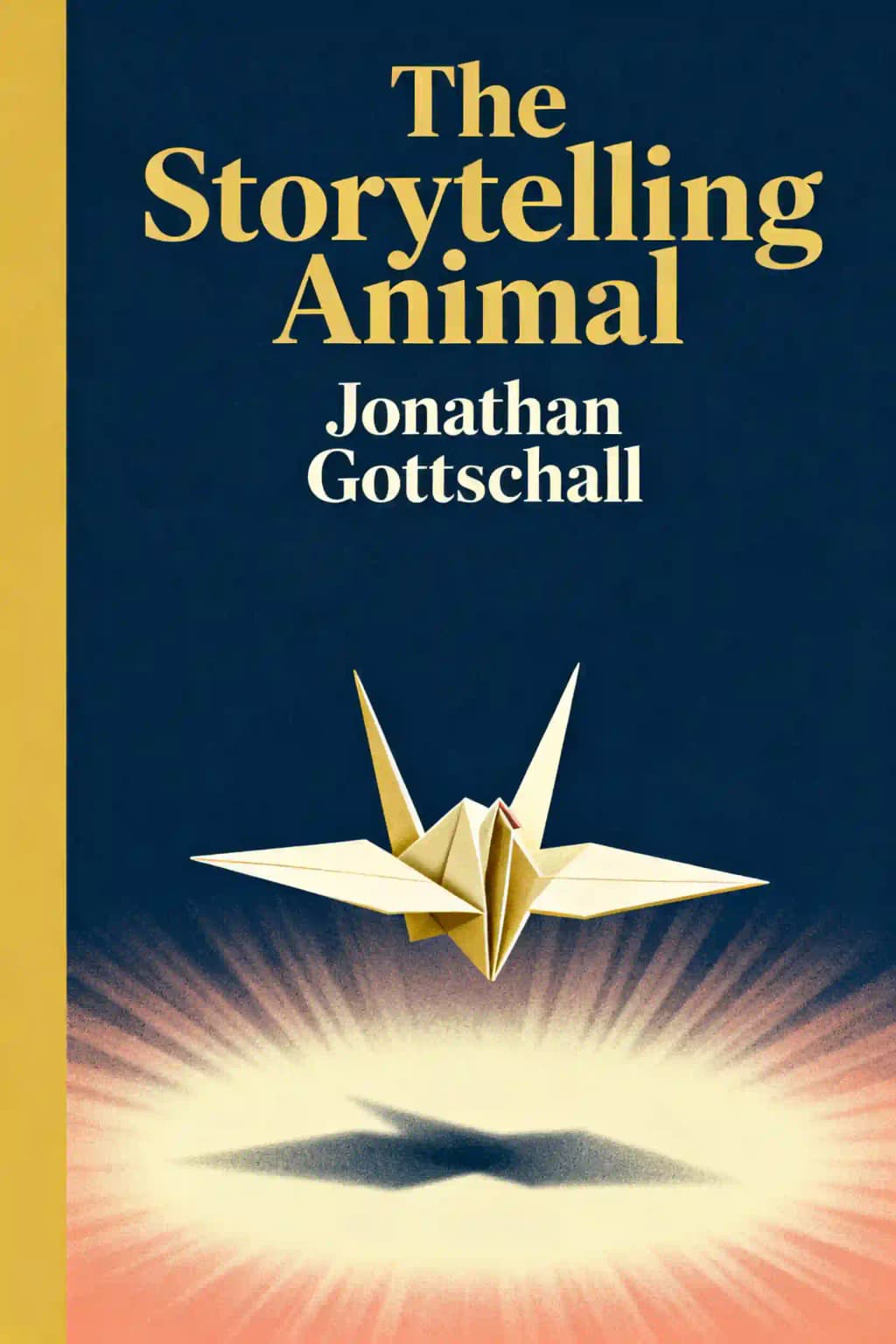
Why are humans obsessed with stories? Jonathan Gottschall's groundbreaking exploration reveals how storytelling shapes everything from dreams to marketing campaigns. Recommended by storytelling coach Kurt Mullen, it explains why Jack Links' Sasquatch ads succeeded where logical arguments fail - stories literally rewire our brains.
Jonathan Gottschall is the acclaimed author of The Storytelling Animal: How Stories Make Us Human and a leading scholar exploring the evolutionary roots of narrative through the lens of science. A Distinguished Fellow in the English Department at Washington & Jefferson College, Gottschall bridges literary analysis with evolutionary psychology to reveal how storytelling shapes human behavior and culture.
His work—including The Professor in the Cage: Why Men Fight and Why We Like to Watch and The Story Paradox: How Our Love of Storytelling Builds Societies and Tears Them Down—has been featured in The New York Times, Scientific American, The Atlantic, and on NPR’s Radiolab and The Joe Rogan Experience.
Known for blending rigorous research with accessible prose, Gottschall’s The Storytelling Animal was named a New York Times Editor’s Choice and a finalist for the Los Angeles Times Book Prize. His writing dissects universal themes of violence, masculinity, and the cognitive science of narrative, establishing him as a pivotal voice in understanding humanity’s inseparable bond with stories. The book has become a cornerstone in discussions about art, evolution, and the science of creativity.
The Storytelling Animal explores how storytelling is an evolutionary adaptation that shapes human behavior, culture, and cognition. Drawing on neuroscience, psychology, and biology, Gottschall argues stories act as "flight simulators" for social dilemmas, helping us navigate life’s challenges. The book examines why humans are irresistibly drawn to narratives, from childhood fantasies to religious myths, and how they reinforce moral values and social cohesion.
This book is ideal for writers, psychologists, marketers, and anyone curious about why stories dominate human life. Gottschall’s interdisciplinary approach appeals to readers interested in the science behind art, the evolutionary roots of creativity, or how narratives influence decision-making. It’s also valuable for parents and educators exploring storytelling’s role in child development.
Yes—it’s a New York Times Editor’s Choice and LA Times Book Prize finalist praised for blending scholarly rigor with engaging prose. Gottschall’s mix of personal anecdotes (like training in MMA fighting) and scientific research makes complex ideas accessible, offering fresh insights into how stories define our humanity.
Gottschall suggests all cultures share a storytelling blueprint: characters face problems, strive for goals, and confront conflict. This structure reflects evolved human psychology, helping societies transmit survival strategies and moral codes. Examples range from ancient myths to modern novels.
Fiction acts as a social simulator, allowing humans to safely practice problem-solving and empathy. Gottschall compares stories to training wheels for real-life challenges, arguing they evolved to strengthen group cooperation and prepare individuals for adversity.
Gottschall cites studies showing brains respond to fictional narratives as if they’re real. For example, MRI scans reveal identical neural activity when reading about actions versus performing them, suggesting storytelling is hardwired into human biology.
In a personal experiment, Gottschall trained at an MMA gym to understand male violence—a theme prevalent in stories across cultures. His firsthand account illustrates how narratives about conflict reflect innate human struggles for status and survival.
Some scholars argue Gottschall oversimplifies storytelling’s cultural diversity or downplays non-evolutionary explanations. Others note his focus on fiction’s adaptive benefits may neglect its potential to spread harmful ideologies.
Gottschall highlights children’s innate storytelling drive, noting kids create imaginary worlds to process emotions and social rules. This “play pretend” phase is framed as evolutionary rehearsal for adult problem-solving.
Gottschall compares stories to pilot training tools: they allow humans to mentally rehearse responses to threats (e.g., betrayal, love, or loss) without real-world risks. This mechanism arguably enhanced ancestral survival rates.
While focused on evolutionary roots, Gottschall notes digital media intensifies storytelling’s reach. He suggests binge-watching or gaming satisfies the same primal narrative cravings as ancient campfire tales.
Gottschall emphasizes leveraging universal story structures (heroes, conflicts, resolutions) to engage audiences. Successful narratives tap into evolved preferences for clear moral lessons and emotionally charged stakes.
Senti il libro attraverso la voce dell'autore
Trasforma la conoscenza in spunti coinvolgenti e ricchi di esempi
Cattura le idee chiave in un lampo per un apprendimento veloce
Goditi il libro in modo divertente e coinvolgente
Stories seem to be good for us—vital, even.
Fiction is a lie that tells us true things, over and over.
We are, quite literally, soaked to the bone in story.
Hell is story-friendly.
Scomponi le idee chiave di Storytelling Animal in punti facili da capire per comprendere come i team innovativi creano, collaborano e crescono.
Distilla Storytelling Animal in rapidi promemoria che evidenziano i principi chiave di franchezza, lavoro di squadra e resilienza creativa.

Vivi Storytelling Animal attraverso narrazioni vivide che trasformano le lezioni di innovazione in momenti che ricorderai e applicherai.
Chiedi qualsiasi cosa, scegli la voce e co-crea spunti che risuonino davvero con te.

Creato da alumni della Columbia University a San Francisco
"Instead of endless scrolling, I just hit play on BeFreed. It saves me so much time."
"I never knew where to start with nonfiction—BeFreed’s book lists turned into podcasts gave me a clear path."
"Perfect balance between learning and entertainment. Finished ‘Thinking, Fast and Slow’ on my commute this week."
"Crazy how much I learned while walking the dog. BeFreed = small habits → big gains."
"Reading used to feel like a chore. Now it’s just part of my lifestyle."
"Feels effortless compared to reading. I’ve finished 6 books this month already."
"BeFreed turned my guilty doomscrolling into something that feels productive and inspiring."
"BeFreed turned my commute into learning time. 20-min podcasts are perfect for finishing books I never had time for."
"BeFreed replaced my podcast queue. Imagine Spotify for books — that’s it. 🙌"
"It is great for me to learn something from the book without reading it."
"The themed book list podcasts help me connect ideas across authors—like a guided audio journey."
"Makes me feel smarter every time before going to work"
Creato da alumni della Columbia University a San Francisco

Ottieni il riassunto di Storytelling Animal in formato PDF o EPUB gratuito. Stampalo o leggilo offline quando vuoi.
Have you ever found yourself unexpectedly moved to tears by a simple melody? One moment you're folding laundry, the next you're transported into someone else's heartbreak, feeling emotions as real as your own memories. This isn't weakness or sentimentality-it's your brain doing exactly what evolution designed it to do. We spend roughly five hours daily watching screens, listen to story-songs during commutes, dream vividly each night, and daydream about two thousand times daily. Add it up, and we're spending nearly half our waking hours lost in imaginary worlds. Even our "real" activities are saturated with narrative: sports broadcasts transform games into epic dramas, commercials are miniature films, and trials become dueling stories of guilt and innocence. We are, quite literally, soaked to the bone in story. This raises a fascinating question: if evolution ruthlessly eliminates wasteful traits, why did it preserve our obsession with make-believe?