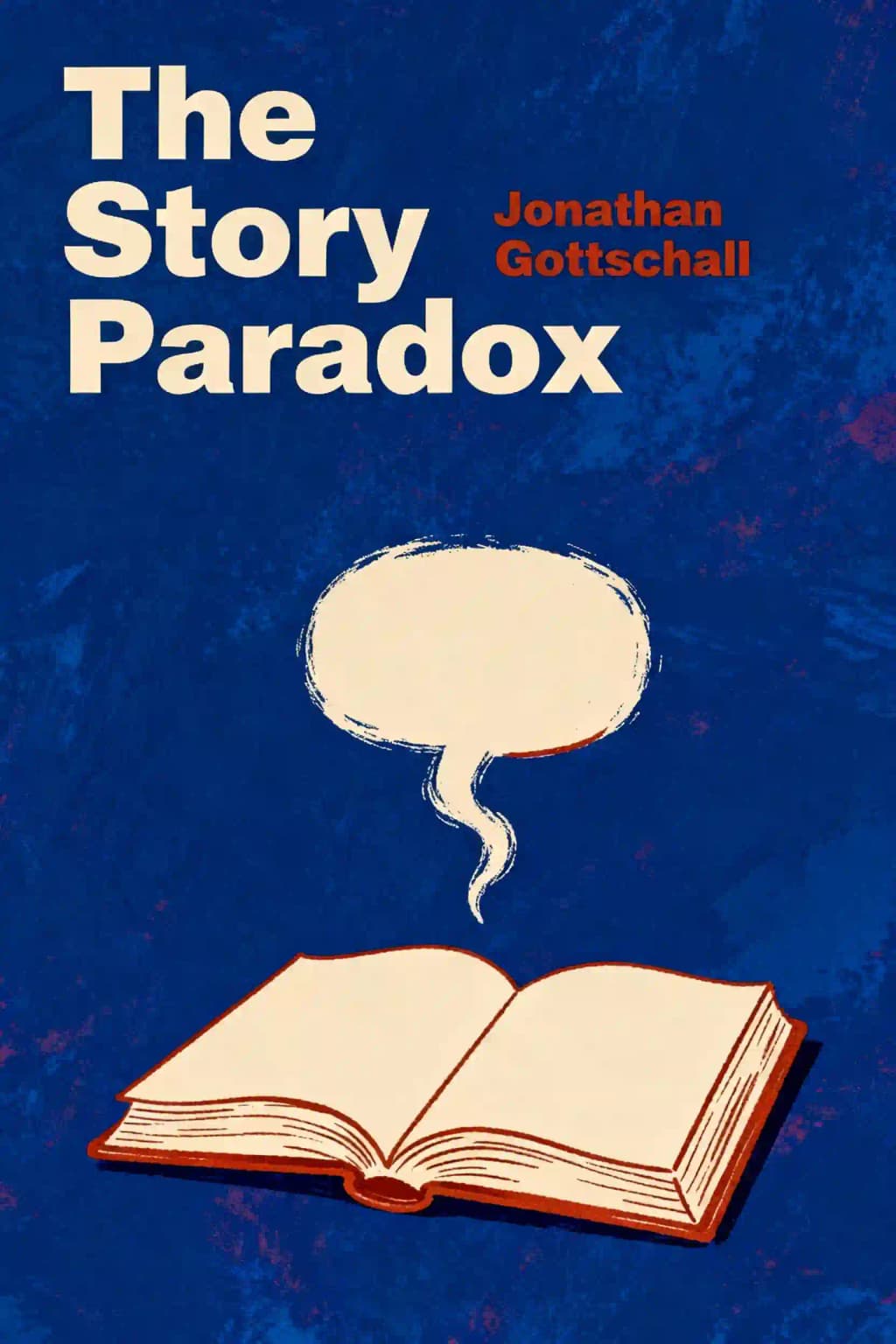
Stories - our greatest human achievement or most dangerous weapon? Jonathan Gottschall's "The Story Paradox" reveals how narratives both build and destroy societies. Steven Pinker calls it essential reading in an era where viral falsehoods threaten democracy. Can we harness storytelling's power for good?
Jonathan Gottschall, author of The Story Paradox: How Our Love of Storytelling Builds Societies and Tears Them Down, is a distinguished scholar bridging evolutionary psychology and narrative studies. A Distinguished Fellow at Washington & Jefferson College, Gottschall explores how stories shape human behavior, culture, and conflict—a theme central to his acclaimed nonfiction works blending scientific rigor with literary analysis.
His bestselling book The Storytelling Animal (a New York Times Editor’s Choice and LA Times Book Prize finalist) established his reputation for dissecting storytelling’s biological roots, while The Professor in the Cage chronicled his immersive study of masculinity through mixed martial arts training.
Gottschall’s research, featured in The New York Times, Scientific American, and NPR, challenges conventional humanities scholarship by integrating quantitative methods. His earlier works, including The Rape of Troy and Literature, Science, and a New Humanities, reexamined classical texts through evolutionary lenses.
The Story Paradox builds on his career-long investigation into storytelling’s dual power to unite and divide, earning praise from Kirkus Reviews for its fresh insights. Translated into multiple languages, Gottschall’s works remain seminal in cross-disciplinary studies of narrative and human nature.
The Story Paradox explores storytelling’s dual role as a societal builder and destabilizer. Gottschall argues that narratives—while foundational to human culture—fuel polarization, conspiracy theories, and misinformation in the digital age. The book blends evolutionary psychology, neuroscience, and examples like Russian social media manipulation to show how stories can manipulate beliefs and erode trust in institutions.
This book is ideal for journalists, policymakers, educators, and anyone interested in media literacy or narrative psychology. It offers critical insights for understanding how stories shape societal norms, political divisions, and online behavior. Readers seeking to navigate misinformation or harness storytelling responsibly will find its analysis particularly valuable.
Yes—the book remains urgent for its examination of AI-generated content, deepfakes, and algorithmic storytelling. Gottschall’s warnings about “weaponized narratives” are amplified by 2025’s digital landscape, making it essential for understanding misinformation crises, echo chambers, and the ethics of immersive technologies like virtual reality.
Gottschall coins “Homo fictus” to describe humans as story-driven beings. Unlike Homo sapiens (“wise humans”), this term emphasizes our species’ reliance on narratives for meaning-making, social cohesion, and identity formation—even when stories distort reality or provoke conflict.
While The Storytelling Animal (2012) celebrated narratives’ evolutionary benefits, The Story Paradox confronts their dangers. This shift reflects Gottschall’s deepened concern about digital media’s power to exploit storytelling’s persuasive mechanics for harmful ends.
Some scholars argue Gottschall underestimates storytelling’s capacity for positive social change. Others note the book focuses heavily on Western media ecosystems, neglecting non-Western storytelling traditions. However, its analysis of viral misinformation remains widely praised.
Gottschall urges users to:
Gottschall warns that AI tools could mass-produce hyper-personalized, emotionally manipulative stories at scale. He advocates for ethical guardrails to prevent AI from deepening societal fractures through addictive, algorithmically optimized narratives.
Senti il libro attraverso la voce dell'autore
Trasforma la conoscenza in spunti coinvolgenti e ricchi di esempi
Cattura le idee chiave in un lampo per un apprendimento veloce
Goditi il libro in modo divertente e coinvolgente
Stories are humanity's "essential poison"-vital for our survival yet potentially toxic when misused.
Humans are storytelling animals, living in stories all day and dreaming in them all night.
Media = Real Life.
Our brains activate as though we ourselves are the girl in peril.
Effective persuasion must be sneaky and indirect.
Scomponi le idee chiave di Story Paradox in punti facili da capire per comprendere come i team innovativi creano, collaborano e crescono.
Distilla Story Paradox in rapidi promemoria che evidenziano i principi chiave di franchezza, lavoro di squadra e resilienza creativa.

Vivi Story Paradox attraverso narrazioni vivide che trasformano le lezioni di innovazione in momenti che ricorderai e applicherai.
Chiedi qualsiasi cosa, scegli la voce e co-crea spunti che risuonino davvero con te.

Creato da alumni della Columbia University a San Francisco
"Instead of endless scrolling, I just hit play on BeFreed. It saves me so much time."
"I never knew where to start with nonfiction—BeFreed’s book lists turned into podcasts gave me a clear path."
"Perfect balance between learning and entertainment. Finished ‘Thinking, Fast and Slow’ on my commute this week."
"Crazy how much I learned while walking the dog. BeFreed = small habits → big gains."
"Reading used to feel like a chore. Now it’s just part of my lifestyle."
"Feels effortless compared to reading. I’ve finished 6 books this month already."
"BeFreed turned my guilty doomscrolling into something that feels productive and inspiring."
"BeFreed turned my commute into learning time. 20-min podcasts are perfect for finishing books I never had time for."
"BeFreed replaced my podcast queue. Imagine Spotify for books — that’s it. 🙌"
"It is great for me to learn something from the book without reading it."
"The themed book list podcasts help me connect ideas across authors—like a guided audio journey."
"Makes me feel smarter every time before going to work"
Creato da alumni della Columbia University a San Francisco

Ottieni il riassunto di Story Paradox in formato PDF o EPUB gratuito. Stampalo o leggilo offline quando vuoi.
Why do conspiracy theories spread faster than truth? Why does political polarization feel impossible to bridge? The answer isn't algorithms or education-it's something far more fundamental. We are storytelling animals, spending over five hours daily immersed in narratives, yet we're blind to how profoundly these stories shape our reality. When students calculate their actual time consuming narratives-from Netflix to Instagram to video games-they're shocked to discover they spend more waking hours in "storyland" than anywhere else. Stories aren't just entertainment; they're the invisible architecture of human consciousness, simultaneously our greatest evolutionary advantage and our most dangerous vulnerability. We devote more resources to fiction makers than to the farmers and doctors who keep us alive, revealing our deep reverence for narrative. But here's the paradox: the same mechanism that binds communities together also tears them apart, creating tribal divisions that threaten our survival in an interconnected world.