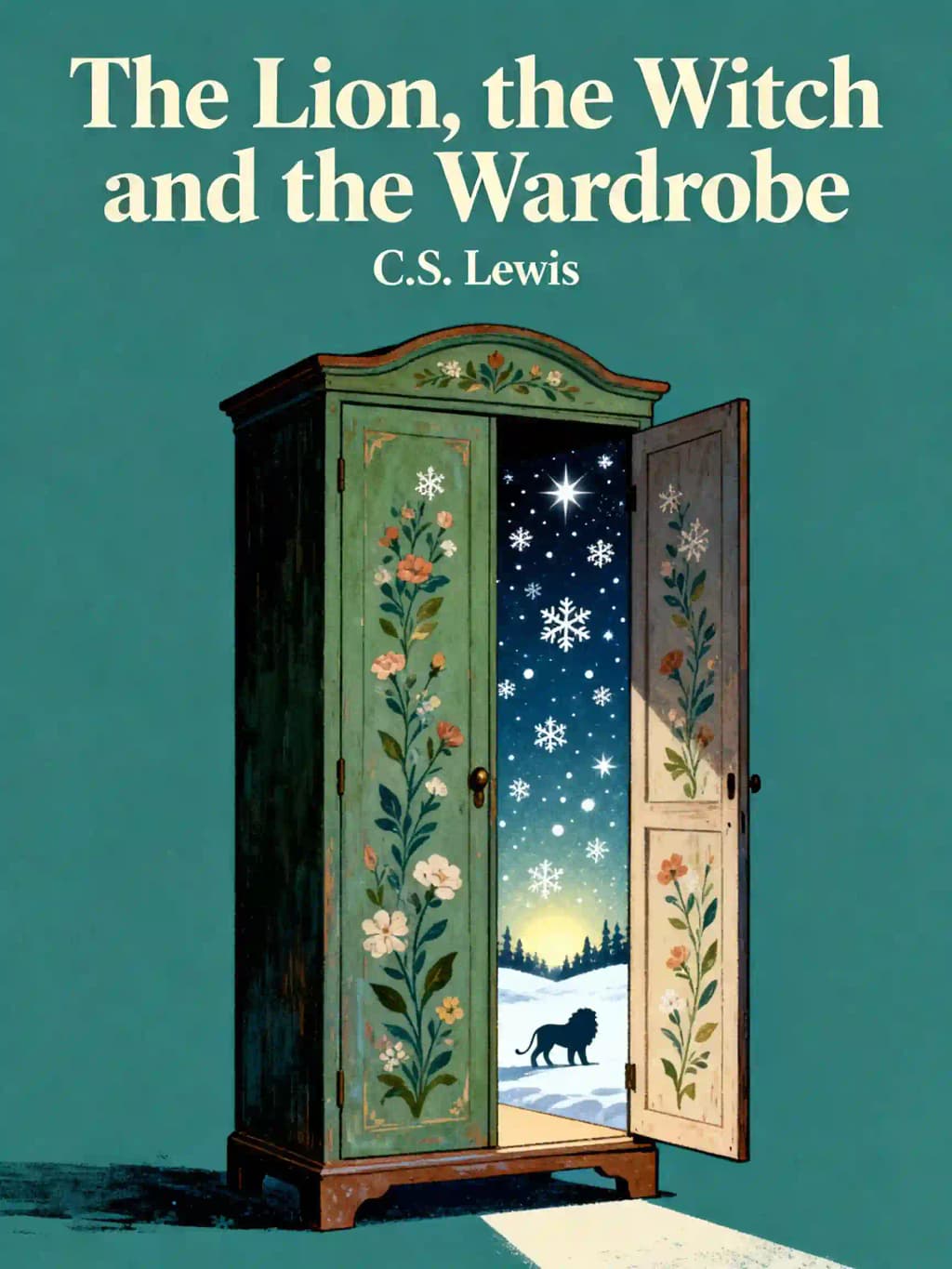
Step through a magical wardrobe into Narnia, where children battle an evil witch alongside a noble lion. C.S. Lewis's 85-million-copy phenomenon blends Christian allegory with fantasy, inspiring J.R.R. Tolkien and ranking among Time's 100 best English novels since 1923.
C.S. Lewis (Clive Staples Lewis, 1898–1963) was an Irish-born scholar and novelist, best known for crafting the timeless fantasy classic The Lion, the Witch and the Wardrobe as part of his acclaimed Chronicles of Narnia series. A pioneering figure in Christian apologetics and fantasy literature, Lewis drew on his expertise as an Oxford literary scholar and his theological insights to explore themes of courage, sacrifice, and redemption in this children’s allegory.
His works, including Mere Christianity and The Screwtape Letters, blend philosophical depth with imaginative storytelling, establishing him as one of the 20th century’s most influential Christian thinkers.
Lewis’s Chronicles of Narnia has sold over 100 million copies worldwide and been translated into 41 languages, with adaptations spanning stage, radio, and film. The series remains a cornerstone of fantasy literature, praised for its integration of mythological archetypes and moral wisdom.
Alongside his fiction, Lewis’s academic works on medieval and Renaissance literature reinforce his legacy as a multifaceted intellectual. The Lion, the Witch and the Wardrobe continues to captivate readers as both a magical adventure and a profound exploration of faith.
The Lion, the Witch and the Wardrobe follows four siblings who enter the magical world of Narnia through a wardrobe. They join the lion Aslan to overthrow the White Witch, who has cursed Narnia with eternal winter. Themes of sacrifice, redemption, and courage unfold as Aslan dies to save the traitorous Edmund, then resurrects to lead a triumphant battle, crowning the children as Narnia’s rulers.
This classic fantasy novel appeals to children aged 8+ and adults seeking allegorical depth. Fans of Christian symbolism, timeless battles between good and evil, and rich world-building will find it compelling. Educators and literary enthusiasts also value its exploration of morality, forgiveness, and mythical storytelling.
Yes—it’s a cornerstone of fantasy literature with over 100 million copies sold. Its blend of imaginative adventure, moral lessons, and spiritual allegory (particularly Aslan’s Christ-like sacrifice) makes it enduringly relevant. The book has inspired films, stage adaptations, and academic analysis, cementing its cultural impact.
Key themes include redemption (Edmund’s betrayal and Aslan’s sacrifice), the triumph of good over evil (defeating the Witch), and faith (Lucy’s unwavering belief in Narnia). Christian allegory permeates the narrative, with Aslan’s resurrection mirroring Easter themes and the Witch symbolizing sin.
Aslan’s voluntary death on the Stone Table to save Edmund parallels Christ’s crucifixion. His resurrection breaks the Witch’s power, echoing Christian teachings about redemption and eternal life. The “Deep Magic” (divine law) and “Deeper Magic” (grace) further reflect theological concepts.
The Stone Table is where Aslan is sacrificed by the White Witch. Its cracking upon his resurrection symbolizes the overthrow of death and evil. This ancient structure represents both divine justice and transformative grace, central to Narnia’s liberation.
Mr. Tumnus, a faun Lucy meets in Narnia, initially conspires to hand her to the Witch but repents, sparking the children’s involvement in Narnia’s fate. His kindness and redemption highlight the novel’s emphasis on moral growth and loyalty.
The “Deep Magic” refers to the divine laws governing Narnia, which the Witch uses to claim Edmund’s life. Aslan’s knowledge of a “Deeper Magic” — allowing a willing innocent’s death to override the curse — underscores themes of sacrificial love and redemption.
While both feature magical worlds and moral battles, Lewis’s work is more overtly allegorical. Unlike Harry Potter’s modern setting, Narnia leans on mythological creatures and Christian themes, offering a shorter, symbolic narrative focused on universal virtues.
Some critics argue its Christian allegory feels heavy-handed, while others note stereotypical portrayals of female characters (e.g., the Witch as purely evil). However, most praise its imaginative scope and emotional depth, acknowledging its historical context.
Notable quotes include:
These lines emphasize courage, identity, and the moral complexity of leadership.
Its exploration of resilience, ethical courage, and hope resonates in modern contexts like climate crises and social justice. The story’s emphasis on teamwork and faith in adversity offers timeless guidance, while its adaptation into films and merch keeps it culturally present.
Fans might enjoy The Hobbit (mythic quests), A Wrinkle in Time (child heroes saving worlds), or Philip Pullman’s His Dark Materials (darker thematic counterpoints). Lewis’s own Prince Caspian continues Narnia’s saga.
Senti il libro attraverso la voce dell'autore
Trasforma la conoscenza in spunti coinvolgenti e ricchi di esempi
Cattura le idee chiave in un lampo per un apprendimento veloce
Goditi il libro in modo divertente e coinvolgente
The ordinary has become extraordinary.
Haven't we all hoped to find something miraculous hidden in an ordinary place?
This moment reveals the moral core of Narnia.
His act of bravery establishes one of the book's central themes.
Suddenly, the impossible becomes undeniable.
Scomponi le idee chiave di Lion, the Witch and the Wardrobe in punti facili da capire per comprendere come i team innovativi creano, collaborano e crescono.
Distilla Lion, the Witch and the Wardrobe in rapidi promemoria che evidenziano i principi chiave di franchezza, lavoro di squadra e resilienza creativa.

Vivi Lion, the Witch and the Wardrobe attraverso narrazioni vivide che trasformano le lezioni di innovazione in momenti che ricorderai e applicherai.
Chiedi qualsiasi cosa, scegli la voce e co-crea spunti che risuonino davvero con te.

Creato da alumni della Columbia University a San Francisco
"Instead of endless scrolling, I just hit play on BeFreed. It saves me so much time."
"I never knew where to start with nonfiction—BeFreed’s book lists turned into podcasts gave me a clear path."
"Perfect balance between learning and entertainment. Finished ‘Thinking, Fast and Slow’ on my commute this week."
"Crazy how much I learned while walking the dog. BeFreed = small habits → big gains."
"Reading used to feel like a chore. Now it’s just part of my lifestyle."
"Feels effortless compared to reading. I’ve finished 6 books this month already."
"BeFreed turned my guilty doomscrolling into something that feels productive and inspiring."
"BeFreed turned my commute into learning time. 20-min podcasts are perfect for finishing books I never had time for."
"BeFreed replaced my podcast queue. Imagine Spotify for books — that’s it. 🙌"
"It is great for me to learn something from the book without reading it."
"The themed book list podcasts help me connect ideas across authors—like a guided audio journey."
"Makes me feel smarter every time before going to work"
Creato da alumni della Columbia University a San Francisco

Ottieni il riassunto di Lion, the Witch and the Wardrobe in formato PDF o EPUB gratuito. Stampalo o leggilo offline quando vuoi.
Four children stumble through a piece of furniture and find themselves in a land locked in eternal winter. A faun befriends a little girl, then weeps at his own treachery. A lion dies on a stone table to save a traitor, then rises again as death itself runs backward. What sounds like a fever dream has become one of the most beloved stories ever told, selling over 100 million copies and inspiring everyone from J.K. Rowling to Neil Gaiman. C.S. Lewis's tale works its magic not through elaborate world-building or complex plotting, but through something simpler and more profound: it captures the ache of longing we all carry for a world more alive than our own, where courage matters and sacrifice redeems.