Capitolo 1
The Civic Cornerstone: Democracy's Urgent Call for Responsibility
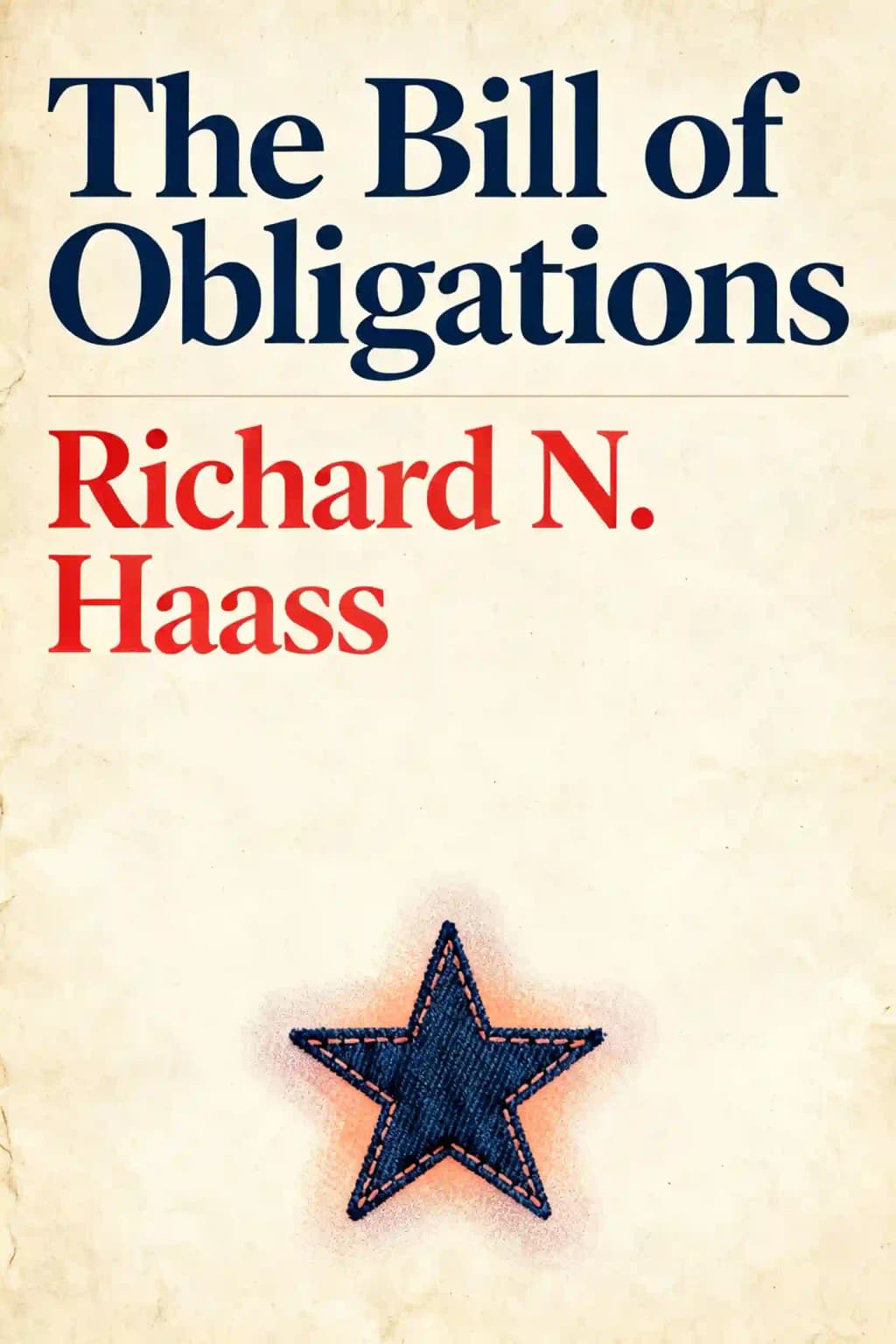
In a time when America's political landscape seems more fractured than ever, Richard Haass's "The Bill of Obligations" arrives with a sobering diagnosis and a hopeful prescription. As a foreign policy expert who has served under four presidents from both parties, Haass delivers a surprising verdict: the greatest threat to American security comes not from abroad but from within. This book has struck a chord across the political spectrum, with figures from Condoleezza Rice to Hillary Clinton praising its clear-eyed analysis. What makes this work particularly compelling is how it reframes our understanding of citizenship itself, arguing that rights alone cannot sustain democracy without corresponding obligations. In a cultural moment when many Americans report "threats to democracy" as their top concern, Haass offers a roadmap for civic renewal that transcends partisan divides, making this one of the most timely and essential reads for anyone concerned about America's democratic future.
Capitolo 2
Democracy's Delicate Balance: Rights, Representation, and Reality
The American democratic experiment began with a profound recognition of democracy's inherent vulnerabilities. Direct democracy-where citizens directly make all decisions-proved impractical and dangerous throughout history. Most citizens lack time, interest, or expertise to govern directly, and majorities can easily trample minority rights. The American solution was republicanism: representative government accountable to citizens through regular elections.
This wasn't America's first attempt at self-governance. The Articles of Confederation had created merely a "firm league of friendship" among sovereign states with minimal federal authority. When delegates met in 1787, they confronted deep divisions between populous and smaller states, democratic versus appointed leadership models, and the relationship between states and central government-with slavery lurking ominously in the background.
Their ingenious solution distributed power through careful checks and balances. As Madison argued, "Ambition must be made to counteract ambition." Power was divided among legislative, executive, and judicial branches, with overlapping authorities requiring cooperation. The judiciary initially seemed the weakest branch but established its crucial power of judicial review in 1803 with Marbury v. Madison.
Many feared an overly powerful federal government. Patrick Henry warned the Constitution "squints towards monarchy." The compromise solution was the Bill of Rights-ten amendments limiting federal power and protecting individual liberties. However, these amendments failed to address the Constitution's most serious flaws regarding slavery, women, Indigenous peoples, and the poor. Only after the Civil War did amendments establish federal supremacy and extend citizenship rights to all persons.
America's political system now limits government power while protecting individual freedoms. Yet the struggle over rights continues, with left and right emphasizing different rights-abortion pits the unborn's rights against a mother's choice; gun debates weigh ownership rights against public safety; voting laws balance electoral integrity against potential disenfranchisement.
What's often overlooked in these debates is the dimension of citizenship that Haass brings into focus: obligations-what citizens owe each other and their country. Unlike legal requirements (paying taxes, serving on juries), obligations are moral and political commitments undertaken voluntarily, yet essential for democracy's survival.
Capitolo 3
Democracy's Danger Zone: The Threat From Within
Americans should be deeply concerned about their democracy's future. The comfortable assumption that the American people always overcome challenges may no longer hold true. The 2020 presidential transition revealed something unprecedented-the peaceful transfer of power, long taken for granted in American democracy, was neither peaceful nor certain.
Unlike authoritarian countries like China and Russia, where leaders extend their rule indefinitely, America had experienced over forty peaceful presidential transitions, even after fiercely contested elections. This changed when the forty-fifth president and many supporters insisted, despite no evidence, that the 2020 election was fraudulent, and actively worked to overturn the results. The United States is proving not immune to democratic backsliding, a global trend of the past two decades.
Political violence in America wouldn't necessarily resemble a traditional civil war but could manifest as decentralized networks linked by social media targeting government buildings, officials, businesses, and even restaurants associated with opposing groups. Once begun, such violence would prove difficult to contain, resembling Northern Ireland's Troubles rather than America's first Civil War.
As Benjamin Franklin reportedly remarked when asked what government the Constitutional Convention had created: "A republic, if you can keep it." This question resurfaces today as America faces division comparable to the Civil War era. Democracy's fragility is evident throughout history-John Adams noted that "Democracy never lasts long. It soon wastes exhausts and murders itself."
This deterioration stems from several factors: loss of common national identity, growing economic inequality, political polarization, and weakening intermediary institutions. The American system, designed for 3 million people in 13 states, struggles to govern 330 million across 50 states. Structural imbalances give disproportionate power to less populous states, creating what some view as minority rule on issues like gun control and abortion rights. Meanwhile, technology has fractured our information ecosystem, replacing shared national experiences with narrowcasting that reinforces existing beliefs.
We've moved from broadcasting to narrowcasting, with social media being particularly pernicious as it undermines social trust and creates mini-societies with their own narratives. The result is a society defined by a lack of shared experiences-no longer a melting or mixing pot but a loose collection of separate pots defined by geography, political beliefs, religion, color, education, and class. As Judge J. Michael Luttig stated, "We Americans no longer agree on what is right or wrong, what is to be valued, what is acceptable behavior, and what is tolerable discourse in civilized society."
Capitolo 4
The Informed Citizen: Democracy's First Defense
Democracy's health depends on an informed citizenry-a belief dating back to the republic's founding. Thomas Jefferson noted that "wherever the people are well informed they can be trusted with their own government," while Barack Obama similarly argued that "democracy doesn't work if we don't have an informed citizenry." This foundational principle has been echoed by leaders and philosophers throughout American history, from James Madison's writings in the Federalist Papers to modern political theorists.
An informed citizen understands how government, economy, and society function; recognizes principal challenges facing the country; and knows contending policy options. They comprehend the three branches of government, the role of checks and balances, and basic economic principles like inflation, taxation, and trade. They can evaluate others' arguments while contributing their own perspectives, ideally with knowledge of the country's history, including pivotal moments like the Civil War, Great Depression, Civil Rights Movement, and other transformative events that shaped current institutions.
This informed citizenry is crucial because American democracy is representative-citizens elect individuals to make governmental decisions rather than making those decisions directly themselves. Citizens must be informed enough to cast wise votes and hold officials accountable between elections. This requires understanding candidates' positions, tracking voting records, and monitoring policy implementation. By contrast, an uninformed citizenry endangers democracy, being less likely to participate and more vulnerable to manipulation through falsehoods and conspiracy theories. Historical examples, from the spread of McCarthyism to modern disinformation campaigns, demonstrate these risks.
Critical thinking requires differentiating between facts (demonstrable assertions), misstatements (false assertions), opinions (judgments based on facts), predictions (statements about the future), and recommendations (preferences about actions). For instance, in discussing climate change, "global temperatures have risen 1.1C since pre-industrial times" is a fact, while "we should implement a carbon tax" is a recommendation. Meaningful debate on issues like COVID-19, climate change, or election integrity can only occur when based on a common set of facts, even if informed people reasonably disagree about analyses, predictions, or recommendations.
As Daniel Patrick Moynihan famously noted, "everyone is entitled to his own opinion, but not to his own facts." When evaluating claims, one must consider the source's credibility, methodology, and potential biases; examine the breadth of expert consensus; and assess the quality and quantity of supporting evidence. Those in positions to influence others-teachers, religious leaders, journalists, and government officials-have a special responsibility to distinguish carefully between facts and opinions. This responsibility extends to social media platforms, news organizations, and educational institutions, which must work to combat misinformation while promoting media literacy and critical thinking skills.
The digital age has both complicated and enhanced citizens' ability to stay informed. While information is more accessible than ever, the proliferation of unreliable sources and echo chambers poses new challenges to maintaining an informed citizenry. Success in modern democracy requires not just access to information, but the skills to evaluate it effectively.
Capitolo 5
Participation: The Lifeblood of Democratic Systems
Democracy depends on citizen participation-it's rule by the people rather than of the people. While elected officials wield significant power, that power derives from those who elect them, as the Declaration of Independence states: "Governments are instituted among men, deriving their just powers from the consent of the governed." This foundational principle emphasizes that democratic legitimacy flows upward from citizens, not downward from leaders.
Yet many Americans don't actively participate in their democracy. The most basic measure of involvement-voting-shows that roughly one-third to 40 percent of eligible voters skip presidential elections, and over half ignore midterm elections. The U.S. ranks 30th among 35 successful democracies in voter turnout. Local elections fare even worse, with some municipal contests drawing less than 15% of eligible voters, despite these elections often having the most direct impact on daily life through decisions about schools, police, and local services.
People avoid voting for various reasons: not being registered, disinterest in politics, disliking available candidates, work constraints, or believing their vote doesn't matter. This overlooks how elections are decided-not nationally but state by state, often by razor-thin margins. In Florida's 2000 election, 537 votes out of nearly six million determined the presidency. In Minnesota's 2008 Senate race, 312 votes out of three million gave Democrats a crucial Senate seat. The 2020 Georgia Senate runoffs, decided by margins of just over 55,000 votes each, determined control of the entire U.S. Senate.
Voting matters beyond just election outcomes. It creates a bond between citizen and government, gives individuals standing in political discourse, motivates civic awareness, and provides accountability. Research shows that voters are more likely to contact their representatives, volunteer in their communities, and stay informed about public affairs. Beyond voting, citizens can strengthen democracy by encouraging others to vote, working for candidates, assisting election administration, or contributing to causes. Digital platforms now offer new opportunities for civic engagement, from online advocacy to crowdfunding grassroots initiatives.
Ordinary citizens can make extraordinary differences-from Rosa Parks challenging segregation to the parent who launched Mothers Against Drunk Driving. The civil rights movement demonstrated how coordinated citizen action could transform society. Modern examples include the marriage equality movement, which succeeded through decades of local activism, and the growing climate action movement led by young activists. Parents can engage children in civic discussions, corporate leaders can facilitate voting through paid time off and workplace registration drives, and religious leaders can connect faith teachings to civic obligations. Democracy cannot be a spectator sport-it empowers citizens only when they participate actively and consistently in the ongoing project of self-governance.
Participation extends beyond electoral politics to include community organizing, peaceful protests, public comment on proposed regulations, and engagement with local government bodies. These varied forms of civic involvement help ensure that democracy remains vibrant and responsive to citizens' needs. When participation wanes, special interests often fill the void, potentially skewing policy away from the public interest.
Capitolo 6
The Art of Democratic Compromise
Compromise has somehow become a four-letter word in American politics, viewed by many as weakness or selling out. Yet compromise was essential to creating our Constitution through the Great Compromise balancing small and large state interests, the 1790 compromise over federal debt and the capital's location, and the addition of the Bill of Rights itself. These foundational compromises established crucial precedents that would shape American governance for centuries to come, demonstrating how opposing interests could find common ground for the greater good.
Democracy requires compromise because power is distributed across multiple branches and levels of government. As Henry Clay, known as "The Great Compromiser," noted, "All legislation, all government, all society is founded upon the principle of mutual concession." Historical examples abound: the Missouri Compromise of 1820, the Compromise of 1850, and the Social Security Act of 1935, which all required significant give-and-take between competing interests. Compromise creates foundations for future progress-as Reagan advised, "If you got 75 or 80 percent of what you were asking for, take it and fight for the rest later." This pragmatic approach helped Reagan achieve major tax reform and Social Security preservation despite divided government.
Successful compromises often build broader political support for initiatives, making them less vulnerable to reversal when power shifts. The Civil Rights Act of 1964, for instance, required careful negotiation between both parties to achieve the necessary supermajority, giving it lasting legitimacy. Similarly, Medicare's passage in 1965 involved concessions to both liberal and conservative concerns, helping it endure as a cornerstone of American healthcare.
Foreign policy particularly suffers without compromise, as demonstrated when Obama's unilateral Iran nuclear agreement was easily abandoned by Trump, damaging American credibility. In contrast, arms control agreements with the Soviet Union, negotiated with bipartisan input, survived multiple administrations. The fundamental question is whether to compromise or stand firm. Gandhi's wisdom offers guidance: compromise on details but not fundamentals. This approach helped achieve Indian independence while maintaining unity among diverse factions.
Leaders must evaluate potential deals by comparing the achievable agreement against having no agreement at all, as Kennedy did during the Cuban Missile Crisis. His willingness to privately trade missiles in Turkey for Soviet withdrawal from Cuba, while maintaining public focus on the Cuban situation, exemplified practical compromise in pursuit of vital objectives.
Those who compromise must explain their reasoning clearly to maintain public trust, as George H.W. Bush failed to do after breaking his "no new taxes" pledge. His experience shows that while compromise may create short-term political vulnerability, transparent communication about difficult choices can help maintain public confidence. Despite these challenges, compromise remains essential to democracy's functioning, allowing diverse societies to navigate differences and achieve progress through mutual accommodation rather than zero-sum conflict.
Capitolo 7
Civility: Democracy's Essential Lubricant
Civility embodies respect, courtesy, and politeness-disagreeing without being disagreeable. As President John F. Kennedy noted in his inaugural address, "civility is not a sign of weakness," while George W. Bush called it "the determined choice of trust over cynicism, of community over chaos." This fundamental principle extends beyond mere politeness to encompass a deeper commitment to democratic discourse and mutual understanding.
When disagreeing with others, the focus should remain on addressing arguments and evidence rather than attacking character or intelligence. This means maintaining a measured tone, avoiding needless repetition, and making a genuine effort to understand opposing viewpoints. Effective civil discourse involves active listening, asking clarifying questions, and acknowledging valid points even while disagreeing with conclusions. Responding calmly to incivility not only makes attackers look worse but helps preserve the possibility of productive dialogue. The ability to change one's mind based on new evidence demonstrates intellectual maturity, as economist John Maynard Keynes reportedly emphasized: "When the facts change, I change my mind. What do you do, sir?"
Unfortunately, incivility has become increasingly prevalent in modern political discourse. High-profile examples abound: President Trump refusing to shake Speaker Pelosi's hand at the State of the Union, followed by her theatrical ripping of his speech; protesters following Senator Sinema into a bathroom to confront her about legislation; and countless instances of social media harassment and intimidation. This deterioration stems from multiple sources: the anonymity provided by social media platforms, the echo chambers created by algorithmic content selection, and demographic "sorting" where Americans increasingly live, work, and socialize primarily with ideologically similar people.
The friendship between Supreme Court Justices Ruth Bader Ginsburg and Antonin Scalia offers an instructive counterexample. Despite their profound ideological differences, they maintained a warm personal relationship built on mutual respect and shared interests. They attended operas together, celebrated holidays with their families, and even rode an elephant together in India. Scalia's approach exemplified principled disagreement: "I attack ideas. I don't attack people." Their relationship demonstrated how intellectual opponents can engage in fierce debate while maintaining personal warmth and learning from each other's perspectives.
Importantly, civility should not be confused with conflict avoidance or the suppression of challenging ideas. True civility requires creating space for uncomfortable truths and unpopular viewpoints while maintaining respectful discourse. Educational institutions and media organizations have a particular responsibility to provide forums for diverse perspectives rather than yielding to pressure to silence dissenting voices. Protecting free expression, even when controversial, is essential to maintaining civil society. This includes defending the right to peaceful protest while condemning harassment and intimidation.
The practice of civility in public discourse requires constant cultivation and renewal. It demands self-awareness, emotional regulation, and a commitment to seeing political opponents as fellow citizens rather than enemies. In an era of increasing polarization, recommitting to civility becomes not just a matter of politeness, but a crucial foundation for democratic survival.
Capitolo 8
Beyond Violence: The Power of Peaceful Change
One defining characteristic of sovereign government is its monopoly on legitimate force within its borders, with self-defense being the only exception. This principle, established through centuries of political development, ensures social stability and prevents vigilantism. When individuals or groups use violence for political purposes, it becomes terrorism-a direct threat to public order and normal societal functioning, undermining the very foundations of civil society.
Democracy's strength lies in offering peaceful channels for pursuing political and economic goals through established institutions, public discourse, and legal processes. Though tempting when frustrated by slow progress or apparent injustice, political violence creates innocent casualties, risks civil war or anarchy, and shifts focus from ends to means. Even when violence "succeeds," it often creates lasting social trauma, destroys vital infrastructure, and breeds cycles of revenge. "Successful" violence sets terrible precedents, robbing victors of legitimacy and forcing them to govern through coercion rather than consent, as seen in numerous post-revolutionary states.
Better alternatives exist: working harder within the system through voting, legislation, coalition-building, and grassroots organizing, or engaging in civil disobedience-nonviolent political action that may break laws but accepts legal consequences. As developed by Henry David Thoreau in response to slavery and the Mexican-American War, and later practiced by Gandhi and King, nonviolent protest works within the existing order while seeking to change it, maintaining moral authority through peaceful resistance.
Gandhi employed a comprehensive strategy of marches, rallies, strikes, and boycotts to achieve Indian independence, never resorting to violence despite multiple arrests and brutal treatment. His Salt March and textile boycotts demonstrated how nonviolent resistance could undermine colonial authority while maintaining moral superiority. This approach kept focus on British policy's immorality rather than Indian tactics, winning international sympathy and support. Similarly, Martin Luther King Jr. used nonviolent resistance through carefully planned marches, strategic rallies, powerful speeches, and calculated acts of defiance to successfully challenge racial discrimination. The Montgomery Bus Boycott and Selma to Montgomery March showed how disciplined nonviolence could expose injustice and force change.
Civil disobedience requires specific conditions to succeed: authorities willing to show some restraint, a free press to document conditions and abuses, and some degree of public sympathy. It may not work against thoroughly authoritarian regimes willing to crush dissent without hesitation or concern for public opinion. Democratic systems, uniquely open to challenge and capable of change, make nonviolent approaches viable, even if change comes gradually. The success of environmental movements, women's suffrage, and labor rights demonstrates this potential.
Those in power must actively maintain democracy's peaceful nature by condemning political violence, holding perpetrators accountable regardless of their cause, and ensuring systems remain fair and responsive to minimize the risk of widespread violence. This includes addressing legitimate grievances through institutional channels, maintaining transparent governance, and protecting rights of peaceful protest and dissent.
Capitolo 9
Country Over Party: The Ultimate Democratic Obligation
The final obligation-putting country and American democracy before party and person-binds the fabric of our society and represents essential patriotism. Despite America's flaws, it remains "the most successful political experiment in human history." This obligation requires character or virtue, which as Madison noted is central to democracy: "To suppose that any form of government will secure liberty or happiness without any virtue in the people, is a chimerical idea."
Character can't be legislated but can be encouraged both morally and practically. Recent Supreme Court controversies illustrate the dangers when institutional integrity is compromised for political gain-from the blocked Merrick Garland nomination to the overturning of Roe v. Wade, actions that diminish the Court's legitimacy and threaten democratic stability.
"Thinking institutionally" means considering long-term institutional health over short-term political advantage. The concept of "loyal opposition" embodies this balance-questioning and holding accountable the party in power while maintaining higher loyalty to law and country. Politicians are unlikely to prioritize country over self-interest without external pressure from citizens who reward such behavior and penalize its absence.
Democracy requires obligations alongside rights at the core of citizenship. These obligations-behaviors that should happen but aren't legally required-strengthen our democracy over time. While rights are essential, viewing them as absolutes without consideration for obligations risks the political system itself, especially when rights conflict. Citizens must demand that politicians embrace these obligations, supporting only candidates committed to democratic principles like rejecting violence, grounding policies in facts, and accepting verified election results.
Democracy must take priority over specific policy concerns-whether taxes, abortion, guns, or other issues-because without a functioning democracy, meaningful debate on these topics becomes impossible. Corporate leaders, religious figures, artists, and those with formal powers all have special responsibilities to uphold democratic principles. The goal should be to leave American democracy in better shape than we found it. As James Madison noted, "a bad cause seldom fails to betray itself," but democracy's supporters cannot rely on this-protecting our democracy requires deliberate action from all citizens.