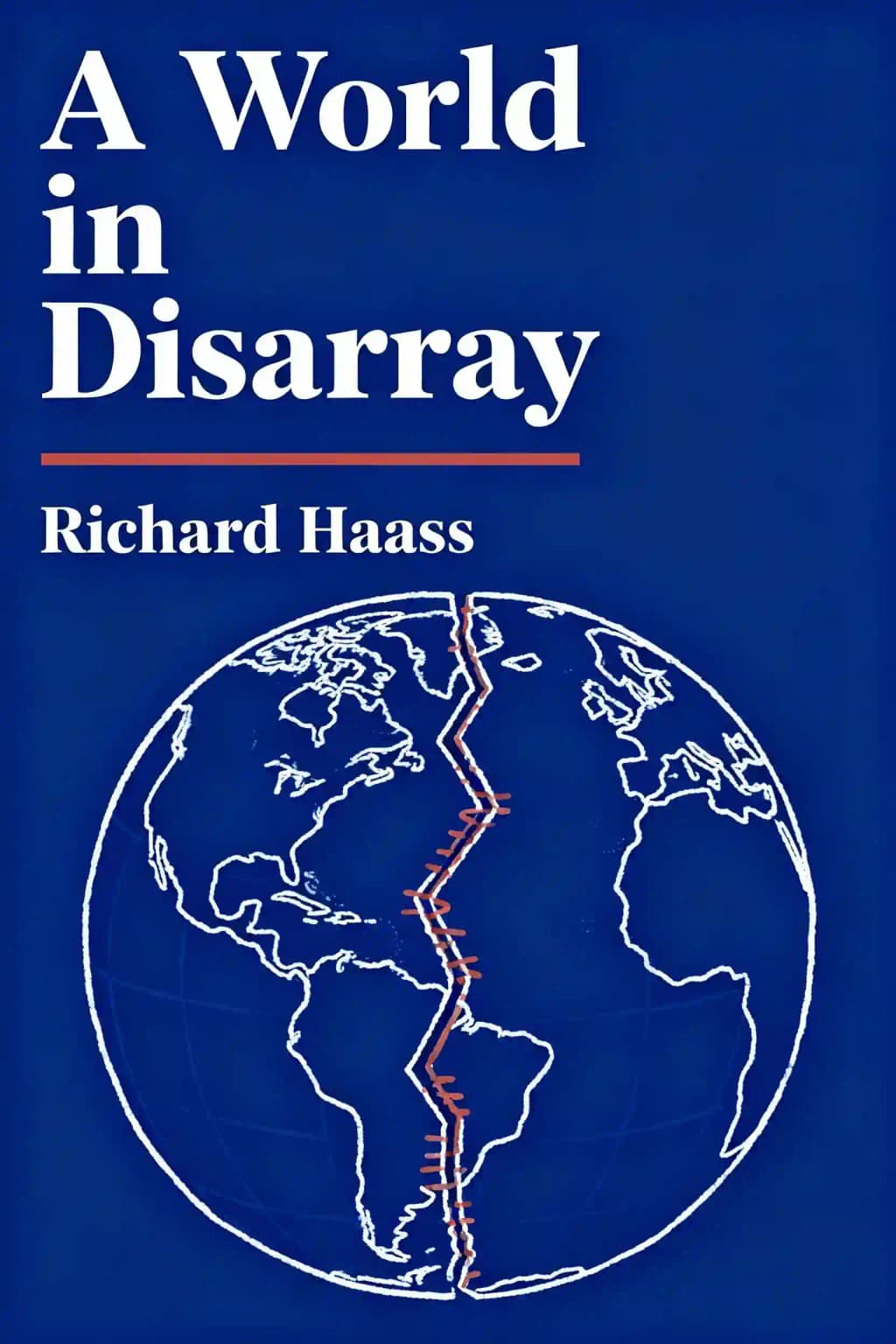
Richard Haass's "A World in Disarray" unveils how the post-WWII global order is crumbling. The Council on Foreign Relations president's "World Order 2.0" concept sparked fierce debate among policymakers by redefining sovereignty as obligation - a blueprint for navigating our increasingly nonpolar world.
Richard N. Haass, president emeritus of the Council on Foreign Relations and bestselling author of A World in Disarray, brings decades of diplomatic expertise to this analysis of global disorder. A Rhodes Scholar with a doctorate from Oxford University, Haass served as Director of Policy Planning under Secretary of State Colin Powell and led peace negotiations in Northern Ireland and Afghanistan.
His work blends firsthand experience in Republican and Democratic administrations with sharp insights into international relations, nationalism, and governance challenges.
Haass’s authoritative voice extends through fourteen books on foreign policy, including The Bill of Obligations: The Ten Habits of Good Citizens, a New York Times bestseller that reimagines civic responsibility in polarized times. A frequent commentator on NPR and major networks, he received the Presidential Citizens Medal and the State Department’s Distinguished Honor Award for public service.
A World in Disarray has become essential reading in political science curricula and think tanks, cementing Haass’s reputation as a clear-eyed strategist for an unstable era.
A World in Disarray analyzes the erosion of global order post-Cold War, tracing geopolitical shifts, regional instability, and failures in international cooperation. Haass proposes "sovereign obligation"—a framework where states regulate internal actions affecting others (e.g., terrorism, climate change)—and emphasizes U.S. leadership renewal to address crises like nuclear proliferation and cyber threats.
Policymakers, students of international relations, and readers interested in geopolitics will benefit from Haass’s analysis of modern disorder. Its blend of historical context, regional case studies (Middle East, Asia, Europe), and pragmatic solutions makes it relevant for those examining U.S. foreign policy or global governance challenges.
"Sovereign obligation" expands traditional sovereignty by requiring states to prevent internal actions (e.g., terrorism, cyberattacks) from harming other nations. Haass argues this principle could address transnational issues like climate change, blending respect for borders with collective responsibility. Critics note challenges in enforcement and achieving global consensus.
Haass critiques post-Cold War U.S. missteps, including overreach and inconsistency, but stresses that American leadership remains irreplaceable. He urges domestic reforms (e.g., reducing political polarization, fiscal discipline) to strengthen global influence, particularly in managing rising powers like China and Russia.
The book examines instability in the Middle East (e.g., terrorism, sectarian conflicts), Asia’s power struggles (China’s rise, North Korea), and Europe’s challenges (Brexit, Russia’s aggression). Haass highlights how regional dysfunctions exacerbate global disarray and require tailored diplomatic strategies.
Yes. Haass identifies climate change as a "global gap" issue where national actions (or inactions) disproportionately affect others. He advocates for "sovereign obligation" to enforce accountability, though acknowledges the difficulty of reconciling differing national interests.
"World Order 2.0" is Haass’s proposed system updating Westphalian principles. It combines sovereignty with obligations to mitigate cross-border threats (e.g., nuclear proliferation, pandemics). This framework relies on coalitions of states and institutions to enforce norms, though implementation hurdles persist.
Haass argues post-Cold War U.S. policies failed to integrate Russia and China into the international system, fueling their revisionist ambitions. He recommends balancing deterrence with cooperation, such as incentivizing China to uphold trade norms and countering Russian aggression in Europe.
Critics argue Haass underestimates non-state actors’ roles and overstates U.S. capacity to lead. The 2017 edition also lacks analysis of Trump-era policies, Brexit, or Syria’s bombing, which later reshaped global dynamics.
Yes. Its themes—resurgent nationalism, U.S.-China rivalry, and climate crises—remain urgent. However, Haass’s emphasis on multilateralism contrasts with recent trends toward unilateralism, prompting debates about adapting his solutions to current realities.
Unlike The Foreign Policy of Restraint, this book prioritizes proactive U.S. engagement tempered by domestic renewal. It shares themes with War of Necessity, War of Choice, analyzing decision-making in crises, but broadens focus to systemic global challenges.
Key lines include:
These underscore Haass’s argument for redefined state responsibilities in a globalized era.
Senti il libro attraverso la voce dell'autore
Trasforma la conoscenza in spunti coinvolgenti e ricchi di esempi
Cattura le idee chiave in un lampo per un apprendimento veloce
Goditi il libro in modo divertente e coinvolgente
The post-Cold War international order seemed to be crumbling before our eyes.
Stability over justice.
Nuclear weapons fundamentally altered great power competition.
The UN clearly discouraged force as a means of settling disagreements.
The world lost its way.
Scomponi le idee chiave di A World in Disarray in punti facili da capire per comprendere come i team innovativi creano, collaborano e crescono.
Distilla A World in Disarray in rapidi promemoria che evidenziano i principi chiave di franchezza, lavoro di squadra e resilienza creativa.

Vivi A World in Disarray attraverso narrazioni vivide che trasformano le lezioni di innovazione in momenti che ricorderai e applicherai.
Chiedi qualsiasi cosa, scegli la voce e co-crea spunti che risuonino davvero con te.

Creato da alumni della Columbia University a San Francisco
"Instead of endless scrolling, I just hit play on BeFreed. It saves me so much time."
"I never knew where to start with nonfiction—BeFreed’s book lists turned into podcasts gave me a clear path."
"Perfect balance between learning and entertainment. Finished ‘Thinking, Fast and Slow’ on my commute this week."
"Crazy how much I learned while walking the dog. BeFreed = small habits → big gains."
"Reading used to feel like a chore. Now it’s just part of my lifestyle."
"Feels effortless compared to reading. I’ve finished 6 books this month already."
"BeFreed turned my guilty doomscrolling into something that feels productive and inspiring."
"BeFreed turned my commute into learning time. 20-min podcasts are perfect for finishing books I never had time for."
"BeFreed replaced my podcast queue. Imagine Spotify for books — that’s it. 🙌"
"It is great for me to learn something from the book without reading it."
"The themed book list podcasts help me connect ideas across authors—like a guided audio journey."
"Makes me feel smarter every time before going to work"
Creato da alumni della Columbia University a San Francisco

Ottieni il riassunto di A World in Disarray in formato PDF o EPUB gratuito. Stampalo o leggilo offline quando vuoi.
Picture the morning of November 9, 2016. Half the world woke up stunned by an election result few saw coming, while Britain was still reeling from its Brexit vote months earlier. Suddenly, the international order that had governed global affairs for decades seemed to be unraveling in real time. Richard Haass, a diplomat who'd spent his career navigating the corridors of power across multiple administrations, recognized this wasn't just political turbulence-it was a fundamental rupture in how the world worked. His book arrived as world leaders scrambled to understand what was happening. Barack Obama reportedly read it in his final weeks in office. Even George Clooney referenced it in interviews. Why? Because Haass offered something rare: a clear explanation of how we got here, written by someone who'd been in the room where it happened. Think of world order not as some utopian dream of global harmony, but as the basic plumbing of international relations-the rules and power structures that keep things flowing. Throughout history, order has required two ingredients: legitimacy (agreement on what's acceptable) and power (the muscle to enforce it).