Capitolo 1
When Life Unravels: Finding Meaning in the Chaos
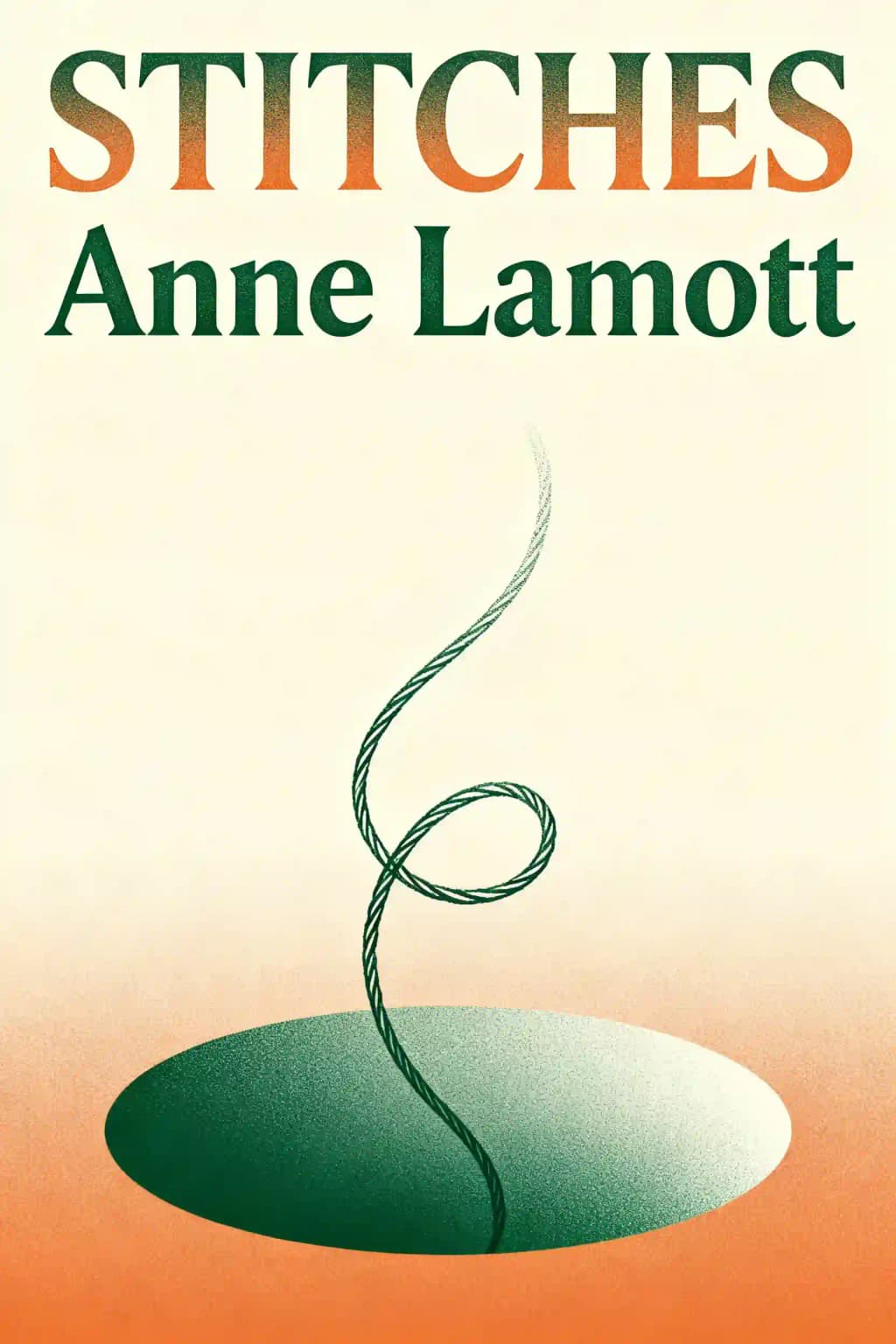
In a world that can feel overwhelmingly sad, where we so often lose our way, Anne Lamott offers a profound meditation on finding meaning amidst life's chaos. "Stitches" has become something of a modern spiritual classic, appearing on the nightstands of everyone from Brene Brown to Elizabeth Gilbert. The book's cultural impact stems from its raw honesty about suffering and its refusal to offer tidy solutions. Lamott, whose earlier work "Bird by Bird" revolutionized writing instruction, brings her trademark blend of humor and spiritual depth to this exploration of how we piece ourselves back together after devastation. What makes this slim volume so powerful is not just Lamott's wisdom, but her willingness to admit when she has none. As Glennon Doyle noted, "Lamott writes the books I need before I know I need them." In a culture obsessed with quick fixes and positive thinking, "Stitches" dares to suggest that meaning emerges not from avoiding pain but from moving through it-stitch by imperfect stitch.
Capitolo 2
The Courage to Face What Is
Most of us find meaning in the ordinary rhythms of daily life-in family gatherings, work accomplishments, and moments of connection with friends. We navigate through global sadness and personal difficulties, seeking solace in nature, art, and home. But when tragedy strikes-whether it's a mass shooting, an environmental disaster, or a personal loss-we instinctively ask "Why?" This question rarely leads anywhere useful. Instead, Lamott suggests we should ask what we're supposed to do now, in the face of horror or emptiness.
There's a natural desire to wrap scary things in pretty bows, to make sense of senselessness. After the Sandy Hook massacre, a wise friend told Lamott, "Is there meaning? Not yet." This profound response acknowledges that meaning isn't always immediately available in the aftermath of tragedy. Sometimes we must stand in the middle of horror, waiting it out, bearing witness to suffering without trying to fix or explain it.
After suffering comes emptiness-a necessary void before new life can emerge. Think about how wildflowers eventually bloom again after devastation. We're all interconnected in this cycle, even with those who commit terrible acts. Our task is to keep doing what's in front of us-cleaning beaches after oil spills, rebuilding towns, returning calls, making casseroles for grieving neighbors.
We live stitch by stitch, moment by moment. If we fixate only on the big picture, we miss the actual stitching-the small actions that gradually create meaning. Every time we choose good over indifference, it builds incrementally toward renewal. The equation becomes: life, death, resurrection, hope. Not as abstract concepts, but as lived reality through small actions performed with great love.
Consider the Sunday school teacher who shows up after community tragedies, lighting candles and making angels from coffee filters with developmentally disabled children. Or recall the boy who survived brain cancer who told Lamott, "I was in a coma, and then I was here again." When she called him a miracle, he raised his fists like Muscleman and agreed: "Yes, I am a miracle." In these moments of awakening-to presence, to connection, to the miracle of being alive at all-we find the threads of meaning.
Capitolo 3
The Truth That Sets Us Free
Augustine believed that to search for God is to have already found God-a profound insight suggesting that merely believing in another world creates space within us for a more radiant reality. Many of us grow up feeling alienated and unworthy, finding this planet scary and confusing. Like most sensitive children, we try to be good sports about our sense of not belonging.
The most insidious form of gaslighting happens when children are made to think they're the problem in dysfunctional families. When parents are a mess-drinking too much, behaving inappropriately-children are doomed unless they believe they're at fault. This creates what Lamott calls "toxic hope"-if they can just do better or need less, perhaps their parents will be fine. In her own childhood home, people would drink and pass out or kiss inappropriately. When questioned, her parents would dismiss it: "Oh, honey, we'd all just been drinking"-as if that explained everything, like saying "we'd all just been putting thorns in our noses."
Growing up in such environments, we learn to doubt our perceptions and minimize what troubles us. But sometimes salvation arrives in unexpected forms. For Lamott at fifteen, it was the women's movement, arriving like cavalry. Women were saying you had to tell the truth to heal and have an authentic life. They validated that girls like her weren't crazy or hypersensitive-they'd been made to feel that way. Getting mad would help free their truth from jail.
Learning to see reality clearly instead of enabling bad behavior requires new skills. So does acknowledging rage and grief. This feels disloyal to family pretense, but pretending turns us from delicious dough into self-conscious pretzels. We must tear down the invisible shield between ourselves and wild, true, beautiful life.
Have you ever noticed how almost everyone worth knowing was once an overly sensitive child? How they've had periods of wilderness that weren't wasted time but opportunities to find life and wildflowers? The American way is to help, not need help, but many of us need a lot of help for a long time. What saves us are gentle, loyal, hilarious companions who help us see ourselves truthfully and love us anyway.
Sometimes our inner renovation resembles stripping a house to its foundation-removing the urine-soaked joists, the rotting structures, the cover-ups and secrets. This radical work creates space for a fresh start. With time and effort, we collect hard-won skills and enough thread to make meaningful repairs to our lives and the lives of others.
Capitolo 4
The Art of Mending What's Broken
After disasters or great losses, we struggle to understand how we'll ever experience cohesion and safety again. Life hands us ugly, mismatched patches for our quilt-brown Hawaiian print alongside orange tartan and sea-foam upholstery. It's healthy to hate what life has given you and be a mess for a while, but eventually you must get back up.
You can unify these incompatible patterns by stitching around the squares with the same color thread. This might mean regular contact with trusted friends, daily rituals like walks, and schedules that provide structure when you've run out of rope. With mossy green thread bordering each square, perhaps the Hawaiian floral looks peaceful next to the sea foam, and the orange plaid becomes a burst of sun.
But what if the insider truth is that you never get over your biggest losses? If you stay permeable rather than sealing your heart, people remain alive inside you forever. This is both blessing and curse-not because your heart will always hurt, but because grief is so frowned upon that you'll think you're crazy for not "getting over it." The cultural lie that we should recover from crushing losses means our emotional GPS can never find true north.
When Lamott's friend Pammy died at thirty-seven, leaving an eighteen-month-old daughter, she refused to pretend she ever got over it. She kept her friend's favorite white linen blouse, which they had shared during Pammy's final days. This "slutty surplice" with its perfect drape became a holy garment, a tangible connection to her brave friend who had traveled fearlessly despite her cancer diagnosis.
For years after Pammy's death, Lamott wore this increasingly fragile shirt for special occasions. She mended the tiny tears in the fabric, sometimes hiding it in the back of her closet only to retrieve it months later. Though she believed in eternal life and realities beyond what we can see, the shirt was her tangible connection to Pammy, who had helped raise her son and lifted her from the depths of a crazy life.
Only a handful of people in your lifetime help redeem the mess of family, and when one dies, hope dies too. We forget so much-great meals, travels, insights-but some people we cannot forget. Years later, during a trip to Laos, Lamott finally tore Pammy's shirt into smaller and smaller scraps and dropped each piece into the Nam Khan River, watching the flotilla bob along until the last wisp of fabric floated away like a petal-not an ending, but a transformation.
Capitolo 5
Together We Survive the Unsurvivable
Alone, we're doomed, yet people are impossible-even those we love most are damaged, prickly, and set in their ways. It's comfortable to observe life from a distance with our superior thoughts, but comfort and isolation aren't where surprises or hope reside. Hope appears when disparate personalities come together, like children who combine clashing patterns that somehow work. The fussy beautician can be beautiful beside the tattooed motorcyclist when they fill food boxes for the needy or read on the same library couch. Only together do we survive unsurvivable loss.
Fifteen years ago, a devastating fire struck Mount Vision, a majestic ridge near a coastal town where Lamott has fond memories. Four teenage boys had camped illegally, built a campfire, and buried it under dirt when they left. Unknown to them, embers continued burning underground, eventually causing a fire that destroyed 12,000 acres of wilderness and nearly fifty homes.
Helicopters saved the town by dropping bay water on the pine forest, but countless wildlife perished-birds, deer, coyotes, bobcats, mountain lions, and beavers. It was as if a bomb had fallen. The boys turned themselves in early, accompanied by their parents. A firefighter wrote to a local paper noting how carefully they had tried to extinguish the flames, not knowing about underground embers.
At a community picnic honoring the firefighters, the board president spoke about ancient customs of sending those who damaged a town "beyond the pale"-outside community protection. He urged the town to make it clear the boys' families should stay, that they were wanted and needed. Even people whose houses had burned down agreed. The town wanted these young men inside the pale, inside the ring of protection. As one observer wrote: "This community, which has just fought so stubbornly to save itself from a holocaust, has turned, almost without missing a beat, to try to save the future of four young men."
This is what community at its best can do-hold both accountability and compassion, justice and mercy. The town recognized that banishing these boys would create another tragedy atop the first. They chose instead to stitch them back into the fabric of community life.
Capitolo 6
When Life Unravels Before Our Eyes
A few years after the Mount Vision fire, in a town twenty miles away, a woman named Helen faced a different kind of catastrophe. Lamott had always envied her seemingly perfect life-her looks, intelligence, warm personality, and beloved spouse. But her husband's mind was dissolving with dementia.
The ground buckled beneath Helen as she moved from being companion to nursing aide. Forty years of love became an unraveling cloth. When life tears apart like this, the secret is to patch, patch, patch-find one place where you can make one stitch that will hold, and do it again and again.
Eventually Helen had to place her husband in a convalescent home. On bad days, he would cry and plead to come home. The fabric of their relationship grew smaller, no longer a blanket for the whole family. But friends showed up-neighbors, relatives, college friends from fifty years before. This net caught her and held her. After a time, there was flow and connection again.
Helen visited her husband daily, finding meaning in small moments-birds from the window, a deer crossing the yard. When he died, it was "the meanest moment of eternity," as Zora Neale Hurston wrote. Yet somehow time passed, her heart softened, and she grew strong. She loves much of her life again-proof that love is sovereign, that love bats last.
Helen's strength became crucial when their mutual friend's son, David, grew deathly ill. David had lived mostly on the streets for thirty years-sweet, smart, courtly, but alcoholic and mentally ill. After suffering massive seizures, he was found half-dead and brought to intensive care.
The townspeople constantly asked after him, visited him, and offered help. His mother, not used to accepting community concern, was transformed by people's love. She began to see her son through others' eyes-not just as her ruined child but as someone who had touched many lives, fixing things for neighbors, being courtly, enjoying nature.
She eventually placed him in a home for people with Alzheimer's. Instead of judgment, the community expressed care: "We miss him. We care about him, and you." Because they were there, she felt part of something bigger than her private suffering. Because she could look at Helen and see that she had survived, she felt things might work out for David too.
These women's lives came apart in ways they never agreed to, but out of the pieces they each sewed something together. Their patchwork reminds us of funky rustic quilts-rough and homely, yet beautiful in their imperfection. Like quilts made from rags and torn clothes that don't match, their lives became something with "enormous solemnity and exuberance."
Capitolo 7
Creating Beauty from Remnants
In July 1986, Lamott stopped drinking-one of the most extreme decisions of her life alongside having a child. After thirty-two years seeking insight from overeducated drinkers like her family, she found herself mentored by sober people who hadn't been "housebroken" for long or practicing good dental hygiene.
These unlikely teachers showed her that she wouldn't always get her way (which felt terrible but was good for her), that life was erratic and impossible, and that maturity meant living with unresolved problems. They taught her that truth wouldn't fit on a bumper sticker, and attempted to teach her humility-not her strong suit. With their help, she learned that raising children is hard, people get ruined, friends die, and still she didn't need to drink.
When Lamott's large, moronic dog Bodhi shredded the bottom half of her beautiful Indian curtains, she salvaged the intact appliqued tops but couldn't find replacements. Her friend Neshama took the two damaged curtains home and created something new-a wild, imperfect fusion of the remnants. She pinned, measured, groaned, and stitched, working around eccentric problems with patches and hand-stitching.
The result was fabulous and crazy-no longer logical and tranquil, but "a whole with issues," a tumbling trick instead of a delicate Madonna. This curtain reminds Lamott daily that beauty emerges from imperfection, from making do with what you've got. Without stitches, you just have rags. And we are not rags.
This metaphor extends beyond curtains to our lives. We all experience damage and tearing. The question isn't whether we'll be torn, but what we'll do with the remnants. Will we discard them as useless? Or will we, like Neshama, find creative ways to stitch them into something new-not perfect, not what we originally planned, but beautiful in its own right?
Capitolo 8
Finding Wonder in the Ordinary
The search for beauty, love, kindness and restoration is the meaning in our difficult modern world. The miracle is simply that we're here-we wake up every morning, still alive. Lamott finds this wonder most recognizable through habits and routines-the morning sequence that leads eventually to dessert. Order and discipline create freedom and meaning. Seeking fame yields little; we won't be remembered anyway. Love is both the question and the answer.
Paying attention saves us from waking up one day in deep regret, having missed our lives as they unfurled. Lamott now notices almost every bird and butterfly that passes-perfect teaspoons of creation. With her Sunday school kids, she makes coffee-filter butterflies and paper-towel-tube chrysalises. She wants them to consider the beauty of the world and the miracle of transformation, to cling to hope despite the environmental tragedies she won't burden them with. She wants them to chase butterflies and experience wonder.
Her friend Barbara died of ALS after beating breast cancer and dedicating her life to teaching women about it. Yet her final years held more meaning than many successful ongoing lives. Despite her feeding tube and loss of voice, she smiled, laughed, spent time with her partner Susie, and enjoyed nature. When Lamott asked how she was near the end, she typed simply, "I am. The disease progresses. The beat goes on." Those four final words continue to ring through her mind.
When we become part of something bigger than our fixated minds, we are saved. This "larger" might be a great cause, a project of restoration, or an expansive sense of the present moment. Under moonlight on sand dunes, you can make yourself tiny or enormous with shadows-discovering all the facets of who you are. We're raised to be bright and shiny, but there's meaning in accepting our dusky, dappled sides.
Capitolo 9
The Sacred Art of Connection
Stories carry profound meaning-whether told around campfires, in bed, or at movies. People who teach others to read or navigate libraries deserve heaven's best seats. Lamott's brother teaches special education, and their father taught English to San Quentin prisoners. All good teachers recognize that inside remote or angry people are souls capable of full human lives. Teaching is a holy calling-the gift of not giving up on people.
You start wherever you can, taking one simple, strong stitch. The knot anchors your thread. You take one more stitch-teach someone the alphabet, then Dr. Seuss, Charlotte's Web, and how to get a GED. Empathy is meaning.
Darning was common in the 1950s, using wooden eggs to fit inside socks. You send parallel threads through damaged fabric, in and out, back and forth, until somehow you have fabric again-good enough, against all odds. A miracle really. It helps to have a darning egg as you go through life. Lamott's tiny church, St. Andrew Presbyterian, has been hers for thirty years. Their choir of eight creates a huge sound, a mix of joy, pain and faith. The singing is full-throated and clear, like running a finger around crystal.
Even with false notes or off-key enthusiasm, they all keep singing-a beautiful mix of magnificence and plainsong that plays on. This is perhaps the ultimate metaphor for finding meaning in a broken world: we keep singing, we keep stitching, we keep showing up for each other. We create beauty not despite our imperfections but through them. We find meaning not in grand gestures but in small acts of love and attention. And somehow, stitch by stitch, we create something that holds-not forever, not perfectly, but well enough to shelter us through the night.
Capitolo 10
The Courage to Begin Again
Life will unravel. This is certain. What's less certain is how we'll respond when it does. Will we isolate ourselves in our pain? Will we become bitter? Or will we, like the people in Lamott's stories, find the courage to begin again-to take that first stitch even when we can't see the final pattern? The path forward often seems impossible to discern, yet countless individuals have shown that renewal is possible, even in the darkest moments.
The women's movement gave Lamott permission to tell the truth about her life, breaking free from the societal expectations that had previously confined her narrative. Through raw, honest storytelling, she found her authentic voice and discovered that vulnerability could be a source of strength. Her sober friends taught her to live with unresolved problems, demonstrating that perfection isn't the goal - progress is. They showed her how to embrace the daily struggle without requiring immediate resolution, finding peace in the journey rather than demanding instant answers.
Helen showed her how to continue loving in the face of devastating loss, maintaining an open heart even after her husband's death. Rather than shutting down, Helen chose to channel her grief into creating deeper connections with others, proving that love doesn't end with loss - it transforms. Barbara demonstrated how to find joy even as her body failed her, turning each day into an opportunity for gratitude despite terminal illness. Her ability to laugh, to celebrate small victories, and to maintain her spirit became a testament to human resilience.
The Mount Vision community revealed how forgiveness creates healing for everyone involved, showing that reconciliation isn't just about the person being forgiven - it's about restoring the entire fabric of community. Through their collective response to tragedy, they demonstrated how shared pain could become shared strength.
These stories aren't exceptional-they're happening all around us, all the time. In hospital waiting rooms, at funeral homes, in recovery meetings, and around kitchen tables, people are finding ways to create meaning from chaos, to stitch beauty from remnants, to forge connection where division might be easier. This is the fundamental work of being human. It's messy, imperfect work, but it's where genuine meaning resides.
Perhaps the most profound insight in Lamott's exploration is that meaning isn't something we find once and for all. It's something we create daily through our choices, our attention, our willingness to stay connected even when it hurts. Each small decision - to reach out instead of withdraw, to forgive instead of resent, to create instead of destroy - becomes a stitch in the tapestry of our lives. We live stitch by stitch, moment by moment, choice by choice. And somehow, over time, these stitches create a life-not the one we planned, perhaps, but one with "enormous solemnity and exuberance."
Like that choir of eight creating a huge sound, we add our voices to the human chorus. Some notes are false, some enthusiasm is off-key, but we keep singing. In joining our voices together, we create something larger than ourselves - a harmony of human experience that resonates across time and space. And the song plays on, enriched by each new voice that joins in, each story that adds to the collective narrative of human resilience and renewal.