Stranded schoolboys descend into savagery on a deserted island - a Nobel Prize-winning exploration of humanity's darkest instincts. Banned yet beloved, this 1954 classic influenced "The Hunger Games" and continues challenging readers: what veneer of civilization might you shed when nobody's watching?
Sir William Gerald Golding (1911–1993), Nobel Prize-winning author of Lord of the Flies, was a British novelist renowned for his incisive explorations of human nature and morality.
A veteran of World War II, Golding served in the Royal Navy, an experience that deeply influenced his examination of civilization’s fragility and humanity’s inherent brutality. Lord of the Flies, his debut allegorical novel, merges gripping survivalist fiction with themes of societal collapse, innocence lost, and the darkness within human psychology.
Golding’s literary authority is cemented by works like Rites of Passage (Booker Prize winner, 1980) and Darkness Visible, which further dissect existential and ethical dilemmas. His writing is celebrated for blending mythic universality with stark realism, a style recognized by the Nobel Committee as “illuminating the human condition.”
Lord of the Flies remains a modern classic, translated into over 30 languages and widely taught as essential literature for its unflinching portrayal of humanity’s dual nature.
Lord of the Flies explores the descent into savagery among a group of British boys stranded on an uninhabited island. Through allegorical storytelling, the novel examines human nature’s inherent darkness, the fragility of civilization, and the conflict between primal instincts and societal order. Key symbols like the conch shell and the “beast” underscore themes of power, fear, and moral decay.
This book is ideal for readers interested in psychological allegories, moral philosophy, or dystopian literature. Students analyzing themes like civilization vs. savagery, educators teaching symbolic storytelling, and fans of classics like 1984 or The Hunger Games will find it compelling. Its exploration of human nature remains relevant for modern discussions about societal collapse and ethical behavior.
Yes—Golding’s masterful use of symbolism and gripping narrative make it a timeless critique of human behavior. It offers profound insights into group dynamics, fear-driven decision-making, and the loss of innocence. The novel’s enduring relevance in psychology, leadership studies, and ethics cements its status as a must-read classic.
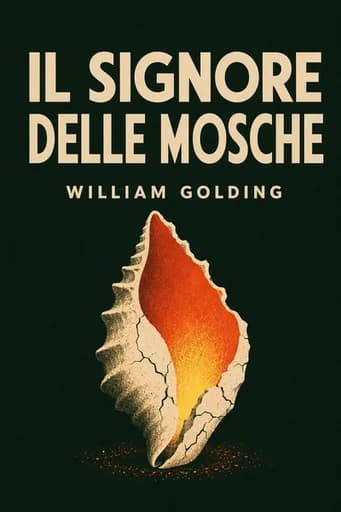
The conch represents order, democracy, and civilized communication. Initially used to organize meetings, its eventual destruction marks the boys’ complete descent into chaos. The shell’s fading influence mirrors the collapse of structured society and the rise of tribal authoritarianism.
Piggy’s glasses embody intellectualism, scientific reasoning, and the power of innovation. Used to start fires, they become a target for Jack’s tribe, symbolizing the rejection of logic in favor of brute force. Their destruction signifies the triumph of ignorance over knowledge.
The severed sow’s head, dubbed the “Lord of the Flies,” symbolizes innate human evil and the psychological “beast” within. Simon’s hallucinatory conversation with it reveals the novel’s central thesis: darkness originates not from external threats but from humanity’s primal instincts.
Major themes include:
The island mirrors the biblical Garden of Eden, initially pristine but corrupted by human presence. Its gradual destruction reflects humanity’s capacity for environmental and moral degradation. The boys’ inability to sustain it underscores the fragility of utopian ideals.
The “beast” symbolizes the primal fear and inherent evil within each boy. While initially perceived as a physical threat, it ultimately represents psychological darkness—a metaphor for humanity’s capacity for violence when freed from societal constraints.
Golding employs dense symbolism to critique human nature:
As an allegory, the novel parallels biblical themes (the Fall of Man) and political critiques (the failure of democracy). The boys’ microcosm reflects macrocosmic societal collapses, suggesting that civilization is a thin veneer over humanity’s inherent brutality.
Golding argues that societal structures are fleeting safeguards against humanity’s natural savagery. The boys’ rapid abandonment of rules, adoption of tribalism, and scapegoating of outsiders mirror real-world authoritarianism and moral hypocrisy. The ending—their rescue by a naval officer—ironically contrasts the island’s chaos with the adult world’s wartime violence, implying cyclical human failure.
Senti il libro attraverso la voce dell'autore
Trasforma la conoscenza in spunti coinvolgenti e ricchi di esempi
Cattura le idee chiave in un lampo per un apprendimento veloce
Goditi il libro in modo divertente e coinvolgente
This belongs to us.
Next time there would be no mercy.
What are we? Humans? Or animals? Or savages?
Bollocks to the rules! We're strong-we hunt!
The silence that follows is the sound of innocence beginning to crack.
Scomponi le idee chiave di Lord of the flies in punti facili da capire per comprendere come i team innovativi creano, collaborano e crescono.
Vivi Lord of the flies attraverso narrazioni vivide che trasformano le lezioni di innovazione in momenti che ricorderai e applicherai.
Chiedi qualsiasi cosa, scegli il tuo stile di apprendimento e co-crea intuizioni che risuonano davvero con te.

Creato da alumni della Columbia University a San Francisco
"Instead of endless scrolling, I just hit play on BeFreed. It saves me so much time."
"I never knew where to start with nonfiction—BeFreed’s book lists turned into podcasts gave me a clear path."
"Perfect balance between learning and entertainment. Finished ‘Thinking, Fast and Slow’ on my commute this week."
"Crazy how much I learned while walking the dog. BeFreed = small habits → big gains."
"Reading used to feel like a chore. Now it’s just part of my lifestyle."
"Feels effortless compared to reading. I’ve finished 6 books this month already."
"BeFreed turned my guilty doomscrolling into something that feels productive and inspiring."
"BeFreed turned my commute into learning time. 20-min podcasts are perfect for finishing books I never had time for."
"BeFreed replaced my podcast queue. Imagine Spotify for books — that’s it. 🙌"
"It is great for me to learn something from the book without reading it."
"The themed book list podcasts help me connect ideas across authors—like a guided audio journey."
"Makes me feel smarter every time before going to work"
Creato da alumni della Columbia University a San Francisco

Ottieni il riassunto di Lord of the flies in formato PDF o EPUB gratuito. Stampalo o leggilo offline quando vuoi.
What happens when the thin veneer of civilization is stripped away? A group of British schoolboys, evacuated during wartime, crash-land on an uninhabited tropical island with no adult supervision. Paradise quickly becomes a nightmare as their initial excitement-"This belongs to us!"-transforms into something darker. Ralph, fair-haired and athletic, finds a conch shell and uses it to summon survivors scattered across the island. The boys establish a primitive democracy, electing Ralph as chief over Jack Merridew, the authoritarian leader of a choir group. Ralph sets three priorities: maintaining a signal fire for rescue, building shelters, and having fun. But troubling signs emerge almost immediately. When Jack encounters a trapped piglet, he draws his knife but hesitates-"the enormity of the knife descending and cutting into living flesh" momentarily overwhelms him. Red-faced with embarrassment, he vows, "Next time there would be no mercy." This hesitation marks a crucial threshold between civilization and savagery. Meanwhile, a small boy with a mulberry-colored birthmark mentions seeing a "beastie" in the forest, planting the first seeds of fear. When the boys build their signal fire, their excitement leads to recklessness-the blaze spreads uncontrolled, and in the aftermath, they realize the boy with the birthmark is missing. Their first casualty, sacrificed to their own carelessness. The silence that follows is the sound of innocence beginning to crack.
"The shelters aren't good. And the-the other thing. They're starting not to care." Ralph's frustration reflects the widening rift on the island. While he and Simon build shelters, Jack obsesses over hunting, and the other boys abandon work for play. This tension between immediate pleasure and long-term survival divides the group. Jack and Ralph clash over priorities. Ralph focuses on maintaining the signal fire for rescue, while Jack pursues hunting for power and primal satisfaction. Their appearances mirror their diverging paths - Ralph maintains his civilized demeanor while Jack transforms, letting his hair grow wild and adopting face paint that frees him from "shame and self-consciousness." The younger boys develop their own dynamic, sharing fears about a mythical beast on the island. Their fears, though dismissed by the older boys, gradually infect the group. In a pivotal scene, Roger throws stones near a littlun named Henry, deliberately missing but drawing closer. Only "the taboo of the old life" - civilization's lingering influence - prevents him from striking directly. This restraint is temporary.
"What are we? Humans? Or animals? Or savages?" Piggy's question captures their deteriorating situation as fear becomes the invisible force driving them toward savagery. What begins as children's nightmares about a "beastie" soon infects the entire group. During a chaotic assembly, Ralph watches as order crumbles, with Jack declaring: "Bollocks to the rules! We're strong-we hunt!" The beast materializes when a dead parachutist lands on the mountain, its corpse moving grotesquely in the wind. Sam and Eric's terrified report of a winged, clawed monster spreads panic, allowing Jack to position himself as protector. When Ralph, Jack, and Roger investigate and glimpse the silhouette, their frightened retreat becomes the catalyst for their society's collapse. The beast serves as the novel's central metaphor - a projection of the boys' inner darkness. As Simon later realizes, "Maybe there is a beast... maybe it's only us." In their fear, the boys manifest the very savagery they dread.
"Who'll join my tribe?" Jack's challenge splits the group after a supposed beast encounter. When his leadership bid fails, he storms off in tears, declaring "I'm not going to play any longer. Not with you," and invites others to join his hunting tribe. His first successful pig hunt marks a turning point. The violent killing ends with him mounting the severed head on a stake as "a gift for the beast" - the Lord of the Flies - symbolizing their descent into primitive superstition. His transformation peaks when he appears "stark naked save for paint and a belt." The painted face becomes a mask erasing his civilized self. The contrast between Ralph's failing signal fire and Jack's successful hunts shifts power dynamics. Jack's tribe raiding for fire marks their transition from separation to open hostility.
"Kill the beast! Cut his throat! Spill his blood!" The chant builds as Jack's tribe performs their ritual dance around the beach fire. Despite their reservations, Ralph and Piggy are drawn into the circle, swept up in its hypnotic power. Simon, after a hallucinatory dialogue with the Lord of the Flies (the pig's head) revealing the beast exists within the boys themselves, discovers the truth: the feared beast is merely the dead parachutist. He hurries to share this revelation. During the storm, Simon emerges from the forest into the frenzied dance. The boys, mistaking him for the beast, attack him despite his attempts to communicate his discovery. In their savage state, they beat him to death. The sea claims Simon's body, surrounded by phosphorescent creatures that create an ethereal departure - a stark contrast to his violent death that reinforces his Christ-like symbolism. The next morning, Ralph confronts the truth - "That was murder" - while Piggy attempts denial: "It was an accident." His trembling voice reveals he knows otherwise.
"Which is better-to have rules and agree, or to hunt and kill?" Jack's tribe has fully embraced savagery, establishing their fortress at Castle Rock while Ralph's group has diminished to just four boys-himself, Piggy, and the twins Sam and Eric. The theft of Piggy's glasses represents a crucial shift. Without fire, Ralph's group loses both their means of rescue and their last symbol of civilization's technological advantage. Piggy insists they confront Jack's tribe to recover his glasses, holding the conch shell as he makes a final appeal to reason and order. At Castle Rock, Roger deliberately sends a boulder crashing down, killing Piggy and shattering the conch into "a thousand white fragments." Their simultaneous destruction marks the final collapse of rational civilization on the island. Jack immediately declares himself chief, attacking Ralph with his spear. After torturing the twins into joining his tribe, Ralph is left alone, fleeing into the forest as their new prey.
Jack's tribe hunts Ralph "like a pig," with Roger having "sharpened a stick at both ends" to mount Ralph's head as an offering to the beast, just like the Lord of the Flies. In desperation, the tribe sets the island ablaze to flush out Ralph. He flees through the burning forest, reduced to "a shock of hair and Piggy's glasses." A naval officer, drawn by the smoke, finds Ralph cornered on the beach. His casual question-"Having a war or something?"-highlights the ironic parallel between civilized warfare and savagery. His reference to "the Coral Island" and expectations of British boys' proper behavior deepens this irony. Ralph breaks down, weeping "for the end of innocence, the darkness of man's heart, and the fall through the air of the true, wise friend called Piggy." The boys' return to a world at war suggests their experience mirrors humanity's inherent nature.