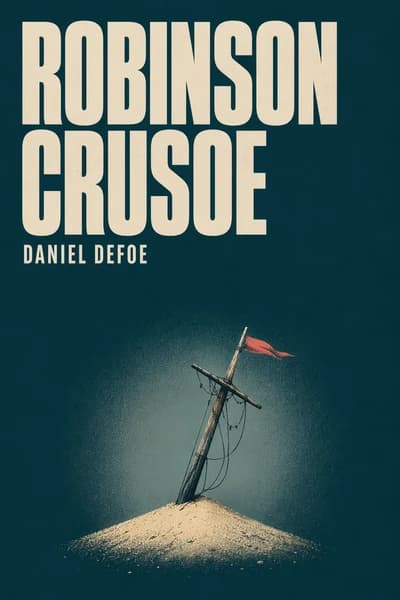
Shipwrecked for 28 years, Defoe's castaway tale birthed modern fiction itself. Translated into 700+ versions, it inspired Rousseau, Marx, and coined "Robinsonade" as a genre. What survival secrets from this 1719 phenomenon still captivate readers three centuries later?
Daniel Defoe (1660–1731) was an English writer, journalist, and political commentator celebrated as a pioneering figure in English literature and author of the groundbreaking adventure novel Robinson Crusoe. Known for his realistic narrative style and focus on themes of survival, individualism, and moral introspection, Defoe drew from his diverse experiences as a merchant, traveler, and political activist to craft stories rooted in vivid detail and psychological depth.
A prolific writer with over 500 published works, Defoe also produced notable titles such as Moll Flanders, A Journal of the Plague Year, and Roxana: The Fortunate Mistress, establishing him as a master of early 18th-century fiction.
His innovative use of first-person narration and meticulous attention to setting in Robinson Crusoe revolutionized the novel as a literary form, blending imaginative storytelling with social commentary. Defoe’s works often explored themes of resilience, morality, and human ambition, reflecting his keen observations of society.
Robinson Crusoe remains one of the most translated books in history, second only to the Bible, and has inspired countless adaptations across media. A monument honoring Defoe, funded by contributions from children worldwide, stands at his gravesite in London’s Bunhill Fields.
Robinson Crusoe follows a shipwrecked Englishman’s 28-year survival journey on a deserted island, detailing his resourcefulness in building shelter, growing food, and taming animals. Central themes include resilience, self-reliance, and colonialism, as Crusoe grapples with isolation, faith, and encounters with indigenous people like Friday. The novel is considered a foundational work in realistic fiction and adventure literature.
Fans of classic adventure literature, students studying 18th-century novels, and readers interested in themes of survival and human ingenuity will find this book compelling. It’s also valuable for those analyzing colonial narratives or philosophical explorations of isolation and identity.
Yes—it’s a timeless classic that influenced the adventure genre and modern realism. Its exploration of resilience, faith, and colonialism remains relevant, offering insights into human adaptability and historical perspectives on exploration.
Key themes include self-reliance (Crusoe’s survival tactics), faith (his religious reflections), and colonialism (his dominance over the island and Friday). The novel also examines morality, isolation, and the clash between “civilization” and nature.
Crusoe’s control of the island, enslavement of Friday, and Eurocentric worldview reflect colonialist attitudes. The novel has been criticized for justifying exploitation through themes of cultural superiority and “civilizing” missions, mirroring 18th-century European expansion.
Friday symbolizes Crusoe’s colonial authority, serving as a loyal servant who adopts English customs and Christianity. Their relationship underscores themes of cultural dominance, with Friday’s submissiveness contrasting Crusoe’s paternalistic control.
Crusoe interprets his survival as divine intervention, shifting from rebellion to religious devotion. His belief that God “preserved” him to save others—like Friday—highlights the novel’s spiritual undertones and moral justification for his actions.
He salvages tools from the ship, builds fortified shelters, farms crops, domesticates goats, and creates a calendar. These efforts emphasize practicality, ingenuity, and the Enlightenment ideal of mastering nature.
The island represents both a prison and a blank slate for Crusoe’s colonial ambitions. It symbolizes isolation’s psychological toll and humanity’s capacity to reshape environments through labor and technology.
Critics argue it glorifies colonialism, oversimplifies non-European cultures, and portrays Crusoe’s actions as inherently righteous. Modern readings also highlight its problematic racial dynamics and Eurocentric worldview.
The novel’s focus on individual perseverance and problem-solving resonates with ideals of personal accountability. However, it also raises questions about the ethics of survival at others’ expense.
Its exploration of resilience, ethical dilemmas in陌生 environments, and human adaptability offers parallels to modern challenges like environmental crises and societal isolation. The story’s allegorical depth invites ongoing reinterpretation.
Senti il libro attraverso la voce dell'autore
Trasforma la conoscenza in spunti coinvolgenti e ricchi di esempi
Cattura le idee chiave in un lampo per un apprendimento veloce
Goditi il libro in modo divertente e coinvolgente
All our discontents about what we want appeared to me to spring from the want of thankfulness for what we have.
Necessity is the mother of invention.
Crusoe's wanderlust prevails.
This initial success fills him with dangerous ambition.
Crusoe acknowledges this decision as evidence of his profound lack of prudence.
Scomponi le idee chiave di Robinson Crusoe in punti facili da capire per comprendere come i team innovativi creano, collaborano e crescono.
Distilla Robinson Crusoe in rapidi promemoria che evidenziano i principi chiave di franchezza, lavoro di squadra e resilienza creativa.

Vivi Robinson Crusoe attraverso narrazioni vivide che trasformano le lezioni di innovazione in momenti che ricorderai e applicherai.
Chiedi qualsiasi cosa, scegli la voce e co-crea spunti che risuonino davvero con te.

Creato da alumni della Columbia University a San Francisco
"Instead of endless scrolling, I just hit play on BeFreed. It saves me so much time."
"I never knew where to start with nonfiction—BeFreed’s book lists turned into podcasts gave me a clear path."
"Perfect balance between learning and entertainment. Finished ‘Thinking, Fast and Slow’ on my commute this week."
"Crazy how much I learned while walking the dog. BeFreed = small habits → big gains."
"Reading used to feel like a chore. Now it’s just part of my lifestyle."
"Feels effortless compared to reading. I’ve finished 6 books this month already."
"BeFreed turned my guilty doomscrolling into something that feels productive and inspiring."
"BeFreed turned my commute into learning time. 20-min podcasts are perfect for finishing books I never had time for."
"BeFreed replaced my podcast queue. Imagine Spotify for books — that’s it. 🙌"
"It is great for me to learn something from the book without reading it."
"The themed book list podcasts help me connect ideas across authors—like a guided audio journey."
"Makes me feel smarter every time before going to work"
Creato da alumni della Columbia University a San Francisco

Ottieni il riassunto di Robinson Crusoe in formato PDF o EPUB gratuito. Stampalo o leggilo offline quando vuoi.
What would you do if you discovered a single footprint on a beach you believed was yours alone? For twenty-four years, Robinson Crusoe had walked that sand in perfect solitude, and then-one mark in the earth, too large to be his own. This moment of terror sits at the heart of a story that has haunted our collective imagination for three centuries. But Robinson Crusoe isn't just an adventure tale about shipwrecks and survival. It's a profound meditation on isolation, faith, and what remains of us when everything familiar is stripped away. Born from the pen of Daniel Defoe at age sixty, this pioneering novel has inspired everything from reality television to philosophical treatises, from children's cartoons to postcolonial criticism. Its power lies not in exotic adventure but in a question we all face: Who are we when no one is watching?