Step into the cockpit with America's legendary fighter ace Robin Olds, whose daring Vietnam War tactics revolutionized aerial combat. How did a mustached maverick outsmart enemy MiGs while challenging military bureaucracy? His leadership philosophy still trains elite pilots at Top Gun today.
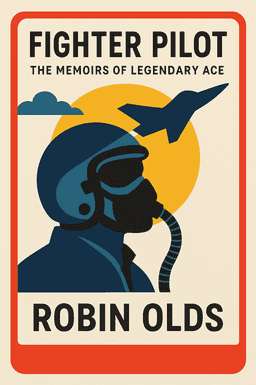
Robin Olds (1922–2007), author of Fighter Pilot: The Memoirs of Legendary Ace Robin Olds, was a decorated U.S. Air Force brigadier general and one of history’s rare triple aces, credited with 17 aerial combat victories across World War II and the Vietnam War.
This military memoir blends firsthand accounts of aerial combat with insights into leadership, innovation under fire, and the evolution of air warfare tactics. A 1943 West Point graduate and National College Football Hall of Fame inductee, Olds rose to prominence as commander of the 8th Tactical Fighter Wing (“Wolfpack”), where his Operation Bolo strategy decimated North Vietnamese MiG-21 forces and set unmatched combat records.
His career-spanning expertise in fighter tactics and squadron command—honed through 259 combat missions—anchors the book’s visceral narratives of dogfights and wartime decision-making. Post-retirement, Olds served as Commandant of Cadets at the U.S. Air Force Academy, shaping future generations of pilots.
Fighter Pilot remains a definitive work in military literature, celebrated for its unflinching portrayal of aerial combat and its author’s legacy as a maverick leader whose innovations reshaped modern air combat doctrine.
Fighter Pilot chronicles Robin Olds’ journey from WWII ace to Vietnam War legend, detailing his 16 aerial victories, leadership innovations, and clashes with military bureaucracy. The memoir combines vivid combat narratives with insights into evolving aviation technology and Cold War military strategy, framed by Olds’ unapologetic personality and dedication to fighter pilot ethos.
Military history enthusiasts, aviation professionals, and leadership scholars will find value in Olds’ firsthand accounts of aerial combat and institutional challenges. The book appeals to readers interested in WWII/Vietnam history, military leadership dynamics, or the transition from propeller-driven to jet-powered warfare.
Yes—Fighter Pilot offers rare candidness about military politics, combat psychology, and the evolution of aerial warfare. Olds’ sharp wit and unvarnished perspectives on iconic battles (like Operation Bolo) make it a standout among military memoirs.
Olds scored 12 aerial victories in WWII, becoming an ace by age 22. Flying P-38 Lightnings and P-51 Mustangs, he demonstrated exceptional dogfighting skills and tactical ingenuity, which later influenced his leadership in Vietnam.
Arriving in 1966, Olds revitalized demoralized pilots by flying missions under junior officers’ command—a humility rarely seen in senior leaders. His “lead from the front” approach resulted in four MiG kills and innovative tactics like the “Wolfpack” formation.
These lines capture his relentless drive and resistance to bureaucratic stagnation.
Olds criticizes the post-WWII Air Force’s overemphasis on nuclear deterrence, arguing it neglected conventional warfare readiness. His advocacy for agile fighter tactics clashed with superiors but proved prescient in Vietnam.
Olds combined technical mastery (transitioning seamlessly to jets) with grassroots rapport-building. He famously grew a non-regulation mustache to bond with troops, symbolizing defiance of rigid hierarchies while maintaining operational discipline.
The memoir starkly describes combat’s mental strain, including survivor’s guilt and the adrenaline-fueled focus required in dogfights. Olds contrasts wartime camaraderie with postwar isolation, offering a nuanced view of military service.
The book documents key transitions: P-80 Shooting Star introductions, F-86 Sabre deployments during Korea, and F-4 Phantom adaptations in Vietnam. Olds’ experiences highlight both technological triumphs and training deficiencies during rapid innovation.
Unlike sanitized accounts, Olds’ narrative balances heroic exploits with self-critical reflections (e.g., marital struggles, career missteps). Its focus on institutional friction distinguishes it from purely battle-centric works.
Olds’ iconic mustache became a rebellion symbol against Air Force grooming standards, fostering unit solidarity in Vietnam. This anecdote encapsulates his ability to challenge bureaucracy without compromising authority.
Senti il libro attraverso la voce dell'autore
Trasforma la conoscenza in spunti coinvolgenti e ricchi di esempi
Cattura le idee chiave in un lampo per un apprendimento veloce
Goditi il libro in modo divertente e coinvolgente
"laughter became as profound as sadness, friendships deepened..."
"We had ringside seats to history but experienced it as a silent film..."
"total exuberance, surrender and mastery all at once"
"A fighter pilot is not just what you do, but who you are."
Scomponi le idee chiave di Fighter Pilot in punti facili da capire per comprendere come i team innovativi creano, collaborano e crescono.
Vivi Fighter Pilot attraverso narrazioni vivide che trasformano le lezioni di innovazione in momenti che ricorderai e applicherai.
Chiedi qualsiasi cosa, scegli il tuo stile di apprendimento e co-crea intuizioni che risuonano davvero con te.

Creato da alumni della Columbia University a San Francisco
"Instead of endless scrolling, I just hit play on BeFreed. It saves me so much time."
"I never knew where to start with nonfiction—BeFreed’s book lists turned into podcasts gave me a clear path."
"Perfect balance between learning and entertainment. Finished ‘Thinking, Fast and Slow’ on my commute this week."
"Crazy how much I learned while walking the dog. BeFreed = small habits → big gains."
"Reading used to feel like a chore. Now it’s just part of my lifestyle."
"Feels effortless compared to reading. I’ve finished 6 books this month already."
"BeFreed turned my guilty doomscrolling into something that feels productive and inspiring."
"BeFreed turned my commute into learning time. 20-min podcasts are perfect for finishing books I never had time for."
"BeFreed replaced my podcast queue. Imagine Spotify for books — that’s it. 🙌"
"It is great for me to learn something from the book without reading it."
"The themed book list podcasts help me connect ideas across authors—like a guided audio journey."
"Makes me feel smarter every time before going to work"
Creato da alumni della Columbia University a San Francisco

Ottieni il riassunto di Fighter Pilot in formato PDF o EPUB gratuito. Stampalo o leggilo offline quando vuoi.
Robin Olds wasn't just a fighter pilot - he embodied the archetype that every military aviator aspires to become. Born in 1922 to Army Air Corps Captain Robert Olds, Robin's earliest memories were filled with the sounds of military aircraft and the presence of aviation pioneers who gathered in his childhood home. By age five, he could identify planes by engine sound alone, a skill his father cultivated by having him close his eyes to name passing aircraft. This early education laid the foundation for a legendary career that would span two wars and make him America's most celebrated fighter ace. When his father died in April 1943, he left Robin with words that would guide his entire career: "I never once went up in the air without learning something new." This philosophy - that every flight offered a lesson - became the cornerstone of Olds' approach to aerial combat and leadership. His first solo flight brought what he described as "total exuberance, surrender and mastery all at once," a feeling that would sustain him through the darkest moments of war.
D-Day gave Olds a ringside seat to history as he flew cover for landing forces. Below spread what he called "the vast panoply of war" - naval gunfire flashing, landing craft crowded with men, and smoke marking burning ships. He watched men wade through gunfire, some sinking under their gear's weight, blood staining the water. "We experienced it as a silent film - our engines drowning out all external sound," he wrote. His first aerial victory came August 14, 1944, during a predawn mission when he spotted and pursued two FW-190s, hitting the wingman who crashed in a huge explosion. By war's end, he had become a double ace at just 22 with sixteen confirmed victories. Combat transformed these young men, developing what Olds called "a profound appreciation for life known only to combat veterans." He noted that "laughter became as profound as sadness, friendships deepened, and every moment felt exactly right, with time's edges tinged by light."
Colonel Hubert "Hub" Zemke's arrival as the 479th's new commander transformed Olds. Zemke, a legendary triple ace, brought combat experience and tactical innovations. Under his mentorship, Olds absorbed crucial leadership principles: master the mission, connect personally with all personnel, make daily visits to all sections, ask probing questions, identify supply shortages, ensure officers know their people's needs, never mislead troops, and accept ultimate responsibility as commander. These principles guided Olds throughout his thirty-year career, including his transition to jets with the P-80 "Shooting Star" at March Field. Despite initial resistance from established pilots who viewed him as an upstart, Olds quickly mastered the jet, which he described as "absolutely beautiful - polished aluminum, smooth lines, with impressive performance and handling characteristics." The P-80's top speed of 558 mph marked a dramatic leap from his combat P-51 Mustang.
By 1966, Olds was frustrated with his Pentagon assignment and Vietnam's restrictive rules of engagement. When offered command of the 8th Tactical Fighter Wing at Ubon Royal Thai Air Force Base, he seized the opportunity, telling his pilots: "I'll be flying as your wingman for a couple of weeks. You are going to teach me, but you'd better teach me good and fast because soon I'm gonna be better than all of you." He immediately instituted post-mission debriefings where he'd openly admit his own mistakes first, creating an environment where everyone could learn. His greatest innovation came in response to increasing MiG activity. With intelligence officer J.B. Stone, Olds developed Operation Bolo - a plan to lure MiGs into combat by having F-4s mimic F-105 strike packages using their call signs, routes, and timing patterns. On January 2, 1967, the trap worked perfectly. MiGs emerged from clouds, and in the ensuing battle, Olds' Wolfpack downed seven MiG-21s, devastating North Vietnam's small fleet. Olds personally scored four MiG kills in Vietnam, deliberately avoiding a fifth when he learned headquarters planned to exploit his ace status by sending him home for parades. "Tell them to go screw themselves! I just won't get number five!" he told a personnel officer.
During his Vietnam tour, Olds grew his famous handlebar mustache as a silent protest against headquarters' restrictive policies. This facial hair, though against regulations, became a powerful symbol of defiance that resonated throughout the 8th Tactical Fighter Wing. His men grew their own mustaches in solidarity, and the unit became known as "Robin's Bastards," with the mustache as their unofficial emblem of warrior spirit. When Olds returned to America in September 1967, the Air Force Chief of Staff immediately ordered him to shave before meeting President Johnson - symbolizing the tension between combat leadership and Pentagon bureaucracy that had long frustrated Olds. In the Oval Office, Olds demonstrated his characteristic directness, proposing a comprehensive strategy to win the war: mine Haiphong harbor, destroy supply lines from China, and launch decisive strikes against Hanoi's military infrastructure. President Johnson showed genuine interest, engaging Olds in detailed discussion.
Robin Olds' life embodied a philosophy beyond mere flying skill. He believed fighter pilots were defined by attitude - cockiness, aggressiveness, self-confidence, with streaks of rebelliousness and fierce competitiveness. These qualities were balanced by discipline, teamwork, and unwavering dedication to mission success. "The bond between pilot and machine transcends mere operation," he explained. "You strap the machine to your butt and become one with it. Hydraulic fluid becomes your blood, titanium your bones, instruments extensions of your senses." This intimate connection allowed him to detect subtle changes in engine pitch or airframe vibration, often identifying mechanical issues before instruments could. Throughout his career, Olds battled bureaucracy that prioritized statistics over combat effectiveness. He challenged tactically unsound rules like requiring fighters to fly predictable patterns that made them vulnerable to enemy fire, while advocating for improved pilot training programs and tactical formations that would save lives.
In his final days battling congestive heart failure in spring 2007, Olds dreamed of flying - landing through white fog to find his departed comrades in an old hangar. "Olds Flight, checking in!" he would announce. His father sat at the piano: "Hello, Robbie. Welcome home." Robin would reply proudly, "Hello, Dad. I was a fighter pilot!" His father would assure him, "Yes, son. You still are." Through retirement, Olds gave speeches, carved wood, skied, and watched his granddaughter grow up. In his final address to his Wolfpack, he distilled his philosophy: "Be soldiers, be warriors, be men! You're learning about yourself. It's teamwork that does it. It's friendship that cements it together. It is dedication that accomplishes the mission." For Robin Olds, being a fighter pilot was his identity. His legacy endures in the spirit he embodied: balancing fierce individualism with selfless teamwork, technical mastery with creative improvisation, and disciplined professionalism with rebellious innovation. In an era of remote technology and detached decision-making, Olds exemplifies the irreplaceable value of personal courage, direct leadership, and a warrior spirit that prioritizes mission while preserving the joy of flight.