Capitolo 1
When Wonder Awakens in the Ordinary World
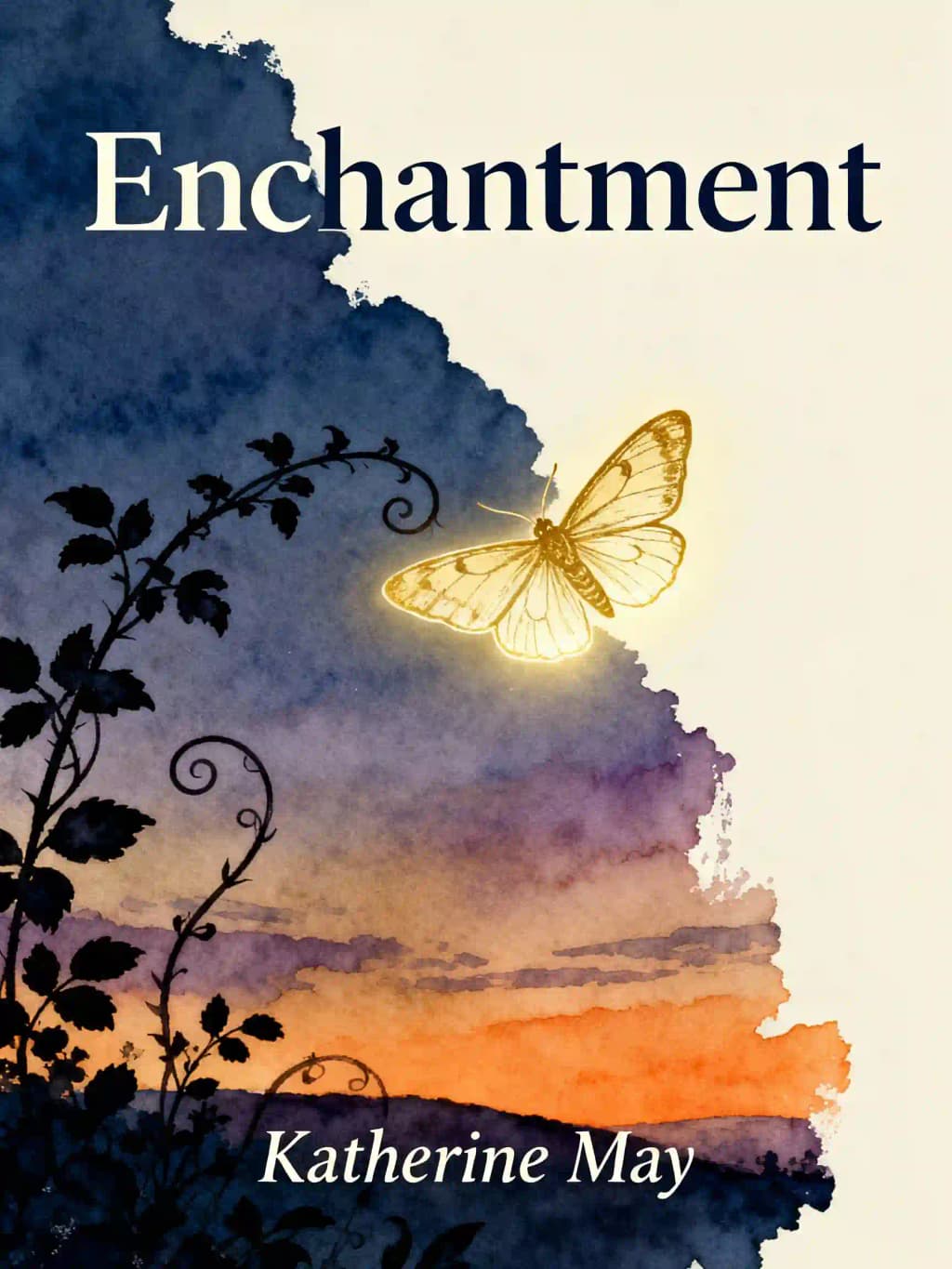
In a world of constant distraction and endless tasks, Katherine May's "Enchantment" arrives like a gentle but urgent reminder of what we've forgotten. This New York Times bestseller from the author of "Wintering" has become a quiet phenomenon, passed between friends like a secret remedy for modern emptiness. Celebrities from Brene Brown to Kristen Bell have praised its ability to reawaken our capacity for wonder. The book's timing feels prophetic-published just as many were emerging from pandemic isolation feeling strangely disconnected from life's meaning and beauty. May, diagnosed with autism in adulthood and recovering from burnout, doesn't offer tidy solutions but instead invites us on a journey through earth, water, fire, and air to rediscover the enchantment that has always surrounded us. Her quest resonates deeply in our age of anxiety, where many feel they've lost something essential but can't quite name what's missing.
Capitolo 2
The Quiet Crisis of Disconnection
I wake disoriented in the night, unable to locate myself in time - a common experience in our digitally saturated age. My attention, once capable of sustained focus, now slides frictionlessly away from books despite my continued purchasing and genuine desire to read. We're living in an age defined by fear, running like startled rabbits from countless threats: climate change, political upheaval, economic uncertainty, and the constant barrage of catastrophic headlines that flood our screens daily.
The overwhelming scale of modern existence makes us feel increasingly small, consumed by survival's endless labor - the emails that need answering, the bills that need paying, the endless scroll of social media that somehow feels both mandatory and hollow. We've become disconnected from meaning, surrendering the traditional rites of passage that once guided us through life's transitions. Birthdays become mere calendar notifications, marriages are reduced to legal documents, and deaths are processed through bureaucratic procedures, rendering our deepest experiences unspeakable in their modernized sterility.
This state of "discombobulation" isn't clinical depression - there's no self-loathing or destructive urges that characterize that condition. Instead, it manifests as a strange emptiness, a peculiar slowness, a difficulty engaging with anything meaningful or substantial. Time behaves oddly, clustering in dark corners like dust bunnies, sparse elsewhere, sometimes looping so that washing my face at night feels like one continuous moment across months. Friends and colleagues increasingly describe similar states, attributing it to various sources: the exhaustion of pandemic parenting, the toll of prolonged isolation, the biological shifts of menopause, or naming it directly for what it is: burnout - a state of emotional, physical, and mental exhaustion.
As an autistic person diagnosed in adulthood, May intimately recognizes burnout's incremental sickening that builds from chronically ignoring your fundamental needs. Despite carefully guarding against it through various coping mechanisms and boundaries, it has returned like an unwelcome houseguest. She sits at her desk, fidgeting between social media tabs and news websites, watching others who seem solid and substantial compared to her flickering, ephemeral sense of self.
What we've collectively lost isn't just energy but enchantment - that small wonder magnified through meaning, an essential nutrient found only when digging in one's own soil of experience and connection. Without it, we lack the crucial ability to integrate seismic changes rather than merely administrate them through to-do lists and productivity apps. We desperately need what John Keats called "negative capability," that intuitive thought mode allowing us to dwell in uncertainty without frantically grasping for reason or immediate resolution.
Enchantment isn't about objective beauty or Instagram-worthy moments but rather about deep, authentic engagement with the world around us - the quality of experience that emerges from close attention to both ordinary and extraordinary moments. Though we might work hard to forget it in our rush to optimize and achieve, enchantment waits patiently for our return, hidden in morning dewdrops, chance encounters, and the quiet spaces between our thoughts.
Capitolo 3
Sacred Moments in Ordinary Places
Mircea Eliade coined "hierophany" to describe how the divine reveals itself, transforming ordinary objects through worshipful attention. For believers, hierophany uncovers absolute reality rather than projecting fantasy-it's experiencing all layers of existence beyond surface appearance. Those with religious experience live in an enhanced world where "the cosmos in its entirety can become a hierophany." This transformation occurs not through magical thinking, but through a shift in perception that reveals the extraordinary within the ordinary, much like how artists see beauty in mundane objects others might overlook.
We can find these sacred moments in unexpected places. May recalls her grandmother eating an orange with such reverence it became a ritual-settling into her green chesterfield chair, laying kitchen paper across her lap, massaging the orange between her knuckles before methodically peeling it. To a child, oranges were commonplace, but her grandmother, who had lived through wartime rationing and the Great Depression, treated them as precious gifts. Now those moments seem sacred in memory-the darkness of the room, the spritz of orange oil catching light, the citrus scent filling the quiet air. The ritual transformed a simple fruit into a meditation on abundance, gratitude, and the connection between generations.
Modern life has lost many of its hierophanies, leaving us with what Eliade called a "shattered universe" of neutral places without meaning. Shopping malls replace town squares, digital screens substitute for storytelling circles, and ancient gathering spots become parking lots. Yet humans retain an instinctive urge to sanctify certain locations-birthplaces, childhood homes, meaningful meeting spots, first kiss locations, or places where significant life events occurred. May is drawn to the vision of ancestors moving through landscapes where each landmark unpacked its own mythology, where familiar places became maps of myth and wisdom, blooming like fractals, inviting ever more nuanced engagement with meaning. Indigenous cultures particularly demonstrate this deep connection to place, where every rock, tree, and river carries stories and spiritual significance.
This embodied knowing seems fundamentally more complex than our current thought habits. We activate a different intelligence that resides throughout our bodies, not just our heads. Our knowing pulses through organs, muscles, and blood - what some traditions call "body wisdom" or "cellular memory." To maintain this connection, we must resist the mind's tendency to box up experiences as completed. We need the humility to remain open daily, allowing ourselves to learn something new, even from experiences we think we've mastered.
The challenge is surrender, letting yourself be cracked open, maintaining a vulnerable heart with permeable skin. This vulnerability isn't weakness but rather a strength that allows us to fully experience life's sacred dimensions. Wounds heal, cracks fill in, and sometimes life is already too painful, causing us to close up again for protection, often without noticing. Yet these very cracks, as Leonard Cohen suggested, are how the light gets in - they become portals to deeper understanding and connection with the sacred in everyday life.
Capitolo 4
The Deep Terrain of Childhood
Two days before lockdown, May kept her son Bert home with a cough. Beyond following guidelines, she wanted to shield him from pandemic anxiety and give him a reserve of pleasure before restrictions began. She took him to the woods, hoping to show him trees in bud, squirrel-marked pinecones, and hibernating bats-to teach him that the world remains rich without human structures, that nature could comfort him when life becomes difficult. The ancient oaks and weathered paths offered a sanctuary from the mounting global tension, a reminder that cycles of nature continue regardless of human crisis.
But Bert ignored her educational plans, instead immersing himself in muddy puddles near the parking lot. This pattern repeats: she brings bark-rubbing materials; he pretends to catch Pokemon. She identifies seaweed; he whips it around playfully. She wants beautiful walks; he wants noisy trampoline centers with flashing lights. His resistance to her carefully planned nature lessons reveals the gap between adult intentions and childhood instincts, between structured learning and pure experiential joy.
Modern childhood has traded dirt under fingernails for hand sanitizer, offering "shallow terrain"-plastic play centers and overly specific toys that quickly lose their appeal. Such environments have nothing beneath their surface, permit only fun while excluding untidier feelings, and must eventually be abandoned as childish artifacts. Shopping malls, indoor playgrounds, and electronic devices create sterile, predictable experiences that lack the depth and mystery of natural spaces. These manufactured environments prioritize safety and cleanliness over discovery and wonder, reflecting society's growing disconnect from natural rhythms.
The forest, however, is "deep terrain"-offering unending variance, complete sensory engagement, seasonal changes, historical connections, and mythological resonance. It's simultaneously safer than spiteful playgrounds yet more genuinely dangerous. Deep terrain offers multiplicity rather than answers, teaching compromise and interpretation while revealing time's true nature-both circular and vast. A fallen log becomes a bridge, a castle, a creature; a patch of moss tells stories of rainfall and shade; bird songs create an ever-changing symphony that connects present moment to ancient patterns.
May wants her son to inherit deep terrains as his birthright, to learn to move through them respectfully while feeling their nourishment. She wants him to crave complexity and feel dissatisfied with shallow experiences. This is why she insists on returning to these places-it's urgent, essential knowledge. Each visit builds layers of memory and understanding, creating a foundation for environmental literacy and emotional resilience.
This desire connects to her own childhood landscape-mud tracks, marshes with rats, swans nesting near an abandoned asbestos factory. She questioned if this compromised nature counted as beautiful compared to the sweeping vistas on TV. Yet she found magic in small wonders: browning rose petals in buckets, chimney lights across the river, headlights ghosting across her quilt, London fireworks tiny on the horizon. These imperfect encounters with nature taught her to find beauty in unexpected places, to value authenticity over perfection, and to recognize that wilderness exists even in urban margins.
The tension between her aspirations for Bert's nature education and his natural inclinations reflects a broader struggle in modern parenting - balancing structured learning with free play, safety with risk, and adult wisdom with childhood wonder. Through their continued encounters with deep terrain, both mother and son learn to navigate these complexities, finding their own path through the wild spaces of childhood.
Capitolo 5
Reconnecting with the Elemental World
When May wants to feel small, she goes to the sea at its lowest ebb. Living near the coast has given her an innate sense of tidal patterns-sometimes she can smell the salty seaweed exposed by retreating waters or hear the different quality of sound when the water is present. After being away from the sea, she loses this rhythm and feels disoriented, as though she's lost her clock.
Standing on the white beach of crushed cockleshells, she gazes at the East Quay's sheer wall, tracking the green line left by high tide meters above the bare seabed. She calculates the impossible volume of water that rises twice daily with elemental clockwork, so gently you barely notice until it's upon you. These tides are gravity made visible-the moon's pull creating two giant waves traveling endlessly around the earth.
Yet May's relationship with water has become complicated. After a frightening incident where she was nearly dashed against wooden groynes while swimming, she began taking swimming lessons to rebuild her confidence. Then the pandemic hit, cutting off her access to both the pool and the sea. Her Meniere's disease worsened after contracting Covid, causing dizziness and nausea from excess fluid in the inner ear. The sea no longer feels level enough, too wet, too much like the inside of her head.
This disconnection extends beyond water. May has lost her ability to read-a shameful secret for an author. Not just casual reading, but the very foundation of who she is has crumbled. She cannot shepherd her attention through even a single chapter without her consciousness retreating to some inaccessible inner sanctum. Fiction suffers most; she's developed a complete disinterest in stories about people who don't exist.
This reading drought is furtive, leaving a gaping void where she once rested her mind. More troubling, she's noticed the same malady in others. Her literary friends-usually fizzing with book recommendations-now shrug and prevaricate when asked what they're reading. They're exchanging nothing, perpetuating an existential exhaustion born of sickness, fear, and lockdowns that have stretched their minds beyond capacity.
Capitolo 6
The Sacred Fire of Deep Play
May begins with a childhood memory: at six years old, she envied classmates with video recorders and Disney films while she had only two issues of "Story Teller" magazine with accompanying audio tapes. Yet she became obsessed with one particular story-"The Goblin Rat," a Japanese fairy tale about a boy too weak for farm work who becomes a monk but can't stop drawing cats. After being expelled for drawing cats on temple screens, he receives advice from the abbot: "At night, avoid large places. Keep to small."
The boy finds an abandoned temple, compulsively draws cats on its walls, then remembers to sleep in a small cabinet. During the night, terrible sounds shake the building. Morning reveals his cats with blood-smeared mouths beside a dead giant rat demon. The tale speaks to quiet, strange children with obsessions that infuriate adults-showing how the boy's unstoppable creative fire saves him. His art burgeons regardless of authority; he becomes merely a conduit for creation that ultimately protects him.
This story illustrates a particular kind of necessary fire that burns within us-what May calls "deep play." It's not merely exuberant silliness but something serious and absolute-complete absorption in something that matters intensely to you but appears trivial to others. It's disappearance into a space of our choosing, the pursuit of pure flow where we test new thoughts and selves. Play is a form of enchantment.
May's literary ambitions were cute at first but elicited disgust by thirteen. She buried her turquoise-inked poems in the kitchen bin, but they haunted her like revenants. She tried to kill her writing identity, avoiding English Literature at university and rejecting student newspaper opportunities. But writing kept punching its way out of whatever grave she dug. Deep play is hard to reclaim once abandoned. The skills took years to relearn-asserting the right to time and space, trusting her instinct, confronting her terror of failure.
Deep play is a labyrinth with no destination; the walking is the thing. Your only reward is more of the same-more wells to fill with your attention, more fires to tend. This quality of attention is rare in adult life and we misunderstand even in children. What matters is nurturing that quality of attention, shielding the flame that allows us to read the contours of the land and sense the heat pooling beneath the soil.
Capitolo 7
Finding Community in Shared Wonder
Though naturally solitary and suspicious of groups, May increasingly craves congregation-people with whom she can gather to reflect and contemplate existence, who hold her accountable and keep her on track. Spiritual solitude, while initially appealing, gradually reveals its limitations. She's considered joining Quakers, drawn to their silent worship and social justice work; Buddhist sanghas, attracted to their meditation practices and teachings on impermanence; even local pagan groups, intrigued by their earth-based spirituality and seasonal rituals. Yet she never takes the final step, held back by an intellectual honesty that makes her question her motivations.
She worries about making only partial commitments to these traditions, or worse, cherry-picking comfortable aspects while ignoring counterbalancing obligations. This selective approach to spirituality - taking the pleasant parts while avoiding the challenging ones - feels dishonest to her. She recognizes that authentic spiritual growth requires embracing both comfort and discomfort, both joy and struggle.
A spiritual practice that merely blankets us in self-acceptance becomes just a bandage for narcissism. True congregations-ones allowing diverse thought-hold us to account, challenging our assumptions and pushing us beyond our comfort zones. May believes God is not a person but the sum total of all of us across time, which only makes our duty greater. We must witness the broad spectrum of humanity rather than defend our own corner, acknowledging both beauty and suffering.
She finds unexpected community in a group of women swimmers at Hartland Quay, where the North Devon coast meets the Atlantic in dramatic cliffs and treacherous waters. Though she doesn't know them personally, they feel familiar in their shared tribe of dryrobes, towelling ponchos, and bright swimming caps - a sisterhood of cold-water enthusiasts. Despite her nervousness about swimming in the jagged Hartland coast, where waves crash against ancient rocks and currents pull unpredictably, she joins them in swimming to Life Rock-a basalt spike in the bay's middle that looks treacherously distant.
Swimming back along the cliff face-chevrons of shale and sandstone formed over 300 million years ago-she feels deliciously small, swimming through deep time. The geological layers tell stories of ancient seas and vanished worlds, making her own existence feel both precious and insignificant. They've witnessed the sea's fragment of power; it's witnessed their exuberant joy. That night in bed, she still feels that rising and falling swell within her, the physical memory of communion with both nature and community.
May also finds community in unexpected places, like an online retreat with the Zen Peacemaker Order during the pandemic lockdown. Their three tenets become anchors in uncertain times: Not-Knowing (abandoning preconceptions and embracing uncertainty), Bearing Witness (noticing the world with compassion and staying present with suffering), and Taking Action (responding thoughtfully to what we've witnessed). Without her usual tools to question, console, or solve, she heard more deeply than ever before, finding connection across digital spaces in shared silence and contemplation. This virtual sangha proves that authentic community can form even in the most unlikely circumstances, bound together by shared intention rather than physical proximity.
Capitolo 8
Reclaiming Ancient Wisdom in Modern Life
Early Sunday morning, church bells ring as May waits for her friend Clare at a bus stop in Harbledown. Clare takes her on a small pilgrimage to St. Nicholas Hospital, founded outside Canterbury in 1084 as England's first leper hospital. Its location near a natural spring with reputed healing properties made it renowned-even Edward of Woodstock, heir to the throne, visited and was reportedly cured of leprosy, giving the spring its name: the Black Prince Well.
Healing wells scatter England's landscape in surprising abundance-historian James Rattue lists over two hundred in Kent alone-but most lie forgotten. The Black Prince Well survives at the edge of retirement homes, tented by an enormous thorny briar rose. Clare pushes back the boughs to reveal a grey limestone arch with worn keystone carved with the Black Prince's three-feathered insignia. Steps lead down to a dark pool about a foot deep, heart-shaped rose petals floating on its surface, occasional bubbles rising as the spring feeds from below.
This place where people sought healing across ages crackles with magic, but May has no template for how to behave around it-no tradition or culture preparing her for this encounter. The chain of understanding that stretched across generations was broken long ago; she's inherited only forgetting.
When she asks Clare what one does here, Clare simply says she goes down the steps and spends time. May takes her turn, and the briar catches her raincoat, pulling it off. "It's a guardian!" Clare says. "It's looked after this well for a long time." May asks permission to visit and leaves her jacket in its custody.
Just steps from the path, she enters a different space-outside sounds muffled, her movements echoing from stone and water. Here is a hierophany, a place imbued with layers of human intent, playing back meanings she doesn't fully understand. She touches the water with her toes, tastes its clean, slightly mineral flavor, and stripes some on her forehead-a half-baptism she feels slightly ashamed of, her modern sensibilities trusting only bottles and taps.
Capitolo 9
The Everyday Magic All Around Us
Each April, the Lyrid meteor shower appears as Earth passes through comet Thatcher's orbit, creating a particularly bright display near the constellation Lyra. Yet despite twelve regular meteor showers yearly, few of us make the effort to witness these magical streaks of light we invest with wishes. Medieval philosophers believed the universe beyond Earth was made of aether or quintessence-a refined substance that transcended earthly elements and composed stars and light.
Today, our electric lights have made the night sky increasingly rare. Even with stars visible from May's garden, light pollution obscures all but the brightest. To truly see meteors requires traveling to Dark Sky Reserves like the islands of Coll and Sark or Exmoor, where communities limit outdoor lighting.
The quest for enchantment reveals an important truth: the numinous surrounds us constantly but requires our deliberate attention. Hierophany-the revelation of the sacred-is something we bring to everyday things rather than something given to us. Seeking enchantment means committing to noticing the world, looking for beauty, making time for contemplation, learning the names of plants and places, and recognizing our interconnectedness with humanity.
On her meteor-watching trip to Exmoor, May discovers that a supermoon has risen, potentially drowning out the fainter light of stars. Her son Bert becomes enchanted with a cairn at the hilltop, spontaneously creating his own ritual by adding stones for each family member. This act of meaning-making is precisely what we need-not to erase human presence from nature but to invite gentleness back into our relationship with the earth.
Though the bright moon and lingering daylight make stargazing difficult, she discovers something unexpected: their moon shadows, casting silhouettes on the ground. This shadow within a shadow becomes magical to them, though it's something she could have found anywhere. The pursuit of enchantment often leads to discovering not what we sought, but what we needed-insights already within us, rearranged into new understanding.
Whether through divine humor or her own reflection, May prefers the mystery of not knowing, staying soft to possibilities rather than hardening into certainties. As they prepare to leave, she glimpses what might be a shooting star-or perhaps just tired eyes imagining one. It doesn't matter. She gets to choose what meaning to make of it. The magic is always there, waiting for our attention on this holy ground.