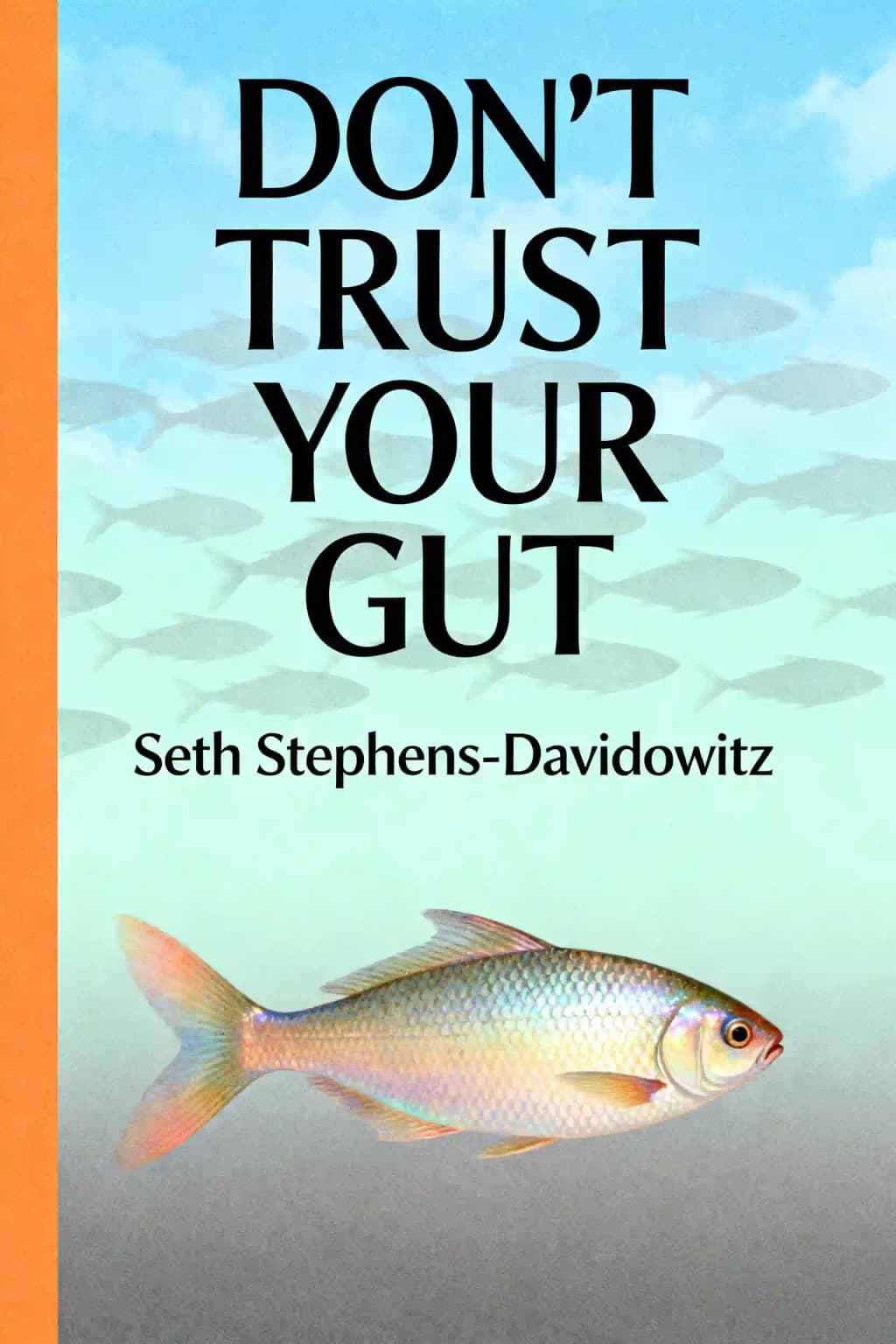
Forget intuition - Seth Stephens-Davidowitz's data-driven manifesto reveals why your gut is sabotaging you. Endorsed by "Freakonomics" co-author Steven Levitt as "the best data storyteller" he's met, this book uses massive datasets to answer life's biggest questions. What counterintuitive truth about success might change everything?
Seth Stephens-Davidowitz, a New York Times bestselling author and data scientist, masterfully bridges behavioral insights and big data in Don’t Trust Your Gut, a groundbreaking guide to data-driven decision-making. With a PhD in economics from Harvard and experience as a Google data scientist and Wharton lecturer, he combines academic rigor with real-world applications to challenge intuition-based choices.
His work has been featured in The Atlantic, Wired, and his New York Times column, establishing him as a leading voice in leveraging technology to decode human behavior.
Stephens-Davidowitz’s earlier bestseller, Everybody Lies, explored hidden truths in internet searches, while Who Makes the NBA? examines AI’s creative potential. A sought-after speaker for institutions like Nasdaq and Google, he advises firms like Citadel and GSK on data strategy.
Don’t Trust Your Gut was hailed by Freakonomics co-author Steven Levitt as “a highly valuable addition to the self-help canon,” reflecting its status as an Economist Book of the Year and a Wall Street Journal bestseller. His research has been translated into over 20 languages, empowering millions to rethink life choices through empirical evidence.
Don't Trust Your Gut challenges conventional self-help advice by using large-scale data analysis to reveal counterintuitive insights about decision-making. Seth Stephens-Davidowitz, a former Google data scientist, examines topics like dating, parenting, career choices, and happiness through datasets from search trends, social media, and academic studies. The book argues that intuition often leads us astray, advocating for evidence-based strategies to navigate life’s biggest decisions.
This book is ideal for readers seeking data-driven alternatives to traditional self-help advice, particularly those interested in behavioral economics, psychology, or sociology. It appeals to skeptics of "gut instinct" philosophies and anyone curious about how big data can reveal hidden patterns in human behavior. Fans of authors like Steven Levitt (Freakonomics) or Malcolm Gladwell will find its approach familiar yet fresh.
Stephens-Davidowitz analyzes anonymized Google searches to uncover taboo or socially hidden behaviors, such as unrealistic dating preferences or secret parental regrets. These datasets provide raw, unfiltered insights into human motivations that traditional research methods often miss.
The book claims data shows:
It challenges intuition-driven parenting with findings like:
Some reviewers argue the data:
Both books use unconventional data to challenge societal assumptions, but Stephens-Davidowitz focuses specifically on personal decision-making rather than broad economic trends. Don't Trust Your Gut adopts a more overt self-help structure while maintaining a similar tone of data-driven skepticism.
Yes, it analyzes data showing:
The book identifies data-backed happiness drivers:
For data enthusiasts and self-help skeptics, yes—it offers fresh perspectives backed by compelling datasets. However, readers seeking step-by-step guides may find it more theoretical than practical. Its strength lies in challenging assumptions rather than providing prescriptive advice.
Senti il libro attraverso la voce dell'autore
Trasforma la conoscenza in spunti coinvolgenti e ricchi di esempi
Cattura le idee chiave in un lampo per un apprendimento veloce
Goditi il libro in modo divertente e coinvolgente
Relationships remain largely unpredictable.
AI remains 'just as clueless as the rest of us' at determining romantic compatibility.
Lighten Up.
Parents have only small effects on life expectancy, health, education, religiosity and adult income.
Scomponi le idee chiave di Don't Trust Your Gut in punti facili da capire per comprendere come i team innovativi creano, collaborano e crescono.
Distilla Don't Trust Your Gut in rapidi promemoria che evidenziano i principi chiave di franchezza, lavoro di squadra e resilienza creativa.

Vivi Don't Trust Your Gut attraverso narrazioni vivide che trasformano le lezioni di innovazione in momenti che ricorderai e applicherai.
Chiedi qualsiasi cosa, scegli la voce e co-crea spunti che risuonino davvero con te.

Creato da alumni della Columbia University a San Francisco
"Instead of endless scrolling, I just hit play on BeFreed. It saves me so much time."
"I never knew where to start with nonfiction—BeFreed’s book lists turned into podcasts gave me a clear path."
"Perfect balance between learning and entertainment. Finished ‘Thinking, Fast and Slow’ on my commute this week."
"Crazy how much I learned while walking the dog. BeFreed = small habits → big gains."
"Reading used to feel like a chore. Now it’s just part of my lifestyle."
"Feels effortless compared to reading. I’ve finished 6 books this month already."
"BeFreed turned my guilty doomscrolling into something that feels productive and inspiring."
"BeFreed turned my commute into learning time. 20-min podcasts are perfect for finishing books I never had time for."
"BeFreed replaced my podcast queue. Imagine Spotify for books — that’s it. 🙌"
"It is great for me to learn something from the book without reading it."
"The themed book list podcasts help me connect ideas across authors—like a guided audio journey."
"Makes me feel smarter every time before going to work"
Creato da alumni della Columbia University a San Francisco

Ottieni il riassunto di Don't Trust Your Gut in formato PDF o EPUB gratuito. Stampalo o leggilo offline quando vuoi.
We like to believe our instincts guide us toward good decisions. We trust the flutter in our chest when we meet someone new, the certainty we feel about our career path, the conviction that we know what will make us happy. But what if nearly every major choice you've made-who you dated, where you lived, how you spent your time-was guided by intuitions that were fundamentally wrong? The uncomfortable truth emerging from massive datasets is this: human intuition, refined over millions of years to help us survive on the savanna, is remarkably bad at navigating modern life's most important decisions. When researchers analyzed millions of data points on relationships, careers, and happiness, they discovered something unsettling. The qualities we desperately seek in romantic partners barely predict relationship satisfaction. The business ideas that excite us most tend to fail fastest. The activities we think will make us happy often leave us miserable. Our guts, it turns out, are terrible advisors. But here's the liberating part-we now have something better.
