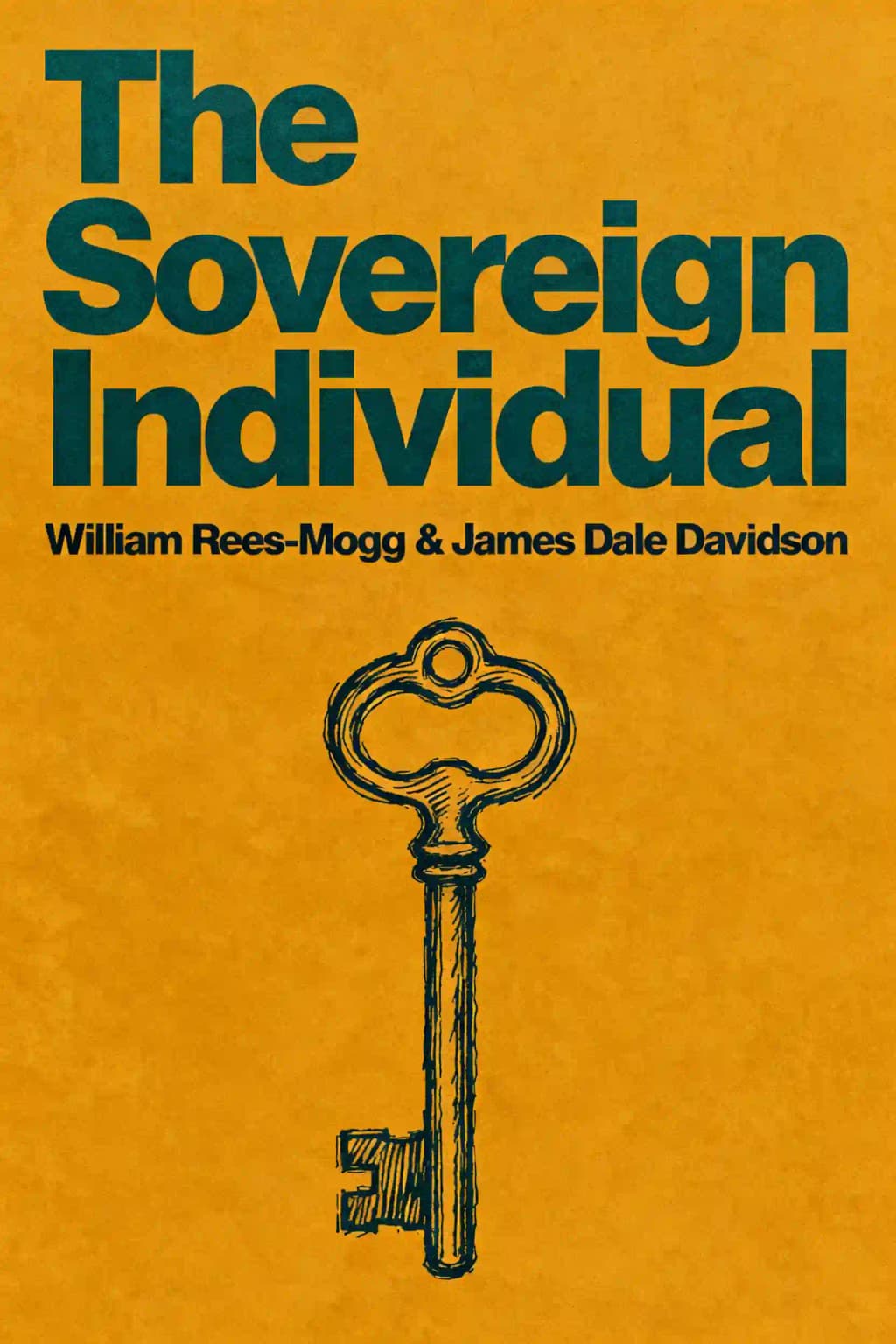
The Sovereign Individual
Overview of The Sovereign Individual
Written in 1997, "The Sovereign Individual" eerily predicted cryptocurrencies, remote work, and social media bubbles. Peter Thiel's favorite book challenges conventional governance, asking: Will technology free individuals from nation-states, or create new power structures entirely?

Key Themes in The Sovereign Individual
- digital sovereignty
- nation state decline
- jurisdictional competition
- information age transition
- decentralized wealth
Quotes from The Sovereign Individual
Ideas rather than physical capital become the primary source of wealth.
Telepresence will allow individuals to span distances at supernatural speed.
The Information Age will leave individuals more responsible for themselves.
Radical change is typically viewed as decline rather than progress.
Characters in The Sovereign Individual
- James Dale DavidsonCo-author and economic forecaster
- William Rees-MoggCo-author and former editor of The Times
About the Author
About the Author of The Sovereign Individual
William Rees-Mogg and James Dale Davidson, authors of The Sovereign Individual: Mastering the Transition to the Information Age, were renowned investment strategists and bestselling authors whose work focused on geopolitical and economic forecasting. Rees-Mogg, a former editor of The Times and respected British media figure, paired with Davidson, an American private investor and founder of the Strategic Investment newsletter, to analyze systemic shifts in global power structures. Their collaboration builds on their earlier bestseller, The Great Reckoning, which accurately predicted the Soviet Union’s collapse and Yugoslavia’s civil war.
The Sovereign Individual (1997), a prescient exploration of decentralization and digital sovereignty, merges their expertise in financial markets and political history.
The book forecasts the internet’s disruption of nation-states, emphasizing themes like cryptocurrency, self-ownership, and the decline of centralized governance. Recalled for its startling accuracy, the 2020 reprint includes a preface by PayPal co-founder Peter Thiel, underscoring its enduring relevance. With over 448 pages in its Touchstone edition, the work remains a cornerstone for understanding the intersection of technology and economic sovereignty.
Download Summary of The Sovereign Individual
Get the The Sovereign Individual summary as a free PDF or EPUB. Print it or read offline anytime.
FAQs About This Book
The Sovereign Individual explores how technological advancements, particularly the Information Revolution, will dismantle nation-states' power, enabling individuals to achieve unprecedented autonomy. Authors Davidson and Rees-Mogg argue that digital currencies, remote work, and borderless economies will shift control from governments to sovereign individuals, creating a "cybereconomy" where taxation and citizenship become optional.
This book is ideal for futurists, entrepreneurs, and policymakers interested in geopolitical trends, cryptocurrency, or decentralized governance. It also appeals to critics of state overreach and those navigating career shifts in tech-driven markets.
Yes, for its prescient analysis of digital disruption’s societal impact. While critics note its underestimation of authoritarian tech surveillance (e.g., China), its insights on taxation, remote work, and cryptocurrency remain relevant.
Key concepts include the decline of nation-states, the rise of cybercurrency, and tax competition between jurisdictions. The authors predict a post-national era where individuals leverage technology to bypass traditional governance, creating a "Fourth Stage" of human organization.
The "Fourth Stage" refers to the Information Revolution’s impact, mirroring past shifts like the Agricultural and Industrial Revolutions. This phase prioritizes intellectual capital over physical assets, enabling sovereign individuals to operate globally without state constraints.
Critics highlight its failure to anticipate authoritarian regimes’ use of surveillance (e.g., China’s social credit system) to counter decentralization. Others argue its vision oversimplifies cultural and political barriers to globalization.
The book foresees governments competing to offer lower taxes to retain citizens and businesses, as digital nomads and offshore platforms reduce dependency on physical jurisdictions.
Cryptocurrency enables financial sovereignty, allowing individuals to bypass state-controlled currencies and banking systems. This aligns with the book’s prediction of decentralized, cyber-based economies.
It anticipates a workforce liberated from geographic constraints, with remote work reducing reliance on state infrastructure. This aligns with modern gig economies and digital nomadism.
- “Genius will be unleashed, freed from government oppression”: Highlights the book’s optimism about innovation in a post-state world.
- “Ideas in your head, not physical capital, will drive wealth”: Emphasizes intellectual capital’s rising dominance.
Unlike Who Moved My Cheese? (focused on adaptability), it analyzes systemic geopolitical shifts. Its blend of economics and tech forecasting aligns closer to The Fourth Industrial Revolution but with a libertarian tilt.
As cryptocurrencies, AI, and remote work reshape global systems, the book’s framework helps contextualize modern debates about digital governance, privacy, and economic sovereignty.